
In the field of precision motion control, harmonic drive gear systems play a pivotal role due to their unique advantages, such as near-zero backlash, compact size, high torque capacity, and large single-stage reduction ratios. These systems are extensively employed in aerospace applications, robotic manipulators, military equipment, and medical devices, where accurate angular position control is paramount. However, the performance of harmonic drive gear mechanisms is often compromised by multiple disturbances, including kinematic errors, flexible stiffness, friction, and hysteresis. These disturbances arise from factors like manufacturing imperfections, elastic deformations, and nonlinear interactions between components. Traditionally, harmonic drive gear systems are idealized as proportional links in control designs, but this simplification fails to achieve the desired accuracy in high-precision applications. Therefore, developing robust control strategies that can effectively mitigate these disturbances is crucial for enhancing the servo performance of harmonic drive gear systems.
My research focuses on addressing the refined angular position control problem for harmonic drive gear systems subject to multiple disturbances. I propose an enhanced anti-disturbance control (EADC) strategy that integrates a disturbance observer (DO) and an extended state observer (ESO). This approach leverages the known dynamics of hysteresis disturbances via the DO, while the ESO estimates the total lumped disturbances excluding hysteresis. Through a composite “feedforward plus feedback” control structure, simultaneous compensation and suppression of multiple disturbances are achieved, ensuring high precision in harmonic drive gear operation. In this article, I will detail the modeling of harmonic drive gear systems, the design of the EADC method, stability analysis, and numerical simulations demonstrating its superiority over conventional control techniques.
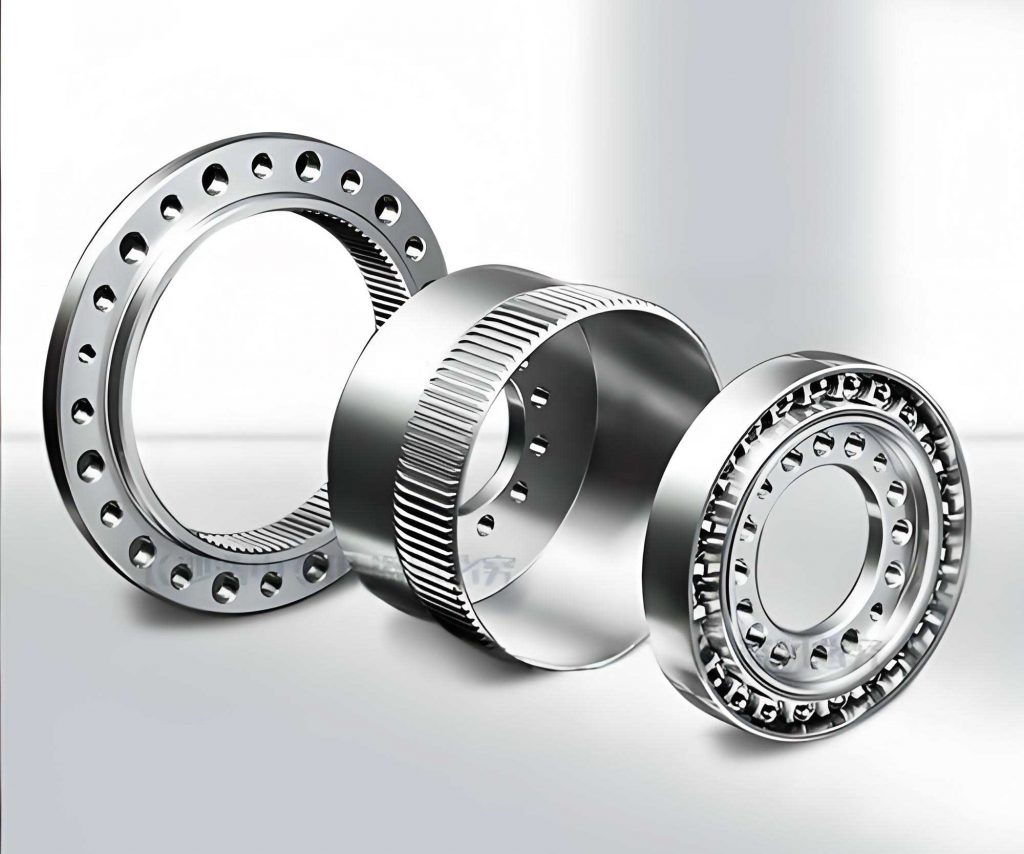
The harmonic drive gear system consists of three main components: the wave generator (WG), the flexspline (FS), and the circular spline (CS). Under ideal conditions, the kinematic relationship among these components is described by the gear ratio. However, in practice, disturbances such as kinematic errors due to manufacturing tolerances, flexible stiffness from elastic deformations, friction from gear interactions, and hysteresis from nonlinear effects significantly degrade performance. The dynamic model of a harmonic drive gear system can be derived using Lagrangian mechanics, accounting for these disturbances. The equations of motion are given by:
$$ J_m \ddot{\theta}_{WG} – T\left(\theta_{FS} – \frac{\theta_{WG}}{N} + \Delta \theta_p\right) Y_p – q Y_p + \tau_f = \tau_m + d, $$
$$ J_l \ddot{\theta}_{FS} – T\left(\theta_{FS} – \frac{\theta_{WG}}{N} + \Delta \theta_p\right) + B_l \dot{\theta}_{FS} + q = 0, $$
$$ \dot{q} + \alpha \left| \dot{\theta}_{FS} – \frac{\dot{\theta}_{WG}}{N} + \dot{\Delta \theta}_p \right| q – A \left( \dot{\theta}_{FS} – \frac{\dot{\theta}_{WG}}{N} + \dot{\Delta \theta}_p \right) = 0, $$
where \( J_m \) and \( J_l \) are the motor and load inertias, \( B_l \) is the load damping, \( T \) represents the nonlinear flexible stiffness, \( \Delta \theta_p \) is the kinematic error, \( Y_p \) is the position-dependent reduction ratio, \( q \) denotes the hysteresis torque, \( \tau_f \) is the friction torque, \( \tau_m \) is the motor torque, and \( d \) is an external disturbance. The flexible stiffness \( T \) is often modeled as a polynomial function:
$$ T(\theta) = a_1 \theta + a_2 \theta^3 + a_3 \theta^5, $$
while the hysteresis is captured by a Bouc-Wen model with parameters \( \alpha \) and \( A \). The kinematic error \( \Delta \theta_p \) can be approximated using Fourier series, and the reduction ratio \( Y_p \) is simplified based on practical considerations. Friction is modeled using dynamic models like LuGre to account for presliding and Stribeck effects. These disturbances are multi-source and multi-type, acting additively or implicitly through state couplings, posing a significant challenge for control design in harmonic drive gear systems.
To tackle this, I design the EADC strategy, which combines a DO for hysteresis estimation and an ESO for total disturbance estimation. The state vector is defined as \( x = [\theta_{FS}, \dot{\theta}_{FS}, \theta_{WG}, \dot{\theta}_{WG}, q]^T \), with the output angle \( y = \theta_{FS} \). The system dynamics are reformulated as:
$$ \ddot{y} = f + b_0 u, $$
where \( f \) represents the total disturbance, decomposed into hysteresis-related terms and other lumped disturbances. The DO is designed to estimate the hysteresis torque \( q \) using its known dynamics:
$$ \dot{w} = -\alpha_0 |q_0| \hat{q} + A_0 q_0 + K (f_0 – B_l x_2 – \hat{q}), $$
$$ \hat{q} = w – K J_l x_2, $$
with \( \hat{q} \) as the estimate, \( w \) an auxiliary variable, and \( K \) a tunable gain. The ESO is then constructed to estimate the remaining disturbances. Let \( y_1 = y \), \( y_2 = \dot{y} \), and \( y_3 = F \), where \( F \) is the lumped disturbance excluding hysteresis. The ESO equations are:
$$ \dot{z}_1 = z_2 – \beta_1 (z_1 – y_1), $$
$$ \dot{z}_2 = z_3 – \beta_2 (z_1 – y_1) – \frac{2}{J_l} \hat{q} + b_0 u, $$
$$ \dot{z}_3 = -\beta_3 (z_1 – y_1), $$
where \( z = [z_1, z_2, z_3]^T \) is the estimated state vector, and the observer gains \( \beta_1, \beta_2, \beta_3 \) are parameterized using bandwidth tuning: \( \beta_1 = 3\omega_o \), \( \beta_2 = 3\omega_o^2 \), \( \beta_3 = \omega_o^3 \), with \( \omega_o \) as the observer bandwidth. The composite control law is then derived as:
$$ u = \frac{1}{b_0} \left[ k_p (r_1 – z_1) + k_d (r_2 – z_2) + (r_3 – z_3) + \frac{2}{J_l} \hat{q} \right], $$
where \( r = [r_1, r_2, r_3]^T \) is the reference input vector, and the controller gains \( k_p = \omega_c^2 \), \( k_d = 2\omega_c \) are set based on the controller bandwidth \( \omega_c \). This control law integrates feedforward compensation from the DO and feedback regulation from the ESO, enabling robust performance in harmonic drive gear systems.
The stability of the proposed EADC method is rigorously analyzed. First, the convergence of the DO is proven by showing that the estimation error \( \tilde{q} = q – \hat{q} \) decays exponentially. The error dynamics are given by:
$$ \dot{\tilde{q}} = -(\alpha_0 |q_0| + K) \tilde{q} – \Delta \alpha |q_0| q + \Delta A q_0, $$
which, under bounded disturbances, ensures that \( \tilde{q}(t) \) converges to a small region around zero. The convergence rate can be enhanced by increasing the gain \( K \). Next, the ESO convergence is established. Defining the estimation errors \( \xi_i = y_i – z_i \) for \( i = 1, 2, 3 \), the error dynamics are:
$$ \dot{\xi}_1 = \xi_2 – \beta_1 \xi_1, $$
$$ \dot{\xi}_2 = \xi_3 – \beta_2 \xi_1 – \frac{2}{J_l} \tilde{q}, $$
$$ \dot{\xi}_3 = h(x, d) – \beta_3 \xi_1, $$
where \( h(x, d) \) is the derivative of the lumped disturbance. Using scaled errors \( \epsilon_i = \xi_i / \omega_o^{i-1} \), it can be shown that the errors are bounded as:
$$ |\xi_i(t)| \leq \sigma_i, \quad \sigma_i = O\left(\frac{1}{\omega_o^k}\right), $$
for some positive integer \( k \), implying that increasing \( \omega_o \) reduces the estimation errors. Finally, the closed-loop stability is proven by analyzing the tracking errors \( e_1 = r_1 – y_1 \) and \( e_2 = r_2 – y_2 \). The error dynamics are:
$$ \dot{e}_1 = e_2, $$
$$ \dot{e}_2 = -[k_p (e_1 + \xi_1) + k_d (e_2 + \xi_2) + \xi_3 – \frac{2}{J_l} \tilde{q}], $$
which, under bounded disturbances and estimation errors, ensures that the tracking errors are ultimately bounded, with bounds decreasing as \( \omega_c \) and \( \omega_o \) increase. This comprehensive stability analysis validates the robustness of the EADC method for harmonic drive gear systems.
To evaluate the performance of the EADC strategy, numerical simulations are conducted, comparing it with three other control methods: friction feedforward compensation with PID (FPID), active disturbance rejection control (ADRC), and disturbance observer-based control (DOBC). The harmonic drive gear system parameters used in simulations are summarized in Table 1.
| Parameter | Value | Unit |
|---|---|---|
| Motor inertia \( J_m \) | 2.9 × 10^{-4} | kg·m² |
| Load inertia \( J_l \) | 1.6 × 10^{-4} | kg·m² |
| Stiffness coefficient \( a_1 \) | 3.1460 × 10^5 | Nm/rad |
| Stiffness coefficient \( a_2 \) | 2.2743 × 10^9 | Nm/rad³ |
| Stiffness coefficient \( a_3 \) | -1.2297 × 10^{13} | Nm/rad⁵ |
| Kinematic error coefficient \( b_2 \) | 0.01692 | – |
| Gear ratio \( N \) | 50 | – |
| Load damping \( B_l \) | 1.3 × 10^{-5} | Nm·s/rad |
| Hysteresis parameter \( \alpha \) | 3.6721 × 10^2 | rad^{-1} |
| Hysteresis parameter \( A \) | 5.5583 × 10^3 | Nm/rad |
The control parameters for the EADC method are set as follows: observer bandwidth \( \omega_o = 200 \) rad/s, controller bandwidth \( \omega_c = 50 \) rad/s, control gain \( b_0 = 100 \), and DO gain \( K = 20 \). For fair comparison, the other methods are tuned to achieve similar response times where applicable. The simulations include reference tracking tests with step, ramp, and sinusoidal inputs, as well as disturbance rejection tests under model uncertainties, external torque disturbances, and output position disturbances.
In the step response test, the reference input is a step signal from 0 to 1 rad. The results show that all methods achieve the desired setpoint, but EADC and ADRC exhibit negligible steady-state error due to total disturbance estimation, while FPID and DOBC show small offsets. The rise times are comparable, but EADC offers smoother control inputs without chattering, which is beneficial for actuator longevity. The tracking errors are quantified using performance indices: mean absolute error (MAE), root mean square error (RMSE), and integral of time-multiplied absolute error (ITAE). As shown in Table 2, EADC consistently outperforms the other methods in terms of these indices for step responses.
| Control Method | MAE (rad) | RMSE (rad) | ITAE (rad·s) |
|---|---|---|---|
| FPID | 0.0336 | 0.0764 | 0.5577 |
| DOBC | 0.0333 | 0.0992 | 0.4415 |
| ADRC | 0.0069 | 0.0683 | 0.0421 |
| EADC | 0.0067 | 0.0675 | 0.0417 |
For ramp and sinusoidal tracking, EADC and ADRC maintain superior performance, with EADC showing slightly better error reduction during transients due to hysteresis compensation. The control effort required by EADC is comparable to ADRC but lower than FPID, indicating energy efficiency. These results highlight the effectiveness of the composite control structure in harmonic drive gear systems.
Disturbance rejection capabilities are tested under various scenarios. First, model parameters such as \( \alpha \), \( A \), \( B_l \), and \( J_l \) are perturbed by ±20%. The EADC method demonstrates strong robustness, with minimal degradation in tracking performance. The output responses under parameter variations are nearly indistinguishable from the nominal case, as evidenced by the small deviations in control signals. This robustness is crucial for harmonic drive gear systems operating in uncertain environments.
Second, an external sinusoidal torque disturbance \( d = 0.5 \sin(\pi t) \) Nm is applied between 2 and 4 seconds. The EADC and ADRC methods effectively suppress the disturbance, maintaining the output angle close to the reference. In contrast, FPID and DOBC exhibit significant error accumulation and sudden jumps in control signals. The disturbance estimation by ESO in EADC enables proactive compensation, leading to smoother operation. The control input profiles confirm that EADC avoids excessive chattering, which is common in FPID due to integral action.
Third, an output position disturbance of 0.1 rad is introduced at 3 seconds to simulate a load change. EADC and ADRC quickly reject the disturbance, returning to the setpoint within a short time, while FPID and DOBC show slower recovery with residual errors. The control effort during disturbance rejection is higher for EADC and ADRC, but this is acceptable given the improved performance. These tests underscore the advantage of combining DO and ESO in handling multiple disturbances in harmonic drive gear systems.
The superiority of EADC can be attributed to its hierarchical disturbance handling. The DO exploits known hysteresis dynamics to reduce conservatism, while the ESO estimates unknown disturbances robustly. This dual-observer approach minimizes the burden on each observer, leading to accurate estimation and compensation. Moreover, the bandwidth parameterization simplifies tuning, making the method practical for real-world harmonic drive gear applications. Compared to ADRC, which relies solely on ESO, EADC achieves better performance when hysteresis is significant, as in low-speed operations of harmonic drive gear systems. Similarly, compared to DOBC, which only uses DO, EADC handles a broader class of disturbances, including unmodeled dynamics and external perturbations.
From a theoretical perspective, the stability analysis provides guarantees for closed-loop performance. The exponential convergence of DO and bounded errors of ESO ensure that the composite control law stabilizes the system even under varying operating conditions. The error bounds derived in the analysis offer insights into parameter selection: increasing observer and controller bandwidths improves accuracy but may require higher control effort. Therefore, a trade-off exists, and in practice, bandwidths should be chosen based on hardware limitations and disturbance characteristics.
In conclusion, the proposed EADC method offers a robust solution for precision control of harmonic drive gear systems under multiple disturbances. By integrating a disturbance observer for hysteresis compensation and an extended state observer for total disturbance estimation, it achieves high tracking accuracy and strong disturbance rejection. Numerical simulations validate its effectiveness against conventional methods like FPID, ADRC, and DOBC. Future work could focus on adaptive tuning of observer gains to further enhance performance under time-varying disturbances, as well as experimental validation on physical harmonic drive gear setups. Additionally, extending the method to multi-axis harmonic drive gear systems in robotic applications would be a valuable direction. Overall, this research contributes to advancing control technologies for harmonic drive gear mechanisms, enabling their use in more demanding precision engineering fields.
The harmonic drive gear technology continues to evolve, with ongoing improvements in materials and manufacturing processes. However, control challenges remain due to inherent nonlinearities. The EADC strategy presented here addresses these challenges through a systematic anti-disturbance framework. As harmonic drive gear systems become more prevalent in areas like space exploration and biomedical devices, such advanced control methods will be essential for achieving reliable and accurate motion control. I believe that the integration of model-based and estimation-based approaches, as demonstrated in EADC, represents a promising paradigm for future developments in harmonic drive gear control systems.