
This work focuses on investigating the stress state within the flexspline of a cup-type harmonic drive gear system. We employ a comprehensive three-dimensional numerical modeling approach that integrates a spring approximation method and a contact element strategy to accurately simulate the complex interactions within the assembly. The primary objectives are to compute the deformation of the flexspline and analyze the stress distribution, particularly at the critical tooth root region, under operational loading. The numerical results are rigorously compared against experimental data to validate the proposed model. The agreement between simulation and experiment in both qualitative trends and quantitative values confirms the viability of this numerical framework for stress analysis. This methodology provides a powerful tool for the virtual prototyping and optimization-driven design of flexspline components in harmonic drive gear systems, ultimately contributing to enhanced reliability and service life.
1. Introduction
Harmonic drive gears represent a sophisticated motion transfer mechanism that relies on controlled elastic deformation to achieve meshing between gear teeth. The system comprises three fundamental components: a flexible spline (flexspline), a rigid circular spline (circular spline), and a wave generator. This unique operating principle endows harmonic drive gears with an exceptional combination of advantages, including compact size, low weight, high reduction ratios in a single stage, near-zero backlash, high positional accuracy, and substantial torque capacity due to the simultaneous engagement of multiple tooth pairs. Consequently, harmonic drive gears have found critical applications across demanding fields such as aerospace robotics, precision optical instruments, semiconductor manufacturing equipment, and medical devices.
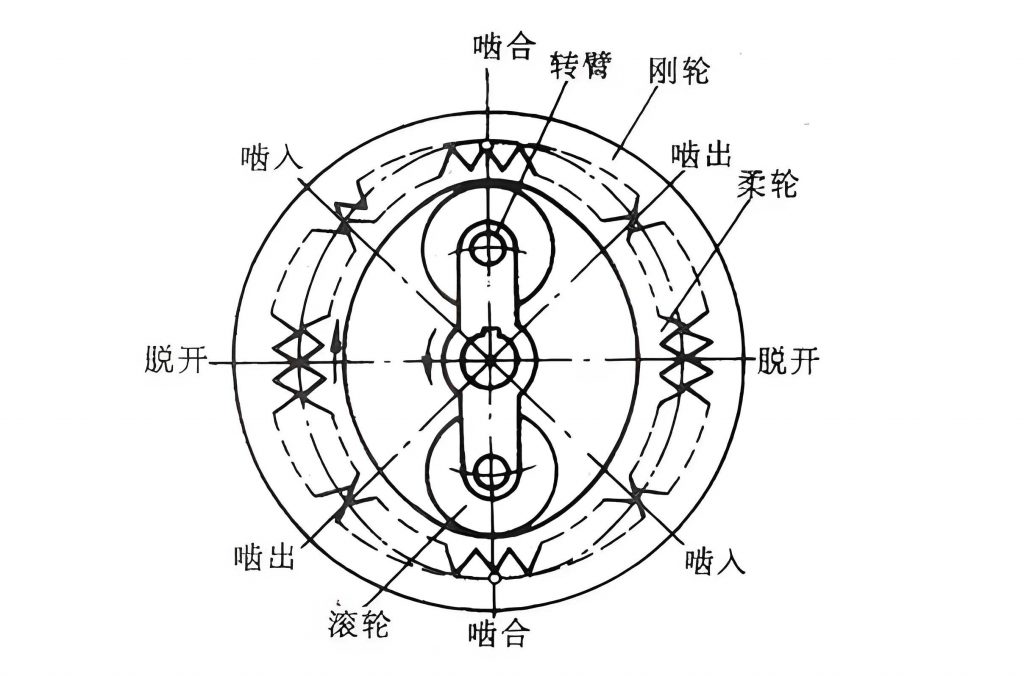
The operation involves an elliptically-shaped wave generator, typically incorporating a flexible bearing, which deforms the flexspline into an elliptical shape. This deformation forces the teeth of the flexspline to engage with those of the circular spline at two diametrically opposite regions along the major axis of the ellipse. As the wave generator rotates, the engagement zones travel around the circumference, creating a smooth, continuous relative motion between the flexspline and circular spline. However, this very mechanism subjects the flexspline to continuous cyclic elastic deformation. The tooth root fillet region, acting as a stress concentrator, is particularly susceptible to fatigue failure initiated by these alternating stresses. Therefore, a detailed understanding of the stress field within the flexspline, especially at the tooth root, is paramount for predicting fatigue life and ensuring reliable design.
Experimental measurement of these stresses is notoriously challenging due to the small size, complex geometry, and moving contact interfaces within the harmonic drive gear assembly. This difficulty has motivated the development of numerical techniques, primarily the Finite Element Method (FEM), as a complementary and often more accessible tool for stress analysis. Previous studies have explored various aspects, such as the influence of geometrical parameters, assembly stresses, and manufacturing errors on flexspline performance. Building upon this foundation, our work presents a detailed 3D FEM modeling strategy that explicitly addresses key contact interactions—specifically between the wave generator’s rolling elements and the flexspline, and between the meshing teeth of the flexspline and circular spline. We simplify the wave generator contact using a spring approximation and model the gear mesh using a contact element insertion/removal technique. The goal is to establish a computationally efficient yet accurate model capable of predicting stress distributions under various load conditions, thereby providing valuable insights for the optimization of harmonic drive gear systems.
2. Numerical Modeling of the Harmonic Drive Gear System
2.1 System Overview and Modeling Philosophy
The system under investigation is a cup-type harmonic drive gear with a flexible bearing wave generator. A schematic cross-section reveals the layered structure: at the core is the elliptical wave generator, whose outer race is in contact with the inner surface of the thin-walled cup-shaped flexspline via a thin lubricant film. The elliptical profile ensures tight contact at the major axis and clearance at the minor axis. Surrounding the flexspline is the rigid circular spline. The torque transmission path involves multiple, simultaneous contact interactions: between the rolling elements (balls) of the wave generator bearing and its races, between the bearing outer race and the flexspline (through the oil film), and between the teeth of the flexspline and the circular spline. Our modeling effort strategically simplifies these contacts to render the 3D simulation tractable while preserving essential physics.
2.2 Modeling of Wave Generator Rolling Elements
The torque from the wave generator is transmitted to the flexspline through the contacts of the bearing balls with the inner and outer races. Modeling each ball with full 3D contact would be computationally prohibitive for system-level analysis. Therefore, we adopt a spring approximation. Each ball contact is represented by a linear spring oriented radially. The force-displacement relationship for this spring is derived from Hertzian contact theory:
$$ F = -k(d – \Delta) $$
where $F$ is the contact force, $k$ is the spring stiffness (Hertzian contact stiffness), $d$ is the radial displacement, and $\Delta$ is the initial radial clearance of the bearing. The stiffness $k$ is not constant but depends on the contact load. However, for the operational range of the harmonic drive gear, the variation in contact load amplitude is relatively small. Thus, an average stiffness value, calculated based on the mean load, can be used effectively without significant loss of accuracy, as supported by prior experimental validation studies.
2.3 Modeling of the Lubricant Film Interface
The thin film of lubricant between the wave generator’s outer race and the flexspline’s inner surface plays a crucial role in load distribution and stress mitigation. We model this interface using a layer of specialized interface elements. These are 16-node isoparametric gap elements that are active only when contact occurs. This “node-to-segment” contact approach allows for the automatic detection of contact and separation without remeshing. The element is formulated to transmit only compressive normal forces, with no capacity for tensile or significant shear stress transmission, mimicking a hydrodynamic or soft elastic layer. The material properties for this layer, defined in a cylindrical coordinate system ($r, \theta, z$), are assigned low elastic moduli to represent its compliant nature:
$$
\begin{aligned}
E_{rr} &= 3.09 \text{ MPa} \\
E_{\theta\theta} &= 2.06 \text{ MPa} \\
G_{r\theta} &= \frac{E_{\theta\theta}}{2(1+\nu)} \approx E_{\theta\theta} / 3
\end{aligned}
$$
Here, $E_{rr}$ and $E_{\theta\theta}$ are the radial and circumferential elastic moduli, respectively, and $G_{r\theta}$ is the shear modulus, with Poisson’s ratio $\nu$ assumed to be small.
2.4 Modeling of Flexspline-Circular Spline Tooth Contact
The most critical interaction for stress generation in the flexspline is the meshing contact with the circular spline. We model this using a contact element strategy. Potential contact pairs between flexspline and circular spline teeth are identified. A special contact element is algorithmically “inserted” between the nodes of these pairs when they come into proximity, indicating the start of meshing engagement. This element has a high stiffness ($E = 206$ GPa) to prevent penetration and to transfer the meshing forces. When the teeth separate, the element is “removed.” The governing condition is based on the calculated normal force $F_n$ at the interface:
- If $F_n < 0$, the teeth are in contact (compressive force).
- If $F_n \ge 0$, the teeth are separated, and the contact element is deactivated.
Since the circular spline is much more rigid than the flexspline, it is modeled as a rigid body to reduce computational cost. Its deformation is considered negligible, and its prescribed boundary conditions govern the kinematic constraints of the assembly.
2.5 Assembled 3D Finite Element Model
Integrating all components leads to the simplified 3D finite element model. The wave generator’s elliptical profile is imposed as a boundary condition on the inner race of the bearing model. The rolling elements are condensed into a series of radial spring connections along the circumference. The flexspline is meshed with fine, hexahedral solid elements, particularly refined at the tooth roots and the critical cup-shell transition area. The contact definitions (oil film layer and gear tooth contacts) are applied accordingly. A sample convergence study is performed by refining the mesh around critical regions until the maximum stress values stabilize, ensuring the independence of results from mesh density.
3. Results and Analysis
3.1 Deformation Analysis of the Flexspline
The deformation profile of the flexspline, especially around the major axis of the wave generator, is a primary output of the simulation. The analysis clearly shows the effect of the circular spline constraint. When the gear tooth contact elements are not activated, the flexspline deforms freely into a more pronounced elliptical shape under the action of the wave generator alone. However, when the contact elements are active, representing actual meshing with the rigid circular spline, the deformation is constrained. The flexspline’s radial displacement is reduced, and the shape conforms more closely to the kinematic requirements of the conjugate motion. This constrained deformation profile from the simulation shows excellent agreement with experimentally measured deformation patterns, validating the contact modeling approach.
3.2 Stress Distribution in the Flexspline
The circumferential stress ($\sigma_{\theta\theta}$) at the root of the flexspline teeth is the critical parameter for fatigue assessment. Under an applied input torque of 329 N·m, the simulation reveals a characteristic and physically meaningful stress distribution around the circumference.
Qualitative Pattern: On the side of the major axis where a flexspline tooth is moving into full engagement (the “leading” side), the material at the tooth root experiences tensile stress. On the opposite (“trailing”) side of the major axis, where a tooth is disengaging, the root material experiences compressive stress. This alternating tension-compression cycle is the fundamental driver of fatigue in harmonic drive gear flexsplines. The maximum magnitudes of both tensile and compressive stresses are typically found near the open end (diaphragm end) of the cup-shaped flexspline, where the bending moment caused by the deformation is greatest. This region is, therefore, the most likely site for fatigue crack initiation.
Quantitative Comparison: A detailed comparison between simulated and experimentally measured circumferential stress along the tooth root from 0° to 180° (the upper half) is presented below and in Table 1. The experimental data shows two distinct stress peaks on either side of the major axis (located at 90°), with a maximum tensile stress of approximately 450 MPa occurring around the 110° position. The numerical simulation captures this pattern with high fidelity, predicting two peaks at similar angular positions and a maximum stress value of around 400 MPa at 110°. The slight under-prediction is within an acceptable margin for complex contact mechanics simulations and can be attributed to factors like idealized material properties, simplified boundary conditions, and the spring approximation for the bearing.
| Angular Position (°) | Experimental Stress (MPa) | Simulated Stress (MPa) | Remarks |
|---|---|---|---|
| 30 | ~ -50 | ~ -30 | Compressive region |
| 70 | ~ +200 | ~ +180 | Rising tensile stress |
| 90 (Major Axis) | ~ +300 | ~ +280 | Near major axis |
| 110 | ~ +450 (Peak) | ~ +400 (Peak) | Maximum tensile stress |
| 130 | ~ +250 | ~ +220 | |
| 150 | ~ -100 | ~ -80 | Transition to compression |
| 170 | ~ -200 | ~ -170 | Compressive region |
3.3 Load Sensitivity and Model Utility
The validated numerical model demonstrates consistent behavior across different load levels. As the input torque is increased, the shape of the stress distribution curve remains similar to the pattern shown in Table 1, but the magnitude of the stresses scales accordingly. This predictable response confirms the model’s robustness for parametric studies. A significant advantage of the numerical approach becomes evident when considering extreme or limiting load conditions. Performing experimental stress measurements at the fatigue limit or under overload conditions is risky and often impractical, as it may lead to the destruction of the prototype. In contrast, the finite element model can safely and easily estimate the stress state under any specified load, providing crucial data for setting design safety factors and predicting performance boundaries for the harmonic drive gear system.
4. Conclusion
In this study, we developed and validated a three-dimensional finite element modeling framework for the stress analysis of the flexspline in a cup-type harmonic drive gear system. The key to the model’s success lies in its strategic simplifications of complex contact interactions: the use of a spring approximation for the wave generator bearing and the implementation of an active contact element strategy for the gear mesh.
The principal findings and contributions are summarized as follows:
- Model Validation: The numerical predictions for flexspline deformation and, more importantly, for the circumferential stress distribution at the tooth root show strong qualitative and quantitative agreement with experimental measurements. This validates the proposed spring approximation and contact element methodology as a viable and accurate approach for analyzing harmonic drive gear systems.
- Stress Insight: The model successfully captures the critical alternating tension-compression stress cycle at the flexspline tooth root, accurately identifying the regions of maximum stress near the open end of the cup, which are the primary locations for fatigue failure.
- Design Tool: The established finite element model serves as a powerful virtual design tool. It enables engineers to conduct detailed parametric studies, investigating the influence of geometric parameters (tooth profile, wall thickness, cup length), material properties, and assembly conditions (wave generator ellipticity, preload) on the stress state of the flexspline.
- Optimization Potential: By facilitating the rapid evaluation of design variations, this modeling approach provides a direct pathway for the performance-driven optimization of harmonic drive gear flexsplines. The goal of such optimization is to minimize peak stresses, improve stress distribution uniformity, and thereby extend the fatigue life and reliability of the entire harmonic drive gear transmission.
Future work will involve extending the model to include dynamic effects, temperature-dependent material properties, and a more detailed simulation of the wave generator bearing. Furthermore, coupling the stress analysis with fatigue life prediction algorithms will create a comprehensive digital twin for the durability assessment of harmonic drive gear systems.