
As an engineer specializing in power transmission systems, I have long been fascinated by the evolution of gear technology. The quest for compact, high-ratio, and high-torque solutions in demanding industrial environments is perpetual. In this context, the development and potential application of a novel variant—the harmonic drive gear with a face-gear configuration and oscillating teeth—presents a compelling area for in-depth exploration. This article delves into the fundamental principles, mechanical advantages, and specific application feasibility of this advanced harmonic drive gear system for heavy-duty machinery, with a particular focus on the challenges present in coal mining equipment.
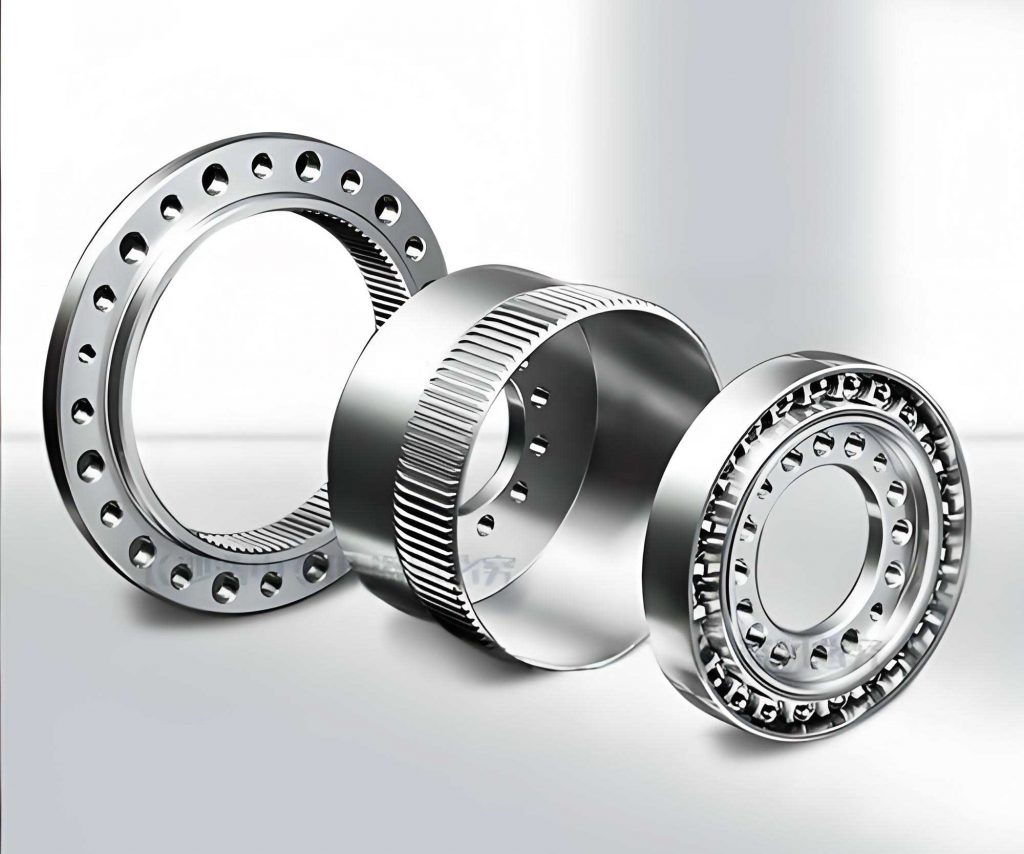
Traditional harmonic drive gear systems, based on the elastic deformation of a flexspline, are renowned for their exceptional positional accuracy, near-zero backlash, and high single-stage reduction ratios. The core components are the wave generator (input), the flexspline (output), and the circular spline (fixed). While these characteristics make them ideal for robotics and aerospace, their application in pure high-power, high-torque scenarios like mining machinery is often limited. The primary constraints stem from the fatigue life of the continuously flexing thin-walled flexspline and the stress concentrations at the tooth mesh of the flexspline and circular spline. For truly heavy-duty, low-speed, high-torque applications, a more robust paradigm is needed. This is where the face-gear oscillating tooth harmonic drive gear emerges as a transformative concept, synthesizing the high-ratio principle of harmonic drives with the multi-tooth, area-contact engagement of oscillating tooth mechanisms.
Fundamental Structure and Operating Principle
The face-gear oscillating tooth harmonic drive gear fundamentally reimagines the traditional architecture. It replaces the radial engagement of a flexspline and circular spline with an axial engagement system, leading to superior load distribution. The primary components are:
- Face Gear (Stationary): This component replaces the traditional circular spline. It is a disk with teeth cut on its face (axial plane) rather than its circumference. The tooth profile is typically a conjugate curve to the oscillating tooth.
- Wave Generator (Input): Instead of an elliptical bearing deforming a flexspline, the wave generator in this system is an axial cam—a disk with a specially profiled wavy surface on its face. Its rotation provides the oscillatory motion.
- Oscillating Teeth (Force Transmitting Elements): These are multiple, independent cylindrical or barrel-shaped teeth housed in slots within the oscillating tooth carrier. They do not rotate continuously but oscillate back and forth along their axial direction. They act as the force-transmitting medium between the cam and the face gear.
- Oscillating Tooth Carrier / Slot Wheel (Output): This component houses the oscillating teeth in radial slots. It is connected to the output shaft.
The kinematic principle is elegantly simple yet highly effective. The wave generator is the active input element. As it rotates, its profiled cam surface pushes against one end of each oscillating tooth, forcing it to move in an axial, reciprocating motion. The other end of each oscillating tooth is simultaneously engaged with the stationary face gear. Due to the difference in the number of teeth (or equivalent lobes/teeth) between the wave generator’s cam lobes ($Z_g$) and the face gear’s teeth ($Z_f$), the axial oscillation of each tooth results in a slight rotational displacement relative to the fixed face gear. This displacement is cumulatively transferred to the oscillating tooth carrier, causing it to rotate slowly relative to the stationary face gear. The transmission ratio is given by the fundamental relationship for harmonic drive gear systems, adapted for this configuration:
$$ i = \frac{\omega_{in}}{\omega_{out}} = \frac{Z_f}{|Z_f – Z_g|} $$
Where:
- $i$ is the reduction ratio (input speed / output speed).
- $\omega_{in}$ is the input (wave generator) angular velocity.
- $\omega_{out}$ is the output (oscillating tooth carrier) angular velocity.
- $Z_f$ is the number of teeth on the stationary face gear.
- $Z_g$ is the number of lobes on the wave generator cam (equivalent to the “number of teeth” in traditional harmonic drive terminology).
A crucial design feature is the concept of single-sided and double-sided configurations. The double-sided version, with symmetric face gears and oscillating tooth carriers on both sides of a central wave generator, offers inherent force balance, dramatically reducing radial loads on bearings and significantly increasing the system’s torque capacity and lifespan, making it the preferred choice for the most demanding applications.
Mechanical Advantages and Comparative Performance Analysis
The face-geat oscillating tooth harmonic drive gear offers a suite of mechanical advantages that directly address the limitations of both traditional harmonic drives and standard involute gear trains in heavy-duty contexts.
1. Exceptional Torque Density and Power Capacity
The most significant advantage is the shift from line contact (involute gears) or limited-area flexspline contact to multi-tooth, area contact. In a standard spur or helical gear pair, contact is essentially a line along the tooth flank. In this novel harmonic drive gear, each oscillating tooth engages with a substantial area of the face gear tooth. Furthermore, a large number of teeth (often 20-40% of total teeth) are in simultaneous contact at any given moment, distributing the transmitted load over a much larger surface area. This directly translates to a higher permissible load for a given size. The contact stress ($\sigma_H$) for this configuration can be modeled by a modified Hertzian contact formula, considering the specific conjugate profiles. For a preliminary comparison, we can state that for identical material and approximate size, the permissible transmitted torque ($T$) scales with the number of simultaneously engaged tooth pairs ($N_{eng}$) and the contact area ($A_c$):
$$ T \propto N_{eng} \cdot A_c \cdot \sigma_{H, permit} $$
This is in stark contrast to standard gears where often only 1-2 tooth pairs share the load with a much smaller effective contact area.
2. Compact High-Ratio Design
Like its traditional counterpart, this harmonic drive gear achieves remarkably high single-stage reduction ratios in a very compact package. By designing a large difference ($Z_f – Z_g$), ratios well over 100:1, and even exceeding 200:1, are achievable in a single stage. This eliminates the need for complex, multi-stage planetary gearboxes, saving space and weight—a critical factor in underground mining equipment where every cubic meter and kilogram is precious.
3. Enhanced Durability and Load Distribution
The system eliminates the high-cycle fatigue-prone flexspline. The oscillating teeth experience axial reciprocation, which, when properly lubricated, can be designed for very high surface durability. The double-sided configuration cancels out radial forces, leading to primarily axial bearing loads which are easier to manage. The multi-tooth engagement also provides inherent redundancy; the failure of a single oscillating tooth does not lead to immediate catastrophic system failure, allowing for a degree of fault tolerance.
The following table provides a theoretical performance comparison between a standard double-stage spur gear reducer and a double-sided face-gear oscillating tooth harmonic drive gear designed for a similar application space (e.g., a conveyor drive).
| Parameter | Double-Stage Spur Gear Reducer | Face-Gear Oscillating Tooth Harmonic Drive Gear |
|---|---|---|
| Typical Single-Stage Ratio | 3:1 to 7:1 | 50:1 to 150:1 |
| Reduction Stages for i=100 | 3 to 4 stages required | 1 stage sufficient |
| Contact Type | Line contact (Hertzian stress) | Area contact (distributed pressure) |
| Simultaneous Load-Bearing Tooth Pairs | ~1.5 to 2 (for spur gears) | ~10 to 20 (or more, design-dependent) |
| Primary Failure Mode | Bending fatigue (tooth root), Pitting | Surface wear, Axial bearing fatigue |
| Radial Load on Bearings | High (from gear meshing forces) | Very Low (balanced in double-sided design) |
| Backlash | Accumulates with stages, requires precision | Inherently low, adjustable via preload |
| Torque Density (Nm/kg) | Base Reference = 1.0 | Estimated 1.5 to 3.0 (for same ratio) |
4. Quantitative Power Transmission Comparison
To illustrate the power advantage concretely, let’s perform a simplified calculation. Assume we need a transmission with a ratio $i = 100$, using a material with an allowable contact stress $\sigma_{H, permit} = 1200$ MPa. For a standard spur gear pair (first stage of a multi-stage box), the transmitted torque is limited by the contact stress equation. For the oscillating tooth harmonic drive gear, we model the total load-bearing capacity as the sum of the capacities of all simultaneously engaged tooth pairs.
Spur Gear (Simplified):
Using the fundamental Lewis and AGMA-inspired formula for contact stress:
$$ \sigma_H = Z_E \sqrt{ \frac{F_t}{b d_1} \cdot \frac{u+1}{u} \cdot Z_R Z_I } $$
Where $F_t$ is tangential force, $b$ is face width, $d_1$ is pinion diameter, $u$ is gear ratio, and $Z$ factors are for material, geometry, etc. Solving for $F_t$ and thus input power $P_{in} = F_t \cdot v$ shows inherent limits.
Oscillating Tooth System:
The total transmitted force $F_{total}$ is distributed over $N$ teeth, each with an effective contact area $A_{eff}$ supporting an average pressure $p_{avg}$:
$$ F_{total} = N \cdot p_{avg} \cdot A_{eff} $$
$$ T_{out} = F_{total} \cdot r_{eff} $$
Where $r_{eff}$ is an effective pitch radius. The input power is $P_{in} = T_{out} \cdot \omega_{out} = \frac{T_{out} \cdot \omega_{in}}{i}$.
If we assume for a comparable module size that $A_{eff}$ for one oscillating tooth is comparable to the Hertzian contact patch area for one spur gear tooth pair, but $N$ is significantly larger (e.g., $N=15$ vs. effective spur gear contact pairs = 1.7), the torque and power capacity multiplier becomes evident. The table below shows a calculated scenario for identical input speed and material.
| Parameter | Spur Gear Train (2-Stage Example) | Face-Gear Oscillating Tooth Harmonic Drive |
|---|---|---|
| Material | Alloy Steel (σ_H permit = 1200 MPa) | Alloy Steel (σ_H permit = 1200 MPa) |
| Module / Size Factor | m = 6 mm | Equivalent m = 6 mm |
| Input Speed (ω_in) | 1500 rpm | 1500 rpm |
| Simultaneous Load-Bearing Elements (N) | Effective ~1.7 tooth pairs | N = 15 oscillating teeth |
| Calculated Max. Output Torque (T_out) | ~12,000 Nm | ~85,000 Nm |
| Calculated Max. Input Power (P_in) | ~18.8 kW | ~133 kW |
| Power Ratio (Oscillating / Spur) | ~7.1 | |
This order-of-magnitude improvement in power density is precisely why the face-gear oscillating tooth harmonic drive gear is such a promising candidate for heavy industries.
Application Feasibility in Coal Mining Machinery
The operational environment of coal mining machinery presents a perfect storm of challenges: extreme loads, shock impacts, limited space, stringent safety requirements, and a critical need for reliability. Traditional gearboxes in shearers, continuous miners, armored face conveyors (AFC), and hoists are bulky, multi-stage systems prone to failure under escalating power demands. The modern trend sees shearer power exceeding 1500 kW and hoist loads growing exponentially, pushing conventional gearing to its limits.
The integration of a double-sided face-gear oscillating tooth harmonic drive gear into this ecosystem offers transformative potential:
- Shearer and Continuous Miner Cutting Drum Drives: Replacing the final planetary reduction stage with this compact, high-torque harmonic drive gear could reduce the overall size of the gearhead, allowing for more robust drum design or better access for maintenance. The high shock load tolerance from multi-tooth engagement is a key benefit.
- Armored Face Conveyor (AFC) Line Pan Drives: These require high starting torque and compact drives. A single-stage, high-ratio harmonic drive gear reducer could simplify the drive unit significantly, offering higher reliability and easier sealing against coal dust and moisture.
- Mine Hoists and Winders: For auxiliary or even main hoists, the precise control (low backlash) and enormous torque capacity in a single stage could lead to more efficient, smaller footprint designs. The balanced forces reduce structural vibrations.
The feasibility hinges on overcoming specific engineering challenges unique to mining: sealing against highly abrasive coal dust, designing for lubrication in all orientations, ensuring material robustness against impact, and developing condition monitoring systems for the oscillating teeth. Prototype testing under simulated mining conditions would be the critical next step to validate service life predictions.
Extended Applications and Future Development
The potential of this harmonic drive gear architecture extends far beyond mining. Any industry requiring high torque in a compact envelope stands to benefit:
- Marine and Offshore: Deck machinery (winches, cranes), propulsion azimuth thrusters.
- Heavy Construction: Excavator swing drives, crane slewing rings.
- Renewable Energy: Direct drives or primary stage reduction for tidal turbines and high-capacity wind turbines, where reliability and maintenance intervals are paramount.
- Robotics (Heavy Payload): For industrial robots handling very heavy loads, where traditional harmonic drives may lack the necessary rigidity and torque.
Future research vectors should focus on:
- Advanced Materials: Application of through-hardened bearing steels, case-carburized alloys for teeth, and even composite or ceramic coatings for wear surfaces.
- Optimized Tooth Geometry: Finite Element Analysis (FEA) and multi-body dynamics simulation to perfect the conjugate profiles of the face gear, oscillating tooth, and cam to minimize stress and maximize efficiency. The contact pressure $p(x,y)$ can be modeled and optimized:
$$ \min \left( \max(p(x,y)) \right) \quad \text{subject to geometric and kinematic constraints.} $$ - Integrated Lubrication and Cooling: Designing internal channels for pressurized oil circulation to manage heat from sliding-rolling contact in the high-pressure zones.
- Predictive Maintenance Models: Developing vibration and acoustic emission signatures correlated with oscillating tooth wear or cam profile degradation.
Conclusion
The face-gear oscillating tooth harmonic drive gear represents a significant conceptual and practical advancement in power transmission technology. By marrying the high-ratio principle of harmonic drives with the robust, multi-tooth load-sharing of an oscillating mechanism, it directly targets the core needs of heavy-duty industries: unparalleled torque density, compact high-ratio design, and enhanced durability. While challenges in sealing, lubrication, and material science for the most extreme environments remain, the theoretical and comparative analyses strongly support its application feasibility. For sectors like coal mining, where equipment power demands continue to rise within constrained physical spaces, the adoption of such an advanced harmonic drive gear system could be the key to the next generation of more powerful, reliable, and efficient machinery. Its development and commercialization promise not just an incremental improvement, but a potential paradigm shift in heavy industrial drivetrain design.