
The pursuit of enhanced performance in robotics and precision machinery places stringent demands on core transmission components. Among these, the harmonic drive gear stands out due to its exceptional characteristics: compact size, high reduction ratios, zero-backlash potential, and coaxial input/output configuration. The operational excellence of a robot is intrinsically linked to the meshing performance of its harmonic drive gear reducer. Central to this performance is the geometry of the tooth profile, which governs load distribution, stress concentration, transmission error, and backlash. Consequently, the evolution of tooth profile design remains a pivotal research focus for advancing harmonic drive gear technology.
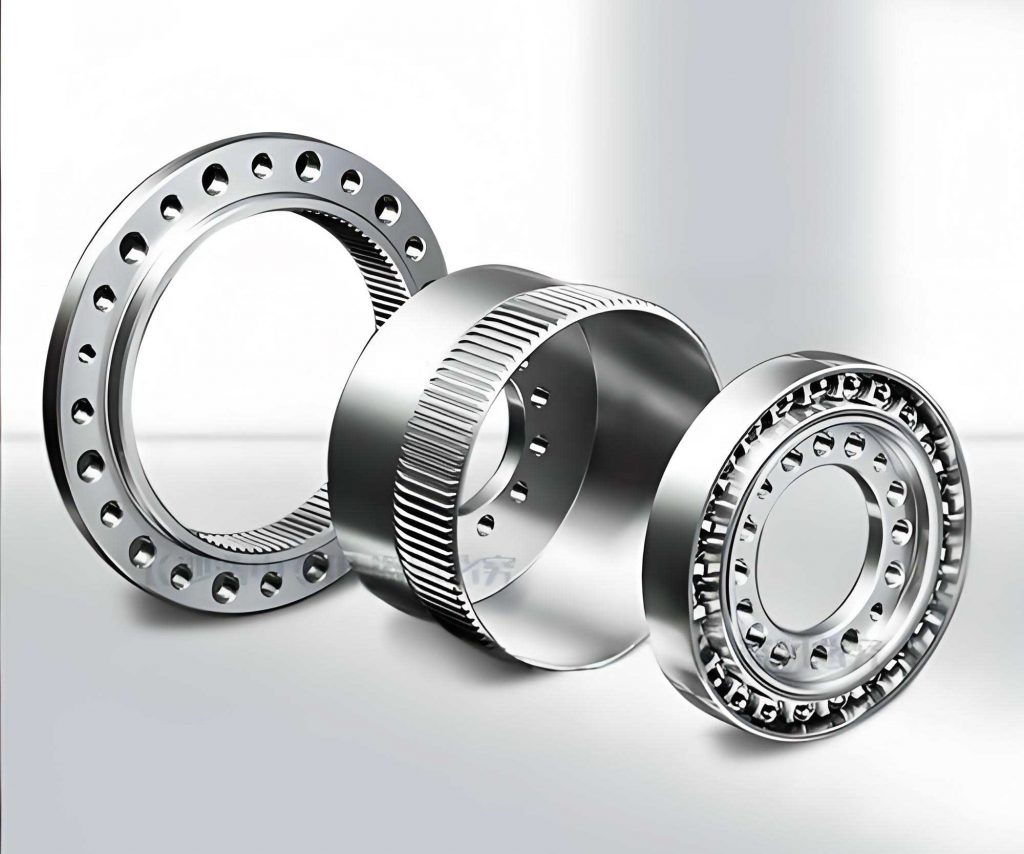
Historically, profile development has progressed from basic concepts to sophisticated geometries. The initial straight-sided profile proposed by Musser oversimplified the complex deformation of the flexspline. The adoption of the involute profile, common in conventional gearing, brought familiarity but introduced challenges like edge contact and sensitivity to assembly deformation in the unique kinematic context of a harmonic drive gear. Alternative profiles, such as the cycloidal and the S-type curve introduced by Ishikawa, offered improvements. The S-type profile, derived from the conjugate motion path, is noted for promoting multi-tooth engagement and generating a more uniform, near-zero meshing clearance. Simultaneously, circular-arc-based profiles, particularly the double-arc and common-tangent double-arc, have been extensively studied for their manufacturability and potential for low and controlled backlash. Each profile family presents distinct advantages and limitations in the quest for an optimal harmonic drive gear design.
This work posits that a superior profile can be engineered by synthesizing the strengths of existing designs. Specifically, we observe that while the common-tangent double-arc profile can achieve very small backlash values, its backlash curve exhibits significant variation over the engagement cycle. Conversely, the S-type profile demonstrates a remarkably flat and uniform backlash characteristic. This paper, therefore, introduces a novel design methodology that strategically combines segments of the S-curve and common-tangent double-arc profiles. The objective is to create a new flexspline profile that inherits the minimal backlash of the double-arc and the uniformity of the S-curve, thereby enhancing the overall meshing performance of the harmonic drive gear.
The proposed methodology is two-fold. First, the geometric synthesis of the new profile is performed. Second, its performance is rigorously evaluated through a conjugate theory and dynamic simulation. The conjugate tooth profile for the circular spline is derived using an Improved Kinematic Method, which offers computational efficiency and generality. Finally, the meshing behavior—including instantaneous backlash and stress distribution within the flexspline under load—is analyzed using transient dynamics simulations within a finite element framework. This integrated approach from design to analysis provides a comprehensive assessment of the novel harmonic drive gear tooth profile’s potential.
1. Synthesis of the Novel Flexspline Tooth Profile
The design philosophy begins with a comparative analysis of key performance indicators for established profiles. A critical parameter is the meshing clearance or functional backlash, which varies as the wave generator rotates. For a standard harmonic drive gear configuration, analysis typically focuses on a 90-degree segment from the major axis. When plotting the backlash for a double-arc (DA), an S-type, and a common-tangent double-arc (CTDA) profile against the wave generator angle (\(\phi\)), distinct trends emerge.
The backlash curves for both the DA and CTDA profiles are non-uniform, characterized by an initial increase to a peak, followed by a decrease. The S-type profile, in contrast, displays a significantly flatter and more uniform backlash curve across the entire engagement range. The CTDA profile generally achieves lower absolute backlash values than the S-type for most of the cycle, except within a specific intermediate zone (approximately between \(\phi = 37^\circ\) and \(\phi = 58^\circ\)) where the S-type profile exhibits slightly lower clearance.
This observation forms the cornerstone of the novel profile synthesis: to construct a profile that, at every point in the engagement cycle, adopts the segment from either the CTDA or the S-type profile that yields the smaller instantaneous backlash. The intersection points of the two backlash curves define the transition zones. The resulting novel profile is a composite curve comprising three distinct segments: the convex arc segment (AB) from the CTDA profile, a middle segment (BC) derived from the S-type profile, and the concave arc segment (CD) from the CTDA profile. The challenge lies in ensuring smooth \(C^1\) continuity (shared point and tangent) at the transition points B and C between the different curve types.
The mathematical definition of the novel flexspline profile in its local coordinate system \(S_1\{O_1, X_1, Y_1\}\) is as follows:
Segment AB (CTDA Convex Arc):
$$ \mathbf{r}_1^{(AB)}(s) = \begin{pmatrix} x_1(s) \\ y_1(s) \end{pmatrix} = \begin{pmatrix} \rho_a \cos(\beta_a – s/\rho_a) + x_{Oa} \\ \rho_a \sin(\beta_a – s/\rho_a) + y_{Oa} \end{pmatrix}, \quad s \in [0, l_1] $$
where \(s\) is the arc length parameter, \(l_1\) is the total arc length of segment AB, \(\rho_a\) is the radius of the convex arc, \(\beta_a\) is the pressure angle at the tooth tip, and \((x_{Oa}, y_{Oa})\) are the coordinates of the arc’s center, defined by profile parameters like addendum height \(h_a^*\), tooth thickness \(t\), and offset values \(x_a, y_a\).
Segment BC (S-Type Derived Curve):
This segment is based on the conjugate path formula for the S-type profile, adjusted for a smooth blend.
$$ \mathbf{r}_1^{(BC)}(\varepsilon) = \begin{pmatrix} x_2(\varepsilon) \\ y_2(\varepsilon) \end{pmatrix} = \begin{pmatrix} 0.25m(\pi + \varepsilon – k \sin \varepsilon) + \xi + \tau + \Delta D \\ -0.5m(1 – k \cos \varepsilon) \end{pmatrix} $$
Here, \(m\) is the module, \(k\) is the radial deformation coefficient (typically ~1), \(\varepsilon\) is the kinematic pressure angle (the parameter), \(\xi\) is a side clearance adjustment, \(\tau\) controls the tooth thickness, and \(\Delta D\) is a crucial transition modification term. The parameter \(\Delta D\) and the range of \(\varepsilon\) are meticulously calculated to ensure that the endpoint \(y_2\) values match the adjacent arc segments and that the tangents at points B and C are continuous. The arc length \(l_2\) of this segment is calculated by integrating the derivative of \(\mathbf{r}_1^{(BC)}\).
Segment CD (CTDA Concave Arc):
$$ \mathbf{r}_1^{(CD)}(s) = \begin{pmatrix} x_3(s) \\ y_3(s) \end{pmatrix} = \begin{pmatrix} x_{Of} – \rho_f \cos[\delta + (s – l_2)/\rho_f] \\ y_{Of} – \rho_f \sin[\delta + (s – l_2)/\rho_f] \end{pmatrix}, \quad s \in [l_2, l_3] $$
where \(l_3\) is the total profile arc length, \(\rho_f\) is the radius of the concave arc, \(\delta\) is its inclination angle, and \((x_{Of}, y_{Of})\) are its center coordinates, derived from parameters like dedendum height \(h_f^*\) and offsets \(x_f, y_f\).
The core of the synthesis algorithm involves solving for the parameters of the BC segment (its effective \(\varepsilon\) range and \(\Delta D\)) such that:
$$ \mathbf{r}_1^{(AB)}(l_1) = \mathbf{r}_1^{(BC)}(\varepsilon_B), \quad \mathbf{r}_1^{(BC)}(\varepsilon_C) = \mathbf{r}_1^{(CD)}(l_2) $$
$$ \frac{d}{ds}\mathbf{r}_1^{(AB)}(s)\bigg|_{s=l_1} \parallel \frac{d}{d\varepsilon}\mathbf{r}_1^{(BC)}(\varepsilon)\bigg|_{\varepsilon=\varepsilon_B}, \quad \frac{d}{d\varepsilon}\mathbf{r}_1^{(BC)}(\varepsilon)\bigg|_{\varepsilon=\varepsilon_C} \parallel \frac{d}{ds}\mathbf{r}_1^{(CD)}(s)\bigg|_{s=l_2} $$
This ensures a smooth, continuous composite curve suitable for a high-performance harmonic drive gear flexspline.
| Symbol | Parameter | Value | Unit |
|---|---|---|---|
| \(m\) | Module | 0.396 | mm |
| \(z_1 / z_2\) | Flexspline / Circular Spline Teeth | 160 / 162 | – |
| \(k\) | Radial Deformation Coefficient | 1.0 | – |
| \(h_a^*\) | Addendum Coefficient | 0.7 | – |
| \(h_f^*\) | Dedendum Coefficient | 0.9 | – |
| \(\rho_a\) | Convex Arc Radius (AB) | 0.600 | mm |
| \(\rho_f\) | Concave Arc Radius (CD) | 0.657 | mm |
| \(\sigma\) | Pressure Angle (Reference) | 4.83 | deg |
| \(\Delta D\) | Transition Modification | 0.0008 | mm |
2. Conjugate Tooth Profile Generation via the Improved Kinematic Method
For the novel flexspline profile to function correctly, its mating tooth profile on the circular spline must be precisely determined. This is a conjugate surface problem. The Improved Kinematic Method provides an efficient and robust solution for the harmonic drive gear conjugate profile calculation. It is based on the fundamental theorem of gear meshing: at the point of contact, the common normal vector \(\mathbf{n}\) must be perpendicular to the relative velocity vector \(\mathbf{v}^{(12)}\) between the two tooth surfaces.
The mathematical formulation begins by defining the coordinate systems. Let \(S_1\{O_1, X_1, Y_1\}\) be attached to the deformed flexspline, and \(S_2\{O_2, X_2, Y_2\}\) be attached to the circular spline. The position vector of a point on the flexspline tooth profile is known in \(S_1\) as \(\mathbf{r}_1(s)\), as defined in the previous section.
The transformation from \(S_1\) to \(S_2\) involves the complex deformation of the flexspline. A common model represents the deformed neutral curve of the flexspline cup. The coordinate transformation matrix \(\mathbf{M}_{21}(\phi_d)\) is a function of the wave generator rotation angle \(\phi_d\), incorporating radial deformation \(w(\phi_d)\), axial rotation \(\phi(\phi_d)\), and the angular shift \(\gamma(\phi_d)\) of the neutral line.
$$ \mathbf{r}_2(s, \phi_d) = \mathbf{M}_{21}(\phi_d) \cdot \mathbf{r}_1(s) $$
$$ \mathbf{M}_{21} = \begin{pmatrix} \cos\phi & \sin\phi & w\sin\gamma & 0 \\ -\sin\phi & \cos\phi & w\cos\gamma & 0 \\ 0 & 0 & 1 & 0 \\ 0 & 0 & 0 & 1 \end{pmatrix} $$
The relative velocity in \(S_2\) is the derivative of the position with respect to time:
$$ \mathbf{v}^{(12)}_2 = \frac{d\mathbf{r}_2}{dt} = \frac{d\mathbf{M}_{21}}{dt} \mathbf{r}_1 = \dot{\phi}_d \frac{d\mathbf{M}_{21}}{d\phi_d} \mathbf{r}_1 $$
The normal vector in \(S_2\) is related to the normal in \(S_1\) by the rotational part of the transformation: \(\mathbf{n}_2 = \mathbf{W}_{21} \mathbf{n}_1\), where \(\mathbf{W}_{21}\) is the 3×3 orientation matrix.
The meshing equation \(\mathbf{n}_2 \cdot \mathbf{v}^{(12)}_2 = 0\) then becomes:
$$ (\mathbf{W}_{21} \mathbf{n}_1)^T \left( \dot{\phi}_d \frac{d\mathbf{M}_{21}}{d\phi_d} \mathbf{r}_1 \right) = 0 $$
This simplifies to the core equation of the Improved Kinematic Method:
$$ \mathbf{n}_1^T \left( \mathbf{W}_{21}^T \frac{d\mathbf{M}_{21}}{d\phi_d} \right) \mathbf{r}_1 = \mathbf{n}_1^T \mathbf{B} \mathbf{r}_1 = 0 $$
where \(\mathbf{B}\) is a matrix that depends solely on the kinematic functions of deformation (\(w, \phi, \gamma\)) and their derivatives with respect to \(\phi_d\), not on the specific tooth profile geometry.
$$ \mathbf{B} = \frac{d\phi}{d\phi_d} \begin{pmatrix} 0 & -1 & 0 & -\frac{w’}{d\phi/d\phi_d}\sin\mu + \frac{\rho \gamma’}{d\phi/d\phi_d}\cos\mu \\ 1 & 0 & 0 & \frac{w’}{d\phi/d\phi_d}\cos\mu + \frac{\rho \gamma’}{d\phi/d\phi_d}\sin\mu \\ 0 & 0 & 0 & 0 \\ 0 & 0 & 0 & 0 \end{pmatrix} $$
Here, \(‘\) denotes differentiation w.r.t. \(\phi_d\), and \(\mu\) is the angular position of the tooth on the deformed rim.
The power of this method lies in \(\mathbf{B}\). For a given harmonic drive gear deformation model, \(\mathbf{B}\) is calculated once. For any flexspline profile point \(\mathbf{r}_1(s)\) with its normal \(\mathbf{n}_1(s)\), the meshing equation \(\mathbf{n}_1^T(s) \mathbf{B} \mathbf{r}_1(s) = 0\) is solved for the corresponding wave generator angle \(\phi_d\). This \(\phi_d\) and the point \(\mathbf{r}_1(s)\) are then plugged into the transformation \(\mathbf{r}_2 = \mathbf{M}_{21}(\phi_d) \mathbf{r}_1(s)\) to yield a conjugate point on the circular spline profile in \(S_2\). By solving this for a dense set of points \(s\) along the novel flexspline profile, the complete conjugate circular spline profile is generated as a point cloud, which is then fitted with a smooth curve. This method is universally applicable to any flexspline profile, making it ideal for evaluating novel harmonic drive gear designs.
3. Transient Dynamics Analysis Framework
Theoretical conjugate design ensures kinematic correctness, but the actual performance of a harmonic drive gear under operating loads must be evaluated through dynamics and stress analysis. A transient dynamics simulation using the Finite Element Method (FEM) is employed for this purpose. The process involves model simplification, meshing, material definition, contact setup, and the application of boundary conditions and loads.
3.1 Simplified 3D Model Assembly:
To balance computational accuracy and cost, simplified yet representative 3D models are created.
- Flexspline: Modeled as a short cylinder with external teeth near the open end. The novel tooth profile, defined by the equations in Section 1, is generated parametrically, and the data points are imported into CAD software to create a solid model.
- Circular Spline: Modeled as a rigid ring with internal teeth. The conjugate profile calculated in Section 2 is used to generate its internal tooth geometry.
- Wave Generator: Comprises a rigid elliptical cam and a flexible bearing. For simplification, the bearing is often omitted, and its effect is approximated by defining frictional contact between the cam surface and the flexspline’s inner bore.
These components are virtually assembled to form the complete harmonic drive gear reducer model.
3.2 Material Properties and Meshing:
Accurate material modeling is essential. The flexspline undergoes cyclic elastic deformation; thus, a high-strength alloy steel with a well-defined yield limit is typically used. The circular spline and wave generator cam, experiencing less deformation, are modeled as rigid or with a standard structural steel model. Key material properties are summarized below.
| Component | Material | Density (kg/m³) | Young’s Modulus (GPa) | Poisson’s Ratio |
|---|---|---|---|---|
| Flexspline | Alloy Steel (e.g., 40CrMoNiA) | 7,830 | 209 | 0.269 |
| Circular Spline | Carbon Steel (e.g., 45#) | 7,850 | 210 | 0.300 |
| Wave Generator Cam | Carbon Steel (e.g., 45#) | 7,850 | 210 | 0.300 |
The assembly is discretized into finite elements. A hex-dominant mesh is generally preferred for better stress resolution. Critical regions like the tooth contact zones and the flexspline fillet area (high-stress concentration) are finely meshed, while less critical areas use a coarser mesh to control problem size.
3.3 Contact Definitions and Boundary Conditions:
Two primary contact pairs are defined with a frictional contact formulation (e.g., coefficient of friction \(\mu = 0.1\)):
- Flexspline Teeth / Circular Spline Teeth: This is the primary gear mesh contact. The flexspline tooth surface is usually set as the contact side, and the circular spline tooth as the target.
- Wave Generator Cam / Flexspline Bore: This contact transmits the motion from the wave generator to deform the flexspline. The cam surface is the target, and the flexspline inner surface is the contact side.
“Large Deflection” analysis is enabled to account for the significant geometric nonlinearity due to the flexspline’s deformation.
The transient analysis simulates a full operational cycle. Boundary conditions are applied in sequential steps:
- Step 1 (Assembly): The circular spline is given a small rotational velocity to help achieve a meshed position without interference. The flexspline output load is zero. The wave generator is held fixed but free to rotate.
- Step 2 (Start-up): The circular spline is fixed. A constant output torque (e.g., 10 N·m) is applied to the flexspline’s output connection (bottom rim). The wave generator is prescribed a constant input rotational velocity (e.g., 180 rad/min or 3 rad/s).
- Step 3 (Steady Operation): Continues from Step 2 with the same loads for several wave generator revolutions to capture steady-state dynamic behavior.
The analysis solves for the system’s dynamic response over time, yielding results such as stress distribution, strain, contact forces, and relative displacements from which instantaneous backlash can be inferred.
4. Performance Analysis and Comparative Results
Applying the aforementioned methodology, a harmonic drive gear with the novel composite profile (NOVEL) was designed and analyzed. Its performance was benchmarked against the standard Double-Arc (DA), S-Type (S), and Common-Tangent Double-Arc (CTDA) profiles using identical major geometric parameters (module, tooth numbers, etc.) and under identical simulation conditions.
4.1 Meshing Backlash (Clearance):
The conjugate theory provides the theoretical unloaded clearance. The plot of meshing clearance versus wave generator angle \(\phi_d\) over a 90° range from the major axis reveals the core advantage of the novel design. The DA and CTDA profiles show the characteristic parabolic-like clearance curve with a pronounced peak. The S-type profile shows the flattest, most uniform clearance. The NOVEL profile, however, successfully captures the best of both worlds: its clearance curve closely follows the lower envelope of the CTDA and S-type curves. It maintains a very low clearance, comparable to the minimum values of CTDA, while exhibiting a uniformity rivaling the S-type. The numerical result indicates a maximum theoretical clearance of only 0.0036 mm for the NOVEL profile, which is a significant improvement in the context of high-precision harmonic drive gear applications.
4.2 Stress Analysis under No-Load and Loaded Conditions:
Transient dynamics simulations provide critical insight into the structural performance. The key metric is the maximum equivalent (von Mises) stress in the flexspline, as this dictates fatigue life and safety factor.
| Tooth Profile | Max. Stress (No-Load) [MPa] | Max. Stress (Loaded, 10 N·m) [MPa] | Stress Increase due to Load [MPa] |
|---|---|---|---|
| Double-Arc (DA) | 1,212.0 | 1,392.5 | 180.5 |
| S-Type (S) | 1,284.4 | 1,385.5 | 101.1 |
| Common-Tangent DA (CTDA) | 1,211.8 | 1,365.8 | 154.0 |
| Novel (NOVEL) | 1,038.0 | 1,211.6 | 173.6 |
The results are revealing. Under no-load conditions (primarily assembly stress from the wave generator’s deformation), the NOVEL profile demonstrates a significant reduction in maximum stress (14-19% lower) compared to the three benchmark profiles. This suggests a more favorable initial stress state.
Under an applied output torque of 10 N·m, the stress in all profiles increases as the load alters the neutral curve deformation and tooth engagement conditions. Crucially, the NOVEL profile maintains its advantage, exhibiting the lowest maximum equivalent stress of 1,211.6 MPa. This represents a reduction of approximately 13% compared to the DA profile, 12.5% compared to the S-type, and 11% compared to the CTDA profile under load.
The location of maximum stress is also important. For all profiles, the peak stress typically occurs at the critical root fillet region of the flexspline tooth near the major axis of the wave generator. The lower magnitude for the NOVEL profile indicates a better load distribution across the multiple engaged teeth, reducing the stress concentration at the most critical point. This is a direct consequence of its optimized geometry, which promotes smoother load transfer between the mating teeth of the harmonic drive gear.
5. Conclusion
This study has presented a systematic methodology for the design and analysis of an advanced tooth profile for harmonic drive gear systems. The central innovation is a novel composite flexspline tooth profile synthesized from segments of the common-tangent double-arc and S-type profiles. The synthesis logic is driven by the principle of selecting, at each engagement phase, the segment that yields the minimal instantaneous meshing clearance.
The geometric design was complemented by the application of the Improved Kinematic Method for efficient and accurate generation of the conjugate circular spline tooth profile. This method, characterized by a deformation-dependent matrix \(\mathbf{B}\) that is profile-agnostic, is highly effective for the analysis of non-standard harmonic drive gear geometries.
A comprehensive transient dynamics finite element analysis framework was implemented to evaluate the real-world performance. The comparative analysis against established profiles (Double-Arc, S-Type, Common-Tangent Double-Arc) yielded compelling results:
- Superior Backlash Characteristic: The novel profile achieves an excellent compromise, maintaining extremely low clearance (min ~0.0036 mm) while exhibiting a uniform characteristic akin to the S-type curve.
- Enhanced Structural Performance: Most significantly, the novel profile demonstrates a substantial reduction in the maximum equivalent stress within the flexspline, both under no-load and loaded (10 N·m) conditions. With a peak stress of only 1,211.6 MPa under load, it outperforms all benchmark profiles, indicating a longer potential fatigue life and higher overload capacity for the harmonic drive gear.
The synthesis of a favorable backlash property with significantly reduced operating stress establishes the proposed novel tooth profile as a promising candidate for next-generation high-performance, high-reliability harmonic drive gear reducers. The integrated design-analysis methodology, combining kinematic synthesis, conjugate theory, and nonlinear transient dynamics, provides a robust theoretical and computational foundation for the continued advancement of harmonic drive technology, particularly for demanding applications in robotics and precision aerospace systems.