
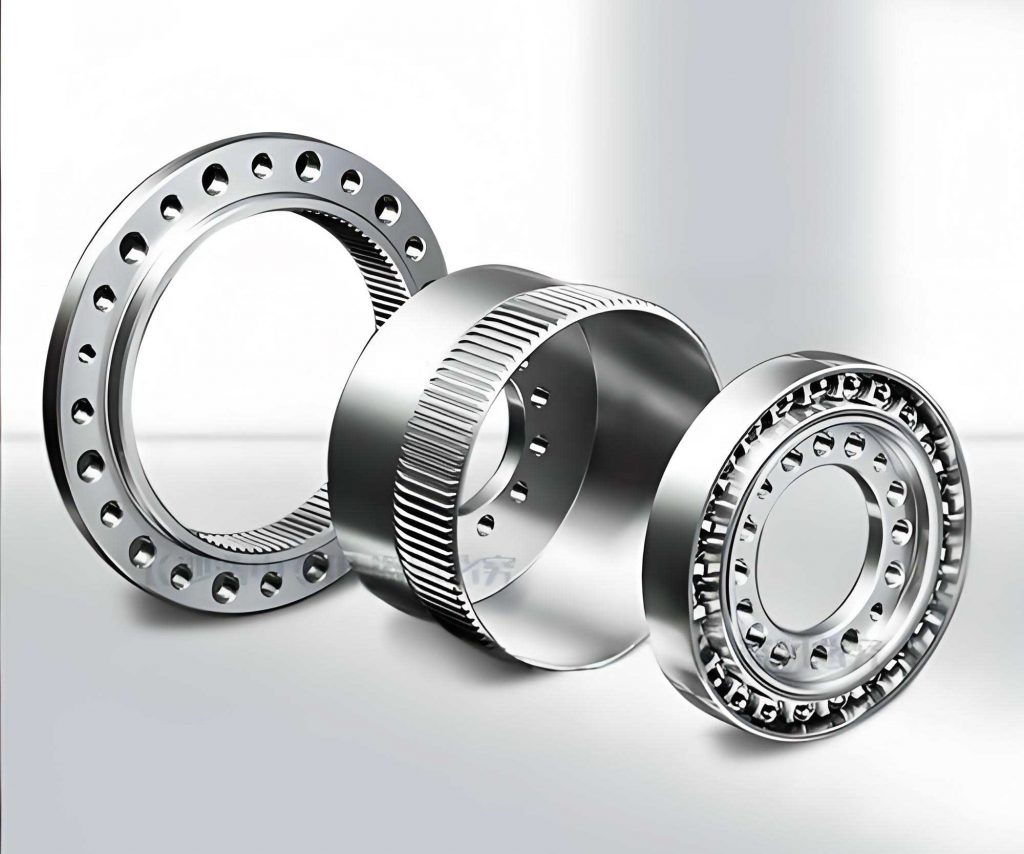
The quest for more efficient, compact, and cost-effective power transmission solutions has consistently driven innovation in mechanical design. Among these, the harmonic drive gear stands out as a unique and highly effective mechanism. Its principle of operation, relying on the controlled elastic deformation of a flexible component, offers unparalleled advantages in terms of reduction ratio, precision, and torque density within a remarkably small package. Traditionally, the key components of a harmonic drive gear—the circular spline (or rigid ring), the flexspline, and the wave generator—are manufactured from high-strength metals. While this ensures durability and high load capacity, it also introduces challenges related to material cost, complex machining processes, weight, and, in some applications, lubrication requirements. This has historically limited the broader adoption of harmonic drive technology in cost-sensitive or weight-critical applications.
This article chronicles a design project focused on reimagining a critical component of the harmonic drive gear: the flexspline. The objective was to replace the conventional steel alloy with a high-performance engineering thermoplastic. The motivations are clear: leveraging the inherent benefits of plastics, such as significantly lower material and manufacturing costs (especially via injection molding), reduced weight, inherent damping characteristics, good fatigue resistance relative to their elastic modulus, and the potential for operation with minimal or no lubrication. By designing a plastic flexspline that meets specific performance criteria, we can unlock new applications for harmonic drive technology. The project encompassed two major phases: first, the structural and parametric design of the plastic flexspline to meet the传动 requirements; and second, the design of a suitable injection mold to manufacture it reliably and with the necessary precision.
Performance Specifications and Design Framework
The redesign project began with a clear set of performance targets for the harmonic drive gear assembly. The specific application called for a compact reducer with the following key specifications:
- Gear Reduction Ratio ($i$): 100
- Number of Wave Generator Lobes ($u$): 2 (a standard two-wave configuration)
- Input Speed: 3000 rpm (from an electric motor)
- Output Torque ($M$): 500 N·m at the flexspline
- Design Life: 3000 hours of operation
- Operating Environment: Maximum ambient temperature of 60°C, no significant shock loads, initial lubrication assumed.
The chosen transmission scheme is a classic configuration: the circular spline is fixed, the wave generator (modeled as an elliptical cam) is the input element, and the cup-shaped flexspline serves as the output element. This configuration is common for achieving high reduction ratios in a compact form factor.
Flexspline Structural Design and Material Selection
The flexspline is the heart of the harmonic drive gear. It is a thin-walled, cylindrical component with external gear teeth that undergoes repeated elastic deformation as the wave generator rotates. This demands a material with an excellent combination of strength, high fatigue endurance limit, good elasticity, and creep resistance. For this application, Polyamide 66 (PA66 or Nylon 66) was selected. PA66 offers a favorable profile: high tensile strength, good resistance to thermal aging, capable of continuous use at elevated temperatures (meeting our 60°C requirement), and good impact properties. Its ability to be easily injection molded is a primary advantage for mass production. A molded-in shrinkage factor of 1.5% was accounted for in all dimensional calculations.
Gear Tooth Parameter Calculation
The fundamental parameters for the flexspline are its pitch diameter ($d$), tooth number ($Z_R$), and wall thickness. For a harmonic drive gear, the number of teeth on the flexspline and the fixed circular spline differ by the number of generator waves. Given a reduction ratio $i = 100$ and $u=2$, the relationship is defined as:
$$ i = \frac{Z_R}{Z_R – Z_C} = \frac{Z_R}{u} $$
Where $Z_C$ is the number of teeth on the circular spline. Solving for $Z_R$ with $u=2$ gives $Z_R = 200$. With the target output torque of 500 N·m and standard design charts correlating torque with flexspline diameter for a given life, a pitch diameter ($d$) of 150.5 mm was determined. The module ($m$) is then:
$$ m = \frac{d}{Z_R} = \frac{150.5}{200} \approx 0.7525 \text{ mm} $$
We standardize this to a module of $m = 0.75$ mm for manufacturing practicality, recalculating the precise pitch diameter as $d = m \times Z_R = 0.75 \times 200 = 150.0$ mm.
Other critical tooth geometry parameters for the flexspline follow a modified involute profile suited for harmonic drive engagement. Key parameters were calculated as follows:
| Parameter | Symbol | Formula / Value | Result (mm) |
|---|---|---|---|
| Module | $m$ | Specified | 0.750 |
| Pressure Angle | $\alpha_0$ | Standard + correction | 29.2° |
| Addendum | $h_a$ | $h_a = 0.875m$ | 0.656 |
| Dedendum | $h_f$ | $h_f = 1.125m$ | 0.844 |
| Tooth Height | $h$ | $h = h_a + h_f$ | 1.500 |
| Tip Clearance | $c$ | $c = 0.25m$ | 0.188 |
| Tooth Thickness on Pitch Circle | $s$ | $s = \frac{\pi m}{2}$ | 1.178 |
Determining the Flexspline Body Structure
A significant design consideration is the wall thickness of the plastic flexspline. While a metal flexspline can have an extremely thin wall to facilitate elastic deformation, a plastic component requires greater thickness to achieve comparable strength and stiffness. A typical rule is to make the plastic wall thickness 2 to 3 times that of an equivalent steel flexspline. For this design, a wall thickness of 2.0 mm was chosen. The overall structure is a cup-shaped flexspline with a rigid boss at the closed end for output connection. The open end is the gear-toothed section that engages with the circular spline. To ensure structural integrity and facilitate assembly, the boss features a pattern of six mounting holes. The final, parametrically defined 3D model of the plastic flexspline was created based on these calculations, forming the basis for the mold design.
Injection Mold Design for the Plastic Flexspline
Manufacturing the complex, thin-walled, and precision-geared flexspline requires a carefully engineered injection mold. The primary challenges are achieving complete fill without defects, minimizing warpage (especially critical for the internal diameter which must maintain tight tolerances for proper harmonic drive gear operation), and ensuring reliable ejection.
Parting and Cavity Layout
The flexspline geometry, being a cup shape without external undercuts, allows for a straightforward parting line located at its largest outer diameter, effectively splitting the mold between the outer surface (core side) and the inner surface & boss face (cavity side). To facilitate machining, cooling, and venting, the six holes in the boss are formed by separate insert pins. A multi-cavity approach is desirable for production efficiency. A one-mold, two-cavity layout was designed, with the cavities mirrored across the mold centerline to balance injection pressures. The 3D mold parting operation clearly defines the core and cavity blocks, along with the boss hole inserts.
Gating System Design and CAE Verification
Selecting the right gating system is crucial. A two-plate mold structure was chosen for its simplicity and cost-effectiveness. For each flexspline cavity, a circular edge gate was selected, entering at the open end of the cup (the non-critical gear end face). This location helps push air ahead of the melt towards the end of fill and minimizes visible gate marks on critical surfaces. The gate land length is 2.0 mm with a diameter of 1.0 mm. The runner system uses a full-round cross-section for minimal pressure drop and heat loss. The primary runner diameter is 7 mm, and the secondary runners leading to each gate are 5 mm in diameter. A Z-shaped cold slug well with a 10 mm diameter is placed at the end of the main runner to trap the initial cold material.
To validate this design, Computer-Aided Engineering (CAE) flow analysis was performed. The simulation model included the part geometry, the runner system, and the gate. The fill time analysis showed a balanced, progressive fill front moving from the gate at the open end towards the closed boss end. Critically, no hesitation or potential weld lines were observed in the critical tooth region or the main body. The pressure drop was within acceptable limits for the chosen material. This CAE verification confirmed the gating system design was suitable for producing sound parts.
Ejection System Design
Ejecting a deep, cup-shaped part without causing distortion requires careful planning. A system of circular ejector pins was designed. Five pins are used per part: one central pin located in the middle of the boss, and four peripheral pins spaced evenly around the boss. All pins have a diameter of 12 mm, providing sufficient contact area to prevent marking or deformation. The required ejection stroke must clear the part completely from the core. The part height is 142.5 mm. Adding a safety margin, the total ejection stroke was set to 160 mm. The ejector plate assembly is designed to travel this distance, ensuring clean and reliable part release after every cycle.
Cooling System Design and Warpage Control
Perhaps the most critical aspect of mold design for this harmonic drive gear component is cooling. Uniform cooling is essential to minimize thermal stresses and control warpage, particularly the roundness of the flexspline’s internal diameter. Non-uniform cooling could lead to an ovalized bore, which would severely impact the meshing performance with the wave generator.
The cooling circuit was designed strategically:
- Fixed Half (Cavity): A combination of straight-through channels and a series-connected channel on the top surface cools the outer wall and boss face of the flexspline. Channel diameter is 8 mm, with a pitch of 40 mm.
- Moving Half (Core): Cooling the internal core that forms the flexspline’s inner surface is vital. A dual-circuit, serial-connected layout was implemented within the core insert. The 8 mm diameter channels are placed as close as possible to the molding surface, with a distance of 43 mm from the channel center to the outer boundary of the core block. This ensures efficient heat extraction from the thickest section of the part.
A separate cooling analysis was performed to predict the effect of this cooling layout on part warpage. The focus was on the deformation of the internal diameter. The analysis results indicated that with the designed cooling system and standard processing parameters for PA66, the predicted maximum deviation from perfect circularity (out-of-roundness) was less than 0.3 mm. This was within the specified tolerance required for the proper functioning of the harmonic drive gear assembly, confirming the adequacy of the cooling design.
Mold Assembly and Operation
The complete mold assembly integrates all these systems. The sequence of operation is standard for a two-plate mold: The mold closes, and molten PA66 is injected. After a holding and cooling phase, the mold opens. The flexspline parts, which shrink onto the core, are pulled to the moving half. The ejection system then advances, driving the ejector plates and pins forward to push the parts off the core. The runner system is also ejected. Once parts and runners are cleared, the mold closes for the next cycle. The integration of properly sized guide pillars, bushings, support pillars under the core plate, and a robust clamping plate ensures the mold operates with the necessary precision and longevity required for producing high-quality plastic components for harmonic drive applications.
Conclusion
This project demonstrates a comprehensive approach to re-engineering a critical metal component for a harmonic drive gear using engineering plastics. It involved a systematic redesign of the flexspline’s geometry, accounting for the different mechanical properties of Polyamide 66 compared to steel, particularly in determining an appropriate wall thickness and verifying gear tooth parameters. The subsequent injection mold design addressed the unique challenges of manufacturing this precise, thin-walled component. Through the strategic application of CAE analysis for filling and cooling, key potential issues like flow hesitation and excessive warpage were identified and mitigated in the design phase. The resulting mold design, featuring a balanced two-cavity layout, a validated edge gating system, a multi-pin ejection system, and a strategically designed conformal cooling circuit, is capable of producing plastic flexsplines that meet the stringent dimensional and performance requirements of a functional harmonic drive gear. This work underscores the viability of using advanced engineering thermoplastics and sophisticated injection molding technology to create cost-effective, lightweight, and high-performance alternatives for specialized mechanical drives, potentially broadening the application horizon for harmonic drive technology.