
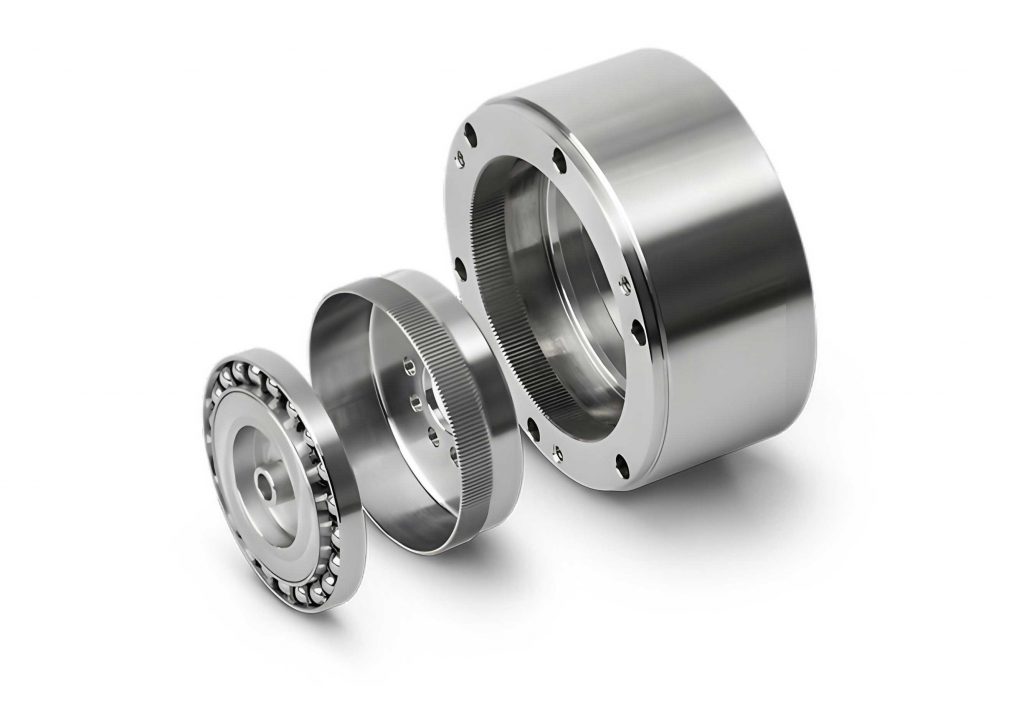
In the field of precision mechanical transmission, harmonic drive gears have garnered significant attention due to their exceptional characteristics, including smooth operation, high load-carrying capacity, large transmission ratios, superior accuracy, compact size, and lightweight design. These advantages make harmonic drive gears indispensable in critical applications such as artificial satellites, lunar exploration projects, medical machinery, light industry, textile machinery, food processing equipment, and aerospace systems. The performance of harmonic drive gears is heavily influenced by backlash, which primarily manifests as tooth flank clearance. For precision harmonic drive gears used in motion transmission, zero minimal clearance is often required, while servo-driven systems demand elimination of tooth flank clearance to ensure bidirectional transmission accuracy. Therefore, backlash elimination techniques are crucial for maintaining the performance of precision harmonic drive gears. In this article, we will explore the research advancements in mechanical backlash elimination for harmonic drive gears, summarizing existing methods and proposing future directions.
Backlash in harmonic drive gears can be categorized into constant backlash and time-varying backlash. Constant backlash arises from design tolerances and manufacturing inaccuracies, whereas time-varying backlash results from wear during operation. Eliminating both types is essential for achieving long-term precision in harmonic drive gears. We will delve into various techniques, emphasizing the role of innovative designs in mitigating backlash.
Elimination of Constant Backlash
Constant backlash in harmonic drive gears is typically addressed through design optimizations and precision manufacturing. Inspired by backlash elimination methods in conventional gear systems—such as eccentric bearing sleeve adjustment, variable tooth thickness axial adjustment, spring-loaded dual-gear mechanisms, and helical gear axial displacement—researchers have adapted these concepts for harmonic drive gears. For instance, optimization algorithms targeting zero backlash have been applied to involute harmonic drive gears, yielding parameters for no-clearance meshing. Similarly, for double-circular-arc harmonic drive gears, selecting appropriate flexspline tooth profile parameters can theoretically achieve zero backlash. Additionally, improving the machining accuracy of both the rigid wheel and flexspline helps reduce initial clearance. However, due to practical limitations in manufacturing precision and inevitable wear, these methods often fail to ensure zero backlash throughout the service life of harmonic drive gears. Thus, there is a pressing need for novel, structurally simple, and self-compensating techniques to eliminate tooth flank clearance in harmonic drive gear pairs.
To summarize the methods for constant backlash elimination, we present the following table:
| Method | Description | Applicability to Harmonic Drive Gears |
|---|---|---|
| Eccentric Bearing Sleeve Adjustment | Adjusts center distance to reduce clearance | Limited due to complex harmonic drive gear geometry |
| Variable Tooth Thickness Axial Adjustment | Modifies tooth thickness axially for tighter meshing | Feasible with tailored flexspline designs |
| Spring-Loaded Dual-Gear Mechanism | Uses springs to press gears together, eliminating gap | Adaptable but may add complexity to harmonic drive gear assemblies |
| Helical Gear Axial Displacement | Axial movement of helical gears to adjust engagement | Less common in harmonic drive gears due to radial meshing nature |
| Tooth Profile Optimization | Optimizes flexspline and rigid wheel profiles for zero clearance | Directly applicable through computational design of harmonic drive gears |
The effectiveness of these methods can be modeled mathematically. For example, the backlash \( B \) in a harmonic drive gear can be expressed as a function of manufacturing tolerances \( \Delta \) and wear \( W \):
$$ B = f(\Delta, W) $$
For constant backlash elimination, the goal is to minimize \( \Delta \) through design. In optimization approaches, an objective function \( J \) aiming for zero backlash might be formulated as:
$$ J = \min \left( \sum_{i=1}^{n} |C_i| \right) $$
where \( C_i \) represents the clearance at the \( i \)-th tooth pair in the harmonic drive gear. By iteratively adjusting parameters like tooth profile coefficients, \( J \) can be driven toward zero.
Elimination of Time-Varying Backlash
Time-varying backlash in harmonic drive gears stems primarily from wear on the flexspline teeth during operation, leading to increased clearance and degraded transmission accuracy. This issue necessitates adaptive or self-compensating mechanisms. Several innovative techniques have been proposed, focusing on modifying the wave generator, flexibilizing the rigid wheel, adding elastic elements, or employing axial adjustments. Below, we explore these categories in detail, highlighting their principles and applications in harmonic drive gears.
Planetary Wave Generator Designs
Planetary wave generators offer a means to dynamically adjust the deformation of the flexspline in harmonic drive gears. One approach involves a tunable planetary wave generator with conical wheels and planetary balls. By adjusting the distance between the conical wheels via screws, the flexspline deformation can be controlled to maintain tight meshing with the rigid wheel, thus eliminating backlash. However, this method requires停机 operation, limiting its practicality. To overcome this, designs with preloaded rolling elements in the wave generator have been developed, allowing continuous compensation for wear in harmonic drive gears. For instance, in微型谐波齿轮传动, planetary rings with external teeth and elastic deformation capabilities are preloaded to adapt to wear-induced clearance. Another variant uses springs to adjust the flexspline’s major axis length dynamically, ensuring zero backlash even with significant tooth wear. Despite these advances, planetary wave generators often rely on frictional transmission, which can affect the accuracy of transmission ratios in harmonic drive gears, especially during startup. Moreover, designs involving fine-pitch meshing may limit load capacity, making them suitable only for微型 harmonic drive gears rather than larger-scale applications.
The adjustment mechanism in planetary wave generators can be described using a model for radial deformation \( \delta_r \) of the flexspline:
$$ \delta_r = k \cdot \Delta d $$
where \( k \) is a deformation coefficient and \( \Delta d \) is the adjustment distance in the wave generator. For backlash elimination, \( \delta_r \) must compensate for wear \( W \):
$$ \delta_r \geq W $$
This ensures that the harmonic drive gear maintains zero clearance over time.
Cam Wave Generator Designs
Cam wave generators are widely used in harmonic drive gears, and their modification for backlash elimination has been extensively studied. We can classify these into elastic cam wave generators and adjustable cam wave generators.
Elastic Cam Wave Generators: These incorporate elastic elements into the cam to provide radial compliance. For example, cams with structural holes or elastic compensation devices at the major axis ends can deform elastically, adjusting the wave generator’s profile to compensate for clearance in harmonic drive gears. Similarly, replacing solid ball rollers in flexible bearings with hollow rollers introduces elasticity; when clearance appears, the hollow rollers expand to fill the gap. These designs are simple, improve shock absorption, reduce noise, and maintain torsional stiffness in harmonic drive gears.
Adjustable Cam Wave Generators: These feature segmented cams with sliding blocks and springs. As wear occurs in the harmonic drive gear, springs push the blocks radially outward, forcing the flexspline to maintain tight contact with the rigid wheel. Adjustable bolts or screws can fine-tune the preload, enabling precise backlash control. Variants include designs with symmetric disc springs or laminated springs that ensure uniform force distribution and higher load capacity. While effective, these mechanisms can be structurally complex and require careful design to avoid instability.
To compare different cam wave generator designs, consider the following table:
| Design Type | Key Features | Advantages for Harmonic Drive Gears | Challenges |
|---|---|---|---|
| Elastic Cam with Holes | Cam body with elastic holes for radial compliance | Simple, good shock absorption, maintains stiffness | Limited deformation range, potential stress concentrations |
| Hollow Roller Bearings | Hollow rollers in flexible bearing for elasticity | Self-compensating, reduces wear in harmonic drive gears | Manufacturing complexity, durability concerns |
| Sliding Block with Springs | Spring-loaded blocks for radial adjustment | Precise clearance control, adaptable to wear | Complex assembly, risk of uneven force |
| Disc Spring Mechanisms | Symmetrical disc springs for uniform radial force | High load capacity, stable compensation in harmonic drive gears | Bulkier design, higher cost |
The force \( F \) exerted by an elastic cam wave generator can be modeled as:
$$ F = E \cdot A \cdot \frac{\Delta L}{L} $$
where \( E \) is the elastic modulus, \( A \) is the cross-sectional area, \( \Delta L \) is the deformation, and \( L \) is the initial length. For backlash elimination in harmonic drive gears, \( F \) must exceed the separating force due to clearance.
Flexibilization of the Rigid Wheel
Another approach to eliminate time-varying backlash in harmonic drive gears is to make the rigid wheel partially flexible. By designing the toothed section of the rigid wheel as a flexible ring, it can elastically deform to compensate for wear. For example, in some harmonic drive gears, the rigid wheel’s toothed portion is a flexible cylindrical ring attached to a rigid body, allowing it to conform to the flexspline’s shape and maintain zero clearance even with tooth wear. This design reduces torsional deformation and increases the number of engaging teeth, enhancing load capacity and accuracy in harmonic drive gears. However, integrating different materials (flexible and rigid) complicates manufacturing and raises costs. Alternative designs, such as split rigid wheels with elastic compensation slots or双圆锥状 flexible rings, have been proposed to simplify production while providing effective backlash compensation. These innovations highlight the potential of flexible rigid wheels in improving the longevity of harmonic drive gears.
The deformation \( \epsilon \) of a flexible rigid wheel under load can be expressed as:
$$ \epsilon = \frac{\sigma}{E} = \frac{F}{A E} $$
where \( \sigma \) is stress, \( E \) is Young’s modulus, \( F \) is the applied force, and \( A \) is the area. For effective backlash elimination in harmonic drive gears, \( \epsilon \) should match the wear-induced gap \( W \).
Adding Elastic Elements Between Wave Generator and Flexspline
Incorporating elastic rings or sheets between the wave generator’s outer ring and the flexspline’s inner surface is a straightforward method for backlash compensation in harmonic drive gears. These elements, preloaded during assembly, use material elasticity to absorb clearance variations. For instance, elastic rings made of spring steel can radially expand to push the flexspline outward, ensuring continuous contact with the rigid wheel. In some designs, axial shims are added to adjust the wave generator’s position, particularly in conical flexspline configurations, deepening engagement to eliminate clearance. This method is simple and cost-effective but may have limited compensation range and durability in high-load harmonic drive gears.
The compensation force \( F_c \) from an elastic ring can be calculated as:
$$ F_c = k_e \cdot x $$
where \( k_e \) is the elastic constant and \( x \) is the compression displacement. For harmonic drive gears, \( F_c \) must be sufficient to overcome backlash forces over time.
Axial Adjustment Method
Unlike radial adjustment techniques, axial adjustment eliminates backlash in harmonic drive gears by moving the rigid wheel or flexspline axially. This method is particularly useful for both cup-type and ring-type flexsplines. For example, in harmonic drive gears with ring flexsplines, adjusting devices can axially shift the rigid wheels to tighten meshing, followed by locking mechanisms to secure the position. Similarly, for cup-type flexsplines, axial movement of the rigid wheel relative to the flexspline reduces clearance. This approach offers precise control and is less sensitive to radial wear patterns, making it valuable for precision harmonic drive gears in servo systems.
The axial displacement \( \Delta_a \) required to eliminate backlash \( B \) in a harmonic drive gear can be derived from the tooth geometry. For helical or conical teeth, the relationship might be:
$$ \Delta_a = \frac{B}{\tan(\beta)} $$
where \( \beta \) is the helix or cone angle. This formula guides the adjustment in axial methods for harmonic drive gears.
Other Backlash Elimination Schemes
Beyond radial and axial adjustments, specialized designs have emerged for unique harmonic drive gear configurations. For instance, in端面活齿谐波齿轮传动, a backlash self-adaptive device uses torsion springs and hollow screws to axially adjust gears, compensating for clearance while offering overload protection. Another innovation combines cycloidal and harmonic drive principles into a摆线针轮谐波减速器, where needles in arc slots engage with flexspline teeth, designed for preloaded, near-zero backlash operation with minimal wear. These approaches expand the applicability of backlash elimination in harmonic drive gears to high-load and hybrid transmission systems.
To encapsulate the various time-varying backlash elimination techniques for harmonic drive gears, we present a comprehensive table:
| Technique Category | Specific Methods | Mechanism | Suitability for Harmonic Drive Gears |
|---|---|---|---|
| Planetary Wave Generator | Tunable conical wheels, preloaded rolling elements | Adjusts flexspline deformation via planetary components | Limited to micro or low-load harmonic drive gears due to friction or meshing constraints |
| Cam Wave Generator | Elastic cams, adjustable sliding blocks, hollow rollers | Radial compliance or movement to compensate for wear | Wide applicability, but design complexity varies; effective for many harmonic drive gear types |
| Flexible Rigid Wheel | Partial flexible rings, split designs with elastic slots | Elastic deformation of rigid wheel to maintain contact | Enhances load capacity but may increase manufacturing cost for harmonic drive gears |
| Elastic Elements | Elastic rings, sheets between wave generator and flexspline | Preloaded elasticity fills clearance gaps | Simple and low-cost, suitable for small to medium harmonic drive gears |
| Axial Adjustment | Axial shifting of rigid wheels or flexsplines | Axial movement tightens meshing independently of radial wear | Precise control, ideal for precision harmonic drive gears in servo applications |
| Hybrid Designs | Cycloidal-harmonic combinations,端面活齿 devices | Combines principles for low wear and self-compensation | Specialized applications, expanding the scope of harmonic drive gears |
The overall backlash \( B_t \) in a harmonic drive gear considering time-varying factors can be modeled as a dynamic system:
$$ B_t(t) = B_0 + \int_{0}^{t} \frac{dW}{dt} dt – C(t) $$
where \( B_0 \) is initial backlash, \( \frac{dW}{dt} \) is wear rate, and \( C(t) \) is compensation from elimination techniques. The goal is to design \( C(t) \) such that \( B_t(t) \approx 0 \) for all \( t \).
Summary and Future Research Directions
In this article, we have reviewed the progress in backlash elimination techniques for harmonic drive gears, covering both constant and time-varying clearance mitigation. From planetary and cam wave generators to flexible rigid wheels, elastic elements, and axial adjustments, each method offers unique benefits for enhancing the precision and longevity of harmonic drive gears. However, challenges remain, such as structural complexity, manufacturing costs, and limitations in load capacity or scalability. Future research should focus on several key areas to advance harmonic drive gear technology.
First, active design of wave generator structures considering geometric and dimensional constraints could lead to more efficient backlash compensation in harmonic drive gears. This involves optimizing parameters like spring constants, cam profiles, and adjustment ranges using computational models. For example, integrating finite element analysis (FEA) with control algorithms might enable real-time adaptation in harmonic drive gears.
Second, developing low-cost manufacturing processes for flexible rigid wheels is essential to make such designs viable for widespread use in harmonic drive gears. Additive manufacturing or advanced composite materials could play a role here.
Third, ensuring reliability and compactness through improved component integration and assembly methods is crucial for harmonic drive gears in demanding applications like aerospace or robotics. This includes robust locking mechanisms, fatigue-resistant elastic elements, and miniaturization for微型 harmonic drive gears.
Finally, exploring hybrid transmission systems that combine harmonic drive gears with other mechanisms (e.g., cycloidal or planetary gears) may yield superior backlash performance and load capacity. Mathematical modeling and simulation will be key in these endeavors. For instance, a generalized model for harmonic drive gear backlash could be:
$$ B_{\text{total}} = \alpha \cdot D + \beta \cdot W – \gamma \cdot C $$
where \( \alpha, \beta, \gamma \) are coefficients, \( D \) is design clearance, \( W \) is wear, and \( C \) is compensation. Optimizing this equation through iterative design can guide future innovations.
In conclusion, backlash elimination remains a critical focus for improving harmonic drive gears. By leveraging mechanical ingenuity and advancing materials science, we can develop next-generation harmonic drive gears that deliver zero clearance, high precision, and long service life across diverse industries. We encourage continued exploration in this vibrant field to unlock the full potential of harmonic drive gears.