
The pursuit of compact, high-ratio, and high-precision motion transmission has long been a central challenge in mechanical design, influencing fields from industrial automation to aerospace exploration. In my extensive work with precision传动 systems, I have consistently found that the harmonic drive gear offers a uniquely elegant solution to this challenge. Its principle of operation, fundamentally different from conventional齿轮 trains, enables exceptional performance characteristics that are difficult to achieve with other technologies. The core of its advantage lies in the controlled elastic deformation of a flexible component. While the theoretical benefits are well-documented, the practical journey from concept to a reliable, optimized physical assembly is fraught with intricate design decisions and meticulous detailing. This article chronicles my detailed approach to the complete design and parametric modeling of a harmonic drive gear, moving from fundamental theory through precise component calculation to the creation of a fully defined three-dimensional digital prototype. The goal is to provide a comprehensive, first-person account that blends analytical rigor with practical modeling strategy, serving as a consolidated reference for engineers undertaking similar development projects.
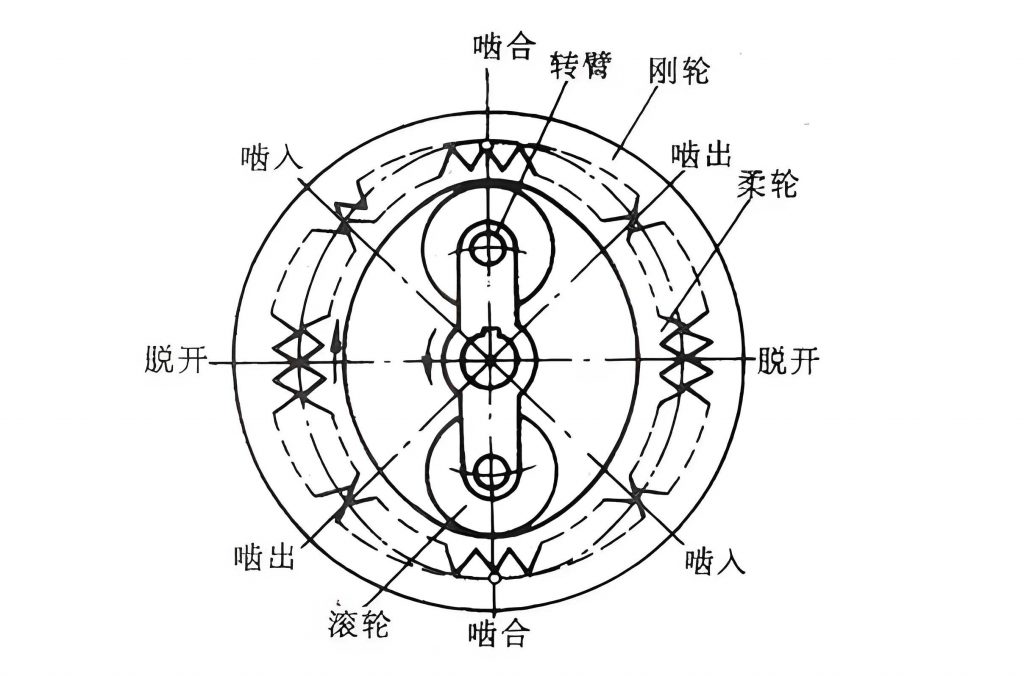
The harmonic drive gear mechanism, at its essence, comprises three primary components: a rigid Circular Spline, a flexible Flexspline, and a Wave Generator. The magic of the system is orchestrated by the wave generator, which is inserted into the Flexspline. As the wave generator rotates, it progressively deforms the originally circular Flexspline into a slight elliptical shape. This controlled deformation causes the external teeth of the Flexspline to engage with the internal teeth of the stationary Circular Spline at two diametrically opposed regions. Crucially, the number of teeth on the Flexspline (\(Z_f\)) is slightly less than that on the Circular Spline (\(Z_c\)). This tooth difference (\(\Delta Z\)) is equal to the wave number (\(n\)), which is typically 2 for the most common and balanced configuration. For a single rotation of the wave generator, the Flexspline undergoes a relative rotational displacement equal to this tooth difference. This kinematic relationship yields the fundamental传动比 formula. When the Circular Spline is fixed, the wave generator serves as the input, and the Flexspline as the output, the reduction ratio (\(i\)) is given by:
$$ i = -\frac{Z_f}{Z_c – Z_f} = -\frac{Z_f}{n} $$
The negative sign indicates that the input and output rotate in opposite directions. This simple formula reveals the potent capability of the harmonic drive gear: a large reduction ratio can be achieved from a single stage with relatively low tooth counts, directly contributing to its compactness.
Foundational Design and Parameter Calculation
Initiating the design of a harmonic drive gear requires establishing top-level performance targets. For this exercise, I defined a target reduction ratio of \(i = 100:1\) for a single-stage, cup-type Flexspline assembly. The Circular Spline is fixed, the Wave Generator is the input, and the Flexspline is the output. A dual-wave (\(n=2\)) configuration was selected for its optimal balance of structural symmetry, load distribution, and manufacturability.
Gearing Parameters: Tooth Count and Module
Starting with the传动比 equation and the wave number, the tooth counts are solved directly. Given \(i = -100\) and \(n=2\):
$$ Z_f = n \times |i| = 2 \times 100 = 200 $$
$$ Z_c = Z_f + n = 200 + 2 = 202 $$
The selection of the module (\(m\)), which defines the tooth size, is closely tied to the radial deformation requirement—specifically, the wave generator’s “wave height” or radial deflection. This deflection must equal the gear’s radial engagement depth. For standardized production tools like dual-wave hobs, common wave height (\(d_w\)) values are used. I selected a wave height of \(d_w = 2.5 \text{ mm}\). The corresponding module is therefore:
$$ m = \frac{d_w}{2} = \frac{2.5}{2} = 1.25 \text{ mm} $$
With \(m\), \(Z_f\), and \(Z_c\) established, the fundamental gear geometry for both the Circular Spline and Flexspline can be calculated. I employ a standard pressure角 (\(\alpha\)) of \(29.2^\circ\) for harmonic drive applications, which differs from the common \(20^\circ\) used in standard involute gears, as it optimizes the engagement conditions under deflection.
| Component | Parameter | Symbol | Formula | Value (mm) |
|---|---|---|---|---|
| Circular Spline | Number of Teeth | \(Z_c\) | \(-\) | 202 |
| Pitch Diameter | \(d_{pc}\) | \(m \cdot Z_c\) | 252.50 | |
| Tip Diameter | \(d_{ac}\) | \(d_{pc} + \frac{7}{8}d_w\) | 254.69 | |
| Root Diameter | \(d_{fc}\) | \(d_{pc} – \frac{9}{8}d_w\) | 249.69 | |
| Tooth Thickness (at pitch) | \(s_c\) | \(0.435 \pi m\) | ~1.71 | |
| Circular Pitch | \(p\) | \(\pi m\) | 3.93 | |
| Flexspline | Number of Teeth | \(Z_f\) | \(-\) | 200 |
| Pitch Diameter | \(d_{pf}\) | \(m \cdot Z_f\) | 250.00 | |
| Tip Diameter | \(d_{af}\) | \(d_{pf} + \frac{7}{8}d_w\) | 252.19 | |
| Root Diameter | \(d_{ff}\) | \(d_{pf} – \frac{9}{8}d_w\) | 247.19 | |
| Tooth Thickness (at pitch) | \(s_f\) | \(0.435 \pi m\) | ~1.71 | |
| Circular Pitch | \(p\) | \(\pi m\) | 3.93 |
Component-Specific Structural Design
Beyond the active齿廓, the structural integrity and functionality of each component in a harmonic drive gear depend on carefully proportioned features.
Circular Spline Design: I opted for a flanged structure over a simple ring, as the flange facilitates precise radial location and mounting. Its dimensions are primarily driven by the need to house the Flexspline and provide adequate structural support. The outer diameter should sufficiently accommodate mounting bolts while maintaining rigidity.
Flexspline Design: The Flexspline is the heart of the mechanism and its most critically stressed part. As a cup-type设计, it consists of a cylindrical shell, a toothed rim, and a rigid output flange (the cup’s bottom). The length of the cylindrical shell (\(L\)) is a key parameter affecting compliance and stress. The wall thickness transitions from a thin, flexible region under the teeth (\(t_1\)) to a slightly thicker general cylindrical wall (\(t_3\)) to manage stress concentration. All transitions are filleted with generous radii (\(R_1, R_2, R_3\)) to mitigate fatigue-inducing stress risers, a critical consideration for the cyclic loading experienced by the harmonic drive gear.
| Flexspline Structural Parameter | Symbol | Design Guideline / Formula | Calculated/Selected Value (mm) |
|---|---|---|---|
| Cylinder Length | \(L\) | \((0.75 \text{ to } 1.0) \times d_{pf}\) | 160.0 |
| Bore Diameter (Cylinder ID) | \(D_i\) | Based on internal clearances | 145.0 |
| Tooth Rim Width | \(b_f\) | \((0.12 \text{ to } 0.25) \times D_i\) | 18.0 |
| Cylinder Wall Thickness | \(t_3\) | \((0.0075 \text{ to } 0.0115) \times D_i\) | 1.8 |
| Output Flange Thickness | \(H\) | \(\geq 3 + 0.01 D_i\) | 8.0 |
| Tooth Base Wall Thickness | \(t_1\) | \((d_{ff} – D_i)/2\) | ~1.1 |
| Key Transition Fillet Radii | \(R_1, R_2, R_3\) | \(0.05D_i \text{ to } 0.1D_i\) | 4.0 – 8.0 |
Wave Generator and Bearing Selection
The wave generator’s function is to impose a precise, controlled elliptical deflection onto the Flexspline. The most reliable and widely adopted design is the cam-and-flexible-bearing assembly. It consists of a solid elliptical (or two-lobe) cam over which a specially designed thin-walled ball bearing is fitted. This bearing, known as a柔性轴承, has a thin, compliant outer ring that conforms to the cam’s shape and transmits it smoothly to the Flexspline’s inner bore, while its inner ring rotates with the cam. The bearing’s external surface provides a near-frictionless interface for the deforming Flexspline.
The major axis of the cam (\(D_{cam,major}\)) is set equal to the Flexspline’s nominal bore diameter (\(D_i\)) plus twice the required radial deflection (\(d_w\)):
$$ D_{cam,major} = D_i + 2 \cdot d_w = 145 + 2 \times 2.5 = 150.0 \text{ mm} $$
The minor axis (\(D_{cam,minor}\)) is correspondingly:
$$ D_{cam,minor} = D_i – 2 \cdot d_w = 145 – 2 \times 2.5 = 140.0 \text{ mm} $$
The柔性轴承 is then selected from standardized series based on this nominal bore (cam major axis) and the required cross-section. For this design, a bearing analogous to a standardized series with a 150mm outer diameter and suitable width is specified. The bearing’s thin-section design is crucial; its compliance allows it to wrap around the cam without internal binding, ensuring the elliptical profile is accurately imparted to the harmonic drive gear’s Flexspline.
Parametric 3D Modeling and Virtual Assembly
Transitioning from calculated parameters to a verifiable virtual model is where parametric Computer-Aided Design (CAD) software becomes indispensable. In my workflow, I utilize a top-down modeling approach within a parametric CAD environment (exemplified by Pro/ENGINEER or Creo Parametric). This methodology ensures that all components are driven by a central set of relations and parameters (\(i, n, m, d_w, Z_f\), etc.), enabling rapid iteration and design validation.
Modeling Philosophy and Core Parameters
The first step is to define the master parameters and relations. This creates a single source of truth for the entire harmonic drive gear assembly. For example:
WAVE_NUMBER = 2TARGET_RATIO = 100FLEXSPLINE_TEETH = WAVE_NUMBER * TARGET_RATIOCIRCULAR_SPLINE_TEETH = FLEXSPLINE_TEETH + WAVE_NUMBERWAVE_HEIGHT = 2.5MODULE = WAVE_HEIGHT / 2
These parameters are then referenced in every subsequent feature and part, from齿廓 sketches to extrusion depths.
Component Modeling Sequence
- Flexspline: I begin by revolving the cup’s main profile (flange, cylinder) based on parameters \(D_i\), \(L\), \(H\). The齿圈 is then added as a helical cut (with a very small lead to create straight teeth) using the defined齿廓方程, linked to \(Z_f\), \(m\), and \(\alpha\). The critical fillets (\(R_1, R_2, R_3\)) are applied last.
- Circular Spline: This is modeled as a ring with an internal齿圈. The齿廓 cut is similarly parametric, driven by \(Z_c\), \(m\), and \(\alpha\). The flange with bolt holes is patterned based on a parameter for the number of mounting holes.
- Wave Generator Cam: The elliptical cam is created by sketching an ellipse with major and minor diameters defined by the formulas \(D_{cam,major}\) and \(D_{cam,minor}\). It is then extruded to the required width.
- Flexible Bearing: While standard bearings can be imported from libraries, a simplified parametric model of the柔性轴承 is created for assembly and interference checking, respecting its thin-walled nature.
Virtual Assembly and Interference Analysis
The assembly is built by constraining the components in their operational states:
- The Circular Spline is fixed.
- The Wave Generator Cam is assembled onto the input shaft and left free to rotate.
- The Flexible Bearing is assembled over the cam (inner ring fixed to cam, outer ring free).
- The Flexspline is assembled over the柔性轴承, with its inner cylindrical surface aligned. Crucially, it is assembled in its neutral, undeformed state.
At this stage, a nominal干涉检查 will show overlap between the Flexspline teeth and the Circular Spline teeth—this is expected because the Flexspline is not yet deformed. The true kinematic and mesh verification often requires advanced tools like mechanism simulation with contact analysis or dedicated gear analysis software to digitally simulate the deformation and engagement. However, the parametric model’s value is immense: it allows immediate visualization of spatial packaging, validation of all clearances in non-engaged areas, and the generation of detailed manufacturing drawings. If a design parameter like the module or wave height needs adjustment, a single change in the master parameter updates the entire harmonic drive gear assembly automatically, drastically reducing the time required for design iterations.
Analysis, Applications, and Concluding Perspectives
The completed virtual model of the harmonic drive gear is not an end product but a starting point for deeper engineering analysis. From this digital twin, several critical analyses can be launched. Finite Element Analysis (FEA) is paramount, particularly for the Flexspline. Static structural analysis under load can reveal stress concentrations, especially in the fillet regions and the tooth root area, validating the chosen wall thicknesses and transition radii. Modal analysis can identify natural frequencies to avoid resonant conditions during operation.
The advantages that drive the adoption of harmonic drive gears are clearly embodied in this design exercise. The achieved 100:1 ratio in a single, coaxial stage is remarkably compact. The large number of teeth in simultaneous engagement (often 15-30% of total teeth) distributes load beautifully, leading to high torque capacity and exceptional torsional stiffness. The absence of sliding friction in the tooth engagement (under ideal conditions) and the precision of the components contribute to excellent positional accuracy and repeatability, with near-zero backlash. These characteristics make the harmonic drive gear the actuator of choice in demanding fields:
- Robotics: For joint actuators in robotic arms, providing high torque, compact size, and precise motion control.
- Aerospace & Satellites: In antenna positioning systems and solar array drives, where reliability, lightness, and precision are non-negotiable.
- Machine Tools: In rotary tables and high-precision indexers for CNC machining.
- Medical Equipment: In surgical robots and imaging devices where smooth, accurate motion is critical.
In my practice, the integration of rigorous theoretical design with robust parametric 3D modeling forms a powerful闭环 for harmonic drive gear development. The mathematical framework ensures functional performance, while the parametric model validates manufacturability, assembly logic, and forms the basis for advanced simulation. This integrated approach significantly de-risks the development process, reducing the number of physical prototypes needed and accelerating the path to a reliable, optimized product. As additive manufacturing and new composite materials advance, the design flexibility offered by such a parametric digital workflow will become even more critical in pushing the performance boundaries of下一代 harmonic drive gear systems, enabling lighter, stronger, and more integrated designs for the future of precision motion control.