
The operational principle of the harmonic drive gear relies on the controlled elastic deformation of a flexible component known as the flexspline. The service life and reliability of the entire harmonic drive gear system are predominantly dictated by the fatigue strength of this flexspline. Consequently, a precise understanding of the stress magnitude and distribution within the flexspline under load is paramount for accurate life prediction and optimal design. Traditional analytical methods often employ significant simplifications, such as treating the flexspline as a smooth, thin-walled shell of equivalent thickness, which may not accurately capture the localized stress concentrations at critical features like the tooth root fillet and the varying wall thickness. This study addresses this gap by proposing and implementing a detailed, parameterized three-dimensional solid finite element modeling approach for the flexspline. The primary objective is to conduct a high-fidelity stress analysis under assembly conditions, moving beyond simplified models to investigate the true stress state in a harmonic drive gear.
Finite element analysis (FEA) has become a standard tool for studying harmonic drive gear components. However, many existing models employ simplifications to reduce computational cost. Common practices include smoothing out the teeth into an equivalent-thickness shell or using combined shell and beam elements. While these approaches provide valuable insights into global deformation and average stress trends, they inherently lack the resolution to analyze the detailed stress field within the tooth structure itself. Other studies have incorporated full tooth models but often use simplified contact definitions or load applications that do not fully replicate the complex interaction between the wave generator and the flexspline’s inner surface. This work aims to bridge these limitations by developing a model that includes an accurate, parameterized representation of the involute tooth profile, complete with root fillets, and by employing advanced non-linear contact mechanics to simulate the wave generator’s action. This allows for a more authentic assessment of the stress distribution in the assembly state of a harmonic drive gear.
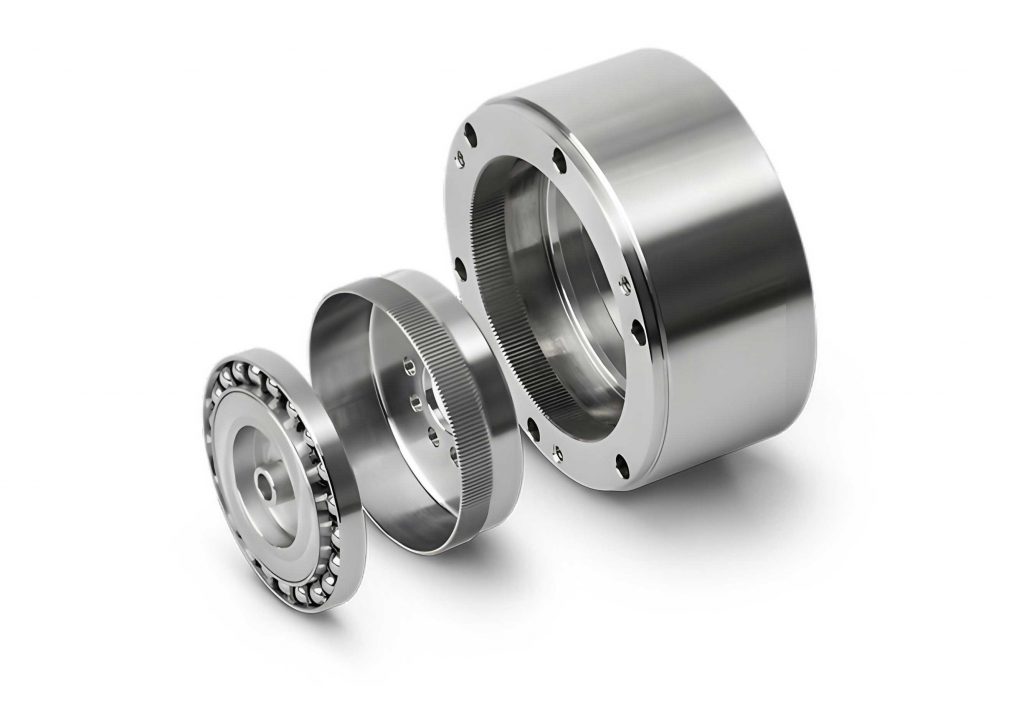
The core of the methodology involves a multi-stage process, integrating theoretical calculations with advanced numerical modeling. To establish a baseline for validation, two classical analytical methods are first employed: the equivalent ring theory and the empirical design code formula. The equivalent ring theory models the flexspline as a circular ring with equivalent bending stiffness, accounting for the stiffening effect of the cylinder. The circumferential stress at an arbitrary cross-section can be calculated using the following piecewise function:
$$
\sigma(\phi) = \frac{w_0 E h}{2 r_m^2} \left[ \frac{4}{\pi} – 2\sin\beta\cos\phi}{ \frac{\pi}{2}\cos\beta + \sin\beta – \beta\cos\beta – \frac{4}{\pi}} \right], \quad (0 \le \phi \le \beta)
$$
$$
\sigma(\phi) = \frac{w_0 E h}{2 r_m^2} \left[ \frac{4}{\pi} – 2\cos\beta\sin\phi}{ \frac{\pi}{2}\cos\beta + \sin\beta – \beta\cos\beta – \frac{4}{\pi}} \right], \quad (\beta \le \phi \le \pi/2)
$$
where $w_0$ is the maximum radial deformation, $E$ is the Young’s modulus, $h$ is the equivalent ring thickness, $r_m$ is the radius of the neutral curve before deformation, $\phi$ is the angular position from the major axis, and $\beta$ is the offset angle of the wave generator rollers.
For comparison, the maximum circumferential stress from a widely-used design standard is also computed. This method simplifies the flexspline to a smooth cylindrical shell and applies correction coefficients based on experimental data:
$$
\sigma_{\phi c} = K_{rt} K_M K_d C_\sigma \frac{w_0 E s}{r_m^2}
$$
Here, $s$ is the wall thickness at the tooth ring, and $K_{rt}$, $K_M$, $K_d$, and $C_\sigma$ are coefficients for bending stiffness, load-induced distortion, dynamic load, and normal stress, respectively.
The foundation of the numerical analysis is the creation of a highly detailed, parameterized 3D solid model of the cup-type flexspline. This is achieved using ANSYS Parametric Design Language (APDL), enabling automatic updates to geometry based on key design variables. The modeling process begins with the generation of an accurate involute tooth profile. For a gear cut by a hob, the coordinates of the involute curve are defined parametrically:
$$
\begin{aligned}
x_1 &= r_1[-\sin(u – \theta) + u \cos\alpha_0 \cos(u – \theta + \alpha_0)] \\
y_1 &= r_1[\cos(u – \theta) + u \cos\alpha_0 \sin(u – \theta + \alpha_0)]
\end{aligned}
$$
In these equations, $r_1$ is the pitch radius, $u$ is the roll angle, $\alpha_0$ is the standard pressure angle, and $\theta$ is half of the angular tooth thickness at the pitch circle. The critical geometric parameters for the flexspline and its teeth used in this study are summarized in the following tables.
| Parameter | Symbol | Value | Unit |
|---|---|---|---|
| Module | $m$ | 0.5 | mm |
| Number of Teeth | $z_1$ | 200 | – |
| Cup Length | $l$ | 80.0 | mm |
| Profile Shift Coefficient | $x_1$ | 3.0 | – |
| Standard Pressure Angle | $\alpha_0$ | 20 | ° |
| Dimension | Symbol | Calculation Formula |
|---|---|---|
| Pitch Radius | $r_1$ | $r_1 = m z_1 / 2$ |
| Tip Radius | $r_a$ | $r_a = 0.5m[z_1 + 2(x_1 + h_a^*)]$ |
| Root Radius | $r_f$ | $r_f = 0.5m[z_1 + 2(x_1 – h_a^* – c^*)]$ |
| Tooth Thickness | $s_p$ | $s_p = (\pi/2 + 2x_1 \tan\alpha_0)m$ |
| Parameter | Symbol | Value | Unit |
|---|---|---|---|
| Tooth Ring Width | $b$ | 8.0 | mm |
| Tooth Ring Wall Thickness | $s$ | 0.7 | mm |
| Distance from Front to Tooth Ring | $f$ | 8.0 | mm |
| Inner Diameter at Fixed End | $d_k$ | 40.0 | mm |
Using the APDL script, points are defined for the tip and root circles, and the involute curve is constructed based on the equations above. A half-tooth profile is created using a point-line-area approach, mirrored to form a complete tooth, and then patterned circumferentially to generate a segment of the tooth ring. This planar tooth ring model serves as an intermediate step for preliminary analysis. A four-roller wave generator is modeled and positioned at the specified offset angle $\beta = 25^\circ$. Contact is defined between the wave generator rollers and the inner surface of the flexspline cylinder using a line-to-line contact formulation, suitable for the 2D plane strain assumption. Symmetry boundary conditions are applied to a quarter-model to reduce computational expense. The mesh is refined at the tooth root fillets to capture potential stress concentrations accurately.
The finite element analysis of this planar model is performed to obtain the stress distribution under the action of the wave generator. To extract meaningful results, three radial paths are defined within the tooth ring wall: the Top Layer (at the tooth root circle), the Middle Layer (at the neutral surface), and the Bottom Layer (at the inner wall surface). The circumferential stress ($\sigma_{\theta}$) along these paths, particularly in the Top and Bottom layers, is extracted and compared with the theoretical values from the equivalent ring theory and the design code. The results show that while the mean trend of the circumferential stress fluctuation around the circumference aligns with the theoretical prediction, the actual stress values from the FEA are significantly higher at the critical Top Layer. For instance, at the minor axis location, the planar model’s Top Layer stress peaks at 106.2 MPa, which is 103.4% higher than the theoretical value (52.2 MPa) and 42.6% higher than the design code value (74.5 MPa). This initial finding underscores the limitation of simplified analytical models in predicting peak stresses in a harmonic drive gear flexspline.
To progress towards a more realistic simulation, the planar tooth ring and wave generator are extruded along the axial direction to create a three-dimensional segment. The cylindrical cup of the flexspline is then added and carefully merged with the tooth ring base using node merging commands in APDL to ensure a continuous mesh at their interface. This results in a complete 3D solid finite element model of the flexspline assembly. In this model, the contact definition is upgraded from line-to-line to a more realistic surface-to-surface contact between the wave generator rollers and the flexspline’s inner cylindrical surface. For detailed analysis, paths are defined not only radially (Top, Middle, Bottom layers) but also axially: at the Front, Middle, and Rear cross-sections of the tooth ring width.
The analysis of the 3D solid model reveals a more complex and severe stress state. The stress contour plots clearly show high-stress regions at the tooth roots near the minor axis. Extracting the circumferential stress from the Middle cross-section (which corresponds directly to the previously analyzed planar model) allows for a direct comparison. The results are striking. The maximum circumferential stress in the Top Layer of the 3D model’s middle section escalates to 170.3 MPa at the minor axis. This represents a dramatic 60% increase compared to the planar model, a 226% increase over the equivalent ring theory value, and a 129% increase over the design code estimation. Similarly, at the wave generator contact region, the stress in the 3D model is about 20% higher than in the planar model. This substantial increase is attributed to the development of a biaxial stress state in the 3D model. Unlike the plane strain condition in the 2D analysis, the middle cross-section of the 3D flexspline is subject to both circumferential and axial bending stresses, with the axial stress contributing to a magnified effective circumferential stress. This phenomenon is not captured by simplified 2D or analytical models and highlights a critical aspect of harmonic drive gear flexspline behavior.
In contrast, the stress in the Bottom Layer (inner wall) of the 3D model showed a more moderate increase of 33% over the planar model at the minor axis, and was nearly identical at the contact region. The stress in the Middle Layer remained relatively low throughout. This confirms that the most critical location for fatigue crack initiation in a cup-type harmonic drive gear flexspline is the tooth root region on the outer surface (Top Layer), and its severity is significantly underpredicted by conventional design analyses.
In conclusion, this study successfully demonstrates a high-fidelity parameterized modeling and analysis framework for the stress assessment of flexsplines in harmonic drive gear systems. The key findings are systematically summarized below:
| Model / Method | Top Layer Stress (MPa) | Bottom Layer Stress (MPa) | Notes |
|---|---|---|---|
| Equivalent Ring Theory | 52.2 | -52.2* | Analytical baseline |
| Design Code Formula | 74.5 | N/A | Empirical design value |
| 2D Planar FEA Model | 106.2 (+103.4% / +42.6%) | 66.0 (+26.4% / -11.4%) | Compared to Theory / Code |
| 3D Solid FEA Model (Mid-Section) | 170.3 (+226% / +129%) | 88.0 (+69% / +18%) | Compared to Theory / Code |
*Theoretical bottom layer stress is taken as the negative of the top layer value.
- Validation of Methodology: The planar finite element model, despite its simplifications, produced a circumferential stress distribution whose mean fluctuation trend aligned well with classical equivalent ring theory. This agreement validates the fundamental correctness of the modeling approach, including the contact definition and boundary conditions, for a harmonic drive gear assembly.
- Limitation of Simplified Models: Both the planar FEA model and the 3D solid model revealed that peak stresses at the critical tooth root (Top Layer) substantially exceed values predicted by analytical theories and standard design codes. This indicates that these traditional methods may be non-conservative for high-precision or high-reliability harmonic drive gear design.
- Critical Importance of 3D Analysis: The transition from a 2D planar model to a full 3D solid model resulted in a significant further increase in the predicted maximum circumferential stress (approximately 60% higher at the minor axis). This is attributed to the development of a biaxial stress state due to axial bending, an effect completely absent in 2D analyses. Therefore, for an accurate assessment of the true worst-case stress in a harmonic drive gear flexspline, a three-dimensional solid finite element analysis incorporating detailed tooth geometry and non-linear contact is essential.
- Critical Failure Location: The analysis consistently identified the tooth root region on the outer layer (Top Layer) of the flexspline as the location of maximum tensile stress, making it the most probable site for fatigue crack initiation and failure in a harmonic drive gear.
The parameterized APDL-based modeling framework developed here provides a powerful tool for designers. It enables rapid exploration of the effects of geometric parameters (such as tooth profile, fillet radius, wall thickness) and operating conditions on the flexspline’s stress state. Future work will involve extending this model to include the rigid circular spline (the internal gear) to simulate the meshing process under loaded conditions, which will introduce additional bending stresses in the teeth and provide a complete picture of the stress history in a working harmonic drive gear. Furthermore, coupling this mechanical analysis with fatigue life prediction algorithms will allow for a direct and accurate estimation of the flexspline’s operational lifespan, leading to more robust and optimized harmonic drive gear systems.