
The precision transmission technology known as harmonic drive gear transmission relies on the elastic wave-like deformation of a flexible component, the flexspline, to achieve motion and torque transfer. This unique mechanism grants harmonic drive gears exceptional advantages, including compact size, lightweight construction, high load-carrying capacity, superior transmission accuracy, and high efficiency. Consequently, they are extensively employed in fields demanding precise motion control, such as aerospace technology, robotics, machine tools, instrumentation, and medical devices. The inherent flexibility of the flexspline, however, introduces non-linear characteristics into the torsional stiffness of the transmission system, which profoundly influences key performance metrics like transmission accuracy and elastic hysteresis (lost motion). The circumferential stiffness at the point where the flexspline teeth mesh with the rigid circular spline is a critical component of the overall system stiffness. Understanding and accurately predicting this stiffness is paramount for optimizing the design and performance of harmonic drive gears.
Under load, the distribution of meshing forces between tooth pairs is non-uniform and varies with applied torque, meshing parameters, and structural geometry. The non-linear deformation of the flexspline under load further complicates its performance analysis. While experimental studies and finite element method (FEM) simulations have been instrumental in revealing the non-linear torsional stiffness and hysteresis, a comprehensive theoretical model that decomposes and quantifies the contributions of various flexspline components to the meshing point stiffness, especially under the pre-stressed condition induced by the wave generator, is essential for insightful design guidance. This work aims to bridge that gap by proposing a detailed theoretical methodology for calculating the circumferential stiffness at the flexspline meshing point and validating it through sophisticated finite element simulations.
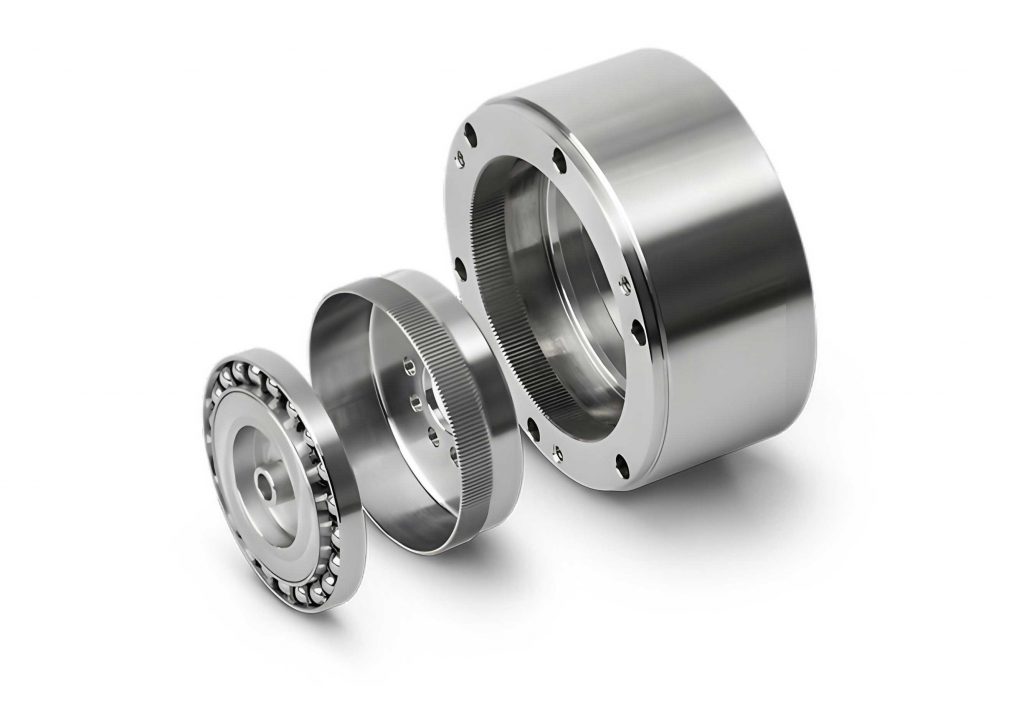
The fundamental operation of a harmonic drive gear involves three primary components: a rigid circular spline, a flexible flexspline (typically cup-shaped), and an elliptical wave generator inserted into the flexspline. The wave generator deforms the flexspline into an elliptical shape, causing its external teeth to engage with the internal teeth of the circular spline at two diametrically opposite regions (the major axis). As the wave generator rotates, the points of engagement travel, resulting in a large reduction ratio between the wave generator’s input and the flexspline’s output. This process subjects the flexspline to a complex state of stress involving both the initial assembly deformation from the wave generator and subsequent load-induced deformations during power transmission. The circumferential stiffness at a meshing point directly resists the tangential force arising from the transmitted torque and is a primary determinant of the system’s torsional compliance and elastic backlash.
Structural Decomposition and Deformation Mechanisms of the Flexspline
To analytically model the stiffness, the cup-type flexspline is conceptually divided into two main subsystems based on their deformation characteristics under a tangential meshing force \(F\): the cylindrical shell (referred to as the “cylinder”) and the tooth body. The cylinder is further subdivided into five distinct regions, as illustrated in Figure 1: the cup bottom (1), the cup bottom fillet (2), the smooth cylindrical section (3), the arc transition section between the cylinder and the gear rim (4), and the gear rim itself (5). The tooth body (6) constitutes the final part. This decomposition allows for the application of appropriate mechanical models to each region.
The load torque \(T\) applied to the flexspline’s output (cup bottom) is related to the tangential force \(F\) at the meshing point near the tooth tip radius \(r_a\) by:
$$T = 2F r_a$$
This force \(F\) induces two primary types of deformation along the load path from the meshing point to the fixed cup bottom: torsional deformation in the cylindrical shell and bending/shearing deformation in the tooth body. The total circumferential displacement at the meshing point, \(\delta_{total}\), is the sum of the equivalent displacements from these two deformation paths.
Theoretical Derivation of Component Deformations
Torsional Deformation of the Cylindrical Shell Components
1. Cup Bottom Torsion: Modeled as a thin circular plate fixed at its inner radius \(r_{fix}=d_k/2\) and subjected to torque \(T\). The shear strain in the plate leads to a circumferential displacement \(v_a\) and rotation \(\theta_a\) at its outer edge (radius \(r_0\)):
$$v_a = \left( \frac{1}{d_k^2} – \frac{1}{4r_0^2} \right) \frac{T r_0}{\pi G \delta_1}, \quad \theta_a = \frac{v_a}{r_0}$$
where \(G\) is the shear modulus (\(G=E/(2(1+\mu))\)), \(E\) is Young’s modulus, \(\mu\) is Poisson’s ratio, and \(\delta_1\) is the cup bottom thickness.
2. Cup Bottom Fillet Torsion: This is a quarter toroidal shell of constant thickness \(\delta_1\) and midline radius \(r_1\). Using energy methods, the average angular twist \(\theta_c\) and the corresponding circumferential displacement \(v_c\) at the connection to the smooth cylinder (radius \(r_m\)) are derived as:
$$\theta_c = \frac{T r_1}{2G \delta_1 \pi} \int_0^{\pi/2} \frac{1}{(r_0 + r_1 \sin \theta)^3} d\theta, \quad v_c = \theta_c \cdot r_m$$
3. Smooth Cylinder Torsion: This thin-walled cylindrical section of length \(l_1\), thickness \(\delta_2\), and mean radius \(r_m\) undergoes simple torsion. Its angular twist \(\theta_t\) and end displacement \(v_t\) are:
$$\theta_t = \frac{T l_1}{G I_{p}}, \quad v_t = \theta_t \cdot r_m, \quad \text{where } I_{p} = 2\pi \delta_2 r_m^3$$
4. Arc Transition Section Torsion: This variable-thickness section connects the smooth cylinder to the gear rim. Its outer diameter varies along its length \(l_2\). The polar moment of inertia \(I_{pg}(x)\) is a function of position \(x\). The total twist \(\theta_g\) and displacement \(v_g\) are found by integration:
$$\theta_g = \int_0^{l_2} \frac{T}{G I_{pg}(x)} dx, \quad v_g = \theta_g \cdot r_{m1}$$
Here, \(r_{m1}\) is the mean radius of the gear rim, and \(I_{pg}(x) = \frac{\pi}{32}[D(x)^4 – d_s^4]\), with \(D(x)\) being the variable outer diameter.
5. Gear Rim Torsion: The gear rim, approximated as a constant-thickness (\(\delta_3\)) cylindrical shell of width \(b\) with teeth removed, experiences torsion. Its deformation is:
$$\theta_d = \frac{T b}{G I_{pd}}, \quad v_d = \theta_d \cdot r_{m1}, \quad \text{where } I_{pd} = 2\pi \delta_3 r_{m1}^3$$
Deformation of the Tooth Body
The tangential force \(F\) acting at the tooth tip causes three deformation components at the tooth itself:
1. Tooth Root Rotation (\(v_r\)): The bending moment \(F \cdot h\) (where \(h\) is the tooth height) applied to the gear rim causes a local rotation \(\theta_r\) at the tooth root, leading to a tip displacement:
$$\theta_r = \frac{12 \pi m F h}{E b \delta_3^3}, \quad v_r = h \cdot \theta_r$$
where \(m\) is the gear module.
2. Tooth Bending Deformation (\(v_b\)): Modeled as a variable-cross-section cantilever beam (with involute profile), the bending-induced tip displacement is calculated using the energy method:
$$v_b = \int_0^h \frac{12 F x^2}{E b [s_i(x)]^3} dx$$
Here, \(s_i(x)\) is the tooth thickness at a distance \(x\) from the root, derived from the involute geometry and modification coefficient \(x_1\).
3. Tooth Shear Deformation (\(v_s\)): The shear energy contributes to an additional tip displacement:
$$v_s = \int_0^h \frac{K}{G A(x)} dx, \quad \text{where } A(x) = b \cdot s_i(x)$$
\(K\) is the shear factor (taken as 1.5 for a rectangular section).
Theoretical Circumferential Stiffness at the Meshing Point
The total circumferential displacement at the meshing point, \(\Delta_{meshing}\), is the sum of the equivalent displacement from cylinder torsion and the tooth body deformation, both caused by force \(F\):
$$\Delta_{meshing} = \frac{T}{K_1} \cdot \frac{r_a}{r_m} + \frac{F}{K_2}$$
where \(r_a/r_m\) is a geometric factor relating cylinder rim rotation to tooth tip displacement. \(K_1\) and \(K_2\) are the equivalent torsional stiffnesses for the cylinder and tooth body paths, respectively:
$$K_1 = \frac{T}{\theta_a + \theta_c + \theta_t + \theta_g + \theta_d}, \quad K_2 = \frac{F}{v_r + v_b + v_s}$$
The effective circumferential stiffness \(k_\theta\) at the meshing point, defined as the tangential force \(F\) required to produce a unit circumferential displacement at that point, is derived from the series combination of these two stiffness paths:
$$\frac{1}{k_\theta} = \frac{1}{2 K_2} + \frac{1}{2 K_1 (r_a / r_m)^2} \quad \text{or equivalently,} \quad k_\theta = \frac{2 K_1 K_2 r_a^2}{K_1 + 2 K_2 r_a^2} = K_1 \cdot \frac{1}{1 + K_1/(2 K_2 r_a^2)}$$
The factor of 2 accounts for the pair of diametrically opposed meshing points in the harmonic drive gear.
Finite Element Model and Simulation Strategy
To validate the theoretical model, a high-fidelity 3D solid finite element model of the cup-type flexspline was developed using ANSYS software (SOLID185 elements). The model included accurate geometrical features: the true involute tooth profile (240 teeth, module 0.2536 mm, pressure angle \(20^\circ\), modification coefficient \(x_1=2.1286\)), all process structures (fillets, transitions), and material properties (Young’s modulus \(E=210\) GPa, Poisson’s ratio \(\mu=0.3\)). The key structural parameters are summarized in Table 1.
| Parameter | Value | Parameter | Value |
|---|---|---|---|
| Young’s Modulus, \(E\) | 210 GPa | Cup Bottom Thickness, \(\delta_1\) | 0.435 mm |
| Pressure Angle, \(\alpha\) | 20° | Cylinder Thickness, \(\delta_2\) | 0.435 mm |
| Poisson’s Ratio, \(\mu\) | 0.3 | Gear Rim Thickness, \(\delta_3\) | 0.700 mm |
| Modification Coefficient, \(x_1\) | 2.1286 | Face Width, \(b\) | 12.780 mm |
| Module, \(m\) | 0.2536 mm | Fixation Hole Diam., \(d_k\) | 30.000 mm |
| Number of Teeth, \(z_1\) | 240 | Cylinder Inner Diam., \(d_s\) | 60.000 mm |
| Cylinder Length, \(l_1\) | 15.18 mm | Fillet Radius 1, \(r_1\) | 0.6525 mm |
| Transition Length, \(l_2\) | 1.9693 mm | Transition Radius, \(r_2\) | 7.450 mm |
Three distinct simulation conditions were defined to isolate effects and facilitate comparison with theory:
1. Unassembled Cylinder Solution: A uniformly distributed tangential force (resultant = 1 N) was applied to all tooth tips on the front face of the flexspline in its initial circular state (no wave generator). The cup bottom inner hole was fixed. The average circumferential displacement of each cylinder component was extracted. This simulates the pure load response without assembly pre-deformation.
2. Assembled Cylinder Solution: The wave generator was modeled, and a surface-to-surface contact analysis was performed to obtain the flexspline’s elliptical assembly deformation. Then, a pair of unit tangential forces was applied to the tooth tips at the major axis on the front face. The load-induced circumferential displacement for each component was calculated as the difference in displacement before and after applying the force. The average value around the circumference is the “assembled solution,” representing the real operational condition.
3. Tooth Body Mean Solution: On the assembled model, tangential forces (totaling 1 N) were applied at three cross-sections (front, middle, rear) of a major-axis tooth. The resulting tooth tip displacements from bending and root rotation were averaged to obtain a “mean solution” comparable to the plane-strain assumption in the theory.
Results: Comparison of Theoretical and FEM Solutions
Cylinder Torsional Deformation
The FEM results for the unassembled cylinder under uniform tangential load showed circumferentially uniform displacements. A comparison with theoretical predictions is shown in Table 2. The theoretical total displacement deviated by only +1.3% from the FEM result, indicating excellent agreement for the unassembled state. The cup bottom deformation constituted the largest portion (≈63%) of the total cylinder deformation.
| Cylinder Component | Theoretical Solution (nm) | Unassembled FEM Solution (nm) | Relative Deviation (%) | Theoretical Contribution (%) |
|---|---|---|---|---|
| Cup Bottom | 13.78 | 13.84 | -0.4 | 63.4 |
| Smooth Cylinder | 4.69 | 4.69 | 0.0 | 21.6 |
| Gear Rim | 2.44 | 2.15 | +13.5 | 11.2 |
| Arc Transition | 0.52 | 0.51 | +2.0 | 2.4 |
| Bottom Fillet | 0.32 | 0.29 | +10.3 | 1.5 |
| Total | 21.75 | 21.48 | +1.3 | 100.0 |
Under the assembled condition, the load-induced displacements varied periodically with the meshing point location (major vs. minor axis). The assembly pre-stress significantly increased the stiffness of the gear rim and smooth cylinder. Table 3 compares the averaged FEM assembled solution with the theoretical solution. The total theoretical displacement was about 11% larger than the FEM result, indicating that assembly deformation increases the effective torsional stiffness of the flexspline cylinder by approximately 10%.
| Cylinder Component | Theoretical Solution (nm) | Assembled FEM Solution (nm) | Relative Deviation (%) |
|---|---|---|---|
| Cup Bottom | 13.78 | 13.81 | -0.2 |
| Smooth Cylinder | 4.69 | 3.78 | +24.1 |
| Gear Rim | 2.44 | 1.30 | +87.7 |
| Arc Transition | 0.52 | 0.50 | +4.0 |
| Bottom Fillet | 0.32 | 0.25 | +28.0 |
| Total | 21.75 | 19.64 | +10.7 |
Tooth Body Deformation
The comparison between the theoretical and FEM mean solutions for tooth body deformation is presented in Table 4. The total deformation showed a very small deviation of +2.2%. Bending deformation constituted the dominant portion (over 93%) of the total tooth body compliance.
| Deformation Type | Theoretical Solution (nm) | FEM Mean Solution (nm) | Relative Deviation (%) | Theoretical Contribution (%) |
|---|---|---|---|---|
| Root Rotation, \(v_r\) | 7.05 | 7.74 | -9.8 | 6.8 |
| Bending, \(v_b\) | 29.47 | 28.00 | +5.2 | 93.2 |
| Total (\(v_r+v_b\)) | 36.52 | 35.74 | +2.2 | 100.0 |
Meshing Point Circumferential Stiffness
Using the deformation results, the equivalent stiffness values \(K_1\), \(K_2\), and the final meshing point circumferential stiffness \(k_\theta\) were calculated for both the theoretical and FEM-based approaches. The results are summarized in Table 5. The theoretical circumferential stiffness \(k_\theta\) was about 5% lower than the FEM-predicted value, demonstrating good agreement and validating the proposed theoretical methodology. The analysis clearly shows that the tooth body stiffness \(K_2\) is significantly lower than the cylinder torsional stiffness \(K_1\), making it the limiting factor for the overall meshing point stiffness \(k_\theta\) in this harmonic drive gear design.
| Solution Type | Cylinder Stiffness, \(K_1\) (N·m/rad) | Tooth Body Stiffness, \(K_2\) (N·m/rad) | Meshing Point Stiffness, \(k_\theta\) (N·m/rad) |
|---|---|---|---|
| Theoretical Solution | 85,489 | 53,221 | 32,801 |
| FEM-Based Solution | 94,513 | 54,383 | 34,520 |
| Relative Deviation | -9.5% | -2.1% | -5.0% |
Parametric Influence on Tooth Body Stiffness
Since the tooth body stiffness is the weaker link, optimizing tooth parameters is crucial for enhancing the overall circumferential stiffness and reducing elastic backlash in harmonic drive gears. The influence of three key parameters—pressure angle (\(\alpha\)), modification coefficient (\(x_1\)), and face width (\(b\))—on the tooth body bending stiffness component (\(K_{2,b} \propto 1/v_b\)) was analyzed theoretically. The trends are summarized below and illustrated in Figure 11.
1. Pressure Angle (\(\alpha\)): Increasing the pressure angle significantly reduces the tooth body stiffness. A larger pressure angle results in a narrower tooth root and a less favorable bending section modulus.
2. Modification Coefficient (\(x_1\)): Positive modification (increasing \(x_1\)) substantially increases tooth body stiffness. It thickens the tooth profile, especially at the critical root section, thereby improving its resistance to bending.
3. Face Width (\(b\)): The tooth body stiffness increases linearly with face width, as expected from beam bending theory (\(Stiffness \propto E \cdot b\)).
Among these, increasing the positive modification coefficient has the most pronounced effect on improving tooth stiffness for harmonic drive gears, which commonly use high positive modification to avoid interference and ensure sufficient backlash.
Conclusion
This study presented a comprehensive theoretical framework for calculating the circumferential stiffness at the meshing point of a harmonic drive gear flexspline. The method decomposes the complex deformation into manageable components: torsional deformation of the cup bottom, fillet, smooth cylinder, transition zone, and gear rim; and bending/rotation deformation of the involute tooth body. Each component’s contribution was derived using principles of mechanics of materials. The theoretical model was rigorously validated against detailed 3D nonlinear finite element simulations of both unassembled and wave generator-assembled flexspline states.
The key findings are:
- The proposed theoretical formulas accurately predict the circumferential stiffness, with a final deviation of only -5% from FEM results, confirming their validity for harmonic drive gear analysis.
- The cup bottom contributes the largest share (over 60%) to the total torsional compliance of the flexspline cylinder, highlighting its importance in design.
- Bending deformation constitutes over 93% of the total tooth body compliance, making it the dominant factor in tooth deflection.
- The assembly deformation induced by the wave generator increases the effective torsional stiffness of the flexspline cylinder by approximately 10%, a non-negligible effect that must be considered for accurate performance prediction.
- The tooth body stiffness is the primary limiter of the overall meshing point stiffness. This stiffness can be effectively enhanced by employing a smaller pressure angle, a larger positive modification coefficient, and a greater face width. Increasing the positive modification coefficient offers the most significant improvement.
This work provides designers of harmonic drive gears with a practical analytical tool to understand the load deformation mechanisms and optimize flexspline geometry for higher torsional stiffness and lower elastic backlash, ultimately leading to improved precision and dynamic performance in robotic and aerospace applications.