
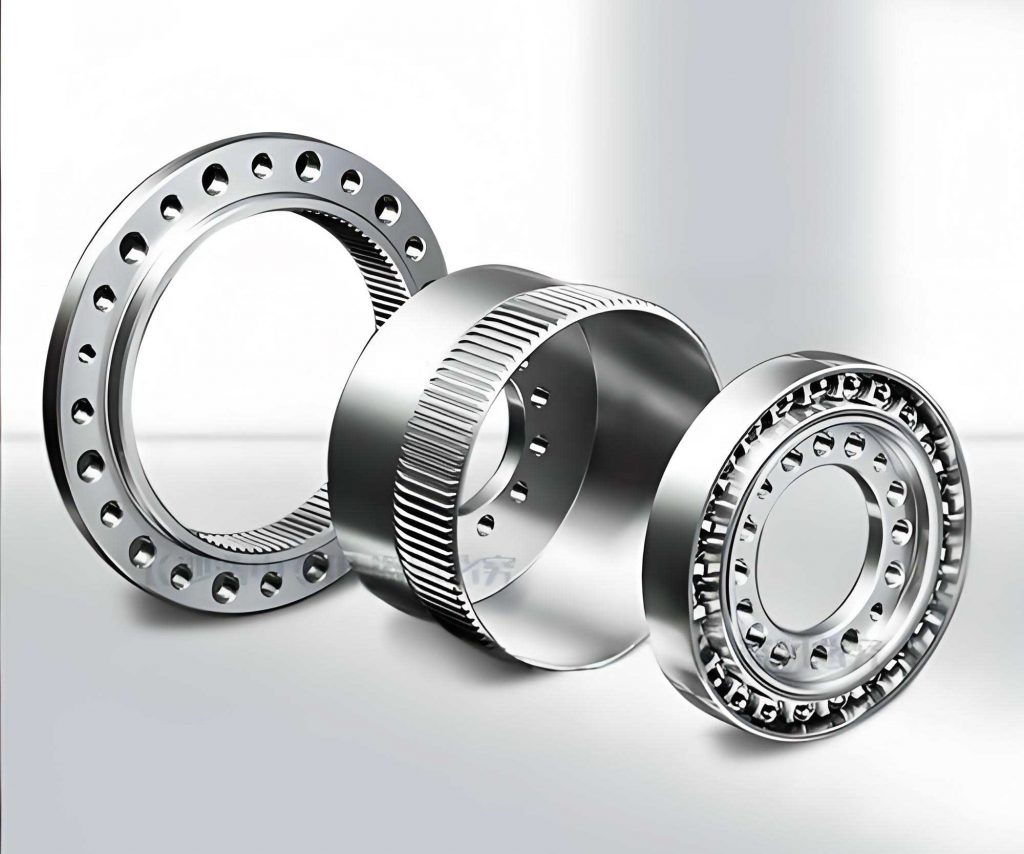
In the field of precision transmission systems, harmonic drive gears have garnered significant attention due to their compact design, high torque capacity, and exceptional accuracy. These gears, comprising a wave generator, a flexspline, and a circular spline, are pivotal in applications ranging from aerospace robotics to medical devices. However, a persistent challenge lies in the spatial deformation of the cup-shaped flexspline under the influence of the wave generator. This deformation induces taper-like distortions along the axis, leading to variations in the neutral curve across cross-sections perpendicular to the rotational axis. Such discrepancies can compromise meshing performance, resulting in reduced contact area and inefficient load distribution. To address this, I have developed a methodology for designing a spatial tooth profile for the circular spline, aiming to enhance the engagement characteristics of harmonic drive gears. This approach transforms the complex spatial meshing problem into a series of planar profile designs across multiple transverse sections, leveraging conjugate theory and advanced modeling techniques. Through this research, I seek to optimize the harmonic drive gear system for improved reliability and efficiency in high-precision applications.
The core principle of harmonic drive gear operation revolves around the elastic deformation of the flexspline, typically a thin-walled cup, by the wave generator. This controlled deformation enables motion transfer between the flexspline and the circular spline. Traditionally, tooth profile design often assumes a uniform deformation along the flexspline’s length, treating the meshing as a two-dimensional problem. However, in reality, especially for cup-type flexsplines, the deformation varies axially. The neutral surface—the geometric midline of the flexspline wall—adopts different contours in different cross-sections. This spatial variation means that a planar tooth profile for the circular spline may only achieve optimal conjugation at a specific section, leading to suboptimal meshing or even interference at other sections. Consequently, the overall performance of the harmonic drive gear, including its backlash, load capacity, and transmission error, can be negatively impacted. My work focuses on acknowledging this spatial deformation characteristic explicitly. By designing a circular spline with a tooth profile that varies along its face width—a spatial tooth profile—I aim to ensure conjugate contact with the deformed flexspline across multiple sections, thereby maximizing the meshing zone and improving the harmonic drive gear’s operational robustness.
To formulate the design of the spatial tooth profile, I begin by establishing the kinematic relationship between the components of the harmonic drive gear. Assuming the circular spline is fixed, I define coordinate systems for the flexspline’s output end and its deformed end. Let \( S(O; X, Y, Z) \) be the fixed coordinate system at the output end, and \( S(o_2; x_2, y_2, z_2) \) at the deformed end, with the \( y \)-axes aligned with the symmetry plane of a circular spline tooth space. Systems \( S_1(o_1; x_1, y_1, z_1) \) and \( S_w(o_w; x_w, y_w, z_w) \) are attached to the flexspline tooth and the wave generator, respectively. When the wave generator rotates with an angular speed \( \omega_H \), it induces a deformation in the flexspline. The key is to describe the neutral curve of the flexspline in any given cross-section. In a transverse section located at a specific axial position \( z \), the neutral curve can be expressed in polar coordinates as:
$$ \rho(\phi) = r_m + w(\phi, z) $$
Here, \( \rho(\phi) \) is the radial distance from the center, \( r_m \) is the radius of the undeformed neutral curve, and \( w(\phi, z) \) represents the radial displacement, which is a function of the angular position \( \phi \) and the axial coordinate \( z \). For a cup flexspline under a typical cam wave generator, the deformation often follows a “straight generatrix” assumption, meaning points along a generator line on the cup wall remain collinear after deformation. This implies that the radial displacement \( w \) can be approximated as varying linearly along the axis from the open end to the fixed end. Therefore, for a section at axial position \( z \), the maximum radial displacement \( w_0(z) \) can be expressed relative to a reference section (e.g., the mid-section). If the total length of the flexspline cup is \( L \) and the maximum displacement at the open end (section 1) is \( w_{0,1} \) and at the fixed end (section N) is \( w_{0,N} \), then for the \( k \)-th section:
$$ w_{0,k} = w_{0,1} + (w_{0,N} – w_{0,1}) \times \frac{k-1}{N-1} $$
The specific form of \( w(\phi) \) for a given section often follows a waveform, such as one generated by a four-roller wave generator. A common model is:
$$ w(\phi) = w_0 \cos(2\phi) $$
for a double-wave harmonic drive gear, where \( w_0 \) is the maximum radial displacement for that section. The angle \( \phi \) here is measured relative to the major axis of the wave generator. The orientation of the flexspline tooth relative to the local radius vector also changes due to deformation. The rotation angle \( \mu \) of the tooth’s symmetry line is given by:
$$ \mu(\phi) = -\arctan\left( \frac{\frac{dw}{d\phi}(\phi)}{r_m + w(\phi)} \right) $$
This geometric relationship is crucial for accurately positioning the flexspline tooth profile in the deformed state. To design the conjugate tooth profile for the circular spline in each cross-section, I employ the envelope theory for planar gearing. The process involves defining the flexspline tooth profile in its local coordinate system \( S_1 \), then transforming it to the fixed system \( S_2 \) via the motion induced by the wave generator and the deformation. For a harmonic drive gear using an involute profile for the flexspline, the tooth profile coordinates \( (x_1, y_1) \) in \( S_1 \) can be expressed parametrically. For the right-side flank of an external involute gear (flexspline), the equations are:
$$ x_1 = r_1 \left[ -\sin(u_1 – \theta_1) + u \cos\alpha_0 \cos(u_1 – \theta_1 + \alpha_0) \right] $$
$$ y_1 = r_1 \left[ \cos(u_1 – \theta_1) + u \cos\alpha_0 \sin(u_1 – \theta_1 + \alpha_0) \right] – r_m $$
In these equations, \( r_1 = m z_1 / 2 \) is the pitch radius of the flexspline, \( m \) is the module, \( z_1 \) is the number of teeth on the flexspline, \( \alpha_0 \) is the standard pressure angle, \( u_1 \) is a rolling parameter related to the involute generation, and \( \theta_1 \) is half the angle subtended by the tooth thickness on the pitch circle. The parameter \( u \) is effectively the roll angle for the involute. The term \( \theta_1 \) depends on the addendum modification coefficient (profile shift) \( x_1 \). For an external gear cut with a rack-type tool, the tooth thickness on the pitch circle is:
$$ e_1 = m \left( \frac{\pi}{2} + 2 x_1 \tan\alpha_0 \right) $$
and thus \( \theta_1 = e_1 / (2 r_1) \). The coordinate transformation from the flexspline tooth coordinates \( (x_1, y_1) \) to the fixed circular spline coordinates \( (x_2, y_2) \) in a given cross-section involves both the rotation due to wave generator motion and the displacement from the deformation. The transformation matrix is:
$$ \begin{bmatrix} x_2 \\ y_2 \\ 1 \end{bmatrix} = \begin{bmatrix} \cos\Phi & \sin\Phi & \rho \sin\varphi_f \\ -\sin\Phi & \cos\Phi & \rho \cos\varphi_f \\ 0 & 0 & 1 \end{bmatrix} \begin{bmatrix} x_1 \\ y_1 \\ 1 \end{bmatrix} $$
where \( \Phi = \mu + \varphi_f \). Here, \( \varphi_f \) is the angular position of the point on the neutral curve relative to the fixed axis, and \( \rho \) is the radial distance from Eq. (1). The relationship between \( \varphi_f \) and the wave generator rotation angle \( \varphi_w \) involves the transmission ratio and the condition of no elongation of the neutral curve. For a harmonic drive gear with a fixed circular spline and rotating wave generator, the flexspline rotates slowly. The relative motion parameter \( \phi \) (from the deformation function) and \( \varphi_1 \) (an integral parameter) are linked by:
$$ \phi = \int_{0}^{\varphi_1} \sqrt{1 + \left( \frac{w}{r_m} \right)^2 + \left( \frac{dw}{d\varphi} / r_m \right)^2 } \, d\varphi $$
In practice, for computational simplicity, I often use a direct mapping based on the wave generator’s position. The conjugate condition, which ensures continuous tangency between the flexspline and circular spline tooth profiles during motion, is given by the equation of meshing:
$$ \frac{\partial x_2}{\partial u} \cdot \frac{\partial y_2}{\partial \phi} – \frac{\partial x_2}{\partial \phi} \cdot \frac{\partial y_2}{\partial u} = 0 $$
For a given parameter \( u \) defining a point on the flexspline tooth profile, solving this equation yields the corresponding value of \( \phi \) (or the motion parameter). Substituting \( u \) and \( \phi \) back into the coordinate transformation gives a point \( (x_2, y_2) \) on the theoretical conjugate profile of the circular spline for that cross-section. By varying \( u \), I generate a set of discrete points representing this theoretical profile. However, for manufacturability, I aim to approximate this theoretical profile with a standard involute curve. This involves finding the best-fit involute parameters—specifically, the profile shift coefficient \( x_2 \)—for the circular spline in each section. I perform a unilateral fitting process, minimizing the deviation between the theoretical points and an involute curve. The basic parameters for the circular spline involute are: pitch radius \( r_2 = m z_2 / 2 \), where \( z_2 \) is the number of teeth on the circular spline (typically \( z_2 = z_1 + 2 \) for a double-wave harmonic drive gear), pressure angle \( \alpha_0 \), and module \( m \). The tooth thickness on the pitch circle for an internal gear (circular spline) machined with a pinion-type cutter is:
$$ e_2 = m \left( \frac{\pi}{2} – 2 x_2 \tan\alpha_0 \right) $$
The fitting algorithm adjusts \( x_2 \) until the involute closely matches the theoretical conjugate points, particularly in the active meshing region. This process is repeated independently for each cross-section along the axis, resulting in a set of profile shift coefficients \( x_2(z) \) that vary with axial position. Thus, the circular spline’s tooth profile becomes a spatial surface, defined by a series of involute profiles in different transverse planes.
To evaluate the meshing performance of the designed spatial tooth profile, I analyze the backlash between engaged tooth flanks. Backlash, the clearance between mating teeth when they are not under load, is a critical indicator of precision and potential for impact noise. For a given pair of meshing teeth at a specific angular position of the wave generator, the backlash is the minimum distance between points on the flexspline tooth surface and the circular spline tooth surface. Research indicates that this minimum distance typically occurs near the tooth tips. Therefore, I calculate the backlash \( j_t \) in each cross-section by considering points on the addendum circles. Let \( K_1 \) be a point on the flexspline tooth addendum and \( K_2 \) the corresponding closest point on the circular spline tooth addendum in the plane. The backlash is approximated by:
$$ j_t \approx \sqrt{ (x_{K2} – x_{K1})^2 + (y_{K1} – y_{K2})^2 } $$
where \( (x_{K1}, y_{K1}) \) and \( (x_{K2}, y_{K2}) \) are the coordinates of these points in the fixed coordinate system. By calculating \( j_t \) for various angular positions of the wave generator across different cross-sections, I obtain a comprehensive map of the backlash distribution. This map reveals the meshing zones—angular intervals where backlash is minimal or zero, indicating conjugate contact—and helps identify any regions of excessive clearance or interference. A well-designed spatial tooth profile for the harmonic drive gear should exhibit a wide and uniform meshing zone with controlled backlash across the face width.
Having determined the tooth profile parameters for multiple cross-sections, the next step is to construct three-dimensional solid models of the flexspline and circular spline for simulation and verification. I use a lofting (or blending) algorithm to generate the spatial surfaces from the planar profile sketches. For the deformed flexspline, I create sketch profiles in several transverse sections (e.g., 9 sections evenly spaced along the axis). Each sketch represents the flexspline tooth ring in that section after deformation, with teeth positioned according to the calculated orientation angle \( \mu \) and the stretched neutral curve. These sketches are then used as cross-sectional profiles in a loft feature to create the solid model of the deformed flexspline cup. Similarly, for the circular spline, I create sketches in the same transverse sections, each containing the involute tooth profile with the specific profile shift coefficient \( x_2 \) for that section. Using these sketches as profiles, I perform a loft cut operation on a cylindrical blank to generate the internal spatial tooth surface of the circular spline. This method, using multiple sections, yields a high-fidelity model that accurately represents the spatial conjugation. However, to reduce computational and design effort, I also explore a simplified lofting approach using only two cross-sectional profiles (e.g., the front and rear sections) connected by straight guide lines. This method relies on the assumption that the tooth flank surface is essentially a ruled surface with straight generatrices, consistent with the deformation hypothesis. The guide lines are straight lines connecting corresponding points on the tooth profiles in the two end sections. The resulting spatial surface is a linear interpolation between the end profiles. I then assemble the flexspline and circular spline models with the wave generator in a CAD environment to create a full harmonic drive gear assembly. This assembly model allows for interference checking and direct measurement of clearances in any cross-section, providing a practical validation of the design.
To demonstrate the application of this spatial tooth profile design methodology, I present a detailed computational example. Consider a double-wave harmonic drive gear with the following basic parameters: flexspline tooth number \( z_1 = 200 \), circular spline tooth number \( z_2 = 202 \), module \( m = 0.5 \, \text{mm} \), standard pressure angle \( \alpha_0 = 20^\circ \), radius of undeformed flexspline neutral curve \( r_m = 50.375 \, \text{mm} \). The flexspline uses a standard involute profile with addendum modification coefficient \( x_1 = 3 \), addendum coefficient \( h_a^* = 1.0 \), and dedendum coefficient \( c^* = 0.35 \). The wave generator is a four-roller type with an installation angle \( \beta = 30^\circ \). I analyze two cases with different flexspline cup lengths: \( L = 80 \, \text{mm} \) and \( L = 50 \, \text{mm} \). For each case, I divide the tooth face width into 9 equally spaced transverse sections (section 1 at the open end, section 5 at the mid-length, section 9 at the fixed end). Assuming a linear variation in maximum radial displacement along the axis, I set the displacement at the mid-section (section 5) to \( w_0 = 1.0 \, \text{mm} \). For the \( L = 80 \, \text{mm} \) cup, the displacements at the ends are calculated accordingly. The neutral curve in each section is modeled as \( \rho(\phi) = r_m + w_0 \cos(2\phi) \), with \( w_0 \) scaled for the section. Using the conjugate design process described, I compute the theoretical tooth profiles and then fit involute curves to determine the profile shift coefficient \( x_2 \) for the circular spline in each section. The results are summarized in the following tables for both cup lengths.
| Parameter | Flexspline (constant) | Circular Spline – Section 1 | Circular Spline – Section 5 | Circular Spline – Section 9 |
|---|---|---|---|---|
| Profile shift coefficient \( x \) | 3.0000 | 2.7170 | 2.6676 | 2.6254 |
| Half tooth thickness angle \( \theta \) (°) | 1.0756 | 1.0786 | 1.0659 | 1.0551 |
| Pitch radius (mm) | 50.000 | 50.500 | 50.500 | 50.500 |
| Addendum radius \( r_a \) (mm) | 51.8740 | 51.7325 | 51.7076 | 51.6863 |
| Dedendum radius \( r_f \) (mm) | 50.8250 | 52.5335 | 52.5088 | 52.4877 |
| Pitch circle tooth space width (mm) | 1.8773 | 1.9013 | 1.8790 | 1.8600 |
Table 1: Key geometric parameters for the harmonic drive gear with cup length \( L = 80 \, \text{mm} \). The circular spline parameters vary across sections.
| Parameter | Flexspline (constant) | Circular Spline – Section 1 | Circular Spline – Section 5 | Circular Spline – Section 9 |
|---|---|---|---|---|
| Profile shift coefficient \( x \) | 3.0000 | 2.7511 | 2.6676 | 2.6300 |
| Half tooth thickness angle \( \theta \) (°) | 1.0756 | 1.0873 | 1.0659 | 1.0563 |
| Pitch radius (mm) | 50.000 | 50.500 | 50.500 | 50.500 |
| Addendum radius \( r_a \) (mm) | 51.8740 | 51.7497 | 51.7076 | 51.6689 |
| Dedendum radius \( r_f \) (mm) | 50.8250 | 52.5505 | 52.5088 | 52.4900 |
| Pitch circle tooth space width (mm) | 1.8773 | 1.9167 | 1.8790 | 1.8620 |
Table 2: Key geometric parameters for the harmonic drive gear with cup length \( L = 50 \, \text{mm} \). The variation in parameters is more pronounced due to the shorter cup.
From these tables, it is evident that the required profile shift for the circular spline decreases from the open end to the fixed end. This trend compensates for the decreasing radial displacement of the flexspline along the axis. The tooth space width on the pitch circle is larger at the open end than at the fixed end, and the addendum radius is slightly smaller at the open end. These variations collectively define the spatial tooth profile of the circular spline. To highlight the advantage of the spatial design, I compare it with a traditional planar tooth profile design. In a planar approach, a single profile shift coefficient \( x_2 \) is chosen for the entire circular spline, typically based on the mid-section condition. For this example, if I set \( x_2 = 2.67 \) (close to the mid-section value), I can analyze the meshing intervals. For the spatial design, the conjugate meshing intervals (angular ranges where backlash is near zero) in sections 1, 5, and 9 are approximately \([-1.4589^\circ, 3.4776^\circ]\), \([0.9143^\circ, 5.8981^\circ]\), and \([3.9252^\circ, 8.9848^\circ]\), respectively. In contrast, the planar profile only achieves a meshing interval of \([0.9143^\circ, 5.8981^\circ]\), which is the interval for the mid-section. This demonstrates that the spatial tooth profile effectively extends the overall meshing zone by engaging teeth at different sections at different wave generator angles, thereby increasing the number of tooth pairs in contact simultaneously and distributing the load more evenly. The backlash distribution across the angular position further supports this. For the planar profile, backlash values outside the mid-section interval are significantly larger, indicating poor contact. For the spatial profile, each section maintains low backlash within its specific interval, ensuring continuous conjugation along the face width as the wave generator rotates.
I proceed to construct 3D assembly models for both harmonic drive gear cases. Using the nine cross-sectional sketches, I loft the deformed flexspline and the circular spline with spatial tooth profiles. I also create a simplified model using only the two end-section profiles with straight guide lines for lofting. After assembly with a wave generator model, I perform interference checks. No global interference is detected, confirming the validity of the conjugate design. To quantitatively compare the two modeling approaches (multi-section loft vs. two-section loft with straight guides), I measure the backlash in several intermediate sections (e.g., sections 3, 5, and 7) for both models. The measurements are taken at various engagement positions. The results show that the differences in backlash values between the two models are minimal. For the \( L = 80 \, \text{mm} \) gear, the maximum deviation in backlash is about 2.74 μm in section 5, with smaller deviations in other sections. This indicates that the simplified two-section lofting method with straight guide lines produces a spatial tooth profile that is very close to the more accurate multi-section profile. Given that typical manufacturing tolerances for harmonic drive gears are on the order of micrometers, this simplified approach is often sufficient for general-precision applications. It significantly reduces the design complexity while still capturing the essential spatial conjugation benefits. The harmonic drive gear assembly model clearly visualizes the meshing condition: at the major axis region, teeth are fully engaged across the face width, while at the minor axis, teeth are completely disengaged, as expected.
The implications of this spatial design are profound for the performance of harmonic drive gears. By accommodating the axial variation in flexspline deformation, the spatial tooth profile minimizes the risk of edge loading and stress concentration at the ends of the teeth. It also enhances the kinematic accuracy by ensuring that more teeth share the load throughout the rotation, reducing transmission error. For shorter cup flexsplines, the taper deformation is more acute, making the spatial design even more critical. In the \( L = 50 \, \text{mm} \) case, the variation in profile shift coefficient \( x_2 \) from end to end is greater than in the \( L = 80 \, \text{mm} \) case, as seen in the tables. This underscores that shorter harmonic drive gears demand more pronounced spatial tooth profiles to achieve optimal meshing. The methodology I have presented is not limited to involute profiles; it can be adapted to other tooth forms, such as double-circular-arc profiles, which are also common in harmonic drive gears. The key is to apply the conjugate condition in each transverse section and then integrate the profiles spatially. Future work could involve coupling this design approach with finite element analysis to predict stress distributions and fatigue life, or with dynamic simulations to study vibration characteristics. Additionally, the impact of different wave generator types (e.g., elliptical cam, disk cam) on the spatial deformation pattern could be incorporated to further refine the profile design.
In conclusion, the design of a spatial tooth profile for the circular spline in a harmonic drive gear system addresses a fundamental limitation imposed by the axial variation in flexspline deformation. By discretizing the problem into multiple transverse sections and applying planar conjugate theory in each, I derive a set of varying tooth profiles that, when integrated via lofting, form a spatially conjugated surface. This approach significantly expands the angular range of conjugate meshing compared to a conventional planar tooth profile, thereby increasing the number of simultaneously engaged tooth pairs and the effective contact area. The backlash analysis confirms improved meshing characteristics across the face width. Furthermore, the investigation into lofting methods reveals that a simplified two-section approach with straight guide lines yields results very close to those from a multi-section model, offering a practical balance between accuracy and design effort for general precision harmonic drive gears. This spatial tooth profile design methodology represents a step forward in optimizing the performance and reliability of harmonic drive gear transmissions, ensuring they meet the stringent demands of modern high-precision applications. The harmonic drive gear, with its unique combination of compactness and high reduction ratios, benefits immensely from such refined design techniques, paving the way for more efficient and durable power transmission solutions in advanced robotics and aerospace systems.