
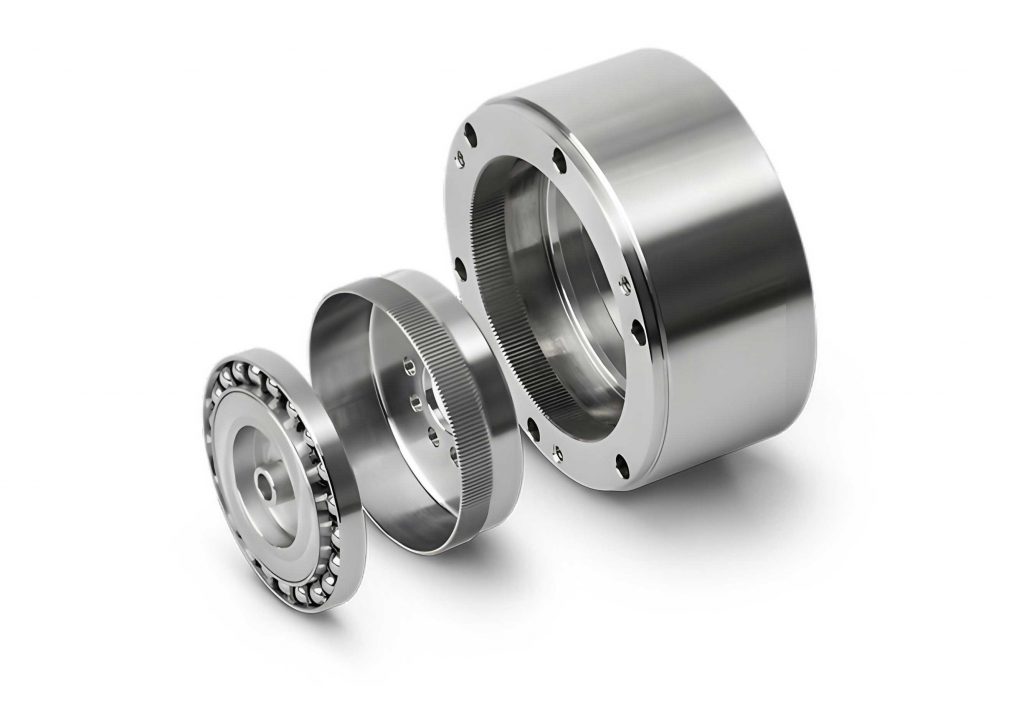
The pursuit of extreme precision in motion control has consistently driven the evolution of transmission technologies. Among them, the harmonic drive gear stands out as a revolutionary solution, achieving remarkable feats in compactness, reduction ratio, and positional accuracy. Its operation is an elegant exploitation of controlled elastic deformation, a principle that sets it apart from conventional rigid-body gearing systems. The core of this technology lies in the flexspline—a thin-walled, flexible cup with external teeth. A wave generator, typically an elliptical cam or a set of bearing-mounted disks, is inserted into this flexspline, forcing it into a controlled non-circular shape. This deformed flexspline then meshes with the internal teeth of a rigid circular spline, creating a high-ratio, near-zero-backlash drive. The accurate prediction and mathematical description of the deformed shape of the flexspline’s neutral curve—the middle surface of its tooth-bearing ring—is not merely an academic exercise; it is the fundamental cornerstone for precise tooth profile design, load distribution analysis, and ultimately, the optimization of the harmonic drive gear’s performance, longevity, and torsional stiffness.
Traditionally, the deformation of the neutral curve in a harmonic drive gear has been approached through the lens of small-deformation ring theory. This method decomposes the total displacement of any point on the initially circular ring into three components: a radial displacement \( u(\phi) \), a circumferential displacement \( v(\phi) \), and a rotation of the normal \( \theta(\phi) \). These components are derived from the equilibrium equations of a curved beam under specific boundary conditions imposed by the wave generator. The final deformed shape is then expressed as a superposition of these displacements onto the initial circular geometry. While this approach offers valuable insights and a tractable analytical framework, its foundational assumption of “small” deformations becomes increasingly tenuous in the context of harmonic drives. The radial deflection of the flexspline is often on the same order of magnitude as its wall thickness, squarely placing the problem in the realm of geometric nonlinearity or large deformation. Consequently, the superposition of independently calculated displacement components can lead to accumulated errors, particularly in the positioning of the neutral curve’s points. These errors directly translate into inaccuracies when locating gear teeth on the deformed flexspline, which can degrade the quality of meshing, increase wear, and introduce unexpected transmission errors in the harmonic drive gear assembly.
This paper presents a paradigm shift from the classical displacement-superposition method. Instead of building the deformed shape from displacement components derived under simplifying assumptions, we propose a method that focuses on the geometric outcome of the deformation process. The central idea is to fit the final, deformed neutral curve using a mathematical function that inherently satisfies the known physical and geometric constraints of the problem. We treat the contact zone between the wave generator and the flexspline as a geometric given—the curve is an offset (isometric line) of the cam profile. For the non-contact zone, we construct a smooth interpolating curve, a quintic polynomial in polar coordinates, whose coefficients are determined by enforcing boundary conditions of continuity, slope, and curvature at the junctions, and crucially, by satisfying the condition that the total arc length of the deformed neutral curve equals the initial arc length plus the stretch induced by the large circumferential membrane forces present in the thin shell. This method, by construction, respects the large-deformation nature of the contact and bypasses the linearizing assumptions of classical theory, aiming to provide a more accurate foundation for subsequent conjugate tooth profile design in harmonic drive gears.
Mechanical Model and Geometric Constraints of Flexspline Deformation
Consider a standard double-disk cam wave generator, which approximates an elliptical shape with two circular arcs of radius \( R \) centered at points offset from the geometric center. Before assembly, the neutral curve of the flexspline’s cylindrical cup is a perfect circle with radius \( r_m \). Upon insertion of the wave generator, the flexspline deforms. In one quadrant, the deformation can be characterized as follows: a portion of the neutral curve wraps around and conforms perfectly to the cam’s profile, forming a contact zone with a wrap angle \( \gamma \). The remaining segment, from the end of contact to the major axis, forms a smooth, free non-contact curve. Due to symmetry, analysis of one quadrant is sufficient. Let \( O_1 \) be the rotational center of the assembly (the cam’s geometric center), and let the major axis lie along the vertical direction. The maximum radial displacement of the flexspline at the major axis is denoted by \( u_0 \).
The geometry dictates the following relations. The eccentricity \( e \) of the cam’s circular arc relative to \( O_1 \) is given by the clearance needed to produce the deflection:
$$ e = r_m + u_0 – R. $$
A point at the boundary of the contact zone, \( B’ \), has coordinates defined by the wrap angle \( \gamma \). The angle subtended by the contact arc on the cam itself is \( \gamma_1 \), which is slightly larger than \( \gamma \) due to the eccentricity:
$$ \gamma_1 = \gamma + \arcsin\left(\frac{e \sin \gamma}{R}\right). $$
Consequently, the coordinates of point \( B’ \) in the global \( O_1-xy \) system are:
$$ x_{B’} = R \sin \gamma_1, \quad y_{B’} = e + R \cos \gamma_1. $$
The corresponding arc length on the undeformed neutral circle is \( \gamma_0 = \gamma_1 R / r_m \).
Geometric Interpolation Method for the Neutral Curve
The proposed method splits the problem logically into two domains: the prescribed contact zone and the unknown free (non-contact) zone.
1. Curve Description in the Contact Zone
In the contact zone (\( 0 \le \phi \le \gamma \), where \( \phi \) is measured from the major axis), the neutral curve is forced to follow the shape of the cam. In the global coordinate system, this is simply a circular arc:
$$ x^2 + (y – e)^2 = R^2, \quad \text{for } x \in [0, x_{B’}]. $$
The endpoint \( x_{B’} \) and thus the entire contact curve definition depend on the unknown wrap angle \( \gamma \).
2. Curve Description in the Non-Contact Zone via Interpolation
For the non-contact zone (\( \gamma \le \phi \le \pi/2 \)), we seek a smooth function. It is convenient to define a local polar coordinate system \( (\rho, \theta) \) with origin at \( O_1 \) and the polar axis \( \theta=0 \) along the line \( O_1B’ \). In this system, \( \theta = 0 \) at point \( B’ \) and \( \theta = \eta = \pi/2 – \gamma \) at point \( A’ \) on the major axis. We postulate the deformed neutral curve in this region can be represented by a polynomial in \( \theta \):
$$ \rho(\theta) = \sum_{i=0}^{4} C_i \theta^i, \quad \theta \in [0, \eta]. $$
A quintic polynomial (5 coefficients plus the unknown \( \gamma \)) is chosen because it allows us to satisfy five independent geometric constraints plus an arc length condition. The necessary constraints are:
| Constraint | Mathematical Condition | Purpose |
|---|---|---|
| C1: Position at B’ | \( \rho(0) = \sqrt{x_{B’}^2 + y_{B’}^2} = \frac{R \sin \gamma_1}{\sin \gamma} = C_0 \) | Ensures continuity of the curve itself. |
| C2: Slope at B’ | The slope \( k_2 = \frac{dy_1/d\theta}{dx_1/d\theta} |_{\theta=0} \) must equal the known slope of the cam arc at \( B’ \), \( k_1 = -\tan(\gamma_1 – \gamma) \). This yields: \( C_1 = -C_0 \tan(\gamma_1 – \gamma) \). | Ensures a smooth, tangent connection (G1 continuity). |
| C3: Curvature at B’ | The curvature radius \( R_2 \) from \( \rho(\theta) \) at \( \theta=0 \) must equal the cam radius \( R \). The general formula for curvature radius in polar coordinates is: $$ R_{curve} = \frac{(\rho^2 + \rho’^2)^{3/2}}{\rho^2 + 2\rho’^2 – \rho \rho”}. $$ Applying this at \( \theta=0 \) gives an equation solving to: $$ C_2 = \frac{R(C_0^2 + 2C_1^2) – (C_0^2 + C_1^2)^{3/2}}{2 R C_0}. $$ |
Ensures curvature continuity (G2 continuity), a critical factor for stress and moment transfer. |
| C4: Slope at A’ | At the major axis (\( \theta=\eta \)), the tangent must be vertical (in the global system), corresponding to a known slope \( k_{A’} = -1/\tan \gamma \) in the local system. This provides a relation: $$ C_3 = -\frac{C_1 + 2C_2 \eta + 4 C_4 \eta^3}{3\eta^2}. $$ |
Enforces the symmetry condition at the major axis. |
| C5: Curvature at A’ | The curvature at \( A’ \) is less straightforward. We use the curvature value from the classical small-deformation theory as a reasonable approximation for this boundary condition. The classical theory provides radial displacement \( u(\phi) \), from which the polar radius \( \rho_1(\phi) = r_m + u(\phi) \) and its derivatives can be computed. The curvature radius at \( \phi = \pi/2 \) is then: $$ R_{A’} = \frac{\rho_1^2(\pi/2)}{\rho_1(\pi/2) – \rho_1”(\pi/2)}. $$ We enforce that the curvature radius from our polynomial \( \rho(\theta) \) at \( \theta=\eta \) equals \( R_{A’} \). This generates a nonlinear equation: \( \mathcal{F}_1(C_4, \gamma) = 0 \). |
Provides a physically plausible boundary condition at the free end, linking the new method to established mechanical response. |
The above five constraints (C1-C5) allow us to express coefficients \( C_0, C_1, C_2, C_3 \) explicitly in terms of \( \gamma \), and \( C_4 \) implicitly via the nonlinear equation from C5.
3. The Arc Length Condition and Final System
The final, critical constraint is the arc length condition. The total length of the deformed neutral curve in one quadrant must equal the original length plus the stretch caused by the large circumferential (membrane) force \( N_1 \). The stretch \( \Delta S \) for a quadrant, derived from mechanical analysis, is:
$$ \Delta S = \frac{s_1^2 u_0}{6 r_m^2} \cdot \frac{1 – \frac{r_m}{u_0}(1 – \frac{r_m}{R})}{\eta – \sin\gamma \cos\gamma} (\gamma \sin\gamma + \cos\gamma), $$
where \( s_1 \) is the wall thickness of the flexspline cup. Therefore, the total deformed arc length is:
$$ S_{def} = \underbrace{\gamma_1 R}_{\text{Contact zone}} + \underbrace{\int_{0}^{\eta} \sqrt{\rho^2 + \left(\frac{d\rho}{d\theta}\right)^2} d\theta}_{\text{Non-contact zone}} = \frac{\pi}{2} r_m + \Delta S. $$
This provides a second nonlinear equation in terms of \( \gamma \) and \( C_4 \): \( \mathcal{F}_2(C_4, \gamma) = 0 \).
The system of two nonlinear equations \( \mathcal{F}_1(C_4, \gamma)=0 \) and \( \mathcal{F}_2(C_4, \gamma)=0 \) is solved simultaneously for the two unknowns: the true wrap angle \( \gamma \) and the polynomial coefficient \( C_4 \). An iterative numerical method (e.g., Newton-Raphson) is employed. The classical theory’s estimate for \( \gamma \) provides an excellent initial guess for rapid convergence. Once solved, the complete neutral curve for the harmonic drive gear flexspline is defined piecewise: a circular arc in the contact region and a quintic polynomial \( \rho(\theta) \) with now-known coefficients in the non-contact region.
Model Solution and Comparative Verification
To validate the proposed geometric interpolation method, a series of models with varying wrap angles were analyzed. The base parameters were held constant: neutral curve radius \( r_m = 61.7 \) mm, radial deflection \( u_0 = 0.7 \) mm, wall thickness \( s_1 = 1.4 \) mm. The cam radius \( R \) was adjusted to generate different theoretical wrap angles \( \gamma_s \) from 2° to 75° according to classical theory. For each case, the new geometric method was solved to find the interpolated wrap angle \( \gamma \) and polynomial coefficients. A representative subset of results is shown in the table below.
| Case (Theoretical γₛ) | Calculated γ (°) | Polynomial Coefficients (C₀ to C₄) |
|---|---|---|
| 2° | 5.19 | 62.3852, -0.3267, -1.7979, 1.2381, -0.1919 |
| 10° | 12.27 | 62.3287, -0.6631, -1.5215, 1.2589, -0.2163 |
| 30° | 30.95 | 62.0507, -1.2583, -1.0367, 1.5694, -0.3667 |
| 50° | 51.08 | 61.6054, -1.6525, -0.6455, 2.7599, -1.0297 |
| 65° | 66.20 | 61.2001, -1.8233, -0.3753, 6.3983, -4.1059 |
The most rigorous verification requires comparison against a trusted benchmark. Since the physical problem involves both large deformations and nonlinear contact, a Finite Element Analysis (FEA) model incorporating these nonlinearities is considered the most accurate representation of reality. A 2D plane-stress model of the flexspline ring in contact with a rigid double-disk cam was constructed. Crucially, the analysis was run in two configurations: one with the “small deformation” assumption switched ON (linear geometry), and one with it switched OFF (large deformation, nonlinear geometry). The results from the nonlinear FEA are taken as the reference “true” solution.
We compare four different predictions for the deformed neutral curve of the harmonic drive gear:
1. Classical Theory (Displacement-Superposition),
2. FEA (Small Deformation),
3. Proposed Geometric Interpolation,
4. FEA (Large Deformation) – Reference.
The key comparison metrics are the wrap angle \( \gamma \) and the length of the semi-minor axis. The discrepancies of the first three methods relative to the nonlinear FEA reference are plotted conceptually below.
| Method | Basis | Wrap Angle Error Trend | Minor Axis Error Trend |
|---|---|---|---|
| Classical Theory | Small-strain ring theory, linear superposition. | Error increases significantly with larger wrap angles (>25°). Stable small error for very small angles. | Error grows progressively with wrap angle. Overestimates minor axis length. |
| FEA (Small Def.) | Numerical solution, but with linearized geometry. | Error is smaller than Classical Theory but still increases with wrap angle. | Error follows a similar growing trend as Classical Theory. |
| Proposed Method | Geometric interpolation with arc-length and continuity constraints. | Excellent agreement with reference for wrap angles between ~25° and 65°. Larger error for very small angles (<25°). | Very close to reference for angles 25°-65°. Deviation increases outside this range. |
The most common and mechanically optimal operating range for harmonic drive gears lies within wrap angles of approximately 30° to 50°. In this critical range, the proposed geometric interpolation method shows nearly perfect alignment with the nonlinear FEA results, while both the classical theory and linear FEA exhibit notable and growing deviations. For instance, in a model targeting a 30° wrap, the new method reduced the polar angle positioning error of teeth by approximately 0.006° and the radial positioning error by about 0.013 mm compared to the classical displacement-superposition approach. This level of accuracy in defining the neutral curve is paramount for generating precise conjugate tooth profiles, which directly impacts the transmission error, load sharing, and service life of the harmonic drive gear.
Discussion and Implications for Harmonic Drive Gear Design
The divergence between the linear (small-deformation) and nonlinear (large-deformation) FEA results underscores a fundamental point: the deformation of the flexspline in a harmonic drive gear is inherently a geometrically nonlinear problem. The classical analytical method, despite its elegance and utility for initial design, inherits the limitations of its kinematic assumptions. The proposed geometric interpolation method successfully circumvents these limitations by focusing on the final deformed geometry rather than the path of deformation.
This approach offers several distinct advantages for the design and analysis of harmonic drive gears:
1. Intrinsic Satisfaction of Global Conditions: The method enforces the correct final arc length, which includes the significant membrane stretch, a factor often inaccurately represented in linear theory.
2. Accurate Boundary Conditions: By directly using the cam profile in the contact zone and enforcing high-order continuity (G2) at the junction, it captures the strong geometric constraint imposed by the wave generator more faithfully than displacement superposition.
3. Computational Efficiency vs. Accuracy: While nonlinear FEA is the most accurate, it is computationally intensive, especially for parametric design studies. The proposed method provides an analytical-like, closed-form description of the neutral curve with accuracy rivaling nonlinear FEA in the practical design range, at a fraction of the computational cost.
4. Foundation for Precise Gearing: The accurate mathematical description of the neutral curve is the essential first step in any conjugate tooth generation algorithm (e.g., envelope method). Reduced error in this foundational step propagates into superior tooth profiles, leading to better meshing conditions, lower wear, higher torque capacity, and smoother motion in the final harmonic drive gear assembly.
It is important to note the limitation of the current interpolation method: its reliance on a curvature condition from classical theory at the major axis (Point A’). For wrap angles outside the 25°-65° range, this approximation contributes to increasing error. Future work could explore deriving a more physically consistent boundary condition for this point, perhaps from a simplified large-deformation membrane-bending model, to extend the robustness of the method across all possible design configurations of the harmonic drive gear.
In conclusion, moving beyond the small-deformation displacement paradigm is crucial for advancing the precision design of high-performance harmonic drive gears. The geometric feature interpolation method presented here offers a compelling alternative, effectively decoupling the problem from linear kinematic assumptions and nonlinear contact complexities. By directly constructing the deformed neutral curve based on its known geometric attributes and global equilibrium conditions, this method delivers a highly accurate and computationally efficient tool. It thereby establishes a more reliable foundation for the subsequent stages of tooth profile synthesis and performance simulation, ultimately contributing to the development of harmonic drive gear systems with unprecedented levels of precision, efficiency, and durability for the most demanding robotic and aerospace applications.