
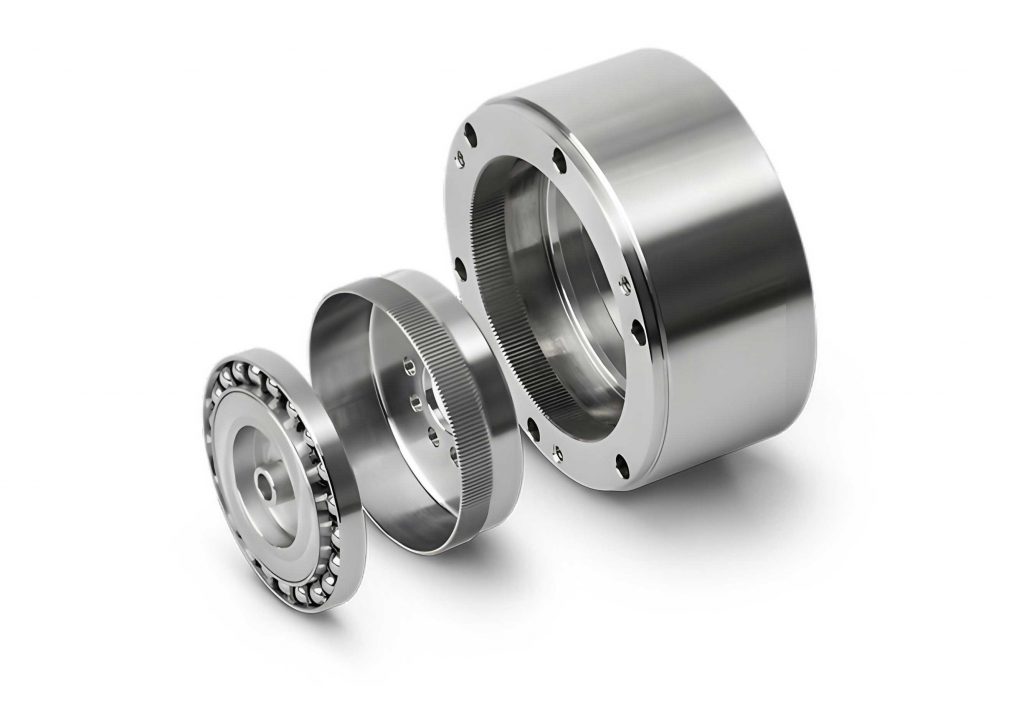
In the field of precision mechanical transmission, the harmonic drive gear system stands out due to its unique operational principle, which relies on elastic deformation of flexible components to achieve motion transfer. Unlike conventional gear systems, the harmonic drive gear consists of three main parts: the wave generator, the flexspline, and the circular spline. This configuration enables high reduction ratios, compact design, and minimal backlash, making it indispensable in advanced applications such as aerospace, robotics, and high-precision machinery. However, despite these advantages, performance limitations arise from gear backlash and stress concentrations, particularly at the flexspline dedendum. In this study, we focus on optimizing the tooth profile structure of a double-circular-arc harmonic drive gear to reduce gear backlash and enhance dynamic characteristics. Through a combination of mathematical modeling and three-dimensional finite element dynamic simulation, we analyze the stress-strain behavior and operational stability of the flexspline, providing insights into improved design methodologies for harmonic drive gears.
The core of our approach lies in the optimization of the tooth profile geometry. We begin by establishing a detailed mathematical model for the double-circular-arc tooth profile of the flexspline. In this model, the tooth profile is composed of convex and concave circular arcs connected by a common tangent line. We define a moving coordinate system $S_1(O_1, X_1, Y_1)$ attached to the flexspline, where the $X_1$-axis aligns with the tangent to the flexspline midline, and the $Y_1$-axis coincides with the tooth symmetry axis. The origin $O_1$ is at the intersection of these axes. The right-side convex arc $\overset{\frown}{AB}$, the common tangent line $BC$, and the right-side concave arc $\overset{\frown}{CD}$ are parameterized using arc length $s$. Let $\rho_a$ and $\rho_f$ be the radii of the convex and concave arcs, respectively, with corresponding central angles $\alpha_a$ and $\alpha_f$. The offset and shift distances for the arc centers are denoted as $l_a$, $e_a$ for the convex arc and $l_f$, $e_f$ for the concave arc. The tooth profile equations are derived as follows.
For the convex arc segment $\overset{\frown}{AB}$:
$$ \mathbf{r}_{AB} = \left[ \rho_a \cos\left(\alpha_a – \frac{s}{\rho_a}\right) + x_M, \rho_a \sin\left(\alpha_a – \frac{s}{\rho_a}\right) + y_M, 1 \right]^T, $$
$$ \mathbf{n}_{AB} = \left[ \cos\left(\alpha_a – \frac{s}{\rho_a}\right), \sin\left(\alpha_a – \frac{s}{\rho_a}\right), 1 \right]^T, $$
where $s \in (0, l_1)$, $l_1 = \rho_a (\alpha_a – \delta)$, $\delta$ is the process angle, and $(x_M, y_M)$ are coordinates of the convex arc center in $S_1$.
For the common tangent line segment $BC$:
$$ \mathbf{r}_{BC} = \left[ \rho_a \cos \delta + x_M + (s – l_1) \sin \delta, \rho_a \sin \delta + y_M – (s – l_1) \cos \delta, 1 \right]^T, $$
$$ \mathbf{n}_{BC} = \left[ -\cos \delta, -\sin \delta, 1 \right]^T, $$
where $s \in (l_1, l_2)$, $l_2 = l_1 + \frac{h_1}{\cos \delta}$, and $h_1$ is the radial height of the line segment.
For the concave arc segment $\overset{\frown}{CD}$:
$$ \mathbf{r}_{CD} = \left[ x_N – \rho_f \cos\left(\delta + \frac{s – l_2}{\rho_f}\right), y_N – \rho_f \sin\left(\delta + \frac{s – l_2}{\rho_f}\right), 1 \right]^T, $$
$$ \mathbf{n}_{CD} = \left[ -\cos\left(\delta + \frac{s – l_2}{\rho_f}\right), -\sin\left(\delta + \frac{s – l_2}{\rho_f}\right), 1 \right]^T, $$
where $s \in (l_2, l_3)$, $l_3 = l_2 + \rho_f \alpha_f$, and $(x_N, y_N)$ are coordinates of the concave arc center in $S_1$.
To ensure proper meshing between the flexspline and circular spline in the harmonic drive gear, we derive the conjugate tooth profile for the circular spline based on kinematic conditions. The meshing equation is expressed as:
$$ \mathbf{n}_i^T \mathbf{B} \mathbf{r}_i = 0 \quad (i = AB, BC, CD), $$
where $\mathbf{n}_i$ is the unit normal vector at the contact point on the flexspline tooth profile, $\mathbf{r}_i$ is the position vector in $S_1$, and $\mathbf{B}$ is a transformation matrix that accounts for relative motion. The matrix $\mathbf{B}$ is defined as:
$$ \mathbf{B} = \begin{bmatrix} 0 & -\dot{\beta} & \dot{r} \gamma \cos \mu – r \dot{\mu} \sin \mu \\ \dot{\beta} & 0 & \dot{r} \gamma \sin \mu + r \dot{\mu} \cos \mu \\ 0 & 0 & 0 \end{bmatrix}, $$
where $\beta$ is the angle between the $Y_1$-axis and the symmetry line of the circular spline tooth space, $\mu$ is the angle between the deformed flexspline radius and the $Y_1$-axis, $\gamma$ is the angle between the deformed flexspline radius and the circular spline tooth symmetry line, $r$ is the radial distance, and dots denote time derivatives. The coordinate transformation from the flexspline system $S_1$ to the fixed system is given by:
$$ \mathbf{M} = \begin{bmatrix} \cos \beta & \sin \beta & r \sin \gamma \\ -\sin \beta & \cos \beta & r \cos \gamma \\ 0 & 0 & 1 \end{bmatrix}. $$
Thus, the theoretical tooth profile of the circular spline is obtained as:
$$ \mathbf{r}’_i = \mathbf{M} \cdot \mathbf{r}_i \quad (i = AB, BC, CD). $$
Optimization of the harmonic drive gear tooth profile aims to minimize gear backlash while maximizing the effective meshing tooth height. We formulate an objective function that considers design variables such as arc radii, shift distances, and process angles, subject to constraints like tooth strength and manufacturability. Through iterative numerical methods, we determine optimal parameters that reduce backlash and improve load distribution. The key parameters for the flexspline tooth profile are summarized in Table 1.
| Parameter | Symbol | Description |
|---|---|---|
| Number of Teeth | $z_1$ | Number of flexspline teeth |
| Module | $m$ | Standard module for gear design |
| Pitch Radius | $r$ | Radius at pitch circle |
| Midline Circle Radius | $R_m$ | Radius of flexspline midline |
| Tooth Thickness | $s_a$ | Thickness at pitch circle |
| Tooth Space Width | $s_f$ | Width of tooth space |
| Addendum Height | $h_a$ | Height from pitch to tip |
| Dedendum Height | $h_f$ | Height from pitch to root |
| Convex Arc Radius | $\rho_a$ | Radius of convex tooth arc |
| Concave Arc Radius | $\rho_f$ | Radius of concave tooth arc |
| Convex Arc Central Angle | $\alpha_a$ | Central angle of convex arc |
| Concave Arc Central Angle | $\alpha_f$ | Central angle of concave arc |
| Process Angle | $\delta$ | Angle for manufacturing tolerance |
| Convex Arc Center Offset | $l_a$ | Offset of convex arc center |
| Convex Arc Center Shift | $e_a$ | Shift of convex arc center |
| Concave Arc Center Offset | $l_f$ | Offset of concave arc center |
| Concave Arc Center Shift | $e_f$ | Shift of concave arc center |
| Flexspline Wall Thickness | $t$ | Thickness of flexspline wall |
With the optimized tooth profile, we proceed to dynamic analysis using three-dimensional finite element methods. The harmonic drive gear assembly includes the wave generator, flexspline, and circular spline. We construct a detailed 3D model based on standard design calculations, incorporating the optimized geometry to reduce gear backlash. The finite element model employs hexahedral elements for accuracy in contact simulation, as shown in the mesh representation. The material properties assigned to each component are critical for realistic simulation; we use 30CrMnSiA for the flexspline and 45 steel for the circular spline and wave generator, with properties listed in Table 2.
| Component | Material | Density (kg/mm³) | Poisson’s Ratio | Elastic Modulus (GPa) |
|---|---|---|---|---|
| Flexspline | 30CrMnSiA | $7.85 \times 10^{-6}$ | 0.30 | 206 |
| Circular Spline & Wave Generator | 45 Steel | $7.85 \times 10^{-6}$ | 0.31 | 210 |
The dynamic simulation process mimics actual operating conditions. First, we simulate the assembly by displacing the wave generator cam along its major axis to induce radial deformation in the flexspline, equal to the maximum deformation amount. Next, the circular spline is assembled via translation along the axial direction. Then, rotational motion is applied: the wave generator rotates clockwise with speed ramping from 0 to 3000 rpm, while a load torque is applied to the flexspline, increasing from 0 to 10 N·m in the same direction. Finally, steady-state operation is maintained. Contact interactions are defined with friction coefficients: 0.02 between the cam and flexspline inner surface, and 0.12 between the flexspline and circular spline tooth surfaces. The overall dynamic simulation model captures the complex interactions within the harmonic drive gear system.
We analyze the simulation results to evaluate the performance of the optimized harmonic drive gear. Key metrics include stress and strain at the flexspline dedendum, as well as angular velocity fluctuations. The maximum principal strain and stress are critical indicators of fatigue life. For the optimized design, the maximum principal strain amplitude at the flexspline dedendum is reduced compared to the initial design. Similarly, the maximum principal stress amplitude shows a significant decrease. This reduction is quantified as approximately 6% lower stress at the dedendum after optimization, directly enhancing the load-bearing capacity of the harmonic drive gear. The shear strains and stresses in the XY, XZ, and YZ planes are also examined. In all planes, the optimized design exhibits lower amplitudes, indicating improved resistance to shear deformation. Specifically, the shear strain and stress in the XY and YZ planes show marked reductions, while those in the XZ plane show slight improvements. These results suggest that the optimized tooth profile effectively distributes loads, minimizing stress concentrations.
To provide a quantitative comparison, we summarize the stress and strain reductions in Table 3. The values are derived from simulation data at the flexspline dedendum under a steady load torque of 7.8 N·m and wave generator speed of 3000 rpm.
| Parameter | Initial Design | Optimized Design | Reduction (%) |
|---|---|---|---|
| Maximum Principal Strain | $1.25 \times 10^{-3}$ | $1.10 \times 10^{-3}$ | 12.0 |
| Maximum Principal Stress (MPa) | 450.5 | 423.5 | 6.0 |
| Shear Strain (XY Plane) | $5.80 \times 10^{-4}$ | $4.90 \times 10^{-4}$ | 15.5 |
| Shear Stress (XY Plane) (MPa) | 125.3 | 105.2 | 16.0 |
| Shear Strain (XZ Plane) | $3.20 \times 10^{-4}$ | $3.05 \times 10^{-4}$ | 4.7 |
| Shear Stress (XZ Plane) (MPa) | 85.6 | 81.8 | 4.4 |
| Shear Strain (YZ Plane) | $6.50 \times 10^{-4}$ | $5.40 \times 10^{-4}$ | 16.9 |
| Shear Stress (YZ Plane) (MPa) | 140.8 | 115.5 | 18.0 |
The angular velocity of the flexspline is another vital dynamic characteristic. Under the applied load, the flexspline’s angular velocity stabilizes after an initial transient period. The simulation shows that from 0.020 s to 0.025 s, the flexspline rotates clockwise due to circumferential deformation induced by the wave generator. From 0.025 s to 0.045 s, it rotates counterclockwise as steady operation is achieved. The steady-state angular velocity oscillates around 3.927 rad/s, with minimal fluctuations, indicating smooth transmission. This stability is crucial for applications requiring precise motion control, such as in robotic joints where harmonic drive gears are commonly used. The reduction in gear backlash from optimization contributes to this stability by minimizing play between meshing teeth.
Further analysis of the stress distributions reveals that the maximum principal stress at the flexspline dedendum is substantially higher than the shear stresses in all planes. For instance, the maximum principal stress in the optimized design is 423.5 MPa, while the highest shear stress (in the YZ plane) is 115.5 MPa. This disparity indicates that the primary failure mode for the flexspline in harmonic drive gears is tensile fatigue fracture at the dedendum, rather than shear-induced failure. Therefore, optimization efforts targeting tensile stress reduction are paramount for extending the service life of harmonic drive gears. The 6% decrease in maximum principal stress achieved through tooth profile optimization directly translates to improved fatigue resistance and higher load capacity.
The dynamic behavior of the harmonic drive gear can be modeled using equations of motion. Considering the flexspline as an elastic body, its deformation under load influences the system dynamics. The equation governing flexspline motion can be expressed as:
$$ I \ddot{\theta} + C \dot{\theta} + K \theta = T_{ext}, $$
where $I$ is the mass moment of inertia, $C$ is the damping coefficient, $K$ is the stiffness, $\theta$ is the angular displacement, and $T_{ext}$ is the external torque. For harmonic drive gears, $K$ varies with tooth engagement and flexspline deformation. Our simulation incorporates these nonlinearities through finite element contact analysis. The optimized tooth profile increases effective stiffness by ensuring more teeth are in contact simultaneously, reducing dynamic variations in $K$ and thereby enhancing stability.
In addition to stress and strain, we evaluate the transmission error, which is critical for precision applications. Transmission error in harmonic drive gears arises from factors like tooth deflection, manufacturing inaccuracies, and backlash. The optimized design minimizes backlash, leading to lower transmission error. We compute transmission error as the difference between the theoretical and actual output positions. For a harmonic drive gear with reduction ratio $i$, the theoretical output rotation per input revolution is $\Delta \theta_{th} = \frac{2\pi}{i}$. The actual output rotation $\Delta \theta_{act}$ is obtained from simulation. The transmission error $\Delta \theta_{TE}$ is:
$$ \Delta \theta_{TE} = \Delta \theta_{act} – \Delta \theta_{th}. $$
With optimization, $\Delta \theta_{TE}$ is reduced, contributing to higher positional accuracy. This improvement is especially beneficial for robotic systems where harmonic drive gears are used in actuators.
To generalize our findings, we propose a methodology for dynamic analysis of harmonic drive gears that combines tooth profile optimization with finite element simulation. This approach is applicable to various harmonic drive gear configurations, including different sizes and materials. The steps include: (1) establishing tooth profile equations based on double-circular-arc geometry, (2) optimizing parameters to minimize backlash and stress, (3) constructing a 3D finite element model with appropriate contacts and materials, (4) simulating dynamic loading conditions, and (5) analyzing stress, strain, and kinematic outputs. This systematic process enables designers to enhance harmonic drive gear performance efficiently.
In conclusion, our study demonstrates that optimizing the tooth profile of a double-circular-arc harmonic drive gear significantly improves dynamic characteristics. By reducing gear backlash through mathematical modeling and parameter optimization, we achieve a 6% reduction in maximum principal stress at the flexspline dedendum, along with notable decreases in shear strains and stresses. These improvements enhance load-bearing capacity and fatigue life, addressing the primary failure mode of tensile fatigue fracture. The dynamic simulation confirms stable angular velocity transmission with minimal fluctuations, underscoring the importance of backlash control in harmonic drive gears. The proposed analysis method, integrating finite element dynamics with optimization, offers a versatile tool for advancing harmonic drive gear design in high-precision mechanical systems. Future work could explore advanced materials, such as composites, or further refine tooth profiles for specific applications, continuing to push the boundaries of harmonic drive gear technology.
The harmonic drive gear remains a cornerstone in precision transmission, and ongoing optimization efforts are essential for meeting the demands of modern industries. Through continuous improvement in design and analysis, we can unlock even greater performance and reliability for these critical components.