
In recent years, the global industrial market has shown keen interest in collaborative robots, which often feature flexible manipulators composed of lightweight links and harmonic drive gears. The compact, lightweight, and flexible structure allows these flexible manipulators to safely interact with humans, and harmonic drive gears are widely regarded as ideal mechanisms for precision positioning systems. However, elastic deformations due to the low stiffness of links and transmission systems can significantly excite mechanical vibrations. Consequently, achieving high-speed and high-precision control performance for flexible manipulators remains challenging. Here, we propose a decoupling positioning control method suitable for a harmonic drive gear-driven flexible double-link manipulator to address the mechanical vibration problem caused by coupling torque between low-stiffness mechanisms and links. We first construct a physical model of a two-link three-inertia manipulator. Then, we analyze performance deterioration in the traditional two-degree-of-freedom (2-DOF) control framework. Next, we approximate the manipulator as a linear double-link dual-inertia system and introduce a decoupler for multi-input multi-output systems to achieve decoupling. We also construct a 2-DOF series control system based on a semi-closed-loop structure to compensate for angular transmission error in the transmission system. Using two typical multi-link motions as examples, we verify the effectiveness of the proposed decoupling positioning control method. Our results show that compared to quasi-full closed-loop control and semi-closed-loop control with angular transmission error compensation, the proposed decoupling control method exhibits better vibration suppression in position and torque waveforms, achieving ±0.1 mm accuracy and 0.1 s settling time. This contributes to building a high-performance positioning system for harmonic drive gear-driven series flexible two-link manipulators.
The use of harmonic drive gears in robotic systems is prevalent due to their high reduction ratios, compactness, and precision. However, the inherent flexibility in harmonic drive gears and lightweight links introduces vibrational modes that degrade positioning accuracy. In this work, we focus on a double-link manipulator where each link is driven by a harmonic drive gear, forming a flexible system with three inertias per link. The vibration issues are exacerbated by coupling torques between links, especially during simultaneous motions. Traditional control methods often treat coupling torques as disturbances, but this approach limits response speed. Therefore, we integrate decoupling strategies into a 2-DOF control framework to handle the multi-variable nature of the system.
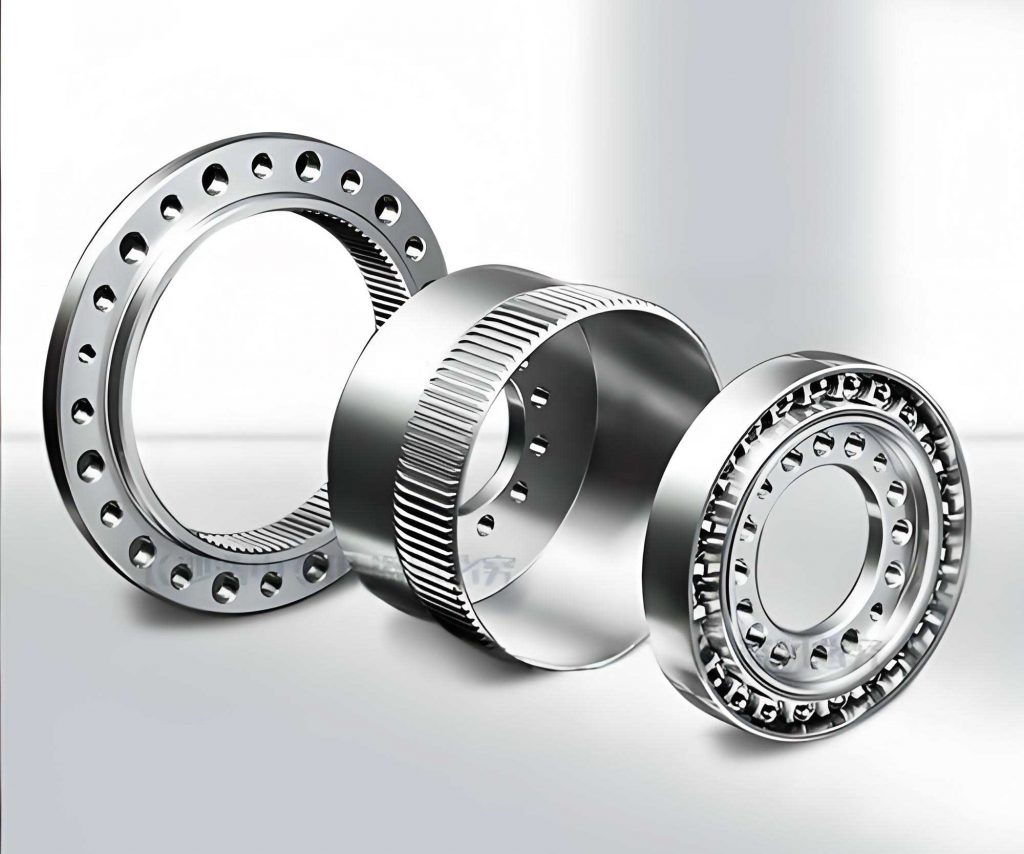
We begin by modeling the manipulator as a two-link three-inertia system. Each link consists of a motor-side inertia, a gear-side inertia, and a link-side inertia, connected by springs representing the stiffness of the harmonic drive gear and the link. The physical model is illustrated below, where the harmonic drive gear’s elasticity is a key factor in system dynamics.
The dynamics for the i-th link can be represented using block diagrams, where coupling torques from other links are included. The coupling torques, derived from the manipulator’s dynamic equations, are given by:
$$ \tau_{c1} = -(\beta + \gamma \cos \theta_{l2}) \ddot{\theta}_{l2} + \gamma (2\dot{\theta}_{l1}\dot{\theta}_{l2} + \ddot{\theta}_{l2}) \sin \theta_{l2} $$
$$ \tau_{c2} = -(\beta + \gamma \cos \theta_{l2}) \ddot{\theta}_{l1} – \gamma \dot{\theta}_{l1}^2 \sin \theta_{l2} $$
Here, $\tau_{c1}$ and $\tau_{c2}$ are coupling torques, $\beta$ and $\gamma$ are coupling inertia factors, and $\theta_{l1}$, $\theta_{l2}$ are link-side angular positions. Friction is modeled using a hyperbolic tangent function:
$$ f_i = F_{ci} \cdot \tanh \left( \frac{\dot{\theta}_{mi}}{v_{ci}} \right) $$
where $F_{ci}$ is the Coulomb friction torque, $v_{ci}$ is a velocity threshold, and $\dot{\theta}_{mi}$ is the motor speed. Angular transmission error in the harmonic drive gear, a critical source of inaccuracy, is expressed as a Fourier series:
$$ \theta_{TEi} = \sum_{j=1}^{n} A(j) \cos \left( j\theta_{li} + \phi(j) \right) = \sum_{j=1}^{n} A(j) \cos \left( j \frac{\theta_{mi}}{N} + \phi(j) \right) $$
where $N$ is the gear ratio. By ignoring harmonic components with amplitudes less than 2 arc-seconds, we obtain a simplified model. The system parameters are summarized in the table below, highlighting the role of harmonic drive gear stiffness and inertia.
| Symbol | Unit | First Link | Second Link |
|---|---|---|---|
| $N$ | – | 100 | 200 |
| $J_{mi}$ | kg·m² | 6.0×10⁻⁶ | 6.0×10⁻⁶ |
| $D_{mi}$ | N·m·s/rad | 1.0×10⁻⁶ | 1.0×10⁻⁶ |
| $J_{ai}$ | kg·m² | 3.5×10⁻² | 1.8×10⁻² |
| $D_{ai}$ | N·m·s/rad | 1.0 | 2.0 |
| $J_{li}$ | kg·m² | 5.0×10⁻¹ | 1.8×10⁻¹ |
| $D_{li}$ | N·m·s/rad | 5.0×10⁻¹ | 3.0×10⁻¹ |
| $K_{gi}$ | N·m/rad | 5000 | 3200 |
| $D_{gi}$ | N·m·s/rad | 2.0 | 0.5 |
| $J_{gi}$ | kg·m² | 4.0×10⁻² | 1.4×10⁻² |
| $K_{li}$ | N·m/rad | 2500 | 800 |
| $F_{ci}$ | N·m | 1.5×10⁻² | 1.5×10⁻² |
| $v_{ci}$ | rad/s | 5.0 | 3.3 |
| $t_{di}$ | s | 5.0×10⁻⁴ | 5.0×10⁻⁴ |
| $\beta$ | kg·m² | 0.18 | 0.18 |
| $\gamma$ | kg·m² | 0.08 | 0.08 |
Traditional 2-DOF control frameworks for such systems often use cascaded loops with feedback and feedforward controllers. For a single link, this works well, but for multiple links, coupling torques cause performance deterioration. We analyze a conventional 2-DOF control framework with semi-closed-loop and quasi-full-closed-loop structures, where the harmonic drive gear’s angular transmission error is compensated in the semi-closed-loop case. However, during multi-link motions, coupling torques introduce significant vibrations, limiting accuracy and settling time.
To address this, we propose a decoupling control method. We first approximate the manipulator as a linear double-link dual-inertia system, assuming rigid joints and negligible nonlinearities, as vibrations are primarily dominated by link flexibility at around 10 Hz. The simplified model’s block diagram highlights the interactions mediated by the harmonic drive gear. The equivalent parameters are computed as:
$$ J_{rmi} = J_{mi} + J_{ai}N^2, \quad D_{rmi} = D_{mi} + \frac{D_{ai}}{N^2}, \quad J_{rli} = J_{li}N^2, \quad D_{rli} = \frac{D_{li}}{N^2}, \quad K_{rli} = K_{li}N^2, \quad J_{rlc} = \frac{\beta}{N^2} + \frac{\gamma}{N^2} \cos \theta_{l2} $$
The dynamics of the double-link dual-inertia system are expressed in matrix form:
$$ \mathbf{J}_0 \ddot{\mathbf{x}} + \mathbf{D}_0 \dot{\mathbf{x}} + \mathbf{K}_0 \mathbf{x} = \mathbf{B}_0 \boldsymbol{\tau} $$
where $\mathbf{x} = [\theta_{rm1}, \theta_{rm2}, \theta_{rl1}, \theta_{rl2}]^T$, $\boldsymbol{\tau} = [\tau_{m1}, \tau_{m2}]^T$, and the matrices are defined as:
$$ \mathbf{J}_0 = \begin{bmatrix} J_{rm1} & 0 & 0 & 0 \\ 0 & J_{rm2} & 0 & 0 \\ 0 & 0 & J_{rl1} & J_{rlc} \\ 0 & 0 & J_{rlc} & J_{rl2} \end{bmatrix}, \quad \mathbf{D}_0 = \text{diag}(D_{rm1}, D_{rm2}, D_{rl1}, D_{rl2}), \quad \mathbf{K}_0 = \begin{bmatrix} K_{rl1} & 0 & -K_{rl1} & 0 \\ 0 & K_{rl2} & 0 & -K_{rl2} \\ -K_{rl1} & 0 & K_{rl1} & 0 \\ 0 & -K_{rl2} & 0 & K_{rl2} \end{bmatrix}, \quad \mathbf{B}_0 = \begin{bmatrix} 1 & 0 & 0 & 0 \\ 0 & 1 & 0 & 0 \end{bmatrix}^T $$
Applying Laplace transform, we derive the transfer matrix:
$$ \mathbf{G}(s) = (\mathbf{J}_0 s^2 + \mathbf{D}_0 s + \mathbf{K}_0)^{-1} \mathbf{B}_0 $$
This matrix is partitioned into motor-angle and load-angle submatrices: $\mathbf{G}(s) = [\mathbf{G}_m(s); \mathbf{G}_l(s)]$. For decoupling, we focus on $\mathbf{G}_m(s)$ in a semi-closed-loop structure. The decoupler is designed to diagonalize the transfer matrix, effectively canceling coupling effects. We then construct a 2-DOF control system with feedforward compensation based on coprime factorization and include an angular transmission error compensator to handle harmonic drive gear inaccuracies. The proposed control framework integrates these elements to achieve independent control of each link.
Our experimental setup involves a planar serial double-link manipulator with lightweight links and elastic joints, each driven by an AC servo motor with a harmonic drive gear. High-resolution encoders are mounted on both input and output sides of the gears. The manipulator’s configuration parameters are listed below, emphasizing the harmonic drive gear’s role in transmission.
| Parameter | First Link | Second Link |
|---|---|---|
| Motor Rated Torque | 0.055 N·m | 0.026 N·m |
| Motor Rated Speed | 3000 rpm | 3000 rpm |
| Gear Ratio (N) | 100 | 100 |
| Link Length | 254 mm | 295.5 mm |
| Link Weight | 58 g | 58 g |
| Payload | – | 1000 g |
The control algorithms are discretized using the Tustin method with a sampling time of 250 µs. We evaluate the proposed method using two typical multi-link motions, chosen to excite vibrations and coupling effects. The motion configurations are summarized in the table below, where the harmonic drive gear’s influence on trajectory tracking is critical.
| Motion | First Link Start | First Link End | Second Link Start | Second Link End |
|---|---|---|---|---|
| Motion 1 | 0° | 3° | 0° | 3° |
| Motion 2 | 0° | 150° | -150° | 0° |
In Motion 1, the acceleration time is about 0.125 s, corresponding to a frequency near the system’s resonant mode, inducing significant vibrations. Coupling torques further degrade performance. In Motion 2, large-angle motions produce strong interactions, with varying inertia and coupling torques. We compare our decoupling method with two traditional approaches: quasi-full closed-loop control and semi-closed-loop control with angular transmission error compensation. The results show that our method achieves better vibration suppression in both position and torque waveforms. For Motion 1, the traditional methods exhibit large vibrational responses, while our decoupling method reduces vibrations substantially, with minor residual vibrations due to the semi-closed-loop structure. The angular transmission error compensator eliminates steady-state errors, ensuring high accuracy. For Motion 2, our method again outperforms traditional methods, showing minimal overshoot in positioning responses.
Quantitatively, our decoupling control method meets the target performance metrics: ±0.1 mm accuracy (equivalent to ±0.022° for the first link and ±0.019° for the second link) and 0.1 s settling time. The harmonic drive gear’s angular transmission error is effectively compensated, and coupling torques are decoupled, enabling precise control. The torque waveforms also demonstrate smoother profiles, indicating reduced mechanical stress on the harmonic drive gear and links.
We further analyze the system’s robustness by considering model uncertainties. The decoupling design relies on an accurate linear model, but in practice, variations in harmonic drive gear stiffness or link flexibility can occur. However, the 2-DOF framework’s feedforward component enhances robustness to some extent. Future work could integrate adaptive mechanisms to handle such variations, especially for human-robot interaction scenarios where external torques may arise.
In conclusion, we present a novel decoupling control method for harmonic drive gear-driven flexible double-link manipulators. By approximating the system as a linear double-link dual-inertia model and applying a decoupler within a 2-DOF semi-closed-loop control structure, we achieve high servo performance. The method compensates for angular transmission errors inherent in harmonic drive gears and decouples inter-link interactions. Experimental validation on two multi-link motions confirms the effectiveness, with achieved accuracy of ±0.1 mm and settling time of 0.1 s. This approach contributes to building high-performance positioning systems for collaborative robots with harmonic drive gears. However, we note that external disturbances and model robustness require further investigation, particularly for applications involving dynamic environments or human contact.
The harmonic drive gear remains a central component in this study, influencing modeling, control design, and experimental outcomes. Its stiffness and transmission errors directly impact vibrational modes, and our control strategy explicitly addresses these aspects. Through continuous refinement, we believe such decoupling methods can be extended to multi-link manipulators with more degrees of freedom, enhancing the capabilities of flexible robotic systems in industrial settings.