
The relentless pursuit of efficiency, reliability, and compactness in modern mining machinery has driven the adoption of advanced motion control technologies. Among these, the harmonic drive gear stands out as a pivotal component in robotic manipulators, conveyor positioning systems, and precision cutting equipment. Its unique operating principle, based on the controlled elastic deformation of a flexible component, provides unparalleled advantages in torque density and positional accuracy within confined spaces. This article provides a comprehensive, first-person analysis of harmonic drive gear design, focusing on a critical aspect that dictates performance: tooth profile geometry. I will delve into the design methodology for two prominent profiles—the involute and the double circular arc—based on the envelope theory of gearing. A detailed comparative analysis follows, highlighting the profound impact of profile selection on the meshing characteristics and overall efficacy of harmonic drive gears in demanding mining applications.
Fundamental Principles of the Harmonic Drive Gear
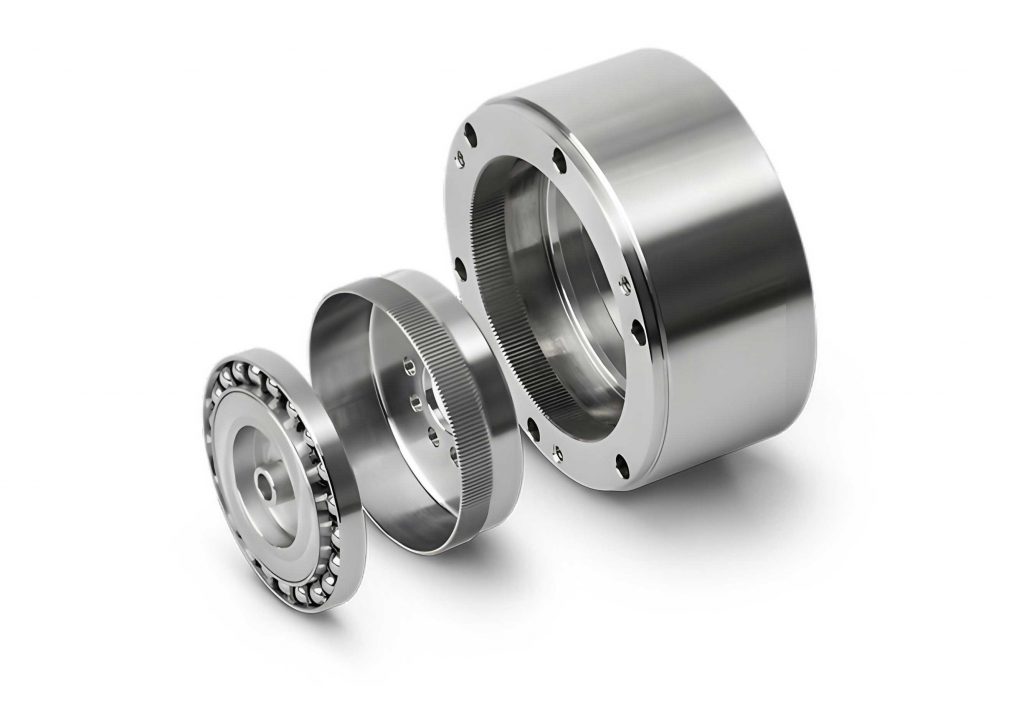
The operational core of a harmonic drive gear is elegantly simple yet mechanically sophisticated. The system comprises three primary elements: a rigid circular spline (or ring gear), a flexible spline (or flexspline), and a wave generator. The wave generator, typically an elliptical cam or a set of opposing bearings, is inserted into the flexible spline, causing it to deform into a non-circular shape. This deformation forces the teeth of the flexible spline to engage with those of the rigid circular spline at two diametrically opposite regions. As the wave generator rotates, the points of engagement travel, creating a relative motion between the two splines. Due to the significant difference in the number of teeth between the flexible and rigid splines (often by 2 or more), a high reduction ratio is achieved in a single stage according to the fundamental kinematic relationship of the harmonic drive gear:
$$ i = -\frac{N_f}{N_f – N_r} $$
where \( i \) is the reduction ratio, \( N_f \) is the number of teeth on the flexible spline, and \( N_r \) is the number of teeth on the rigid circular spline. The negative sign indicates that the output rotation direction is opposite to the input. The performance of this system is not merely a function of tooth counts; it is critically dependent on the precise geometry of the interacting tooth profiles, which ensures smooth force transmission, minimal backlash, and high torsional stiffness.
Design of Harmonic Drive Gear with Involute Tooth Profile
The involute curve, the workhorse of conventional gear design, has been historically applied to harmonic drive gears. Its mathematical predictability and ease of manufacturing are its main attractions. The design process involves defining the flexible spline profile and applying the envelope theory to generate the conjugate rigid spline profile.
Mathematical Modeling of the Flexible Spline
I establish a coordinate system attached to the flexible spline tooth, with the y-axis aligned to the tooth’s symmetry axis and the origin at the intersection of this axis with the neutral curve of the spline’s rim. The parametric equations for an involute profile in this moving coordinate system \( \sigma_f(x, y) \) are derived from its base circle. The coordinates of any point on the involute are given by:
$$ x = r_b[-\sin(\eta) + \xi \cos(\alpha_0)\cos(\eta + \alpha_0)] $$
$$ y = r_b[\cos(\eta) + \xi \cos(\alpha_0)\sin(\eta + \alpha_0)] – r_m $$
where:
- \( r_b \) is the radius of the base circle.
- \( \alpha_0 \) is the standard pressure angle at the standard pitch circle (e.g., 20° or 25°).
- \( \xi \) is a parameter related to the roll angle, defined as \( \xi = \tan(\alpha_k) – \tan(\alpha_0) \), with \( \alpha_k \) being the pressure angle at the point of interest.
- \( \eta \) is a constant phase angle incorporating the tooth thickness modification (profile shift), calculated as \( \eta = \frac{\pi}{2N_f} + \text{inv}(\alpha_0) + \frac{2x_f \tan(\alpha_0)}{N_f} \), where \( x_f \) is the profile shift coefficient of the flexible spline.
- \( r_m \) is the radius of the neutral curve of the undeformed flexible spline.
For the analysis, I assume the wave generator produces a cosine-based radial displacement of the flexible spline’s neutral curve, a common model for elliptical generators. The radial displacement \( \rho(\phi) \) is:
$$ \rho(\phi) = r_m + \omega_0 \cdot m \cdot \cos(2\phi) $$
where \( \omega_0^* \) is the radial deformation coefficient (typically 0.8 – 1.2), \( m \) is the gear module, and \( \phi \) is the angular coordinate relative to the wave generator’s major axis.
Envelope Theory and Generation of the Conjugate Rigid Spline
The core task is to find the shape of the rigid circular spline tooth that will correctly mate with the defined flexible spline tooth as it undergoes its prescribed deformation. According to gearing theory, the necessary condition for conjugation is that the relative velocity vector at the contact point is perpendicular to the common normal vector. This leads to the equation of meshing.
I define a series of coordinate transformations: from the flexible spline tooth system \( \sigma_f \) to the flexible spline body system \( \Sigma_f \), then to a fixed space system, and finally to the rigid circular spline system \( \Sigma_r \). The equation of meshing can be expressed as:
$$ \mathbf{n}^{(f)} \cdot \mathbf{v}^{(fr)} = 0 $$
where \( \mathbf{n}^{(f)} \) is the unit normal vector to the flexible spline tooth surface in the moving system, and \( \mathbf{v}^{(fr)} \) is the relative velocity vector of the flexible spline tooth point with respect to the rigid spline. Solving this equation simultaneously with the parametric surface equations of the flexible spline yields the line of contact in the rigid spline’s coordinate space for each instantaneous position (parameterized by the wave generator angle \( \phi \)). By sweeping \( \phi \) through the engagement cycle, the envelope of all these contact lines defines the tooth profile of the rigid circular spline.
Analysis of Meshing Characteristics
Applying this procedure numerically (e.g., via MATLAB or similar computational tools) for a specific set of parameters reveals the meshing behavior. For an involute profile, the conjugate region diagram typically shows two distinct meshing zones per tooth engagement cycle, as summarized in Table 1.
| Parameter | Value |
|---|---|
| Flexible Spline Teeth (\(N_f\)) | 160 |
| Module (\(m\)) | 0.6 mm |
| Radial Deformation Coefficient (\(\omega_0^*\)) | 1.0 |
| Pressure Angle (\(\alpha_0\)) | 20° |
| Meshing Zone 1 (Angular Range, \(\phi\)) | 1.82° to 4.80° |
| Meshing Zone 2 (Angular Range, \(\phi\)) | 37.84° to 40.24° |
| Active Profile Length (per zone) | ~0.053 to 0.104 mm |
| Primary Contact Type | Point contact, often near the tooth tip (dedendum of the rigid spline). |
The simulation of the assembly, assuming the flexible spline deforms with a constant neutral curve length, shows that the involute-based harmonic drive gear operates without gross interference. However, under no-load conditions, a clearance exists between the teeth, which is minimal at the tooth tips. Under load, contact occurs primarily at or near these tip/dedendum regions, leading to a “point contact” or “edge contact” condition. While multiple teeth share the load, this concentrated contact generates high Hertzian stresses, potentially accelerating wear and pitting, which is a critical consideration for the durability of a harmonic drive gear in mining equipment.
Design of Harmonic Drive Gear with Double Circular Arc Tooth Profile
The double circular arc (DCA) profile was developed specifically to address the limitations of the involute in strain wave gearing. Its design aims to achieve favorable contact conditions over a much larger portion of the engagement cycle.
Profile Geometry Definition
The DCA profile on the flexible spline consists of two circular arcs: a convex arc near the tooth tip and a concave arc near the tooth root, often connected by a straight tangent segment. The profile is defined by several key parameters, as illustrated in a dedicated coordinate system \( \sigma_f \). The parametric equations for the convex (superscript \(a\)) and concave (superscript \(f\)) arcs are:
Convex Arc:
$$ \mathbf{r}_s^a = (-\rho_a \cos \alpha_a – l_a)\mathbf{i} + (\rho_a \sin \alpha_a + h_f + \delta_l + X_a)\mathbf{j} $$
$$ \mathbf{n}_s^a = (\cos \alpha_a)\mathbf{i} + (\sin \alpha_a)\mathbf{j} $$
Concave Arc:
$$ \mathbf{r}_s^f = (\frac{\pi m}{4} + l_f – \rho_f \cos \alpha_f)\mathbf{i} + (h_f + \delta_l + X_f – \rho_f \sin \alpha_f)\mathbf{j} $$
$$ \mathbf{n}_s^f = (-\cos \alpha_f)\mathbf{i} + (-\sin \alpha_f)\mathbf{j} $$
where:
- \( \rho_a, \rho_f \) are the radii of the convex and concave arcs, respectively.
- \( \alpha_a, \alpha_f \) are the variable pressure angles along the respective arcs.
- \( l_a, l_f \) are the horizontal distances from the arc centers to the tooth centerline.
- \( h_f \) is a reference height dimension.
- \( \delta_l \) is the profile “technological angle” ensuring proper clearance.
- \( X_a, X_f \) are vertical offsets of the arc centers.
- \( \mathbf{i}, \mathbf{j} \) are unit vectors along the x and y axes.
Conjugate Analysis and the Double Conjugation Phenomenon
Applying the same envelope theory process to the DCA profile leads to a significantly different conjugate region diagram. The results, as synthesized in Table 2, reveal its superior characteristics.
| Parameter | Value |
|---|---|
| Flexible Spline Teeth (\(N_f\)) | 160 |
| Module (\(m\)) | 0.6 mm |
| Radial Deformation Coefficient (\(\omega_0^*\)) | 1.0 |
| Convex Arc Radius (\(\rho_a\)) | 0.57m |
| Concave Arc Radius (\(\rho_f\)) | 0.68m |
| Technological Angle (\(\delta_l\)) | 8.5° |
| Meshing Zone 1 (Angular Range, \(\phi\)) | 0.64° to 9.25° |
| Meshing Zone 2 (Angular Range, \(\phi\)) | 15.36° to 52.03° |
| Active Profile Length (per zone) | Up to ~0.172 mm |
| Key Feature | Double Conjugation: For a given generator angle \(\phi\), two distinct points on a single DCA tooth satisfy the meshing condition. |
The most significant finding is the presence of double conjugation. For a single angular position of the wave generator, the meshing condition is satisfied at two different points along the profile of a single flexible spline tooth. This phenomenon corresponds to the two distinct intersections of a horizontal line (constant \(\phi\)) with the conjugate region curve in the analysis plot. This characteristic is fundamental to the performance enhancement offered by the DCA harmonic drive gear.
Assembly simulation of the DCA design shows that, even under no-load conditions, the flexible spline teeth maintain near-continuous contact with the rigid spline teeth through a combination of convex-to-concave and convex-to-flank interactions. The clearance is minimal and uniformly distributed. Under load, the contact spreads over a significantly larger area of the tooth profile, avoiding the detrimental edge contact seen in the involute design.
Comparative Analysis and Performance Implications
The theoretical and simulated differences between the involute and DCA profiles translate directly into tangible performance advantages for the double circular arc harmonic drive gear, especially in harsh environments like mining.
| Aspect | Involute Profile Harmonic Drive | Double Circular Arc (DCA) Profile Harmonic Drive |
|---|---|---|
| Meshing Zone Extent | Two narrow, discrete zones (~3° and ~2.4° wide). Limited total engagement arc. | Two broad zones (~8.6° and ~36.7° wide). Significantly larger total engagement arc. |
| Contact Type & Pattern | Primarily point/edge contact, especially under load. High local stress. | Area contact facilitated by the conjugate arcs. Lower contact pressure, smoother load transition. |
| Double Conjugation | Absent. Single contact point per tooth per engagement zone. | Present. Two simultaneous contact points per tooth, improving load distribution and kinematic stability. |
| Backlash & Stiffness | Higher inherent clearance under no-load. Lower torsional stiffness due to point contact. | Negligible clearance, “pre-tensioned” mesh. Higher torsional stiffness due to area contact and double conjugation. |
| Wear & Durability | Higher susceptibility to abrasive wear and pitting at contact points. Shorter lifespan under heavy loads. | Superior wear resistance due to lower contact stress and favorable contact geometry. Enhanced longevity. |
| Positioning Accuracy | More susceptible to error from tooth deflection and clearance. Lower repeatability. | Higher accuracy and repeatability due to stiffer mesh and minimal backlash. |
| Suitability for Mining | Adequate for less demanding, low-precision applications. | Ideal for high-torque, high-precision, high-reliability applications like robotic cutting arms and precision conveyors. |
The mathematical rationale for the improved load sharing can be appreciated by considering the contact force per tooth. For a given output torque \( T_{out} \), the tangential force \( F_t \) at the pitch radius \( r_p \) is \( F_t = T_{out} / r_p \). In an involute system with \( n_{inv} \) teeth in contact, each tooth carries approximately \( F_t / n_{inv} \), but at a high stress concentration factor \( K_{inv} \). In a DCA system with \( n_{dca} \) teeth in contact, and with double conjugation effectively increasing the number of load-bearing contacts, the force per contact point is reduced. More importantly, the contact stress \( \sigma_H \) for Hertzian contact is proportional to \( \sqrt{F / \rho} \), where \( \rho \) is the relative radius of curvature. The DCA profile’s designed arc radii \( \rho_a \) and \( \rho_f \) are optimized to provide a larger, more favorable effective radius of curvature \( \rho_{eff} \) compared to the near-zero curvature at an involute tip-edge contact, leading to a substantial reduction in contact stress:
$$ \sigma_{H, DCA} \propto \sqrt{\frac{F_{contact, DCA}}{\rho_{eff, DCA}}} \ll \sigma_{H, Inv} \propto \sqrt{\frac{F_{contact, Inv}}{\rho_{eff, Inv}}} $$
This fundamental difference in stress state is a key reason why the double circular arc harmonic drive gear excels in high-cycle, high-load applications common to mining machinery.
Conclusion and Outlook
The choice of tooth profile is not a minor detail but a fundamental design decision that governs the performance envelope of a harmonic drive gear. Through the rigorous application of envelope theory and kinematic analysis, this investigation has elucidated the clear superiority of the double circular arc profile over the traditional involute profile for high-performance applications. The DCA profile’s defining feature—double conjugation—enables a wider meshing zone, area contact, minimal backlash, higher stiffness, and superior load distribution. These attributes directly translate into enhanced durability, precision, and reliability, which are non-negotiable requirements for mining equipment operating under extreme conditions of load, contamination, and continuous operation.
While the design and manufacturing of the double circular arc profile is more complex, its benefits for the harmonic drive gear system are substantial. For the next generation of intelligent, robotic, and highly efficient mining machinery, the adoption of advanced harmonic drive gears equipped with optimized double circular arc or similar sophisticated profiles (e.g., S-shaped profiles) will be instrumental in achieving new levels of performance, safety, and productivity. The continued refinement of these profiles, coupled with advancements in materials and lubrication, promises to further expand the capabilities of this remarkable compact drive technology.