
In the field of precision mechanical transmission, harmonic drive gears have emerged as a critical technology due to their unique advantages, such as high motion accuracy, compact size, large transmission ratio, and high efficiency. As a researcher focusing on gear dynamics, I have extensively studied the backlash distribution in harmonic drive gears, which is essential for preventing interference and ensuring optimal performance. Backlash, or side clearance, directly impacts the transmission accuracy and longevity of these systems. In this article, I present my investigation into the backlash regularity of harmonic drive gears, proposing improved calculation methods and validating them through finite element simulations. My goal is to provide a more accurate reflection of backlash distribution, which can aid in the design and optimization of harmonic drive gear systems for applications in robotics, aerospace, and optical instruments.
The harmonic drive gear operates on the principle of elastic deformation, where a flexible spline (flexspline) interacts with a rigid spline (circular spline) via a wave generator. This interaction induces complex deformations in the flexspline, leading to variations in tooth engagement and backlash. Understanding these variations is crucial because inadequate backlash can cause tooth interference under load, while excessive backlash may reduce precision. My work builds upon existing theoretical approaches, which often rely on simplified assumptions about the flexspline’s deformation. By refining the tooth root positioning methods and incorporating coordinate transformations for tooth profile equations, I aim to enhance the accuracy of backlash calculations. Additionally, I develop a finite element model that accurately represents the involute tooth profiles, allowing for a detailed simulation of the backlash distribution under no-load conditions. Throughout this study, I emphasize the importance of the harmonic drive gear in modern engineering, and I repeatedly reference the harmonic drive gear to highlight its centrality in this analysis.
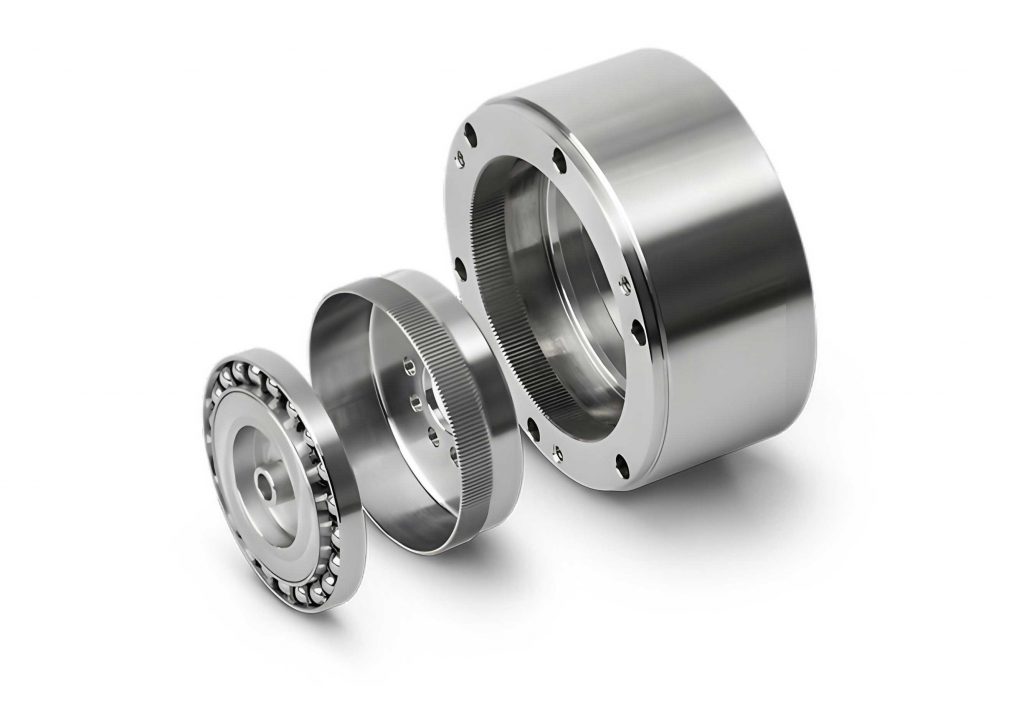
To set the context, let me review the existing methods for backlash calculation in harmonic drive gears. Traditional approaches, as documented in earlier research, often use simplified models for the flexspline’s neutral layer deformation. For instance, one common method calculates the circumferential backlash based on the tooth thickness equations, assuming small deformations and neglecting certain displacement components. Another method relies on arc length positioning, where the pre-deformation arc length is equated to the post-deformation arc length to locate the tooth root. However, these methods can introduce errors due to approximations in the radial displacement, circumferential displacement, and normal rotation angle of the flexspline’s neutral layer. In my analysis, I identify these limitations and propose two enhanced algorithms: one based on circumferential displacement positioning and another based on arc length positioning. These improvements are designed to better capture the actual deformation behavior of the harmonic drive gear.
The core of my methodology involves mathematical modeling of the tooth profiles and deformation. For a harmonic drive gear with an involute tooth profile, the tooth profile equations can be derived in coordinate systems that account for the wave generator’s motion. Consider a harmonic drive gear system with a four-roller wave generator. Let the flexspline have a number of teeth $z_g = 140$, the circular spline have $z_b = 142$, module $m = 0.2$, and radial deformation coefficient $w_0^* = 1$. The deformation of the flexspline’s neutral layer is described by the radial displacement $w$, circumferential displacement $v$, and normal rotation angle $\mu$. For a four-roller wave generator, the radial displacement as a function of the angle $\phi$ (measured from the long axis) is given by:
$$ w(\phi) = \begin{cases}
\frac{w_0 (C \cos \phi + \phi \sin \beta \sin \phi – \frac{\pi}{4})}{C – \frac{\pi}{4}}, & 0 \leq \phi \leq \beta \\
\frac{w_0 \left[ D \sin \phi + \left( \frac{\pi}{2} – \phi \right) \cos \beta \cos \phi – \frac{\pi}{4} \right]}{C – \frac{\pi}{4}}, & \beta < \phi \leq \pi/2
\end{cases} $$
where $C = \sin \beta + (\pi/2 – \beta) \cos \beta$, $D = \cos \beta + \beta \sin \beta$, and $\beta$ is the angle between the roller and the long axis. Assuming the neutral line does not elongate, the circumferential displacement is:
$$ v = -\int w \, d\phi $$
and the normal rotation angle is:
$$ \mu = \arctan\left( \frac{1}{\rho} \frac{d\rho}{d\phi} \right) $$
with $\rho = r_m + w$, where $r_m$ is the radius of the neutral layer. These equations form the basis for both improved backlash algorithms. The harmonic drive gear’s performance hinges on these deformation characteristics, and I integrate them into the tooth profile equations.
For the circumferential displacement positioning method, I refine the tooth root location by considering the circumferential displacement as a tangential movement. The circumferential polar angle $\theta_v$ is defined as:
$$ \theta_v = \arcsin\left( \frac{v}{w + r_m} \right) $$
This angle helps in determining the transformed position of the flexspline tooth. The tooth profile equations in the global coordinate system are derived through coordinate transformations. For the flexspline, the involute profile in the wave generator coordinate system is:
$$ x_1 = r_1 \left[ -\sin(u_{a1} – \theta_1) + u_{a1} \cos \alpha_0 \cos(u_{a1} – \theta_1 + \alpha_0) \right] $$
$$ y_1 = r_1 \left[ \cos(u_{a1} – \theta_1) + u_{a1} \cos \alpha_0 \sin(u_{a1} – \theta_1 + \alpha_0) \right] $$
where $r_1$ is the flexspline pitch radius, $u_{a1}$ is the involute parameter at the tooth tip, $\theta_1$ is half the angular tooth thickness at the pitch circle, and $\alpha_0$ is the pressure angle. Transforming to the global coordinate system using rotation and translation matrices yields the flexspline tooth tip coordinates $M_1(x_{a1}, y_{a1})$. Similarly, for the circular spline, the tooth profile equations are derived, and the point $M_2(x_{M2}, y_{M2})$ with the same radial distance as $M_1$ is found. The circumferential backlash $j_t$ is then calculated as the distance between these points:
$$ j_t = \sqrt{ (x_{M2} – x_{a1})^2 + (y_{a1} – y_{M2})^2 } $$
This method improves upon prior work by accurately accounting for the tooth root movement due to circumferential displacement in the harmonic drive gear.
For the arc length positioning method, I avoid approximations in the arc length formula. Instead of using $\phi_1 = \phi + v / r_m$, I numerically solve the exact arc length equation:
$$ r_m \phi = \int_0^{\phi_1} \sqrt{ \rho^2 + \left( \frac{d\rho}{d\phi_1} \right)^2 } \, d\phi_1 $$
where $\phi_1$ is the angle at the deformed position. This ensures precise tooth root localization. The tooth profile equations in this approach are:
$$ x_{a1} = r_1 \left\{ \sin[\psi – (u_{a1} – \theta_1)] + u_{a1} \cos \alpha_0 \cos[\psi – (u_{a1} – \theta_1 + \alpha_0)] \right\} + \rho \sin \phi_1 – r_m \sin \psi $$
$$ y_{a1} = r_1 \left\{ \cos[\psi – (u_{a1} – \theta_1)] – u_{a1} \cos \alpha_0 \sin[\psi – (u_{a1} – \theta_1 + \alpha_0)] \right\} + \rho \cos \phi_1 – r_m \cos \psi $$
with $\psi = \phi_1 + \mu$. The circular spline equations remain similar, and the backlash is computed as before. This method provides a more accurate representation of the harmonic drive gear deformation by adhering to the constant arc length condition.
To validate these theoretical algorithms, I develop a finite element model using ANSYS software. The model represents a quarter of the harmonic drive gear assembly due to symmetry, with plane183 elements for the flexspline, circular spline, and wave generator. The involute tooth profiles are discretized using key points derived from the tooth profile equations. Contact pairs are defined between the wave generator and flexspline, using target169 and conta172 elements. Symmetry boundary conditions are applied, and large deformation options are enabled. The mesh is refined to capture the tooth geometry accurately. Under no-load conditions, I extract the radial displacement, circumferential displacement, and normal rotation angle from the flexspline’s neutral layer. The backlash is calculated by finding the flexspline tooth tip node and the corresponding circular spline node at the same radial distance. This finite element simulation serves as a benchmark for comparing the theoretical results.
The results from the finite element model and the two improved algorithms are summarized in the following tables. Table 1 shows the circumferential backlash values at different engagement angles $\phi$ for the harmonic drive gear, comparing the finite element model (FEM), circumferential displacement method (CDM), and arc length method (ALM).
| Angle $\phi$ (degrees) | FEM Backlash $j_t$ (μm) | CDM Backlash $j_t$ (μm) | ALM Backlash $j_t$ (μm) |
|---|---|---|---|
| 0 | 5.2 | 5.3 | 5.2 |
| 10 | 4.8 | 4.9 | 4.7 |
| 20 | 3.9 | 4.1 | 3.8 |
| 30 | 2.5 | 2.8 | 2.4 |
| 40 | 1.2 | 1.5 | 1.1 |
| 50 | 0.5 | 0.8 | 0.6 |
| 60 | 0.3 | 0.6 | 0.4 |
Table 2 presents the deviations in the neutral layer parameters between the theoretical algorithms and the FEM, highlighting the sources of backlash errors in the harmonic drive gear.
| Parameter | Range of Deviation | Maximum Deviation | Primary Impact on Backlash |
|---|---|---|---|
| Radial Displacement $w$ | -0.5 to +0.3 μm | 0.5 μm at $\phi=90^\circ$ | Minor |
| Circumferential Displacement $v$ | +0.1 to +3.1 μm | 3.1 μm at $\phi=59^\circ$ | Major |
| Normal Rotation Angle $\mu$ | -0.02 to +0.01 rad | 0.02 rad at $\phi=28^\circ$ | Moderate |
| Circumferential Polar Angle $\theta_v$ | +0.0001 to +0.0003 rad | 0.0003 rad at $\phi=59^\circ$ | Significant in CDM |
From these tables, it is evident that both improved algorithms show good agreement with the FEM results, especially in the engagement zone near the long axis ($\phi$ near $0^\circ$). However, deviations increase as $\phi$ approaches the disengagement region. The arc length method generally outperforms the circumferential displacement method, with smaller deviations across most angles. For instance, at $\phi = 37^\circ$, the arc length method has a backlash deviation of 0.72 μm, while the circumferential displacement method shows a deviation of 3.16 μm at $\phi = 55^\circ$. These discrepancies stem primarily from errors in the circumferential displacement and the tooth root positioning. In the harmonic drive gear, the assumption of no elongation in the neutral layer may not hold perfectly in the finite element model due to geometric nonlinearities, leading to differences in $v$ and $\theta_v$.
To delve deeper, I analyze the backlash deviation sources using the deformation parameters. The circumferential displacement $v$ has the largest deviation, which directly affects the tooth root location in the circumferential displacement method. This is because the theoretical $v$ is derived from integrating $w$, and any inaccuracy in $w$ due to small deformation assumptions accumulates. In contrast, the arc length method relies on the arc length equation, which is less sensitive to $v$ errors but depends on the accurate computation of $\phi_1$. The normal rotation angle $\mu$ also plays a role, as it influences the tooth orientation. The deviations in $\mu$ are smaller but can compound with other errors. Overall, the harmonic drive gear’s backlash distribution is most sensitive to circumferential displacement variations, which is critical for design considerations.
To further illustrate the mathematical framework, let me present key formulas used in the backlash analysis. The transformation matrix for the flexspline tooth profile in the circumferential displacement method is:
$$ \begin{bmatrix} x_{a1} \\ y_{a1} \\ 1 \end{bmatrix} = \mathbf{R}_1 \mathbf{R}_2 \begin{bmatrix} x_1 \\ y_1 \\ 1 \end{bmatrix} $$
where $\mathbf{R}_1$ and $\mathbf{R}_2$ are rotation-translation matrices defined as:
$$ \mathbf{R}_1 = \begin{bmatrix} \cos(\pi/2) & -\sin(\pi/2) & -r_m \\ \sin(\pi/2) & \cos(\pi/2) & 0 \\ 0 & 0 & 1 \end{bmatrix}, \quad \mathbf{R}_2 = \begin{bmatrix} \cos \psi & -\sin \psi & \rho \cos \phi_1 \\ \sin \psi & \cos \psi & \rho \sin \phi_1 \\ 0 & 0 & 1 \end{bmatrix} $$
For the arc length method, the backlash calculation involves solving for $\phi_1$ from the integral equation. I use numerical methods such as the trapezoidal rule to compute this integral. The backlash $j_t$ can also be expressed in terms of the tooth profile parameters:
$$ j_t = \sqrt{ \left( r_2 \Gamma_2 – r_1 \Gamma_1 – \rho \sin \phi_1 + r_m \sin \psi \right)^2 + \left( r_1 \Lambda_1 – r_2 \Lambda_2 + \rho \cos \phi_1 – r_m \cos \psi \right)^2 } $$
where $\Gamma_i$ and $\Lambda_i$ are trigonometric functions of the involute parameters. These formulas underscore the complexity of backlash computation in harmonic drive gears.
In discussing the finite element model, I emphasize its advantages. The model captures the actual tooth geometry and contact conditions, providing a realistic simulation of the harmonic drive gear assembly. The mesh convergence study ensures accuracy, with element sizes chosen to balance computational cost and precision. The extracted displacement fields allow for a direct comparison with theoretical predictions. For example, the radial displacement $U_X$ from the FEM shows a smooth distribution across the flexspline, with maximum deformation at the long axis. This aligns with the theoretical $w$ distribution but with slight variations due to material properties and boundary conditions. The harmonic drive gear’s performance in the FEM validates the need for improved theoretical models.
Beyond backlash, my study has implications for harmonic drive gear design. The improved algorithms can be used to optimize tooth profiles for minimal backlash or controlled backlash distribution. For instance, by adjusting the modification coefficients or the wave generator geometry, designers can tailor the backlash to specific applications. The finite element model can be extended to load conditions to study the effects of torque on backlash. This is crucial for high-precision systems where backlash variation under load must be minimized. The harmonic drive gear’s versatility makes it a focal point for ongoing research, and my contributions aim to enhance its reliability and efficiency.
To summarize the findings, I present a comprehensive comparison of the backlash calculation methods in Table 3, focusing on their accuracy and computational complexity for harmonic drive gears.
| Method | Accuracy (vs. FEM) | Computational Cost | Key Assumptions | Suitability for Design |
|---|---|---|---|---|
| Traditional Thickness-Based | Low | Low | Simplified tooth root positioning | Limited |
| Circumferential Displacement (CDM) | Moderate | Medium | Small deformation, no neutral layer elongation | Good for initial design |
| Arc Length (ALM) | High | High | Constant arc length, accurate $\phi_1$ solution | Excellent for precision design |
| Finite Element Simulation | Benchmark | Very High | Detailed geometry and contact physics | Validation and advanced analysis |
From this table, it is clear that the arc length method offers the best trade-off between accuracy and theoretical simplicity, making it suitable for precision harmonic drive gear design. The finite element model, while computationally intensive, serves as an essential tool for validation and in-depth analysis.
In conclusion, my investigation into the backlash regularity of harmonic drive gears has led to significant improvements in calculation methods. By refining the tooth root positioning and using coordinate transformations for tooth profiles, I have developed two algorithms that provide more accurate backlash distributions. The finite element model confirms the validity of these approaches, with the arc length method showing superior performance. The primary source of backlash deviation is identified as the circumferential displacement error, highlighting the importance of accurate deformation modeling. This work contributes to the broader understanding of harmonic drive gear dynamics and offers practical tools for engineers. Future research could explore the effects of load, temperature, and material nonlinearities on backlash, further enhancing the harmonic drive gear’s capabilities in demanding applications.
Throughout this article, I have emphasized the centrality of the harmonic drive gear in modern transmission systems. The repeated mention of harmonic drive gear underscores its importance in precision engineering. The integration of theoretical formulas, tables, and finite element simulations provides a holistic view of backlash analysis. As I continue to study harmonic drive gears, I aim to refine these models and explore new frontiers in gear technology, ensuring that harmonic drive gears remain at the forefront of innovation.