
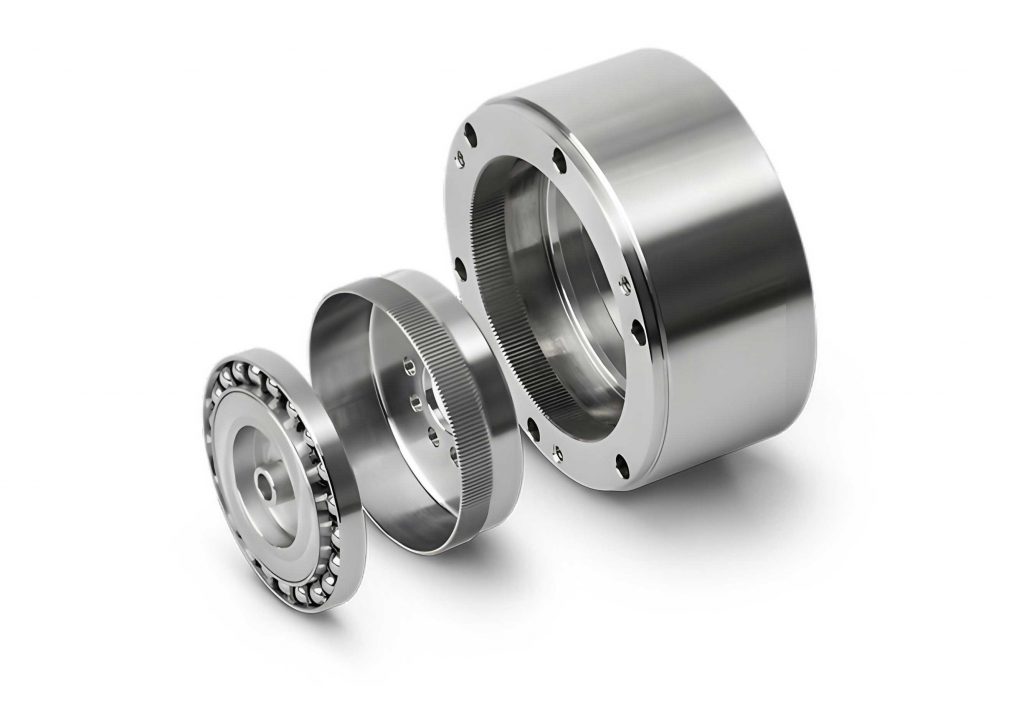
The harmonic drive gear is a unique mechanical transmission system renowned for its high reduction ratio, compact size, lightweight construction, and excellent positional accuracy. Its core components are the wave generator, the flexspline, and the circular spline. The performance of this transmission is critically dependent on the design of the tooth profiles on the flexspline and circular spline. Among various profile types, the S-shaped tooth profile is known for its larger contact area and more uniform backlash distribution, leading to smoother engagement. However, its effective meshing zone is often limited, especially after modifications to avoid interference under deformation. While conjugate tooth profile design theories can significantly expand the meshing interval, they often become intractable when dealing with complex curve equations like those of the S-profile.
This article proposes a novel design methodology—the effective edge-conjugate point method—based on the numerical envelope principle. This approach circumvents the analytical difficulties associated with solving complex S-shaped profile equations. By discretizing the motion trajectory of a given profile and applying boundary extraction algorithms combined with fundamental conjugate conditions, we can numerically generate the mating tooth profile. We demonstrate this method by using the convex portion of an S-profile as the base and compare the resulting conjugate profiles with those designed by the traditional backlash adjustment method. Comprehensive analysis through planar numerical simulations and finite element modeling reveals significant improvements in meshing characteristics and contact stress distribution for the harmonic drive gear designed with the new method.
The kinematic and geometric relationships within a harmonic drive gear form the foundation for any tooth profile design. We establish coordinate systems to describe the relative motion. Let $S_0\{O, X, Y\}$ be the moving coordinate system attached to the wave generator, $S_1\{O_1, X_1, Y_1\}$ be the moving system attached to the flexspline, and $S_2\{O_2, X_2, Y_2\}$ be the fixed system attached to the circular spline. The origin $O$ of $S_0$ coincides with $O_2$ of $S_2$. The origin $O_1$ of the flexspline system lies on the neutral curve of the deformed flexspline within $S_0$.
Key angular parameters include: $\phi_1$, the rotation angle of the deformed flexspline end relative to the Y-axis in $S_0$; $\phi$, the rotation angle of the undeformed flexspline end; $\phi_2$, the rotation angle of the wave generator relative to the circular spline; $\mu$, the normal rotation of the flexspline; $\gamma$, the angle of the deformed flexspline end relative to the $Y_2$-axis; and $\beta$, the normal angle of the flexspline relative to the circular spline. All angles are positive counter-clockwise.
Based on the assumption of constant neutral layer arc length before and after deformation, we have:
$$
r_m \phi = \int_{0}^{\phi_1} \sqrt{r^2 + \left( \frac{dr}{d\phi_1} \right)^2} d\phi_1
$$
where $r_m$ is the radius of the undeformed flexspline neutral layer, and $r$ is the expression of the deformed neutral curve as a function of $\phi_1$.
From the kinematic theory of harmonic drive gears, the relationship between $\phi_2$ and $\phi_1$ is:
$$
\phi_2 = \frac{z_r}{z_g} \int_{0}^{\phi_1} \sqrt{r^2 + \left( \frac{dr}{d\phi_1} \right)^2} d\phi_1
$$
where $z_r$ and $z_g$ are the number of teeth on the flexspline and circular spline, respectively. The angles $\mu$, $\gamma$, and $\beta$ are given by:
$$
\mu = \arctan\left(-\frac{r’}{r}\right), \quad \gamma = \phi_1 – \phi_2, \quad \beta = \gamma + \mu
$$
Using $\phi_1$ as the independent variable for all motion parameters allows for precise subsequent calculations for the harmonic drive gear conjugate profiles.
Conjugate Tooth Profile Design via Numerical Envelope Method
Motion Trajectory Generation
To visualize the meshing state and obtain the envelope, we generate the family of motion curves for one tooth profile relative to its mating part. The coordinate transformation matrix from the flexspline system $S_1$ to the circular spline system $S_2$, $M_{21}$, is:
$$
M_{21} = \begin{bmatrix}
\cos \beta & \sin \beta & r \sin \gamma \\
-\sin \beta & \cos \beta & r \cos \gamma \\
0 & 0 & 1
\end{bmatrix}
$$
Consequently, a point on the flexspline tooth profile defined in $S_1$ as $\mathbf{r}_1 = (x_1, y_1, 1)^T$ has coordinates in $S_2$ given by:
$$
\mathbf{r’}_1 = \begin{bmatrix} x’_1 \\ y’_1 \\ 1 \end{bmatrix} = M_{21} \cdot \mathbf{r}_1
$$
This equation, calculated over a range of $\phi_1$, generates the trajectory curve family of the flexspline tooth profile as seen from the fixed circular spline.
Effective Edge-Conjugate Point Methodology
The core of the numerical method involves extracting the boundary of the discrete point cloud from the trajectory family. In computational geometry, the `boundary` function (e.g., in MATLAB) can compute the bounding polygon or shape for a set of 2D points. However, not all points on this boundary are valid conjugate points. According to the theory of gearing, at the point of contact between two conjugate surfaces, the relative velocity vector must be orthogonal to the common normal vector. This is expressed by the conjugate condition (meshing equation):
$$
\mathbf{n}^{(i)} \cdot \mathbf{v}^{(i)} = 0
$$
where $\mathbf{n}^{(i)}$ and $\mathbf{v}^{(i)}$ are the common normal vector and relative velocity vector at the contact point in coordinate system $S_i$ ($i=0,1,2$).
For the case where the circular spline is fixed and the flexspline moves, the condition in the $S_2$ system becomes:
$$
\mathbf{n}_2 \cdot \mathbf{v}_2 = \mathbf{n}_1^T W_{21}^T \frac{dM_{21}}{dt} \mathbf{r}_1 = 0
$$
where $W_{21}$ is the corresponding $2\times2$ rotational sub-matrix of $M_{21}$. A similar equation can be derived for the case where the flexspline is fixed.
The effective edge-conjugate point method proceeds as follows:
- Start with a known base tooth profile (e.g., the convex side of an S-profile).
- Using the kinematic relations, generate its motion trajectory curve family relative to the mating gear’s coordinate system over the desired range of $\phi_1$.
- Discretize this family into a dense cloud of points.
- Use a boundary-finding algorithm (like `boundary`) to extract the outer contour (envelope) of this point cloud.
- Filter the points on this contour by checking the conjugate condition (Eq. 6). Points satisfying the condition (within a small numerical tolerance) are the effective edge-conjugate points.
- Fit a smooth curve through these filtered points. This curve is the numerically derived conjugate tooth profile for the mating gear.
This method effectively solves for the envelope without requiring an analytical solution to the complex differential equations of gearing, making it particularly suitable for profiles like the S-shape in harmonic drive gears.
Design Case Study and Comparative Analysis
Traditional Backlash Adjustment Method for S-Profile
We first design an S-profile using the conventional method for a harmonic drive gear with parameters listed in the table below. This method is based on the rack approximation principle and curve mapping, followed by profile modification to avoid interference and final adjustment of the concave side by adding/subtracting a constant clearance.
| Parameter | Symbol | Value |
|---|---|---|
| Module | $m$ | 0.268 mm |
| Number of Flexspline Teeth | $z_r$ | 160 |
| Number of Circular Spline Teeth | $z_g$ | 162 |
| Deformation Coefficient | $w_0$ | 1 |
| Addendum Coefficient | $h_a^*$ | 0.6 |
| Dedendum Coefficient | $h_f^*$ | 0.75 |
A standard elliptical cam wave generator is assumed, with the neutral curve given by $r = \frac{ab}{\sqrt{a^2\sin^2\phi_1 + b^2\cos^2\phi_1}}$, where $a$ and $b$ are the major and minor semi-axes. The resulting approximate convex profiles are obtained via mapping and then modified to prevent interference. Finally, constant backlash is added or subtracted to generate the complete mating concave profiles. The initial engagement clearance is uniform along the profile.
S-Profile Design via Effective Edge-Conjugate Point Method
Using the same modified convex S-profile as the base, we apply the numerical envelope method. The process is performed twice:
- Circular Spline Convex as Base: The convex profile of the circular spline (half of its full tooth) is used to generate its motion trajectory relative to the flexspline. The effective edge-conjugate points are extracted and fitted to form the flexspline concave profile.
- Flexspline Convex as Base: The convex profile of the flexspline is used to generate its trajectory relative to the circular spline. The extracted points form the circular spline concave profile.
The completed tooth profiles for both gears are assembled with their respective convex sides and root fillets. A key observation is that the initial clearance in this design is not constant; it decreases from the pitch region towards the tooth root.
Analysis of Meshing Characteristics for a Single Tooth Pair
Planar motion simulation for $\phi_1 \in [0, 90^\circ]$ confirms that both design methods produce non-interfering tooth pairs for the harmonic drive gear. The meshing performance of the effective edge-conjugate profile shows distinct advantages:
- Double Meshing (Two-Point Contact): At specific angles of engagement, the flexspline tooth contacts the circular spline tooth at two distinct points simultaneously. This is observed as two valid conjugate points existing for a single value of $\phi_1$.
- Re-engagement (Quadratic Meshing): A single point on the flexspline tooth profile enters and leaves the meshing zone, and then re-enters it at a later stage during the motion cycle. This is observed as two different $\phi_1$ values corresponding to the same point on the flexspline profile.
- Extended Meshing Interval: While the traditional profile meshes only in the interval $[9.561^\circ, 49.589^\circ]$, the conjugate profile exhibits an additional early meshing interval $[1.146^\circ, 8.365^\circ]$, significantly widening the active engagement zone.
Simulation and Performance Evaluation
Full Gear Assembly Meshing Analysis
To evaluate the overall performance of the harmonic drive gear, we analyze the assembly state of a full quarter model (exploiting symmetry). A tooth pair is considered to be in a potential meshing state if the clearance between profiles is less than 0.003 mm. The results are summarized below:
| Design Method | Meshing Teeth in Quadrant | Total Meshing Teeth (Full Circle) | Percentage of Flexspline Teeth Engaged |
|---|---|---|---|
| Traditional Backlash Adjustment | 19 pairs | 76 pairs | 47.5% |
| Effective Edge-Conjugate Point | 22 pairs | 88 pairs | 55.0% |
The effective edge-conjugate design increases the total number of simultaneously engaged tooth pairs by **15.78%**, with over half of all flexspline teeth sharing the load at any given time. This directly translates to a higher load capacity and better force distribution for the harmonic drive gear.
Finite Element Analysis of Contact Stress
A 2D finite element model of the complete gear assembly was created to compare the contact stress under load. A torque of 40 N·m was applied to the flexspline. The key findings from the FEA are as follows:
- Larger Contact Zones: The conjugate profiles exhibit longer continuous segments under contact stress compared to the traditional profiles.
- Visual Evidence of Two-Point Contact: On several flexspline teeth, two separate regions of concentrated contact stress are visible, confirming the two-point contact phenomenon predicted by the planar analysis.
- Reduced Maximum Contact Stress: The peak contact stress is significantly lower for the conjugate design.
| Design Method | Maximum Contact Stress | Stress Reduction |
|---|---|---|
| Traditional Backlash Adjustment | 141.82 MPa | Baseline |
| Effective Edge-Conjugate Point | 107.27 MPa | 24.36% |
The **24.36% reduction** in maximum contact stress is a direct consequence of the enlarged effective contact area and the multi-point load sharing inherent in the conjugate design. This reduction greatly diminishes surface wear and improves the fatigue life of the harmonic drive gear components.
Conclusion
This article presented and validated an effective edge-conjugate point method for designing harmonic drive gear tooth profiles, specifically applied to the S-shaped profile. By leveraging numerical envelope techniques and discretized conjugate conditions, this method overcomes the analytical challenges of traditional conjugate theory for complex curves. A comparative study with the conventional backlash adjustment method was conducted through detailed planar kinematic analysis and finite element simulation.
The key conclusions are:
- The proposed method successfully enables the design of conjugate S-profiles for harmonic drive gears, achieving both two-point contact and quadratic meshing (re-engagement). This significantly expands the meshing angle and arc length compared to the traditional design.
- The conjugate design increases the total number of simultaneously engaged tooth pairs in the harmonic drive gear by 15.78%, with 55% of flexspline teeth participating in load sharing. This markedly enhances the transmission’s load capacity.
- Finite element analysis confirms that the conjugate profiles exhibit larger contact zones and a 24.36% reduction in maximum contact stress. This effective distribution of load leads to lower wear and improved durability of the flexspline and circular spline tooth surfaces.
The effective edge-conjugate point method provides a robust and practical design tool for optimizing the meshing performance and reliability of high-precision harmonic drive gears.