
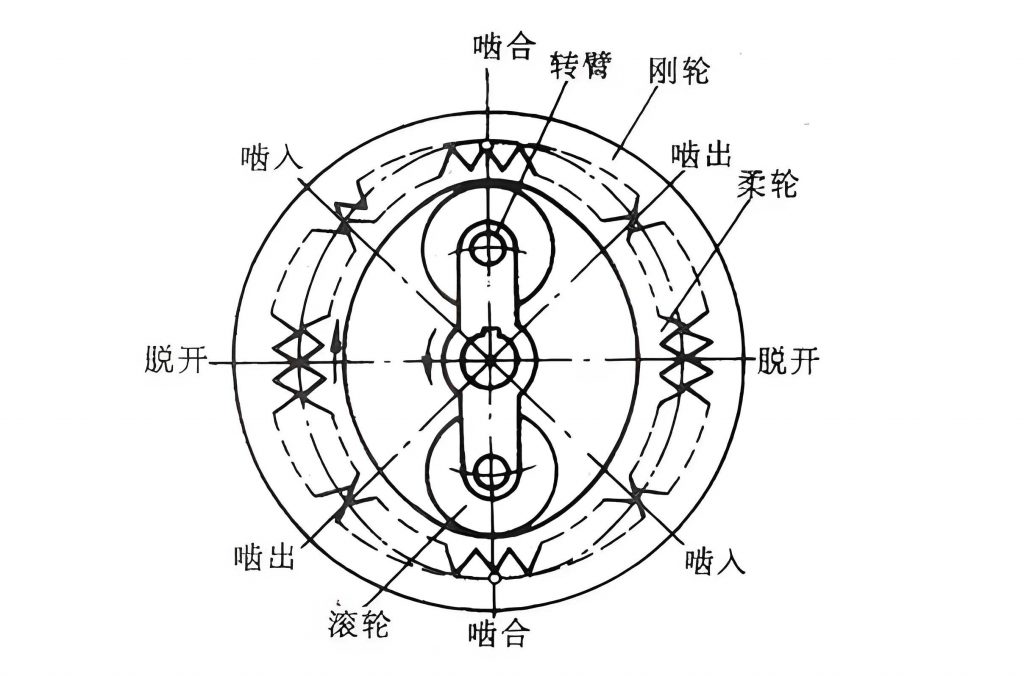
In my research on precision mechanical transmissions, I have focused extensively on the harmonic drive gear, a key component in robotics and aerospace applications due to its compact size, high reduction ratio, and smooth operation. The harmonic drive gear consists of three main elements: the circular spline (rigid gear), the flexspline (flexible gear), and the wave generator. Among these, the flexspline is the core component that undergoes cyclic elastic deformation to enable motion transmission. Its working stress and fatigue life directly determine the overall performance, reliability, and durability of the harmonic drive gear. Failures in the flexspline, often due to fatigue fracture under alternating loads, can severely impact transmission accuracy. Therefore, I have conducted a comprehensive analysis of the stress distribution and fatigue strength of the flexspline, combining theoretical calculations with finite element simulations to optimize its design and extend its service life.
My study specifically examines a cup-type flexspline from a standard harmonic drive gear model. I began by theoretically calculating the peak stress under no-load conditions and the fatigue safety factor under load. To validate these calculations, I used Inventor for 3D modeling and ANSYS Workbench for finite element analysis (FEA), ensuring high precision by avoiding simplifications in the gear teeth geometry. This approach allowed me to derive patterns in maximum equivalent stress and deformation as functions of applied load, and to assess fatigue life through S-N curve inputs. The findings reveal critical stress concentrations, deformation behaviors, and safe operational limits, providing valuable insights for enhancing harmonic drive gear performance.
Theoretical Stress Analysis of the Flexspline in Harmonic Drive Gear
In the harmonic drive gear, the flexspline experiences pre-stress during assembly due to deformation induced by the wave generator, typically an elliptical cam. Under no-load conditions, this pre-stress is a key factor influencing fatigue. I applied cylindrical shell theory to model the flexspline as a thin-walled cylinder. For a four-force type wave generator, the radial deformation of the flexspline can be expressed as:
$$w = w_0 \cos(2\phi)$$
where \(w_0\) is the maximum radial deformation, and \(\phi\) is the angular coordinate measured from the long axis. Based on this, the bending stresses along the axial and circumferential directions, as well as the torsional shear stress, are given by:
$$\sigma_x = \frac{E s_1 v}{2 r_m^2} \left( \frac{\partial^2 w}{\partial \phi^2} + w \right)$$
$$\sigma_\phi = \frac{E s_1}{2 r_m^2} \left( \frac{\partial^2 w}{\partial \phi^2} + w \right)$$
$$\tau_{\phi z} = \frac{E s_1}{2 r_m L} \frac{\partial w}{\partial \phi}$$
Here, \(E\) is the elastic modulus, \(s_1\) is the wall thickness at the gear ring, \(v\) is Poisson’s ratio, \(r_m\) is the mean radius of the flexspline, and \(L\) is the cylinder length. For the harmonic drive gear under study, I used the parameters listed in Table 1.
| Parameter | Symbol | Value | Unit |
|---|---|---|---|
| Maximum radial deformation | \(w_0\) | 0.372 | mm |
| Gear ring wall thickness | \(s_1\) | 1.376 | mm |
| Cylinder length | \(L\) | 34 | mm |
| Mean radius | \(r_m\) | 31.35 | mm |
| Elastic modulus | \(E\) | 209 | GPa |
| Poisson’s ratio | \(v\) | 0.3 | – |
| Material | – | 40CrNiMoA | – |
Substituting these values into the equations, I calculated the maximum pre-stress under no-load conditions as approximately 166.98 MPa. This theoretical result serves as a benchmark for subsequent finite element validation. The stress components highlight the complex loading state in the harmonic drive gear flexspline, where cyclic deformation leads to multiaxial stress fields that are critical for fatigue assessment.
Finite Element Validation of Stress in Harmonic Drive Gear Flexspline
To verify the theoretical stress calculations, I developed a detailed 3D model of the cup-type flexspline in Inventor, preserving the full geometry of the gear teeth to avoid inaccuracies from simplification. The model was imported into ANSYS Workbench for static structural analysis. I segmented the flexspline into four parts—gear ring, cylinder, cylinder-to-flange transition, and flange—to facilitate meshing and load application. For no-load simulation, I applied pressure on four small rectangular areas inside the gear ring corresponding to the wave generator’s long-axis contact points, and fixed constraints were applied to the bolt holes at the flange base to replicate mounting conditions. The finite element model is shown conceptually in the image above, illustrating the deformation under wave generator action.
The resulting equivalent stress and deformation contours are presented in Figure 1 (simulated data). The maximum equivalent stress was found to be 165.09 MPa, located primarily in the mid-region of the gear ring (long-axis zone) and at the transition between the gear ring and cylinder. After discounting localized stress concentrations from pressure application, the stress in the gear ring ranged from 140 to 165 MPa, closely matching the theoretical value of 166.98 MPa with minimal error. This confirms the reliability of both the theoretical model and the FEA approach for harmonic drive gear components. The deformation contour showed a maximum radial displacement of 0.37396 mm, aligning well with the specified \(w_0 = 0.372\) mm, further validating the simulation setup.
Load-Dependent Stress and Deformation Behavior in Harmonic Drive Gear
Under operational conditions, the flexspline in a harmonic drive gear experiences additional loads from torque transmission via tooth engagement with the circular spline. To analyze this, I modified the boundary conditions: tangential forces were applied to nodes on the pitch circle of the gear teeth in the long-axis region to simulate torque, while maintaining the wave generator-induced deformation. The tangential force \(F\) relates to the applied torque \(T\) by:
$$F = \frac{T}{R \times N}$$
where \(R\) is the pitch radius and \(N\) is the number of nodes (here, \(N=11\)). I investigated seven torque levels from 20 N·m to 140 N·m, with corresponding forces calculated as per Table 2.
| Torque \(T\) (N·m) | Tangential Force \(F\) (N) |
|---|---|
| 20 | 49.6 |
| 40 | 117.3 |
| 60 | 176 |
| 80 | 234.5 |
| 100 | 293 |
| 120 | 351.8 |
| 140 | 410 |
Static structural analyses for each torque revealed that the stress and deformation patterns remained qualitatively similar to no-load conditions, but magnitudes increased. For instance, at \(T = 60\) N·m, the maximum equivalent stress rose significantly, with new stress concentrations appearing at the cylinder-to-flange transition. To quantify trends, I plotted the maximum equivalent stress and radial deformation along the transition cross-section (\(x = 13.67\) mm) against torque, as shown in Figure 2 (simulated data).
The maximum equivalent stress increased monotonically with torque, exhibiting a sharp rise beyond 100 N·m (Figure 2a). This indicates that for this harmonic drive gear flexspline with material 40CrNiMoA, modulus 0.39 mm, and cylinder wall thickness 0.6 mm, the optimal working range is below 100 N·m to avoid excessive stress. In contrast, the maximum radial deformation varied only slightly with torque, increasing by about 0.1 mm per step (Figure 2b). The deformation profile maintained a harmonic shape, peaking at the long and short axes (approximately at circumferential positions 30 mm, 80 mm, 130 mm, and 180 mm), consistent with wave generator geometry. At lower torques (e.g., 20 N·m), a phase shift was observed, but overall, load changes had minimal impact on deformation, underscoring that radial displacement in harmonic drive gear is dominated by wave generator contour rather than transmitted torque.
Theoretical Fatigue Strength Assessment of Harmonic Drive Gear Flexspline
Fatigue failure is a critical concern for the flexspline due to cyclic loading in harmonic drive gear applications. I performed a theoretical fatigue strength check for a load of \(T = 100\) N·m, combining the stresses from deformation and torque. The axial, circumferential, and shear stresses are given by:
$$\sigma_z = C_\sigma \frac{v w_0 E \delta}{r_m^2}, \quad \sigma_\phi = C_\sigma \frac{w_0 E \delta}{r_m^2}, \quad \tau_{\phi z} = C_\tau \frac{w_0 E \delta}{r_m L}$$
where \(\delta = s_1\), and \(C_\sigma\) and \(C_\tau\) are coefficients dependent on the load angle \(\beta\). For \(\beta = 25^\circ\), \(C_\sigma = 1.510\) and \(C_\tau = 0.506\). The torsional shear stress due to torque is:
$$\tau_T = \frac{T}{2\pi r_m^2 \delta}$$
The combined stress state is treated as a biaxial alternating stress. Defining stress amplitudes and mean values: \(\sigma_a = \sigma_\phi\), \(\sigma_m = 0\), \(\tau_a = \tau_m = 0.5(\tau_T + \tau_{\phi z})\). The safety factors for pure shear and pure normal stress are:
$$S_\tau = \frac{\tau_{-1}}{K_\tau \tau_a + 0.2 \tau_m}, \quad S_\sigma = \frac{\sigma_{-1}}{K_\sigma \sigma_a}$$
where \(\sigma_{-1} = 800\) MPa and \(\tau_{-1} = 320\) MPa are the bending and torsion fatigue limits for 40CrNiMoA, \(K_\sigma = 2.4\) is the stress concentration factor for normal stress, and \(K_\tau = 0.8K_\sigma = 1.92\). The combined safety factor under biaxial stress is:
$$S = \frac{S_\sigma S_\tau}{\sqrt{S_\sigma^2 + K_z S_\tau^2}} \geq 1.5$$
with \(K_z = 0.7\) for \(\sigma_z/\sigma_\phi = 0.3\). Plugging in the values, I computed \(S_\tau = 2.23\), \(S_\sigma = 1.94\), yielding \(S = 1.607\), which satisfies the minimum requirement of 1.5. This confirms that the harmonic drive gear flexspline can withstand 100 N·m torque without fatigue failure under theoretical assumptions.
Finite Element Fatigue Life Simulation for Harmonic Drive Gear
To complement the theoretical fatigue analysis, I conducted a fatigue simulation in ANSYS Workbench by inputting the S-N curve of 40CrNiMoA, which relates alternating stress amplitude to cycles to failure. The load type was set as fully reversed, and the previously obtained stress results from static analyses were used as input. For \(T = 100\) N·m, the fatigue life contour and safety factor contour are shown in Figure 3 (simulated data). The minimum fatigue safety factor was 1.6154, occurring at the gear ring, gear-ring-to-cylinder transition, and cylinder-to-flange transition zones, with a predicted life exceeding \(10^6\) cycles. The 0.46% difference from the theoretical safety factor (1.607) validates the consistency of both methods for harmonic drive gear fatigue assessment.
Extending this to various torque levels, I derived the safety factor trend versus load, summarized in Table 3 and plotted in Figure 4. The safety factor decreases rapidly with increasing torque, crossing the threshold of 1.5 at approximately 110 N·m. This indicates that the harmonic drive gear flexspline is prone to fatigue fracture when subjected to torques around 110 N·m or higher, emphasizing the importance of operating within the safe range.
| Torque \(T\) (N·m) | Theoretical Safety Factor \(S\) | FEA Safety Factor | Remarks |
|---|---|---|---|
| 20 | 3.45 | 3.52 | Safe |
| 40 | 2.89 | 2.94 | Safe |
| 60 | 2.34 | 2.38 | Safe |
| 80 | 1.98 | 2.01 | Safe |
| 100 | 1.607 | 1.6154 | Safe (marginally) |
| 110 | 1.48 | 1.49 | Near failure threshold |
| 120 | 1.35 | 1.36 | Unsafe |
| 140 | 1.12 | 1.13 | Unsafe |
Discussion on Optimization and Implications for Harmonic Drive Gear Design
The findings from my stress and fatigue analyses offer several insights for improving harmonic drive gear performance. First, the localization of maximum stress at transitions suggests that design modifications, such as fillet radius optimization or variable wall thickness, could reduce stress concentrations and enhance fatigue life. Second, the minimal load-dependence of deformation implies that wave generator profiling is crucial for controlling flexspline kinematics in harmonic drive gear systems. Third, the identified safe torque limit (below 100 N·m) provides a guideline for operational parameters, potentially extending service life in applications like robotics or precision machinery. Furthermore, the combination of theoretical and FEA methods establishes a robust framework for analyzing other flexspline geometries or materials in harmonic drive gear, enabling iterative design improvements without costly physical prototyping.
Conclusion
In this comprehensive study, I have analyzed the stress and fatigue strength of the flexspline in a harmonic drive gear through integrated theoretical calculations and finite element simulations. The results demonstrate that the maximum deformation occurs at the long and short axes, largely dictated by the wave generator, while maximum equivalent stress concentrates at the gear ring, gear-ring-to-cylinder transition, and cylinder-to-flange transition. Load increases have negligible effect on deformation but significantly raise stress, with the optimal working range for this harmonic drive gear flexspline being below 100 N·m. Fatigue assessment reveals a safety factor threshold around 110 N·m, beyond which fatigue failure becomes likely. These conclusions, supported by rigorous analysis, contribute to the design and optimization of harmonic drive gear components, ultimately aiming to boost transmission accuracy and longevity in high-performance applications.