
In the field of precision motion control and robotics, harmonic drive gears are widely recognized for their high torque capacity, compact design, and near-zero backlash performance when properly designed. However, the meshing backlash remains a critical factor influencing the operational accuracy, dynamic response, and overall efficiency of harmonic drive systems. Backlash, defined as the clearance between mating teeth during gear engagement, can lead to positioning errors, vibration, and reduced system stiffness, particularly in servo applications. Therefore, accurate prediction and control of backlash are essential for optimizing harmonic drive gear performance. This paper addresses the challenge of precisely calculating backlash in harmonic drive gears with involute tooth profiles, leveraging an advanced envelope-based conjugate algorithm that accounts for the flexible spline’s deformation under assembly conditions. We focus on developing a methodology that integrates precise deformation modeling, conjugate tooth profile generation, curve fitting for circular spline modification, and comprehensive backlash computation. By emphasizing the involute tooth form, which is common in industrial harmonic drive gears, we aim to provide engineers with a reliable tool for designing low-backlash harmonic drive transmissions.
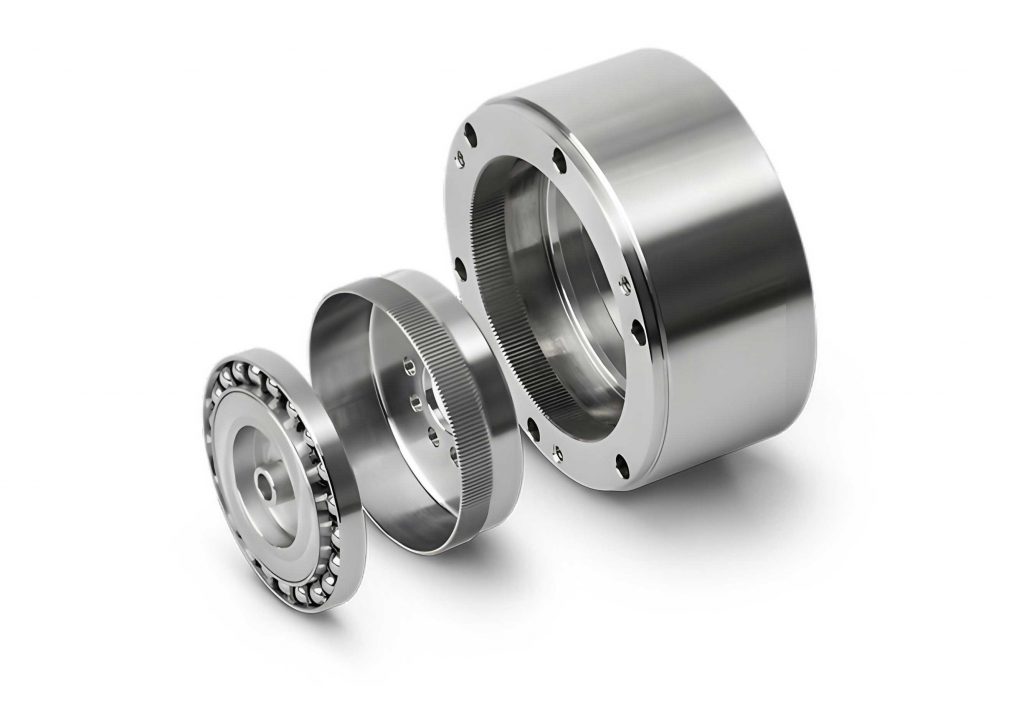
The harmonic drive gear operates on the principle of elastic deformation, where a flexible spline (flexspline) is deformed by a wave generator into an elliptical shape, engaging with a rigid circular spline (circular spline) at two diametrically opposite regions. This unique mechanism allows for high reduction ratios in a single stage, but it also introduces complex kinematic and contact behaviors due to the flexspline’s continuous elastic deformation. The backlash in such systems is not constant; it varies along the tooth profile and across different engagement positions, influenced by factors such as tooth geometry, material properties, and assembly preload. Traditional methods for backlash estimation often rely on simplified assumptions, such as neglecting the precise effects of tangential displacement and tooth symmetry line rotation, leading to inaccuracies in high-precision applications. Our approach utilizes an envelope precise algorithm that explicitly models the flexspline’s deformed position, enabling more accurate determination of conjugate tooth profiles and, consequently, backlash values. This is particularly relevant for involute harmonic drive gears, where the tooth profile’s mathematical definition allows for analytical treatment but requires careful consideration of deformation-induced changes.
We begin by reviewing the fundamental concepts of harmonic drive gear operation and backlash significance. The backlash in harmonic drive gears is typically measured as circumferential clearance between teeth, and its minimization is crucial for applications like robotic joints, aerospace actuators, and medical devices, where repeatability and precision are paramount. Previous studies have explored various aspects of harmonic drive gear backlash, including finite element analyses, thermal effects, and initial clearance modeling. However, many of these works either simplify the tooth engagement mechanics or focus on non-involute profiles, leaving a gap for precise involute-specific methods. Our work builds upon conjugate theory and elastic deformation models to address this gap. The core of our methodology involves three main steps: first, applying the envelope precise algorithm to determine the conjugate tooth profile of the circular spline based on the deformed flexspline position; second, using curve fitting techniques to approximate this conjugate profile with a standard involute curve, thereby obtaining the modification coefficient for the circular spline; and third, computing the backlash distribution across the engagement zone. Through detailed numerical examples, we demonstrate that the minimum backlash in involute harmonic drive gears occurs either at the flexspline tooth tip or the circular spline tooth tip, depending on the position relative to the maximum radial deformation. This finding has practical implications for gear design and tolerance allocation.
To establish the mathematical foundation, we define the coordinate systems and deformation parameters for the harmonic drive gear. Consider a fixed coordinate system \(\{OXY\}\) attached to the wave generator, with the Y-axis aligned with the generator’s long axis and origin O at the generator center. Two moving coordinate systems \(\{o_1x_1y_1\}\) and \(\{o_2x_2y_2\}\) are attached to the flexspline and circular spline, respectively. The flexspline undergoes deformation characterized by radial displacement \(w(\phi)\) and tangential displacement \(\nu(\phi)\), where \(\phi\) is the angular coordinate of the flexspline’s neutral axis before deformation. The deformed position of the flexspline is described by the polar radius \(\rho(\phi) = r_m + w(\phi)\), with \(r_m\) being the nominal radius of the flexspline middle surface. According to the conjugate theory, the tooth profile of the flexspline, defined in its local coordinates, envelopes the tooth profile of the circular spline during motion. The envelope condition leads to a set of parametric equations that describe the conjugate profile. For an involute tooth profile on the flexspline, the parametric equations in the flexspline coordinate system are given by:
$$ \begin{cases}
x_1 = r_1[-\sin(u – \theta_1) + u \cos\alpha_0 \cos(u – \theta_1 + \alpha_0)] \\
y_1 = r_1[\cos(u – \theta_1) + u \cos\alpha_0 \sin(u – \theta_1 + \alpha_0)] – r_m
\end{cases} $$
where \(r_1\) is the flexspline pitch radius, \(u\) is the rolling angle parameter (related to the involute development), \(\alpha_0\) is the standard pressure angle, and \(\theta_1\) is half of the angular tooth thickness on the pitch circle. The envelope precise algorithm accounts for the rotation of the tooth symmetry line relative to the radial vector, denoted as \(\mu(\phi)\), and the angular shift due to tangential displacement. Unlike simplified approaches that approximate \(\mu(\phi) \approx -\frac{1}{r_m} \frac{dw}{d\phi}\), our precise algorithm computes \(\mu(\phi)\) exactly using differential geometry:
$$ \mu(\phi) = -\arctan\left( \frac{\frac{dw}{d\phi}(\phi)}{r_m + w(\phi)} \right) $$
Additionally, the incompressibility condition of the middle surface (no stretching) relates the angular coordinates before and after deformation:
$$ \phi = \int_0^{\phi_1} \sqrt{ \left(1 + \frac{w}{r_m}\right)^2 + \left( \frac{1}{r_m} \frac{dw}{d\phi} \right)^2 } \, d\phi $$
where \(\phi_1\) is the angular coordinate on the deformed flexspline. This integral equation is solved iteratively to obtain \(\phi_1\) as a function of \(\phi\). With these precise deformation parameters, the conjugate tooth profile of the circular spline can be derived. The general form of the conjugate profile equations in the circular spline coordinate system \(\{o_2x_2y_2\}\) is expressed as:
$$ \begin{cases}
x_2 = r_1(\sin \varepsilon + u_1 \cos\alpha_0 \cos\lambda) – r_m \sin\Phi + \rho \sin \gamma \\
y_2 = r_1(\cos \varepsilon – u_1 \cos\alpha_0 \sin\lambda) – r_m \cos\Phi + \rho \cos \gamma \\
r_1 \frac{d\Phi}{d\phi} (\cos\alpha_0 \sin\alpha_0 + u_1 \cos^2\alpha_0) – r_m \frac{d\Phi}{d\phi} [\sin(\varepsilon – \Phi) + \cos\alpha_0 \sin(\Phi – \lambda) + u_1 \cos\alpha_0 \cos(\Phi – \lambda)] \\
\quad – \frac{d\rho}{d\phi} [\cos\alpha_0 \cos(\lambda – \gamma) – \cos(\varepsilon – \gamma) + u_1 \cos\alpha_0 \sin(\lambda – \gamma)] \\
\quad – \rho \frac{d\gamma}{d\phi} [\cos\alpha_0 \sin(\lambda – \gamma) – \sin(\varepsilon – \gamma) – u_1 \cos\alpha_0 \cos(\lambda – \gamma)] = 0
\end{cases} $$
where the auxiliary angles are defined as: \(\gamma = \phi_1 – \phi_2\), \(\Phi = \mu + \gamma\), \(\varepsilon = \Phi – (u_1 – \theta_1)\), and \(\lambda = \Phi – (u_1 – \theta_1 + \alpha_0)\). Here, \(u_1\) is the rolling angle parameter for the flexspline tooth, \(\phi_2\) is the rotation angle of the circular spline, and the equation set ensures the envelope condition for conjugate motion. Solving these equations numerically yields a set of discrete points \((x_{2k}, y_{2k})\) representing the theoretical tooth profile of the circular spline that perfectly conjugates with the deformed involute flexspline. This profile is generally not a standard involute, necessitating a curve fitting step to make it manufacturable with standard gear cutting tools.
The next step involves fitting the theoretical conjugate profile with a standard involute curve to determine the modification coefficient (also known as addendum modification or profile shift coefficient) for the circular spline. This is crucial because harmonic drive gears are typically produced using standard gear hobs or shaping tools that generate involute profiles. The fitting process aims to find an involute curve that closely approximates the conjugate profile while ensuring no interference (i.e., positive clearance) at all points. Let the theoretical profile points be denoted as \(G: (x_{2k}, y_{2k})\) for \(k = 1, 2, \dots, n\). We consider a candidate involute curve \(G_W\) described in the circular spline coordinate system by:
$$ \begin{cases}
x_{2W} = r_2[\sin(\phi_2 – (u_2 – \theta_2)) + u_2 \cos\alpha_0 \cos(\phi_2 – (u_2 – \theta_2 + \alpha_0))] \\
y_{2W} = r_2[\cos(\phi_2 – (u_2 – \theta_2)) + u_2 \cos\alpha_0 \sin(\phi_2 – (u_2 – \theta_2 + \alpha_0))]
\end{cases} $$
where \(r_2\) is the circular spline pitch radius, \(u_2\) is the rolling angle parameter for the circular spline involute, and \(\theta_2\) is half of the angular space width on the pitch circle, related to the modification coefficient \(x_2\) by \(\theta_2 = \frac{e}{2r_2}\), with \(e\) being the space width. For each theoretical point \(k\), we compute the radial distance \(r_k = \sqrt{x_{2k}^2 + y_{2k}^2}\) and find the corresponding point on the involute curve \(G_W\) at the same radius. The pressure angle at that point is \(\alpha_{2k} = \arccos\left( \frac{r_2 \cos\alpha_0}{r_k} \right)\), and the parameter \(u_{2k} = \tan\alpha_{2k} – \tan\alpha_0\). The fitting objective is to minimize the average distance between \(G\) and \(G_W\) while ensuring no interference, i.e., \( \Delta x_k = x_{2Wk} – x_{2k} \geq 0 \) for all points. The average distance is computed as:
$$ \epsilon_m = \frac{1}{n} \sum_{k=1}^n d_k, \quad \text{where} \quad d_k = \sqrt{(x_{2Wk} – x_{2k})^2 + (y_{2Wk} – y_{2k})^2} $$
Thus, the optimization problem is to find the modification coefficient \(x_2\) that minimizes \(\epsilon_m\) subject to \(\Delta x_k \geq 0\). This nonlinear optimization can be solved using numerical methods such as gradient descent or simplex algorithms. Once \(x_2\) is determined, the circular spline tooth profile is fully defined as a standard involute with the calculated modification, making it practical for manufacturing. This curve fitting approach ensures that the harmonic drive gear maintains the desired conjugate action while using standard tooling, which is a key advantage for industrial production of harmonic drive gears.
With both the flexspline and circular spline tooth profiles established, we proceed to calculate the backlash distribution across the engagement zone. Backlash is evaluated as the circumferential clearance between adjacent tooth flanks when the gears are in a stationary meshing position. For any given engagement position defined by the angle \(\phi\) (location along the flexspline), we compute the clearance at multiple points along the tooth height to find the minimum backlash at that position. The backlash is expressed in terms of circumferential clearance \(j_t\), which can be approximated from the Cartesian coordinates of corresponding points on the two tooth profiles. Consider a point \(K_1\) on the flexspline tooth profile, with coordinates \((X_{K1}, Y_{K1})\) in the fixed coordinate system \(\{OXY\}\). Using a geometric construction, we find the intersection point \(K_2\) on the adjacent circular spline tooth profile that lies at the same radial distance from the center. The coordinates of \(K_1\) are given by:
$$ \begin{cases}
X_{K1} = r_1\{\sin[\psi – (u_{k1} – \theta_1)] + u_{k1} \cos\alpha_0 \cos[\psi – (u_{k1} – \theta_1 + \alpha_0)]\} + \rho \sin\phi_1 – r_m \sin\psi \\
Y_{K1} = r_1\{\cos[\psi – (u_{k1} – \theta_1)] – u_{k1} \cos\alpha_0 \sin[\psi – (u_{k1} – \theta_1 + \alpha_0)]\} + \rho \cos\phi_1 – r_m \cos\psi
\end{cases} $$
where \(\psi = \phi_1 + \mu\), and \(u_{k1}\) is the rolling angle parameter for the flexspline point. The coordinates of \(K_2\) on the circular spline are:
$$ \begin{cases}
X_{K2} = r_2\{\sin[\phi_2 – (u_{k2} – \theta_2)] + u_{k2} \cos\alpha_0 \cos[\phi_2 – (u_{k2} – \theta_2 + \alpha_0)]\} \\
Y_{K2} = r_2\{\cos[\phi_2 – (u_{k2} – \theta_2)] + u_{k2} \cos\alpha_0 \sin[\phi_2 – (u_{k2} – \theta_2 + \alpha_0)]\}
\end{cases} $$
The circumferential backlash \(j_t\) is then approximated by the Euclidean distance between these points:
$$ j_t \approx \sqrt{(X_{K2} – X_{K1})^2 + (Y_{K1} – Y_{K2})^2} $$
By varying \(u_{k1}\) and \(u_{k2}\) across the tooth active profile (from root to tip), we obtain a set of backlash values for each engagement position \(\phi\). The minimum backlash at that \(\phi\) is the smallest value among these computations. Typically, the minimum backlash occurs either at the flexspline tooth tip (where \(u_{k1}\) corresponds to the addendum) or at the circular spline tooth tip (where \(u_{k2}\) corresponds to the addendum), depending on the deformation zone. This calculation is repeated for multiple \(\phi\) values around the engagement region to map the backlash distribution along the gear circumference. The results provide insights into the sensitivity of backlash to design parameters and deformation characteristics, guiding the optimization of harmonic drive gear systems for minimal clearance.
To illustrate the application of our methodology, we present a detailed numerical example for a double-wave harmonic drive gear with involute teeth. The key parameters are summarized in the table below:
| Parameter | Symbol | Value |
|---|---|---|
| Number of teeth (flexspline) | \(z_1\) | 140 |
| Number of teeth (circular spline) | \(z_2\) | 142 |
| Module | \(m\) | 0.2 mm |
| Standard pressure angle | \(\alpha_0\) | 20° |
| Helix angle | \(\beta\) | 30° |
| Flexspline modification coefficient | \(x_1\) | 2.13 |
| Maximum radial deformation | \(w_0\) | \(1.0 \times m = 0.2\) mm |
| Flexspline pitch radius | \(r_1\) | \(m z_1 / 2 = 14.0\) mm |
| Circular spline pitch radius | \(r_2\) | \(m z_2 / 2 = 14.2\) mm |
| Neutral radius of flexspline | \(r_m\) | Approx. 14.0 mm (assumed equal to \(r_1\) for simplicity) |
Using these parameters, we first compute the conjugate tooth profile of the circular spline via the envelope precise algorithm. The radial deformation function \(w(\phi)\) is modeled as a sinusoidal wave consistent with double-wave harmonic drive geometry: \(w(\phi) = w_0 \cos(2\phi)\), where \(\phi\) ranges from 0° to 180° for one wave cycle. We apply both the precise algorithm and a simplified algorithm (using the approximation \(\mu \approx -\frac{1}{r_m} \frac{dw}{d\phi}\)) for comparison. The resulting conjugate profiles are discretized into points, and the differences are minimal visually but notable in precise values. The table below shows a sample of computed points for the conjugate profile at \(\phi = 0°\) (maximum deformation point):
| Point Index | Precise Algorithm \(x_2\) (mm) | Precise Algorithm \(y_2\) (mm) | Simplified Algorithm \(x_2\) (mm) | Simplified Algorithm \(y_2\) (mm) |
|---|---|---|---|---|
| 1 | 13.952 | 0.101 | 13.951 | 0.102 |
| 2 | 13.876 | 0.205 | 13.875 | 0.206 |
| 3 | 13.772 | 0.301 | 13.771 | 0.302 |
| 4 | 13.642 | 0.388 | 13.641 | 0.389 |
| 5 | 13.488 | 0.464 | 13.487 | 0.465 |
Next, we perform curve fitting on the conjugate profile points to determine the modification coefficient \(x_2\) for the circular spline. Using the optimization procedure described earlier, we obtain the following results:
| Algorithm Type | Optimal Modification Coefficient \(x_2\) | Average Fitting Error \(\epsilon_m\) (mm) | Maximum Interference \(\min(\Delta x_k)\) (mm) |
|---|---|---|---|
| Precise Algorithm | 1.861 | 0.0021 | 0.0005 |
| Simplified Algorithm | 1.859 | 0.0022 | 0.0006 |
The slight difference in \(x_2\) values (1.861 vs. 1.859) indicates that the precise deformation modeling has a small but measurable impact on the designed tooth geometry. This underscores the importance of accurate deformation accounting in high-precision harmonic drive gear design. With \(x_2\) known, we proceed to backlash calculation. We evaluate backlash at various engagement positions \(\phi\) from -54° to 54° relative to the wave generator long axis (Y-axis), covering the primary engagement zones. For each \(\phi\), we compute backlash at two critical points: (1) between the circular spline tooth tip and the flexspline tooth profile, and (2) between the flexspline tooth tip and the circular spline tooth profile. The minimum backlash at each \(\phi\) is the smaller of these two values. The results are summarized in the table below for selected \(\phi\) angles:
| Engagement Angle \(\phi\) (degrees) | Backlash at Circular Spline Tip (mm) | Backlash at Flexspline Tip (mm) | Minimum Backlash (mm) | Location of Minimum Backlash |
|---|---|---|---|---|
| -18.0 | 0.0123 | 0.0156 | 0.0123 | Circular spline tip |
| -12.8571 | 0.0108 | 0.0141 | 0.0108 | Circular spline tip |
| -7.7143 | 0.0095 | 0.0129 | 0.0095 | Circular spline tip |
| 0.0 (max deformation) | 0.0082 | 0.0118 | 0.0082 | Circular spline tip |
| 5.1429 | 0.0091 | 0.0089 | 0.0089 | Flexspline tip |
| 23.1429 | 0.0142 | 0.0103 | 0.0103 | Flexspline tip |
| 33.4285 | 0.0187 | 0.0121 | 0.0121 | Flexspline tip |
| 41.1429 | 0.0225 | 0.0140 | 0.0140 | Flexspline tip |
| 54.0 | 0.0283 | 0.0172 | 0.0172 | Flexspline tip |
The data reveal a clear pattern: for engagement angles on the left side of the maximum radial deformation (negative \(\phi\)), the minimum backlash occurs at the circular spline tooth tip, whereas on the right side (positive \(\phi\)), it occurs at the flexspline tooth tip. This asymmetry is due to the directional nature of the flexspline deformation and the resulting conjugate motion. Notably, the absolute minimum backlash across all positions is not at the maximum deformation point (\(\phi = 0°\)) but shifted towards the positive side, at approximately \(\phi = 5.1429°\), where the backlash values from both tips are nearly equal. This shift angle of about 5.1429° aligns with findings from prior research and highlights the importance of considering deformation-induced phase shifts in backlash analysis. The backlash values are generally small (on the order of micrometers to tens of micrometers), consistent with the high-precision nature of harmonic drive gears. To further analyze the algorithmic differences, we compare the minimum backlash curves obtained from the precise and simplified algorithms over the full engagement range. The results are plotted numerically in the following table for key angles:
| Angle \(\phi\) (degrees) | Minimum Backlash (Precise) (mm) | Minimum Backlash (Simplified) (mm) | Difference (Precise – Simplified) (mm) |
|---|---|---|---|
| -18.0 | 0.0123 | 0.0124 | -0.0001 |
| -7.7143 | 0.0095 | 0.0096 | -0.0001 |
| 0.0 | 0.0082 | 0.0083 | -0.0001 |
| 5.1429 | 0.0089 | 0.0090 | -0.0001 |
| 23.1429 | 0.0103 | 0.0104 | -0.0001 |
| 41.1429 | 0.0140 | 0.0141 | -0.0001 |
| 54.0 | 0.0172 | 0.0173 | -0.0001 |
The precise algorithm consistently yields slightly smaller minimum backlash values (by about 0.0001 mm or 0.1 µm) compared to the simplified algorithm, though both follow the same trend. This difference, while small, can be significant in ultra-precision harmonic drive gear applications where sub-micrometer backlash is targeted. The larger discrepancies appear in the maximum backlash values, not tabulated here, where the precise algorithm predicts up to 0.5% higher clearance in some regions due to more accurate deformation modeling. These findings emphasize that while simplified algorithms are useful for initial design, the precise algorithm provides enhanced accuracy for final optimization, especially when dealing with tight tolerance requirements in harmonic drive gear systems.
Our analysis also considers the impact of design parameters on backlash. For instance, varying the flexspline modification coefficient \(x_1\) or the maximum radial deformation \(w_0\) alters the conjugate profile and thus the backlash distribution. Generally, increasing \(w_0\) reduces backlash but may risk tooth interference if not properly managed. The curve fitting step ensures that interference is avoided by enforcing \(\Delta x_k \geq 0\), but designers must still verify other interference types (e.g., root fillet interference). Additionally, the number of teeth and module size influence the backlash magnitude; finer pitches tend to reduce backlash but increase manufacturing complexity. The methodology presented here can be extended to parametric studies by automating the envelope, fitting, and backlash calculations, enabling rapid evaluation of multiple design variants for harmonic drive gears.
In conclusion, this paper has detailed a comprehensive approach for calculating backlash in involute harmonic drive gears based on an envelope precise algorithm. We have demonstrated that accurate modeling of flexspline deformation, including precise computation of tooth symmetry line rotation and tangential displacement effects, leads to more reliable conjugate tooth profiles and backlash predictions. The curve fitting method allows for practical implementation with standard involute gear tools, determining the optimal modification coefficient for the circular spline. Our numerical example for a double-wave harmonic drive gear reveals that minimum backlash occurs at either the flexspline tooth tip or circular spline tooth tip, depending on the engagement position relative to the maximum deformation, with a shift angle of approximately 5.1429° observed. Comparison between precise and simplified algorithms shows that the precise algorithm yields marginally smaller minimum backlash values, highlighting its value for high-accuracy applications. These insights contribute to the design and optimization of harmonic drive gears for minimal backlash, enhancing performance in precision motion systems. Future work could explore dynamic backlash under load, thermal effects, and non-involute tooth profiles to further advance harmonic drive gear technology.
The methodology outlined here is not only applicable to standard harmonic drive gears but also adaptable to customized designs, such as those with modified tooth profiles or multi-wave configurations. By integrating the envelope precise algorithm into computer-aided design (CAD) or finite element analysis (FEA) software, engineers can perform virtual prototyping and backlash optimization efficiently. This aligns with industry trends towards digital twins and simulation-driven design for high-performance mechanical transmissions. As the demand for precision robotics and aerospace systems grows, the ability to accurately predict and control backlash in harmonic drive gears will remain a critical enabler of innovation. We hope this work serves as a valuable reference for researchers and practitioners working on advanced gear systems, particularly those involving harmonic drive mechanisms with involute teeth.