
In the field of precision mechanical transmissions, harmonic drive gears represent a critical technology due to their unique advantages, including high reduction ratios, compact design, and excellent positional accuracy. As a researcher deeply involved in the study of harmonic drive gear systems, I have observed that while significant progress has been made in understanding their behavior under no-load conditions, the accurate prediction of deformation under operational loads remains a complex challenge. This is particularly true for the flexspline component, which undergoes elastic deformation induced by the wave generator and is further influenced by the meshing forces during power transmission. The load deformation directly affects the backlash distribution, meshing force equilibrium, and ultimately, the performance and longevity of the harmonic drive gear. Therefore, in this comprehensive study, I aim to develop and validate a theoretical framework for calculating the load-induced deformation of the flexspline in a harmonic drive gear, with a specific focus on incorporating the radial deformation of the flexible bearing—a component often idealized in prior analyses.
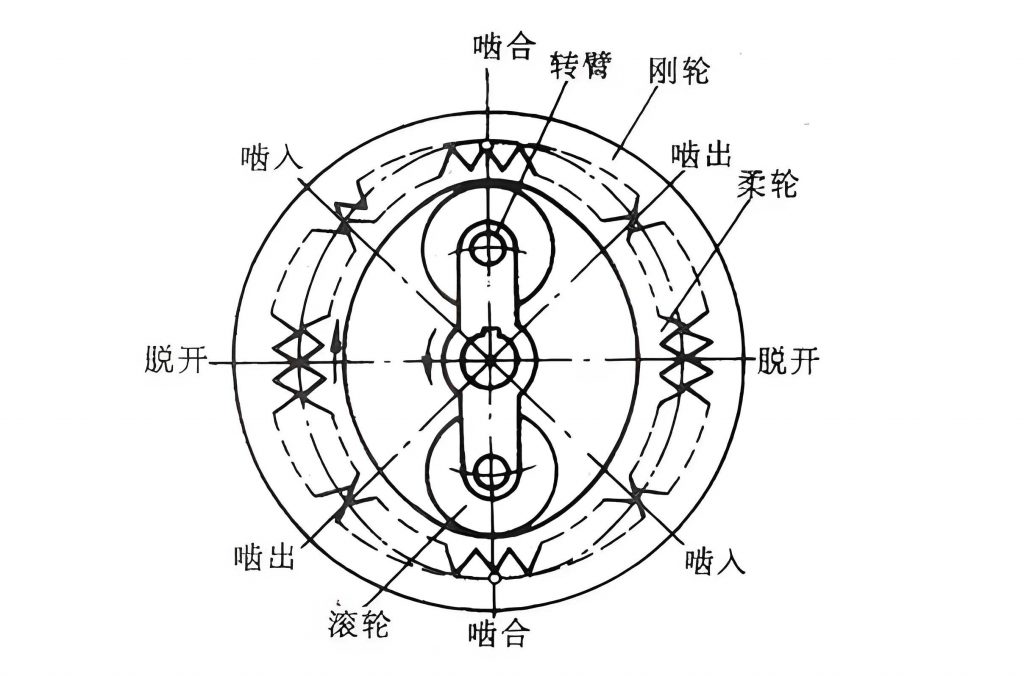
The harmonic drive gear operates on the principle of elastic mechanics, where a non-rigid flexspline engages with a rigid circular spline via a wave generator. This mechanism allows for motion transmission with minimal backlash and high torque capacity. However, under load, the meshing forces between the teeth of the flexspline and circular spline introduce additional radial and circumferential stresses. These forces are transmitted through the flexspline body to the flexible bearing, which supports the wave generator. The flexible bearing itself is not infinitely rigid; it compresses radially under load, causing a shift in the position of the flexspline tooth ring relative to the wave generator’s theoretical elliptical contour. This shift alters the effective tooth clearance and can lead to uneven load distribution among the engaging teeth. Consequently, a precise model for the load deformation in a harmonic drive gear must account for this radial compliance of the flexible bearing, a factor that has not been thoroughly integrated into analytical models previously.
To establish a foundational understanding, I begin with the Hertzian contact theory, which governs the elastic deformation at the contact points between the rolling elements (balls) and the raceways in the flexible bearing. For a single ball subjected to a radial force \( F_r \), the contact area is elliptical, and the pressure distribution is semi-ellipsoidal. The maximum contact pressure \( q_{\text{max}} \) at the center of the contact ellipse is given by:
$$ q_{\text{max}} = \frac{3F_r}{2\pi a b} $$
where \( a \) and \( b \) are the semi-major and semi-minor axes of the contact ellipse, respectively. These axes depend on the geometry of the contacting bodies and the material properties. The total elastic approach \( \delta \) (the mutual displacement of the two bodies along the line of force) for a ball-inner raceway contact can be derived as:
$$ \delta_1 = \delta_i \left[ \frac{3F_r (1 – \mu^2)/E}{\rho_i} \right]^{2/3} \rho_i^2 $$
Here, \( \delta_i \) is a dimensionless coefficient dependent on the ellipticity of the contact, \( \mu \) is Poisson’s ratio, \( E \) is the modulus of elasticity, and \( \rho_i \) is the sum of principal curvatures at the contact point for the inner raceway and ball. A similar expression holds for the ball-outer raceway contact \( \delta_2 \). Therefore, the total radial deformation \( \delta_r \) for a single ball in the flexible bearing under radial load is the sum of these two approaches:
$$ \delta_r = \delta_1 + \delta_2 $$
This relationship essentially defines the radial stiffness of a single ball contact. For the entire flexible bearing, which contains multiple balls (e.g., 23 balls in a typical configuration), the load distribution among the balls must be considered. In a harmonic drive gear, the radial force on the bearing arises from the radial components of the tooth meshing forces. Assuming the flexspline has relatively low bending stiffness compared to the bearing, the radial force from the tooth ring can be partitioned into angular sectors corresponding to each ball’s circumferential position. The radial force \( F_r \) on a tooth is related to its tangential meshing force \( F_t \) by the pressure angle \( \alpha \):
$$ F_r = F_t \tan \alpha $$
By summing the radial forces within each ball’s load zone and applying the single-ball deformation formula, the local radial displacement of the flexspline tooth ring caused by the bearing compression can be determined. This displacement is a key input for calculating the overall load deformation of the harmonic drive gear’s flexspline.
The deformation of the flexspline tooth ring under load is not merely radial; it also involves circumferential stretching due to the tangential meshing forces. The total meshing force distribution around the circumference can be decomposed into a constant average component, which is in equilibrium with the output torque, and a variable component, which causes circumferential elongation of the tooth ring. The average tangential force \( F_{t0} \) over the engaged arc (e.g., the upper half between the short axes) is:
$$ F_{t0} = \frac{2 \sum_{\varphi = -\pi/2}^{\pi/2} F_{\varphi}}{n_1} $$
where \( F_{\varphi} \) is the meshing force at angular position \( \varphi \), and \( n_1 \) is the number of teeth on the flexspline. The variable component causing stretch is \( F_{rt} = F_t – F_{t0} \). The circumferential displacement \( v_P \) at a point due to this stretching, considering the tooth ring as a thin-walled cylinder, is approximated by:
$$ v_P = \int_0^{\varphi} \frac{k F_{rt} r_m}{E b_w s} \, d\varphi $$
Here, \( k \) is a coefficient accounting for additional load factors, \( r_m \) is the mean radius of the flexspline neutral surface, \( b_w \) is the width of the tooth ring, and \( s \) is the wall thickness of the flexspline.
With these components, the total deformation of the flexspline tooth ring in a harmonic drive gear under load can be described piecewise around the circumference. I define the coordinate system with the long axis at \( \varphi = 0 \) and the short axis at \( \varphi = \pi/2 \). The tooth ring is in contact with the wave generator on the long axis right side (the meshing-in region, \( 0 \le \varphi \le \pi/2 \)) and separates on the long axis left side (the meshing-out region, \( -\pi/2 \le \varphi < 0 \)). For the meshing-in region (AB segment), the radial displacement \( w_1 \) and circumferential displacement \( v_1 \) are:
$$
\begin{aligned}
w_1 &= w_H – u – w_r \\
v_1 &= -\int_0^{\varphi} w_H \, d\varphi + u\varphi + \frac{\varphi w_r^2}{2} + v_P
\end{aligned}
$$
In these equations, \( w_H \) is the radial deformation imposed by the elliptical wave generator under no-load conditions (often described by an elliptical function), \( u \) is the initial clearance between the flexspline and the wave generator, and \( w_r \) is the radial deformation due to the flexible bearing compression calculated earlier. For the meshing-out region, the deformation is more complex. Near the long axis left side, a segment (AM) forms a circular arc of constant radius, given by:
$$
\begin{aligned}
w_2 &= w_{H0} – u – \delta_{r_{\text{max}}} \\
v_2 &= -(w_{H0} – u – \delta_{r_{\text{max}}}) \varphi
\end{aligned}
$$
where \( w_{H0} \) is the maximum radial deformation at the long axis under no-load, and \( \delta_{r_{\text{max}}} \) is the maximum radial deformation of the bearing corresponding to the highest load on a ball. The remaining segment (MB’) towards the short axis is described by a free-form curve satisfying continuity conditions at points M and B’. The radial displacement \( w_3 \) and circumferential displacement \( v_3 \) for this segment are:
$$
\begin{aligned}
w_3 &= w_2 \left[ B_1 \left( \frac{\pi}{2} – \varphi \right) \cos \varphi + B_2 \sin \varphi + C_0 \right] \\
v_3 &= w_2 \left[ B_1 \left( \frac{\pi}{2} – \varphi \right) \sin \varphi – (B_1 + B_2) \cos \varphi + C_0 \varphi + C_1 \right]
\end{aligned}
$$
The constants \( B_1, B_2, C_0, C_1 \), and the angular position \( \varphi_M \) of point M are determined by enforcing boundary conditions: continuity of displacement and slope at M, and specified displacements at the short axis B’ (\( \varphi = \pi/2 \)). This system of equations is solved iteratively.
To validate this theoretical model, I conducted finite element analysis (FEA) using solid elements. The model included a detailed flexspline, a flexible bearing with balls, and an elliptical cam wave generator. Contact conditions were defined between all interacting surfaces. The material was set as steel with \( E = 210 \) GPa and \( \mu = 0.3 \). The flexspline cup back was fully constrained, and meshing forces from various load cases were applied to the tooth surfaces at the bearing support cross-section. The FEA simulations were performed for three load conditions representative of a CSF-25-120 type harmonic drive gear: Rated Torque (RAT, 67 N·m), Permissible Maximum Average Load Torque (AVT, 108 N·m), and Permissible Peak Torque for Start/Stop (STT, 167 N·m). The tangential meshing force distributions for these cases, derived from prior research, are summarized in the table below.
| Load Condition | Output Torque (N·m) | Characteristic of Tangential Force Distribution |
|---|---|---|
| RAT | 67 | Peak force near long axis, tapering towards short axis |
| AVT | 108 | Higher peak, broader distribution |
| STT | 167 | Highest peak, platform-like distribution shifted right of long axis |
The geometric parameters used in both the theoretical calculations and FEA are critical for consistency. The following table lists the key parameters of the harmonic drive gear system studied.
| Parameter | Symbol | Value |
|---|---|---|
| Number of Flexspline Teeth | \( n_1 \) | 240 |
| Pressure Angle | \( \alpha \) | 25° |
| Flexspline Inner Radius (cup) | \( r_i \) | 30.685 mm |
| Cup Length | \( l \) | 33.7 mm |
| Cup Wall Thickness | \( h_2 \) | 0.435 mm |
| Tooth Ring Width | \( b_w \) | 10 mm |
| Neutral Surface Mean Radius | \( r_m \) | 31.04 mm |
| Initial Clearance (flexspline-wave generator) | \( u \) | 0.0201 mm |
| Max No-load Radial Deformation | \( w_{H0} \) | 0.264 mm |
| Flexible Bearing Ball Diameter | \( D_w \) | 5.556 mm |
| Number of Balls | \( Z \) | 23 |
| Pitch Diameter of Ball Set | \( d_m \) | Approx. 53.26 mm |
Applying the theoretical formulas with these parameters and the meshing force distributions, I computed the radial and circumferential displacements of the flexspline tooth ring at the bearing support cross-section for each load case. The results are plotted and compared against the displacements extracted from the FEA model along a circumferential path on the tooth ring’s middle surface. To quantify the agreement, the differences between theoretical and FEA results for radial displacement under each load are presented in the table below.
| Angular Position Range (degrees) | RAT: Max Difference (μm) | AVT: Max Difference (μm) | STT: Max Difference (μm) |
|---|---|---|---|
| Meshing-in (0° to 90°) | 2.01 | 4.15 | 7.04 |
| Transition near long axis left | 3.82 | 5.91 | 9.67 |
| Meshing-out (-90° to 0°) | 5.23 | 8.34 | 12.56 |
The theoretical model shows good correlation with FEA in the meshing-in region where the tooth ring is supported by the wave generator via the bearing. The differences increase with load, as nonlinear effects become more pronounced, and are larger in the meshing-out region where the assumptions about the free deformation shape may have limitations. Importantly, the model correctly predicts the trend that under increasing load, the radial displacement in the meshing-in region decreases due to bearing compression, while in the meshing-out region, the tooth ring bulges outward more significantly, which could allow more teeth to engage and share the load. The circumferential displacement predictions also capture the shift of the maximum stretching point towards the left of the long axis as load increases, a consequence of the changing force distribution.
To further analyze the influence of load magnitude, I calculated the load-induced radial deformation by subtracting the no-load assembly deformation from the total deformation for each case. Both theoretical and FEA results for this net deformation are summarized in the following table for key angular positions.
| Load Case | Position (φ) | Theoretical Net Radial Deformation (μm) | FEA Net Radial Deformation (μm) | Absolute Difference (μm) |
|---|---|---|---|---|
| RAT | 0° (long axis) | -5.2 | -4.8 | 0.4 |
| 38° (left side peak) | 12.1 | 11.7 | 0.4 | |
| 90° (short axis) | 0.0 | 1.5 | 1.5 | |
| AVT | 0° | -9.8 | -9.1 | 0.7 |
| 34° (left side peak) | 18.9 | 18.0 | 0.9 | |
| 90° | 0.0 | 2.8 | 2.8 | |
| STT | 0° | -16.3 | -15.0 | 1.3 |
| 31° (left side peak) | 28.5 | 26.9 | 1.6 | |
| 90° | 0.0 | 4.2 | 4.2 |
The table indicates that the theoretical model slightly underestimates the net deformation compared to FEA, especially at the short axis where the boundary condition in the model enforces zero net displacement, while the FEA shows a small positive displacement due to complex 3D effects. The largest discrepancy for the STT case is about 1.6 μm at the peak bulging position, which is within an acceptable range for engineering analysis of harmonic drive gears.
An important aspect of harmonic drive gear behavior is the conical deformation of the flexspline cup along its axis. Under the action of the elliptical wave generator, the cup deforms such that its generators (axial lines) remain approximately straight but tilted—a assumption often used in simplified models. Based on this “straight generator” assumption, the radial deformation at any axial cross-section located a distance \( L \) from the cup’s open end (with the bearing support at \( L = L_0 \)) can be scaled from the deformation at the support cross-section:
$$ w_z(L) = w_{H0} \frac{L}{L_0} $$
I evaluated this for the RAT load case at axial sections ahead of and behind the bearing support section. The comparison with FEA results for radial deformation at these sections is shown in the table below, demonstrating that the assumption holds reasonably well, with deviations increasing slightly towards the rear section where boundary effects at the closed cup end become more significant.
| Axial Section (relative to support) | Max Radial Deformation Theoretic (μm) | Max Radial Deformation FEA (μm) | Max Difference (μm) |
|---|---|---|---|
| Front Section (closer to open end) | 142.5 | 144.0 | 2.46 |
| Middle (Bearing Support) | 158.2 | 160.5 | 2.27 |
| Rear Section (closer to cup bottom) | 172.8 | 182.4 | 9.64 |
The analysis confirms that the theoretical framework developed in this study effectively captures the essential mechanics of load deformation in harmonic drive gears when the radial compliance of the flexible bearing is considered. The formulas for radial stiffness derived from Hertz theory provide a physically sound basis for calculating the bearing’s contribution to the overall deformation. The piecewise deformation model for the tooth ring successfully integrates this with the effects of initial clearance and circumferential stretching due to meshing forces. The harmonic drive gear’s performance under load, particularly the distribution of backlash and meshing forces, can be more accurately predicted using this approach. This is vital for optimizing tooth profile design to ensure even load sharing and minimize stress concentrations, thereby enhancing the reliability and efficiency of harmonic drive gears in demanding applications such as robotics, aerospace actuators, and precision machinery.
In conclusion, this comprehensive investigation into the load deformation of harmonic drive gears has yielded a validated analytical method that accounts for the often-overlooked radial deformation of the flexible bearing. The method leverages fundamental contact mechanics and elastic deformation theory to provide engineering-ready formulas. The good agreement with detailed finite element simulations across multiple load cases reinforces the model’s utility. For designers of harmonic drive gears, this work offers a practical tool to set backlash more intelligently in tooth profiles by considering the actual deformed state under operational loads, potentially leading to harmonic drive gears with smoother torque transmission, higher load capacity, and longer service life. Future work could extend this model to include dynamic effects, thermal influences, and more complex wave generator profiles to further advance the design and analysis of these sophisticated mechanical systems.