
Harmonic drive gears, also known as strain wave gears, represent a pivotal technology in precision motion control due to their unique combination of high reduction ratios, compactness, zero-backlash potential, and high torque capacity. The fundamental operating principle relies on the controlled elastic deformation of a thin-walled component, the flexspline, by an elliptical wave generator. This deformation engages the teeth of the flexspline with those of a rigid circular spline, producing a relative rotational motion. The kinematic relationship is defined by the difference in the number of teeth between the two splines. Given its foundation in elastic deformation, the meshing between the circular spline and the flexspline falls within the realm of spatial elastic conjugation, making precise tooth profile design inherently complex and critical for optimal performance.
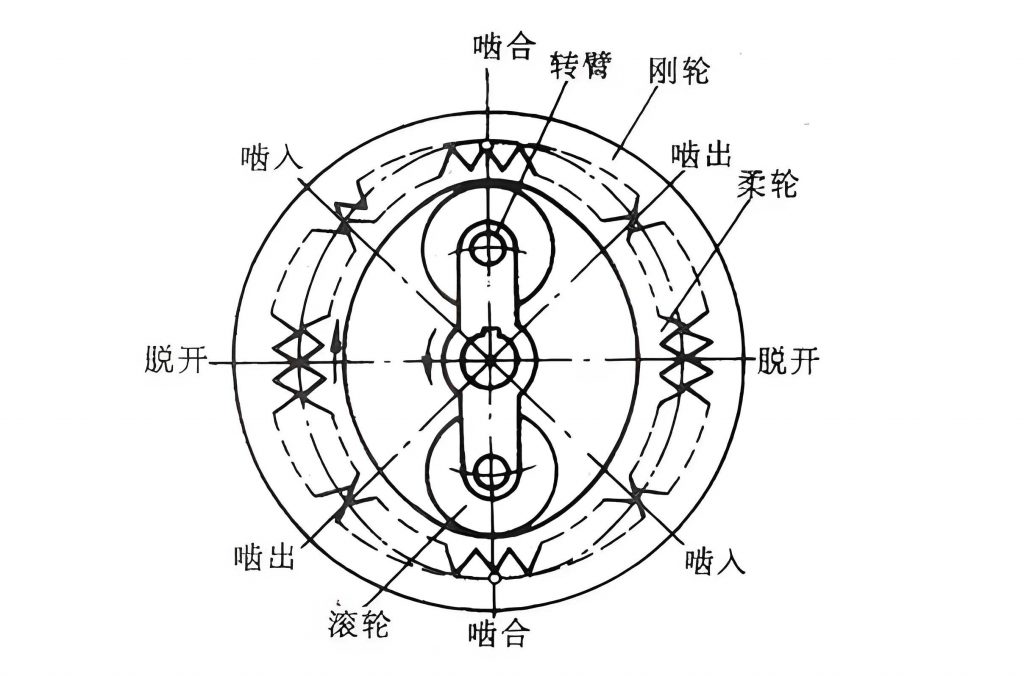
A core challenge in the design of harmonic drive gears is the precise control of the clearance, or backlash, between mating tooth profiles. Insufficient clearance can lead to interference and high contact stresses under load, potentially causing premature failure or increased wear. Conversely, excessive clearance results in larger transmission error and positional inaccuracy, diminishing the system’s precision. Traditional design approaches often consider the tooth profile in a single, designated cross-section of the flexspline. However, when the wave generator is assembled into a cup-type flexspline, the deformation induces a taper effect. This means that various cross-sections along the flexspline’s axis experience different magnitudes of maximum radial displacement. Consequently, while a specific design section may achieve perfect or near-perfect meshing, other axial sections can suffer from interference or inadequate contact. This issue is particularly pronounced in harmonic drive gears with shorter flexsplines. To enhance the overall load distribution, transmission smoothness, and longevity, a three-dimensional, or spatial, tooth profile design is essential. This design ensures that all cross-sections along the tooth length maintain favorable meshing conditions simultaneously under load.
This article delves into the methodology for designing and optimizing the spatial tooth profile for involute harmonic drive gears. The involute profile is chosen for its manufacturability and well-understood geometric properties. The core of the methodology involves first determining the conjugate tooth profile for a specific design section using a precise envelope algorithm based on the flexspline’s assembly deformation. The discrete points of this conjugate profile are then fitted with an ideal involute curve to define the circular spline’s tooth form. Subsequently, a clearance optimization control model is established. This model is applied to optimize the profile shift coefficient for other flexspline cross-sections which have different radial displacements due to taper. For sections where radial displacement decreases significantly, an additional adjustment of the active tooth depth might be necessary alongside the profile shift modification. The ultimate goal is to synthesize a three-dimensional flexspline tooth profile that satisfies spatial meshing requirements, thereby substantially improving the performance of the harmonic drive gear compared to conventional planar profile designs.
Theoretical Foundation: Conjugate Tooth Profile Generation
The accurate generation of the theoretical conjugate tooth profile is the cornerstone of designing high-performance harmonic drive gears. The process begins by establishing coordinate systems to describe the relative motion between the wave generator, the deformed flexspline, and the fixed circular spline.
Let a fixed coordinate system \( S_C (O_C-x_Cy_Cz_C) \) be attached to the circular spline, with the \( y_C \)-axis aligned with the symmetry line of a circular spline tooth space. A moving coordinate system \( S_f (O_f-x_fy_fz_f) \) is attached to a tooth on the deformed end of the flexspline, with its \( y_f \)-axis aligned with the tooth’s symmetry line. Another moving system \( S_w (O_w-x_wy_wz_w) \) is attached to the wave generator, with its \( y_w \)-axis aligned with the generator’s major axis. In the initial state, these \( y \)-axes are coincident.
As the wave generator rotates counterclockwise by an angle \( \phi_w \), the flexspline rotates clockwise. The output end (undeformed part) of the flexspline rotates by \( \phi_F \) relative to the circular spline. The relationship is governed by the gear ratio:
$$ \phi_F = \phi_w \frac{(z_2 – z_1)}{z_2} $$
where \( z_1 \) and \( z_2 \) are the number of teeth on the flexspline and circular spline, respectively.
The polar radius \( \rho \) of a point on the deformed neutral curve of the flexspline is given by:
$$ \rho(\phi) = r_m + u(\phi) $$
where \( r_m \) is the radius of the neutral curve before deformation, and \( u(\phi) \) is the radial displacement. The angular position \( \phi_f \) of the flexspline tooth coordinate system incorporates the circumferential displacement \( v(\phi) \):
$$ \phi_f = \phi_F + \theta_{vz} = \phi_F + \frac{v(\phi)}{r_m + u(\phi)} $$
The angle \( \theta_{uz} \) that the tooth symmetry line makes relative to the radial vector is:
$$ \theta_{uz}(\phi) = -\arctan\left(\frac{\dot{\rho}}{\rho}\right) = -\arctan\left(\frac{\dot{u}(\phi)}{r_m + u(\phi)}\right) $$
The condition of no elongation of the middle surface provides the relationship between the independent variable \( \phi_1 \) (the angle of the flexspline deformed end relative to the wave generator’s major axis) and \( \phi \):
$$ \phi \, r_m = \int_{0}^{\phi_1} \sqrt{(r_m + u)^2 + (\dot{u})^2} \, d\phi $$
Using the envelope theory, the conjugate circular spline tooth profile \( C(x_c, y_c) \) corresponding to the flexspline involute profile \( F(x_f(s), y_f(s)) \) is determined by solving the following system of equations for the parameter \( s \) and the conjugate angle \( \phi \):
$$
\begin{cases}
x_c(s, \phi) = x_f(s)\cos\phi_\Sigma + y_f(s)\sin\phi_\Sigma + \rho \sin\phi_f \\
y_c(s, \phi) = -x_f(s)\sin\phi_\Sigma + y_f(s)\cos\phi_\Sigma + \rho \cos\phi_f \\[10pt]
\dfrac{\partial x_c}{\partial s} \dfrac{\partial y_c}{\partial \phi}\dfrac{d\phi}{d\phi_1} – \dfrac{\partial x_c}{\partial \phi}\dfrac{d\phi}{d\phi_1} \dfrac{\partial y_c}{\partial s} = 0 \\[10pt]
\phi_\Sigma = \theta_{uz} + \phi_f
\end{cases}
$$
This process yields a set of discrete points representing the theoretical conjugate tooth profile of the circular spline for the specified flexspline design section.
Fitting the Circular Spline Involute Profile
The discrete conjugate profile \( C \) must be represented by a standard geometric curve for practical manufacturing and analysis. Based on the characteristics of the involute, the discrete points are fitted with an ideal involute curve \( G_w(x_{2wk}, y_{2wk}) \). The equation for this fitting involute is:
$$
\begin{cases}
x_{2\omega k} = r_2\left[ -\sin(u_{2k} – \theta_2) + u_{2k} \cos\alpha_0 \cos(u_{2k} – \theta_2 + \alpha_0) \right] \\
y_{2\omega k} = r_2\left[ \cos(u_{2k} – \theta_2) + u_{2k} \cos\alpha_0 \sin(u_{2k} – \theta_2 + \alpha_0) \right]
\end{cases}
$$
where \( r_2 \) is the pitch radius of the circular spline, \( u_{2k} \) is the involute roll angle parameter, \( \theta_2 \) is half the angular tooth space width on the pitch circle (\( \theta_2 = e/(2r_2) \), with \( e \) being the circular tooth thickness), and \( \alpha_0 \) is the standard pressure angle.
The fitting process is a constrained optimization. The fitted involute \( G_w \) must not intersect the theoretical curve \( C \), requiring:
$$ \Delta x_k = x_{2wk} – x_{c} \ge 0 $$
The objective is to minimize the average deviation \( \epsilon_m \) between corresponding points on \( G_w \) and \( C \):
$$ \epsilon_m = \frac{1}{n}\sum_{k=1}^{n} d_k $$
where \( d_k \) is the distance from a point on \( C \) to the corresponding point on \( G_w \). This distance is a function of the circular spline’s profile shift coefficient \( x_2 \) and the parameter \( u_{2k} \). By optimizing \( x_2 \) to minimize \( \epsilon_m \), the definitive involute profile for the circular spline is obtained. This profile ensures optimal conjugation with the flexspline’s design section tooth profile.
Spatial Tooth Profile Design Methodology
The taper deformation of the cup flexspline implies that cross-sections perpendicular to its axis have varying maximum radial displacements \( w_0 \). A harmonic drive gear designed for perfect meshing in one section (the “design section”) will likely exhibit sub-optimal meshing (interference or excessive clearance) in others. The spatial design aims to adjust the flexspline’s tooth profile parameters along its axis to compensate for this effect.
The core of the adjustment is the optimization of the profile shift coefficient \( x_1 \) for each axial section \( i \), based on the specific radial displacement \( w_{0,i} \) of that section. For sections where \( w_{0,i} \) is larger than that of the design section, \( x_1 \) must generally be decreased to avoid tooth tip interference with the circular spline. For sections where \( w_{0,i} \) is smaller, \( x_1 \) must generally be increased to reduce clearance and ensure contact. The adjustment is governed by a clearance optimization control model.
Clearance Optimization Control Model
The instantaneous clearance \( j_t \) between two meshing tooth profiles is defined as the minimum distance between corresponding point pairs along the tooth height at a given meshing position \( \phi \). For involute profiles, \( j_t \) is a complex nonlinear function of the flexspline shift coefficient \( x_1 \), the circular spline shift coefficient \( x_2 \), the meshing position angle \( \phi \), and the active tooth depth \( h_n \). An approximate calculation for a given \( \phi \) uses the distance between the flexspline tooth tip point \( K_1(x_{ka}, y_{ka}) \) and the corresponding closest point \( K_2(x_{k2}, y_{k2}) \) on the circular spline profile:
$$ j_t \approx \sqrt{(x_{k2} – x_{ka})^2 + (y_{ka} – y_{k2})^2} $$
The objective of the optimization is to find the value of \( x_1 \) for a given section that brings the calculated clearance pattern as close as possible to a desired target clearance \( j_c \), typically aiming for near-zero clearance in the primary meshing zone while avoiding interference.
We formulate an objective function \( F(x_1) \) as the sum of clearances at \( n \) discrete meshing positions across the engagement range:
$$ F(x_1) = \sum_{k=1}^{n} \sqrt{(x_{k2}(x_1) – x_{ka}(x_1))^2 + (y_{ka}(x_1) – y_{k2}(x_1))^2} $$
Minimizing \( F(x_1) \) optimizes the overall meshing tightness for the section. This minimization is subject to several geometric constraints essential for a functional harmonic drive gear:
- Non-Interference Condition: The flexspline profile must not penetrate the circular spline profile.
$$ \begin{cases} x_{k2}(x_1) – x_{ka}(x_1) \ge 0 \\ y_{ka}(x_1) – y_{k2}(x_1) \ge 0 \end{cases} $$ - Undercut Avoidance Condition: The root of one gear must not interfere with the tip of the mating gear.
$$ \left[ r_{g2} – r_{g1}(x_1) \right] – (h_n + w_{0,i}) > 0 $$
where \( r_{g1}, r_{g2} \) are the start/stop radii of the active involute profiles. - Radial Clearance Condition: Sufficient space must exist at the root of the circular spline.
$$ r_{f2} – \left[ r_{a1}(x_1) + w_{0,i} + 0.2m \right] \ge 0 $$
where \( r_{f2} \) is the circular spline root radius, \( r_{a1} \) is the flexspline tip radius, and \( m \) is the module. - Disengagement Condition at Minor Axis: Teeth must be able to disengage smoothly at the minor axis of the wave generator.
$$ (r_{a2} + 1.08w_{0,i}) – r_{a1}(x_1) > 0 $$
Solving this constrained optimization problem for each axial section yields the optimal profile shift coefficient \( x_{1,i} \), defining the spatial variation of the flexspline tooth profile.
Design Case Study and Analysis
To illustrate the spatial design process, consider an involute harmonic drive gear with the following base parameters: module \( m = 0.5 \) mm, flexspline teeth \( z_1 = 200 \), circular spline teeth \( z_2 = 202 \), pressure angle \( \alpha_0 = 20^\circ \), addendum coefficient \( h_a^* = 1 \), dedendum coefficient \( c^* = 0.35 \). A four-roller wave generator with a cam ellipse angle \( \beta = 30^\circ \) is used. The wall thickness of the design section is \( \delta = 0.9 \) mm, with a maximum radial displacement \( w_0 = 0.5 \) mm. For this design section, the initial flexspline profile shift is \( x_1 = 3.0 \) and the active tooth depth is \( h_n = 0.8 \) mm.
Using the conjugate theory and fitting method described earlier, the circular spline involute profile is determined. Its key parameters are summarized below alongside the design section parameters.
| Parameter | Flexspline (Design Section) | Circular Spline |
|---|---|---|
| Profile Shift Coefficient, \( x \) | 3.00000 | 2.66756 |
| Half of Angular Tooth Space on Pitch Circle, \( \theta \) | 1.07562° | 1.06590° |
| Pitch Radius, \( r \) (mm) | 50.000 | 50.500 |
| Tip Radius, \( r_a \) (mm) | 51.87396 | 51.70755 |
| Root Radius, \( r_f \) (mm) | 50.82500 | 52.50878 |
| Circular Tooth Thickness, \( s \) (mm) | 1.87731 | 1.87895 |
Spatial Profile Design for a Long Flexspline (L=80 mm)
Assuming a linear taper, the maximum radial displacement \( w_{0,i} \) for other sections can be calculated. Applying the clearance optimization control model to sections with different \( w_{0,i} \) yields their optimized profile shift coefficients \( x_{1,i} \). The results for selected sections are presented below.
| Section | Max Radial Displ. \( w_0 \) (mm) | Opt. Shift Coeff. \( x_1 \) | Tip Radius \( r_a \) (mm) |
|---|---|---|---|
| 1 (Front) | 0.527 | 2.94061 | 51.83997 |
| 2 | 0.5135 | 2.97109 | 51.85740 |
| 3 (Design) | 0.500 | 3.00000 | 51.87396 |
| 4 | 0.4865 | 3.02682 | 51.88934 |
| 5 (Back) | 0.473 | 3.05160 | 51.90358 |
The trend is clear: as the maximum radial displacement decreases from the front to the back of the flexspline, the optimal profile shift coefficient increases almost linearly. This adjustment compensates for the reduced deformation by effectively “shifting” the flexspline tooth outward to maintain proper contact with the fixed circular spline profile. Motion simulation confirms that each optimized section exhibits a trajectory within the circular spline tooth space free of interference and with a controlled, minimal clearance pattern. The zero-clearance (or near-zero-clearance) engagement zones for different sections are distributed across a wider range of the meshing cycle compared to a single planar profile, increasing the potential contact length along the tooth face and improving overall load sharing in the harmonic drive gear.
Spatial Profile Design for a Short Flexspline (L=40 mm)
In a shorter flexspline, the taper effect is more severe, leading to greater variation in \( w_{0,i} \). Initial optimization for the rear section (Section 5, \( w_0 = 0.42 \) mm) by adjusting only \( x_1 \) resulted in a coefficient of 2.91142. However, simulation revealed that while interference was avoided, the resulting clearance was excessively large, rendering the section ineffective for load transmission. This indicates that for sections where the radial displacement decreases dramatically, modifying only the profile shift coefficient is insufficient.
A secondary adjustment strategy is required: reducing the active tooth depth \( h_n \) for that section before re-optimizing \( x_1 \). For the problematic rear section, \( h_n \) was reduced from 0.8 mm to 0.6 mm. The clearance optimization was then performed again, yielding a new, higher optimal shift coefficient.
| Parameter | Adjustment (Only \( x_1 \)) | Secondary Adjustment (\( h_n \) & \( x_1 \)) |
|---|---|---|
| Active Tooth Depth, \( h_n \) (mm) | 0.8 | 0.6 |
| Profile Shift Coefficient, \( x_1 \) | 2.91142 | 3.07060 |
| Tip Radius, \( r_a \) (mm) | 51.82332 | 51.71450 |
Motion simulation of the secondarily adjusted profile shows a dramatic improvement. The tooth trajectory maintains non-interference while operating with significantly reduced clearance, making the section capable of participating effectively in the load sharing of the harmonic drive gear. This two-step process—depth reduction followed by shift optimization—is crucial for achieving good spatial meshing in harmonic drive gears with high taper deformation.
Analysis of Meshing Performance
The performance superiority of the spatially designed harmonic drive gear over a conventional planar design is evident in the analysis of clearance distribution and engagement intervals.
For the long flexspline case, the zero-clearance engagement points for different sections are spread across a range of the mesh cycle (e.g., from approximately \( \phi = 1.5^\circ \) to \( \phi = 7^\circ \)). This spatial distribution means that under load, as teeth deflect, multiple cross-sections along the tooth length can potentially come into contact simultaneously or in rapid succession. This effectively increases the total contact area and smooths the transfer of load from one tooth pair to the next, enhancing torque capacity and reducing transmission error.
In the short flexspline case, the optimized spatial profile creates several zones with very low clearance across different sections at varying mesh angles. While a single section might not have a continuous near-zero zone, the composite effect of all sections ensures that there is always at least one section with favorable meshing conditions throughout a significant portion of the rotation. This greatly expands the functional engagement range compared to a planar profile, which would likely have perfect contact in only one narrow zone and poor contact or interference elsewhere.
The fundamental advantage can be summarized: the spatial tooth profile design transforms the harmonic drive gear from a component that meshes correctly only in a single plane to one that meshes effectively across a three-dimensional volume. This leads to:
- Increased Simultaneous Contact Area: More tooth surface is in functional contact at any given load, reducing contact stress.
- Extended Meshing Interval: The transition of load between tooth pairs is smoother and occurs over a larger rotation angle.
- Improved Load Distribution: Axial load sharing minimizes stress concentrations.
- Enhanced Transmission Accuracy and Stiffness: Reduced effective clearance and more teeth in contact improve positional precision and torsional rigidity.
Conclusion
The design of high-performance involute harmonic drive gears necessitates moving beyond planar tooth profile analysis to embrace a full spatial design paradigm. The methodology presented herein, based on precise conjugate theory, involute fitting, and a rigorous clearance optimization control model, provides a systematic approach to this challenge. Key findings include:
- The conjugate circular spline profile for a designated flexspline section can be accurately determined via an envelope algorithm and fitted with an optimal involute.
- The variation in maximum radial displacement along the flexspline axis due to taper deformation can be compensated for by optimizing the profile shift coefficient \( x_1 \) for each cross-section. The adjustment is generally linear with respect to the change in radial displacement.
- For axial sections where the radial displacement is significantly reduced (often at the rear of short flexsplines), a two-step adjustment—reducing the active tooth depth \( h_n \) followed by re-optimizing \( x_1 \)—is essential to restore effective meshing without interference.
- The resulting spatial tooth profile for the harmonic drive gear substantially outperforms a planar profile. It achieves a wider effective engagement zone, promotes simultaneous contact across multiple axial sections, and significantly improves overall transmission performance, including load capacity, smoothness, and accuracy.
This spatial design and optimization framework is therefore critical for unlocking the full potential of harmonic drive gears in demanding applications such as robotics, aerospace, and precision machinery, where reliability, precision, and compactness are paramount.