
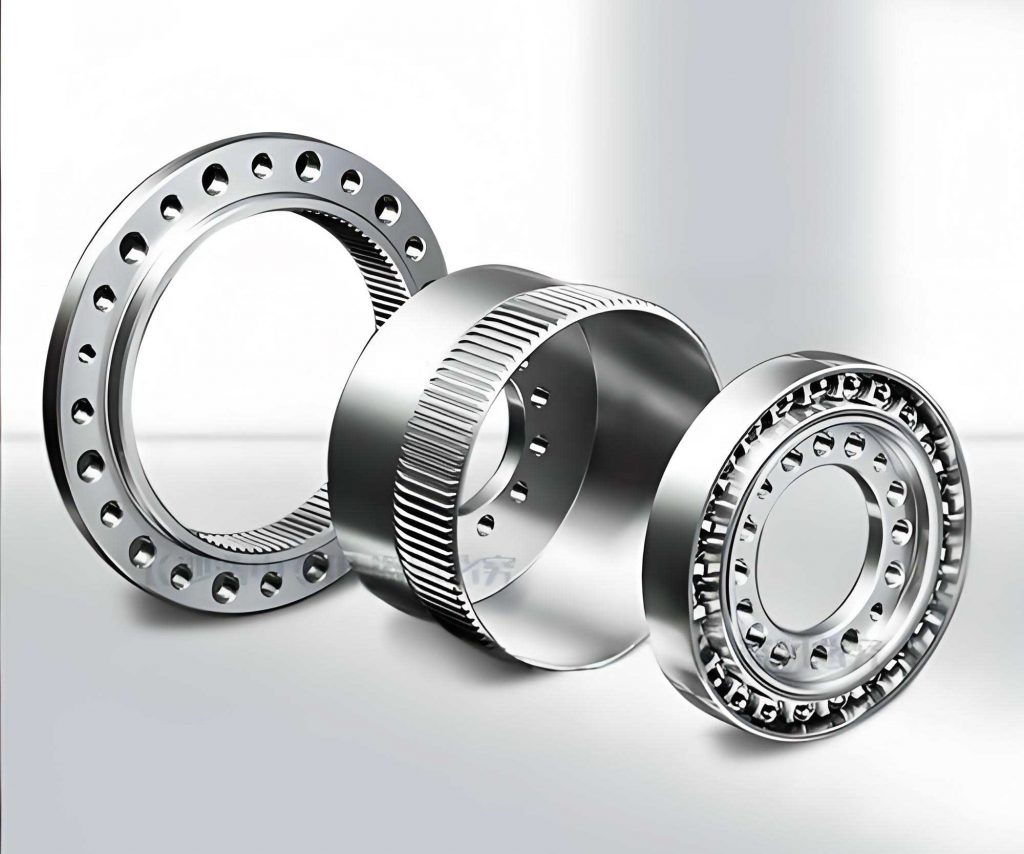
In the realm of precision mechanical transmissions, the harmonic drive gear stands out due to its compact size, high reduction ratio, and exceptional accuracy, making it indispensable in applications such as industrial robots, aerospace systems, and precision instruments. The flexspline, a key component of the harmonic drive gear, is typically a thin-walled gear with a large modification coefficient (often around 3), and its geometric accuracy directly impacts the near-zero backlash and smooth operation of the transmission. As a researcher focused on advancing manufacturing techniques for harmonic drive gears, I have undertaken a study to quantitatively analyze how errors in forming hobs affect the machining precision of large modified flexsplines. This investigation aims to establish error models, simulate hobbing processes, and evaluate theoretical machining errors, thereby providing insights for controlling hobbing accuracy and improving flexspline quality. In this article, I will detail our methodology, present findings using formulas and tables, and discuss implications for manufacturing harmonic drive gears.
The core of our analysis lies in understanding the forming hob, which is specially designed for machining large modified gears. Unlike standard hobs, the forming hob has a modified pressure angle and module to accommodate the unique geometry of flexsplines in harmonic drive gears. The design parameters are derived from the flexspline’s pitch circle diameter, which is determined as the average of the addendum and dedendum diameters. For a typical large modified flexspline with a module of 0.8 mm, a pressure angle of 20°, a modification coefficient of 3, and 150 teeth, the pitch circle diameter \(d_p\) is calculated as:
$$ d_p = \frac{d_a + d_f}{2} $$
where \(d_a\) is the addendum diameter and \(d_f\) is the dedendum diameter. The pressure angle at this pitch circle, \(\alpha_{np}\), is then computed and rounded to design the hob. Specifically, the hob’s module \(m_{nh}\) and pressure angle \(\alpha_{nh}\) are set equal to the flexspline’s values at the pitch circle: \(m_{nh} = m_{np}\) and \(\alpha_{nh} = \alpha_{np}\). The hob’s pitch diameter \(d_h\) is given by:
$$ d_h = D_h – (d_p – d_f) $$
where \(D_h\) is the hob’s outer diameter. The normal tooth thickness of the hob at its pitch circle, \(S_{nh}\), is derived based on the flexspline’s geometry to ensure proper meshing in harmonic drive gears. These design adjustments are crucial for minimizing machining errors in harmonic drive gear flexsplines.
To assess the impact of hob errors on harmonic drive gear accuracy, we developed a comprehensive error model for the forming hob. This model incorporates three primary error sources: tooth profile error, cutting edge helix error, and radial run-out error. The tooth profile error, denoted as \(\delta_{ihn}(s)\) for the \(i\)-th cutting edge, represents deviations in the hob’s axial tooth shape from the ideal profile. We convert this to axial deviations \(\delta_{ihx}(s)\) for simulation purposes. The cutting edge helix error, \(\delta_{ihL}\), accounts for axial displacements along the hob’s spiral, with the error per revolution \(\delta_{z1}\) influencing multiple cutting edges. For the \(i\)-th edge, this is expressed as:
$$ \delta_{ihL} = i \cdot \frac{\delta_{z1}}{Z_k} $$
where \(Z_k\) is the number of hob gashes. Radial run-out error arises from installation inaccuracies, causing the hob axis to tilt and shift. This is characterized by radial displacements at the left and right ends of the hob, \(E_L\) and \(E_R\), with phase angles \(\eta_L\) and \(\eta_R\). These errors lead to rotations \(\beta_y\) and \(\beta_z\) and translations \(T_y\) and \(T_z\) of the hob axis, calculated as:
$$ \beta_y = \arcsin\left(\frac{z_{oL} – z_{oR}}{L_h}\right), \quad \beta_z = \arcsin\left(\frac{y_{oL} – y_{oR}}{L_h}\right) $$
$$ T_y = \frac{y_{oL} + y_{oR}}{2}, \quad T_z = \frac{z_{oL} + z_{oR}}{2} $$
where \(L_h\) is the hob length, and \(y_{oL}, z_{oL}, y_{oR}, z_{oR}\) are coordinates of the hob end centers. Combining these errors, the actual cutting edge position \(E_h^i(s)\) in the hob coordinate system is modeled using transformation matrices that account for both geometric and installation errors. This error model forms the basis for our hobbing simulation of harmonic drive gear flexsplines.
We conducted a theoretical simulation of the hobbing process to compute machining errors for large modified flexsplines in harmonic drive gears. The simulation involves calculating the trajectory surface generated by the hob’s cutting edges relative to the workpiece coordinate system. For the \(i\)-th cutting edge, the trajectory \(G_g^i(s, \phi)\) in the gear coordinate system is derived through a series of coordinate transformations that incorporate hob rotation \(\phi\), axial feed \(\zeta\), and gear rotation \(\psi\). The relationships are:
$$ \zeta = \pm \frac{z_h f \phi}{2\pi z}, \quad \psi = \pm \frac{z_h \phi}{z} $$
where \(z_h\) is the number of hob starts, \(z\) is the number of gear teeth, \(f\) is the axial feed per gear revolution, and signs depend on the hobbing direction. The flexspline tooth surface for a large modified gear is represented as an involute profile extruded along the axis. For the \(k\)-th tooth slot, the surface \(F_k(\theta, \mu)\) is given by:
$$ F_k(\theta, \mu) = \begin{pmatrix} \pm [r_b \sin(\theta – \Gamma – k \cdot \delta) – r_b \theta \cos(\theta – \Gamma – k \cdot \delta)] \\ r_b \cos(\theta – \Gamma – k \cdot \delta) + r_b \theta \sin(\theta – \Gamma – k \cdot \delta) \\ \mu \\ 1 \end{pmatrix} $$
where \(r_b\) is the base circle radius, \(\theta\) is the involute unfolding angle, \(\mu\) is the axial distance, \(\Gamma\) is a rotation angle accounting for modification, and \(\delta = 2\pi / z\). The normal vector \(n_k(\theta, \mu)\) is computed via cross products of partial derivatives. To evaluate machining errors, we determine the shortest distance from points on the theoretical tooth surface to the hob trajectory surface along the normal direction. This yields tooth profile errors, while base pitch errors are calculated by finding intersections of normals with adjacent actual tooth profiles and comparing to theoretical base pitch values. Our simulation focuses on a typical harmonic drive gear flexspline with parameters as in Table 1, using a forming hob designed per Table 2.
| Module (mm) | Modification Coefficient | Pressure Angle (°) | Number of Teeth | Addendum Diameter (mm) | Dedendum Diameter (mm) |
|---|---|---|---|---|---|
| 0.8 | 3 | 20 | 150 | 126.4 | 122.8 |
| Hob Type | Normal Module (mm) | Normal Pressure Angle (°) | Pitch Diameter (mm) | Axial Tooth Thickness (mm) | Outer Diameter (mm) |
|---|---|---|---|---|---|
| Standard Hob | 0.8 | 20 | 30 | 1.2571 | 32 |
| Forming Hob | 0.8295 | 25 | 30.3797 | 1.3672 | 32 |
Our analysis reveals significant insights into how hob errors influence the accuracy of harmonic drive gear flexsplines. We examined three error types individually and in combination, with results summarized in tables and formulas. For tooth profile errors, the hob’s tooth profile error \(\delta_{ihn}\) directly transfers to the flexspline, causing nearly linear deviations. When the hob tooth profile error is set to -5 µm (indicating inward deviation), the flexspline tooth profile error averages around 5.5 µm, as shown in simulation data. This relationship is expressed as:
$$ \Delta f_{\text{profile}} \approx k_p \cdot \delta_{ihn} $$
where \(\Delta f_{\text{profile}}\) is the flexspline tooth profile error and \(k_p\) is a factor close to 1 for harmonic drive gear flexsplines. The cutting edge helix error has a more pronounced effect, especially on base pitch accuracy. For a helix error \(\delta_{z1} = 10\) µm per revolution, the flexspline tooth profile error varies along the tooth height, from negative values at the root (overcutting) to about 10–12 µm at the tip. The base pitch error \(\Delta p_b\) is approximately equal to the helix error:
$$ \Delta p_b \approx \delta_{z1} $$
This is critical for harmonic drive gears, as base pitch errors affect meshing smoothness and backlash. Radial run-out error, while less impactful on base pitch, induces wavy tooth profile errors along the tooth height. For a run-out of 0.06 mm, the average tooth profile error is about 40% of the run-out value, or 24 µm, but base pitch errors remain below 0.7 µm. The phase angles of run-out influence error distribution but not magnitude. These findings are consolidated in Table 3, which quantifies error contributions for harmonic drive gear flexsplines.
| Hob Error Type | Error Value | Flexspline Tooth Profile Error (µm) | Flexspline Base Pitch Error (µm) | Key Relationship |
|---|---|---|---|---|
| Tooth Profile Error | -5 µm | ~5.5 (average) | Negligible | Linear transfer |
| Cutting Edge Helix Error | 10 µm/rev | 10–12 (tip), negative at root | ~10 | \(\Delta p_b \approx \delta_{z1}\) |
| Radial Run-out Error | 0.06 mm | ~24 (average, 40% of run-out) | < 0.7 | Phase-dependent distribution |
| Combined Errors | Multiple sources | Additive effects dominate | Helix error primary | Non-linear interactions |
To further elucidate these effects, we derived sensitivity formulas for harmonic drive gear flexsplines. The tooth profile error sensitivity \(S_{\text{profile}}\) to hob tooth profile error is near unity, indicating direct mapping. For helix error, the sensitivity of base pitch error \(S_{\text{base}}\) is approximately 1, as per the equation above. Radial run-out sensitivity \(S_{\text{run-out}}\) for tooth profile error is around 0.4, derived from empirical simulation data. These sensitivities guide tolerance allocation in hob manufacturing for harmonic drive gears. For instance, controlling helix error is paramount for maintaining base pitch accuracy, which is essential for the precise operation of harmonic drive gears. Our simulation also considered axial feed effects, with a feed rate of 1 mm/rev used for the large modified flexspline. The results show that feed influences error distribution but not overall trends, reinforcing the dominance of hob geometry errors.
In conclusion, our study on forming hob errors for harmonic drive gear flexsplines demonstrates that geometric inaccuracies in hobs significantly impact machining precision. The cutting edge helix error is the most critical, causing substantial tooth profile and base pitch errors in harmonic drive gears, with base pitch deviations closely matching the hob’s helix error per revolution. Tooth profile errors from the hob transfer linearly to the flexspline, while radial run-out induces wavy profile errors with an average magnitude of about 40% of the run-out value but minimal effect on base pitch. These insights emphasize the need for stringent control of hob helix accuracy during manufacturing of harmonic drive gears. By optimizing hob design and error compensation, manufacturers can enhance flexspline quality, leading to improved performance and longevity of harmonic drive gear systems. Future work could explore real-time error compensation techniques or advanced hob materials to further push the boundaries of precision in harmonic drive gears.
Throughout this analysis, we have underscored the importance of harmonic drive gear accuracy by repeatedly examining how hob errors propagate to flexsplines. The formulas and tables provided offer a quantitative framework for engineers to prioritize error sources and implement corrective measures. As harmonic drive gears continue to evolve in applications like robotics and aerospace, mastering these manufacturing nuances will be key to achieving superior transmission characteristics. Our hope is that this research contributes to the ongoing advancement of harmonic drive gear technology, enabling more reliable and efficient systems worldwide.