
The pursuit of compact, high-ratio, and precise motion transmission has been a longstanding challenge in mechanical engineering. Among the solutions developed in the mid-20th century to meet the stringent demands of aerospace technology, strain wave gearing, also known as harmonic drive, stands out for its unique operating principle and exceptional performance characteristics. The fundamental strain wave gear configuration typically consists of three primary components: a rigid circular spline, a flexible spline (or “flexspline”), and a wave generator. The ingenious interaction between these parts allows for significant speed reduction in a remarkably small envelope. However, despite its advantages, the conventional strain wave gear design is fundamentally limited by the fatigue life of its flexible spline. The cyclical deformation required for operation inevitably leads to material stress concentrations and eventual failure, impacting reliability and lifespan. This persistent issue has driven ongoing research to re-imagine the core mechanics of strain wave gearing. In this analysis, I present a detailed exploration of a novel design paradigm that seeks to overcome this limitation by replacing the monolithic flexible spline with an assembly of discrete, movable teeth. This approach aims to retain the beneficial kinematic properties of traditional strain wave gears while fundamentally altering the stress distribution and manufacturing methodology.
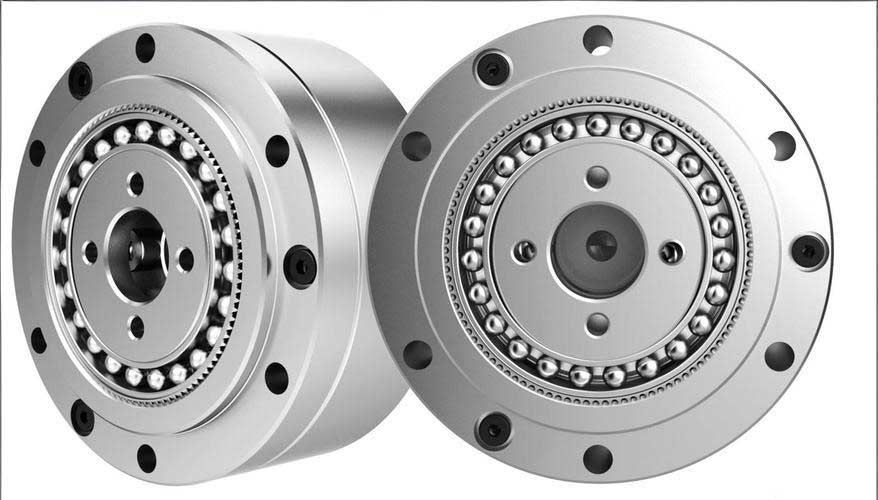
The conventional strain wave gear operates on a beautifully simple yet effective principle. The wave generator, often an elliptical cam or a set of rolling bearings, is inserted into the flexible spline, deforming it from a perfect circle into a slight elliptical shape. This deformation causes the teeth on the flexible spline to engage with the teeth on the rigid circular spline at two diametrically opposite regions. As the wave generator rotates, the region of engagement travels circumferentially. Because the flexible spline has fewer teeth (typically 2 fewer) than the rigid circular spline, each complete revolution of the wave generator results in a small relative rotation between the two splines in the opposite direction. The gear reduction ratio is given by a fundamental formula:
$$ i = -\frac{N_f}{N_r – N_f} $$
where \( N_r \) is the number of teeth on the rigid circular spline and \( N_f \) is the number of teeth on the flexible spline. The negative sign indicates the output direction is opposite to the input. For a typical configuration where \( N_r = 102 \) and \( N_f = 100 \), the reduction ratio \( i = -50 \). This principle grants the strain wave gear its hallmark features: high reduction ratios in a single stage, minimal backlash, high torque capacity relative to size, and coaxial input/output shafts. Nonetheless, the necessity for the flexspline to endure continuous elastic deformation remains its Achilles’ heel.
The proposed movable-tooth strain wave gear reconfigures this system into four main components: a standard rigid circular spline (1), a set of independent movable tooth segments collectively forming the “active gear” (2), a specially profiled cam wave generator (3), and a carrier plate termed the “movable tooth disk” (4). The rigid circular spline is fixed to the housing. The cam wave generator serves as the high-speed input shaft. The movable tooth disk acts as the low-speed output member, rotating in the direction opposite to the input. The core innovation lies in the decomposition of the continuous flexspline into discrete segments.
| Feature | Conventional Strain Wave Gear | Movable-Tooth Strain Wave Gear |
|---|---|---|
| Flexible Element | Monolithic thin-walled flexspline | Discrete movable tooth segments |
| Primary Stress | Cyclic bending & membrane stress in the flexspline wall | Contact & compressive stress in individual tooth segments |
| Manufacturing | Requires specialized processes for flexspline (hobbing, heat treatment of thin sections) | Tooth segments can be machined on standard gear cutting equipment |
| Failure Mode | Fatigue crack initiation and propagation in the flexspline | Potential for wear or contact fatigue at individual tooth interfaces |
| Assembly/Replacement | Complete flexspline replacement required | Individual worn tooth segments could potentially be replaced |
Detailed Component Design and Kinematics
The design of the movable tooth segments is critical. Each segment is not a single tooth but a short arc comprising several teeth (e.g., 5 teeth). This ensures a continuous, overlapping engagement (contact ratio > 1) with the rigid circular spline to guarantee smooth motion transfer. Each segment is equipped with two distinct guiding elements. On one face, a radial positioning element (e.g., a pin or slider) protrudes. This element engages with a cam track on the wave generator. On the opposite face, a tangential positioning element protrudes, which engages with a corresponding slot in the movable tooth disk.
The wave generator is no longer a simple elliptical bearing assembly but a precision cam. Its profile is the master determinant of the radial motion law for the tooth segments. The cam track consists of a rise segment, a fall segment, and dwell segments. For a single-wave configuration (two lobes of engagement, similar to a traditional strain wave gear), a typical cam might have a 90° rise, a 180° dwell, and a 90° fall. The rise amount \( R_{max} \) defines the radial displacement of the tooth segments and must be precisely coordinated with the gear tooth geometry to achieve proper meshing depth without interference. The radial position \( r(\theta_w) \) of a tooth segment’s guiding element as a function of the wave generator’s input angle \( \theta_w \) can be described by a piecewise function based on the cam profile. For a simple harmonic rise on the first lobe, it could be:
$$ r_1(\theta_w) = R_{base} + \frac{R_{max}}{2} \left(1 – \cos\left(\frac{2\pi}{\Theta_{rise}} \theta_w\right)\right), \quad \text{for } 0 \le \theta_w < \Theta_{rise} $$
where \( R_{base} \) is the base radius and \( \Theta_{rise} \) is the rise angle in radians. A second, phase-shifted lobe would control the segments 180° apart.
The movable tooth disk is the output element. Its primary functions are to maintain the precise circumferential spacing of the tooth segments and to transmit output torque. The slots in this disk interact with the tangential positioning elements on the tooth segments. These slots must provide precise lateral (tangential) constraint to prevent skewing or tilting of the tooth segments during meshing, while allowing free radial motion. The torque \( T_{out} \) is transferred from the engaged tooth segments to the disk through the side walls of these tangential elements.
Working Principle and Force Transmission
The operation of this movable-tooth strain wave gear is a coordinated sequence. As the cam wave generator rotates, its profile pushes specific sets of tooth segments radially outward via their radial positioning elements. This controlled radial displacement causes the teeth on these segments to progressively engage with the internal teeth of the fixed rigid circular spline. Simultaneously, the reaction force from the meshing teeth creates a tangential component. This tangential force is transferred through the body of the tooth segment to its tangential positioning element, which presses against the side wall of the slot in the movable tooth disk. Consequently, the disk is forced to rotate.
Because the rigid spline is fixed, the only kinematic path for the reaction is to cause a slow rotation of the movable tooth disk. The reduction ratio is still governed by the difference in the number of teeth between the rigid spline and the effective “gear” formed by the movable segments. If the assembly of movable segments conceptually has \( N_m \) teeth (distributed across all segments) and the rigid spline has \( N_r \) teeth, the ratio is:
$$ i = -\frac{N_m}{N_r – N_m} $$
In practice, \( N_m \) is designed to be slightly less than \( N_r \), typically by 2 for a single-wave configuration. For instance, with \( N_r = 101 \), if the movable segments collectively represent \( N_m = 100 \) teeth, the ratio is -100. The following table outlines key design parameters for a conceptual model.
| Parameter | Symbol | Example Value | Note |
|---|---|---|---|
| Module | \( m \) | 0.5 mm | Defines tooth size |
| Number of Rigid Spline Teeth | \( N_r \) | 101 | Fixed component |
| Number of Movable Segment Teeth (Effective) | \( N_m \) | 100 | Collective count from all segments |
| Number of Movable Segments | \( S \) | 20 | e.g., 20 segments with 5 teeth each |
| Cam Wave Generator Rise | \( R_{max} \) | 2.0 mm | Total radial displacement |
| Pressure Angle | \( \alpha \) | 20° | Standard gear parameter |
| Theoretical Reduction Ratio | \( i \) | -100 | \( i = -N_m / (N_r – N_m) \) |
The force analysis within this new strain wave gear architecture is distinct. In a traditional strain wave gear, the flexspline experiences complex, time-varying bending stresses. In the movable-tooth design, the primary stresses in the active components are contact stresses at three key interfaces: 1) between the tooth flanks of the segment and the rigid spline, 2) between the radial positioning element and the cam surface, and 3) between the tangential positioning element and the slot wall in the output disk. The contact stress \( \sigma_c \) at the tooth interface can be approximated by the Hertzian formula for parallel cylinders, which is a function of the normal load \( F_n \), the material properties (Young’s modulus \( E \), Poisson’s ratio \( \nu \)), and the effective radius of curvature \( \rho \):
$$ \sigma_{c, max} = \sqrt{\frac{F_n E}{\pi \rho (1-\nu^2)}} $$
This shift from bulk material fatigue to localized contact fatigue presents a different set of challenges and potential lubrication requirements, but also offers a more manageable stress field that does not involve cyclical plastic deformation of a single critical component.
Advantages, Challenges, and Further Research
The movable-tooth architecture for strain wave gearing proposes several compelling advantages. Firstly, it eliminates the need to manufacture a complex, high-precision thin-walled flexspline, which often requires dedicated, specialized machinery and delicate heat treatment processes. The individual tooth segments can be produced using conventional gear hobbing or shaping machines, potentially reducing cost and increasing production flexibility. Secondly, by removing the continuously deforming flexspline, the primary failure mode associated with classical strain wave gears is circumvented. The system’s lifespan may then be determined by more predictable factors like surface wear or rolling contact fatigue, which can be mitigated through material selection, hardening, and lubrication. Thirdly, the design inherently avoids the tooth interference issues that can sometimes plague very high-ratio internal gear pairs, as the radial path of each tooth segment is directly controlled by the cam profile.
However, this novel strain wave gear design introduces its own set of challenges that require thorough investigation. The kinematic complexity increases with the number of moving joints and precise interactions. The need for extremely low-friction and low-backlash interfaces at both the radial and tangential guides is paramount to maintain high transmission efficiency and positional accuracy. Any play or elastic deformation in these guides will directly contribute to lost motion. The design and manufacturing tolerances for the cam profile, the segment guides, and the output disk slots are exceptionally tight to ensure synchronized motion of all segments. Dynamic analysis is also more complex, as the system involves the periodic acceleration and deceleration of multiple discrete masses (the tooth segments) in both radial and tangential directions, which could influence vibration and noise characteristics compared to a monolithic flexspline.
Further research is essential to mature this concept. Key areas include:
- Comprehensive Efficiency Modeling: Developing a detailed analytical and simulation model to predict mechanical efficiency, accounting for friction at the cam-slider interface, the disk-slot interface, and gear mesh losses.
- Dynamic and Stability Analysis: Studying the vibrational modes and dynamic response of the segmented system under varying loads and speeds to ensure smooth operation.
- Optimal Cam Profile Synthesis: Researching cam profiles beyond simple harmonic curves that might optimize force transmission, minimize peak contact stresses, or reduce vibrations.
- Prototype Testing and Validation: Building and testing physical prototypes to measure actual performance metrics like torque capacity, torsional stiffness, backlash, efficiency, and durability under load.
In conclusion, the movable-tooth strain wave gear represents a significant conceptual departure from the established harmonic drive principle. It directly addresses the core limitation of flexspline fatigue by re-engineering the flexible element into a controlled assembly of rigid segments. While the traditional strain wave gear relies on the elastic deformation of a continuum, this new approach leverages precise kinematic control of discrete elements to achieve the same effective epicyclic motion. This shift has the potential to simplify manufacturing, improve life predictability, and open new avenues for high-performance speed reduction. The viability of this innovative strain wave gear variant ultimately depends on successfully managing the increased complexity in guidance and coordination of its moving parts, a challenge that invites deep engineering analysis and refinement. The pursuit of such alternative architectures is crucial for advancing the state of the art in precision gearing technology beyond the boundaries of conventional designs.