
In the field of precision motion control, the strain wave gear, also known as harmonic drive, plays a pivotal role due to its high reduction ratio, compactness, and minimal backlash. As a researcher focused on advanced gearing systems, I have undertaken a detailed study to achieve truly backlash-free operation in strain wave gear sets through meticulous selection and correction of profile shift coefficients. This article presents my first-person perspective on the engineering design considerations, interference analysis, mathematical modeling, and optimization processes involved. The core objective is to ensure that the flexible spline (flexspline) and circular spline (circular spline) mesh without clearance while maintaining manufacturability and high precision. Throughout this discussion, the term “strain wave gear” will be emphasized repeatedly to underscore its centrality in this research.
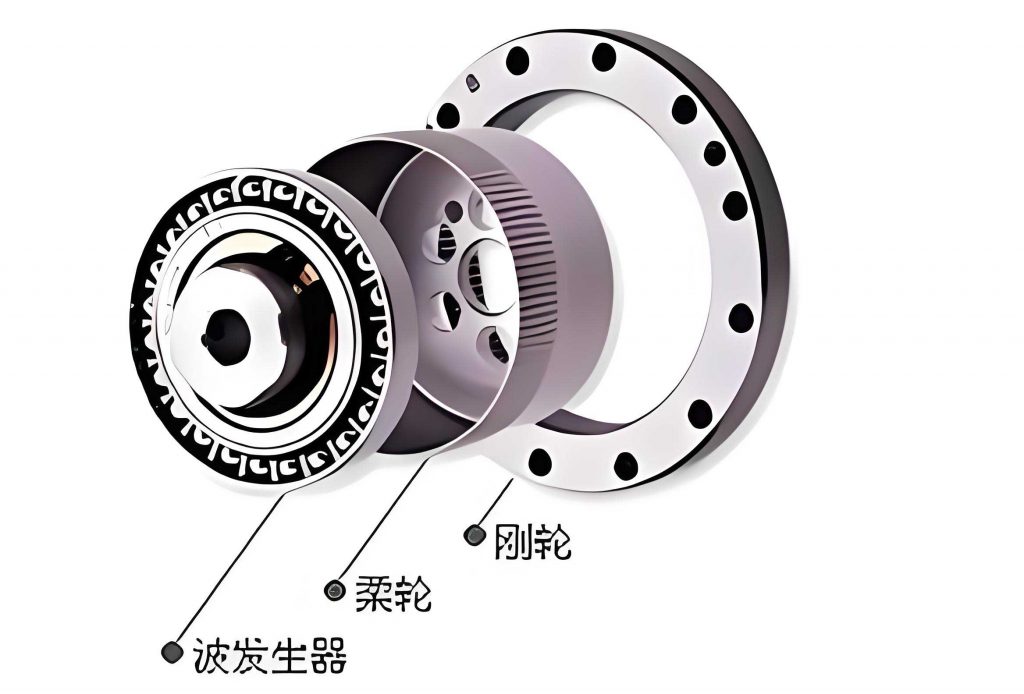
The fundamental operation of a strain wave gear relies on the elastic deformation of a flexible spline by a wave generator, enabling meshing with a rigid circular spline. To eliminate backlash—a critical requirement for applications in robotics, aerospace, and precision instrumentation—the tooth profiles must be designed to mesh with zero or controlled negative clearance. My approach centers on using standard involute profiles for both the flexible and circular splines, modified through profile shifting to approximate conjugate action and prevent interference. This methodology balances theoretical rigor with practical manufacturing constraints.
Key Engineering Design Considerations
Before delving into calculations, several foundational decisions were made to guide the design of the backlash-free strain wave gear. These considerations ensure that the system is not only theoretically sound but also feasible to produce and inspect with high accuracy.
First, I selected a standard pressure angle of α = 20° and a module of m = 0.3 mm for the involute tooth profiles of both the flexible spline and circular spline. This choice leverages the mature, high-precision machining and inspection equipment available for small-module gears, simplifying manufacturing while achieving the necessary accuracy. The goal is to use parameter optimization to make these standard involutes closely approximate the ideal conjugate profiles required for strain wave gearing, thereby eliminating interferences and ensuring smooth motion transmission.
Second, both the flexible spline and circular spline employ positive profile shifts. This is essential to avoid radial interference between the teeth. Additionally, to further prevent tooth overlap and radial interference, the addendum coefficient of the flexible spline is drastically reduced, resulting in a stub tooth design. To enhance the contact ratio and support low-backlash transmission, I adopted a negative gear ratio modification (角变位负传动) where the circular spline’s profile shift coefficient is less than that of the flexible spline. Specifically, this means ξG < ξR, promoting multiple tooth engagement and reducing positional error.
Third, the gear accuracy for both splines is set to Grade 6 according to the GB/T2363—1990 standard, which dictates the precision of other components in the assembly. This grade ensures minimal tooth-to-tooth variation, contributing to consistent backlash performance.
Fourth, the transmission ratio is chosen as iGBR = -85, where the wave generator is the input, the circular spline is fixed, and the flexible spline is the output. This high ratio is typical for strain wave gear applications and influences the parametric design.
Interference in Internal Gear Meshing and Determination of Addendum Coefficients and Profile Shift Coefficients
When both splines use involute profiles, interference issues inherent to internal gear meshing must be carefully addressed. The selection of profile shift coefficients (ξR for the flexible spline, ξG for the circular spline), the type of transmission (positive or negative modification), and the addendum coefficients (haG* and haR*) are all optimized to approximate conjugation and avoid interference.
Basic Parameters and Transmission Ratio
The fundamental parameters for this strain wave gear design are as follows:
- Module: m = 0.3 mm
- Pressure angle: α = 20°
- Number of teeth on circular spline: ZG = 172
- Number of teeth on flexible spline: ZR = 170
- Number of waves: Zd = ZG – ZR = 2
The transmission ratio, with the circular spline fixed, is calculated as:
$$ i^{G}_{BR} = \frac{Z_{R}}{Z_{R} – Z_{G}} = \frac{170}{170 – 172} = -85 $$
This negative sign indicates that the output rotation is opposite to the input, which is characteristic of strain wave gear systems.
Selection of Addendum Coefficients and Clearance Coefficients
Through theoretical analysis and computation, I determined that the circular spline should use standard tooth proportions, while the flexible spline employs an ultra-stub tooth design to ensure sufficient tooth tip thickness and satisfy all non-interference conditions. The chosen coefficients are summarized in Table 1.
| Component | Addendum Coefficient (ha*) | Clearance Coefficient (c*) |
|---|---|---|
| Circular Spline (G) | 1.0 | 0.25 |
| Flexible Spline (R) | 0.408 | 0.25 |
The reduced addendum on the flexible spline minimizes the risk of tip interference during the wave-induced deformation. The clearance coefficient ensures proper radial spacing.
To select ξR and ξG that satisfy the condition of tip clearance being greater than zero (no interference) but less than the minimum allowable clearance, I relied on the tip clearance equation. Since this equation is transcendental, determining the optimal coefficients typically requires numerical methods and iterative approximation via computer algorithms. This process ensures that the strain wave gear operates without physical contact issues.
Determination of Initial Profile Shift Coefficients ξR0 and ξG0
Based on theoretical analysis, the initial profile shift coefficients for the flexible spline and circular spline in a strain wave gear with α = 20° can be estimated using the following formulas:
$$ \xi_{R0} = K_a K_i \sqrt[3]{2 i^{G}_{BR}} $$
$$ \xi_{G0} = \xi_{R0} + (0.2 \sim 0.25) m $$
In this design, for precision transmission and to prevent radial interference, I modified the typical offset of 0.1m to a range of 0.2m to 0.25m. Here, Ka is a coefficient related to the pressure angle α, and Ki is a coefficient related to the transmission ratio. Their values are given in Tables 2 and 3.
| Pressure Angle α (°) | Ka |
|---|---|
| 20 | 0.59 |
| Other angles | Refer to standard tables |
| Transmission Ratio Range | Ki |
|---|---|
| i > 50 | 1.0 |
| 30 < i ≤ 50 | 1.05 |
| i ≤ 30 | 1.10 |
Substituting the values: Ka = 0.59, Ki = 1.0, iGBR = 85, and m = 0.3 mm, we compute:
$$ \xi_{R0} = 0.59 \times 1.0 \times \sqrt[3]{2 \times 85} = 0.59 \times \sqrt[3]{170} $$
Calculating the cube root: \(\sqrt[3]{170} \approx 5.539\). Thus:
$$ \xi_{R0} = 0.59 \times 5.539 \approx 3.2684 $$
For ξG0, I chose the midpoint of the range: 0.22m = 0.22 × 0.3 = 0.066 mm. Therefore:
$$ \xi_{G0} = 3.2684 + 0.066 = 3.3344 \approx 3.335 $$
These initial values serve as a starting point for further refinement to achieve zero backlash in the strain wave gear.
Determination of Profile Shift Correction ΔξR
The initial coefficients ensure non-interference, but to achieve true zero backlash, a correction must be applied based on an analysis of the tooth flank clearance (side clearance) between the flexible and circular splines.
Analysis of Tooth Flank Clearance
The side clearance equation for the meshing of the flexible spline and circular spline can be expressed in a coordinate system attached to the circular spline. Let (xaRG, yaRG) be the coordinates of the flexible spline tooth tip in the circular spline coordinate system, and (xRG, yRG) be the coordinates of the intersection point on the circular spline tooth profile along the common normal from the flexible spline tip. The clearance HRG is given by:
$$ H_{RG} = \sqrt{ (x_{aR}^{G} – x_{RG})^2 + (y_{aR}^{G} – y_{RG})^2 } $$
This equation accounts for the relative position of the tooth profiles during meshing. By evaluating HRG across the entire engagement angle, I computed the clearance values at multiple discrete positions (e.g., 210 positions covering the full mesh cycle). The minimum clearance, HRGmin, was found at a specific rotational position φR = 0.108782475 rad, with a value of:
$$ H_{RGmin} = 0.005391647 \text{ mm} $$
All clearance values were positive, indicating no interference, but the presence of clearance implies backlash. To eliminate this, the profile shift coefficient must be adjusted to introduce controlled negative clearance (interference) at some mesh points, which will be compensated by elastic deformation in the actual strain wave gear assembly.
Optimizing the Correction ΔξR
The correction ΔξR is determined based on the difference between the computed minimum clearance and the allowable clearance [H]. Since the design aims for near-zero backlash, I allowed for negative clearance (overlap) in a portion of the mesh cycle, not exceeding -0.005 mm, and occurring in about 30% to 40% of the engagement positions. This ensures that the gear set operates with minimal backlash without risking jamming due to excessive interference.
Using an optimization approach (such as the golden section search), I iteratively adjusted ΔξR to find where the minimum clearance HRGξmin becomes approximately zero. After multiple iterations, the optimal correction was found to be:
$$ \Delta \xi_R = 0.1066 $$
With this correction, the following outcomes were observed:
- Out of 210 mesh positions, approximately 76 positions (about 36%) exhibit negative clearance (interference), with the maximum negative value being HRGmin = -0.005626157 mm.
- The remaining 134 positions (about 64%) have positive clearance, with a maximum value of HRGmax = 0.01171995 mm.
- The mesh includes points with zero clearance, and the maximum interference is small enough to be accommodated by the elastic deformation of the flexible spline in a real strain wave gear, preventing jamming while effectively eliminating backlash.
This optimized correction ensures that the strain wave gear operates with the desired backlash-free characteristics, leveraging the system’s inherent flexibility.
Final Determination of Profile Shift Coefficients ξR and ξG
With the initial values and the correction determined, the final profile shift coefficients for the flexible spline and circular spline are calculated as follows:
$$ \xi_R = \xi_{R0} + \Delta \xi_R = 3.2684 + 0.1066 = 3.375 $$
$$ \xi_G = \xi_{G0} = 3.335 $$
These values represent the optimized parameters for manufacturing the gears. The flexible spline has a slightly higher profile shift coefficient than the circular spline, consistent with the negative transmission modification strategy. This combination, along with the stub tooth design for the flexible spline, ensures non-interference, high contact ratio, and minimal backlash in the strain wave gear system.
Mathematical Models and Formulas for Strain Wave Gear Design
To generalize this approach, I have compiled key formulas used in the design of backlash-free strain wave gears. These equations are essential for engineers working on similar systems.
1. Transmission Ratio: For a strain wave gear with fixed circular spline and wave generator input, the ratio is:
$$ i^{G}_{BR} = \frac{Z_R}{Z_R – Z_G} $$
2. Initial Profile Shift Coefficient for Flexible Spline:
$$ \xi_{R0} = K_a K_i \sqrt[3]{2 |i^{G}_{BR}|} $$
where Ka and Ki are tabulated coefficients.
3. Initial Profile Shift Coefficient for Circular Spline:
$$ \xi_{G0} = \xi_{R0} + k \cdot m $$
with k typically in the range 0.2 to 0.25 for precision strain wave gears.
4. Tooth Flank Clearance Equation: In a coordinate system fixed to the circular spline, the clearance at any meshing position is:
$$ H_{RG}(\phi) = \sqrt{ \left( x_{aR}^{G}(\phi) – x_{RG}(\phi) \right)^2 + \left( y_{aR}^{G}(\phi) – y_{RG}(\phi) \right)^2 } $$
where φ is the angular position of the flexible spline relative to the wave generator.
5. Condition for Zero Backlash: To achieve near-zero backlash, the correction ΔξR should satisfy:
$$ \min_{\phi} H_{RG}(\phi; \xi_R + \Delta \xi_R, \xi_G) \approx 0 $$
with a subset of φ yielding small negative values (e.g., -0.005 mm to 0).
These formulas, combined with numerical simulation, enable the precise design of strain wave gear sets for various applications.
Practical Implications and Manufacturing Considerations
Implementing these design parameters in actual strain wave gear production requires attention to manufacturing tolerances and material properties. The use of standard involute profiles with modified addendum and profile shifts allows for conventional gear cutting and grinding processes, which is a significant advantage. However, the ultra-stub tooth design for the flexible spline may necessitate special tooling or adjustments in hobbing or shaping machines.
Furthermore, the accuracy grade of 6 (per GB/T2363-1990) implies tight controls on tooth profile, pitch, and runout. This ensures that the theoretical backlash performance is realized in practice. In a strain wave gear, the flexible spline’s elasticity must also be factored into the tolerance stack-up; the calculated negative clearances will be partially absorbed by deformation, leading to a snug fit without excessive stress.
It is also worth noting that the wave generator’s profile (often an elliptical bearing) influences the meshing behavior. While this study focuses on tooth geometry, the interaction between the wave generator and flexible spline deformation is crucial for overall performance. Future work could integrate the wave generator kinematics into the clearance model for even greater accuracy.
Conclusion
In this comprehensive study, I have explored the methodology for achieving backlash-free operation in strain wave gear systems through optimized profile shift coefficients. By starting with standard involute profiles and applying systematic modifications—including positive profile shifts, stub tooth design for the flexible spline, and a negative transmission modification—I have developed a design that avoids interference while minimizing clearance. The iterative correction of the profile shift coefficient based on tooth flank clearance analysis ensures that the gear mesh exhibits near-zero backlash, with controlled negative clearance in a portion of the engagement cycle to compensate for elastic deformation.
The key outcomes include definitive values for ξR = 3.375 and ξG = 3.335 for a strain wave gear with m = 0.3 mm, α = 20°, ZR = 170, and ZG = 172. These parameters, derived from mathematical models and optimization, provide a practical blueprint for manufacturing high-precision strain wave gears. The repeated emphasis on “strain wave gear” throughout this article highlights its significance in precision motion transmission, and the methodologies presented here can be adapted to other sizes and ratios.
Ultimately, this research underscores the importance of integrating theoretical gear design with practical manufacturing constraints to realize advanced mechanical systems. The strain wave gear, with its unique combination of high reduction ratio and low backlash, continues to be a critical component in modern technology, and refinements in its design, as discussed herein, contribute to even greater performance and reliability.