
In the field of precision motion control and robotics, the strain wave gear, also known as harmonic drive, stands out due to its exceptional characteristics: high reduction ratios, compact design, and zero-backlash operation. At its core, the operation of a strain wave gear relies on the controlled elastic deformation of a flexible component, the flexspline, induced by a wave generator. The accurate prediction of this deformation, particularly of the neutral line within the flexspline’s tooth ring, is paramount for analyzing mesh conditions, designing conjugate tooth profiles, and ensuring optimal transmission performance. Traditional analysis, grounded in the assumptions of small deformation and an inextensible neutral line, has served as the foundation for decades. However, both geometric scrutiny and finite element simulations increasingly suggest that this fundamental assumption might not hold true. Specifically, the neutral layer of the flexspline appears to undergo circumferential stretch or compression during operation. This revelation challenges the conventional kinematic models used for tooth design and gap calculation. Therefore, in this work, we aim to rigorously investigate the deformation mechanics of the flexspline under a two-disk wave generator, explicitly calculating the internal forces and the resulting stretch deformation of the neutral line. We will develop a theoretical framework based on force equilibrium and geometric constraints, validate it with finite element analysis, and discuss its implications for the design and analysis of strain wave gear systems.
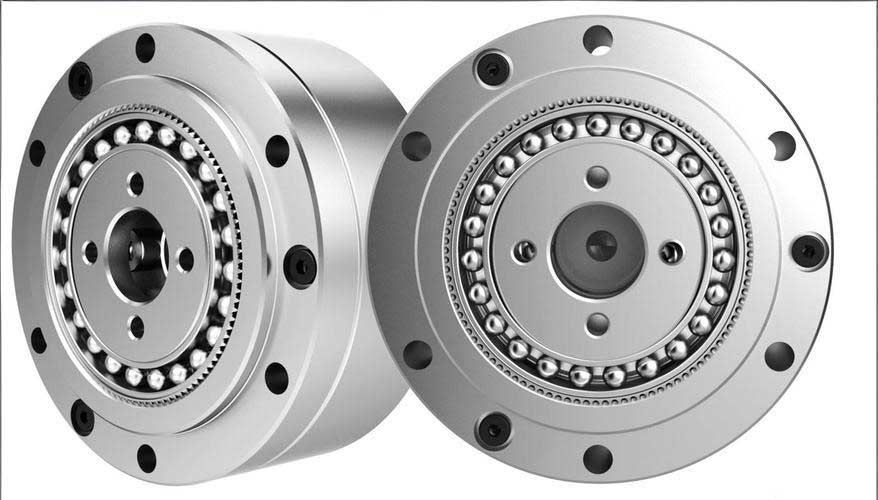
The unique principle of the strain wave gear involves three primary components: a rigid circular spline, a flexible flexspline with external teeth, and an elliptical wave generator inserted into the flexspline. The wave generator deforms the flexspline into an elliptical shape, causing its teeth to engage with those of the circular spline at two diametrically opposite regions. As the wave generator rotates, the engagement zones travel, resulting in a slow relative rotation between the flexspline and circular spline. The kinematic relationship is defined by the difference in tooth count between the two splines. The performance and longevity of the strain wave gear are deeply tied to the stress state and deformation pattern of the flexspline. For years, the design of tooth profiles, especially for involute teeth, has been based on calculating the radial displacement and rotation of the neutral line, assuming its length remains constant. This simplification, while useful, may introduce inaccuracies, particularly for tooth profiles like circular arcs designed for larger contact areas. A more precise understanding of the neutral line’s behavior, including its stretch, is thus critical for advancing strain wave gear technology.
The central problem we address stems from the classical analysis model for the strain wave gear. This model posits that the neutral line of the flexspline, a circle of radius \(r_m\) in its free state, deforms into a specific non-circular curve under the wave generator’s action without changing its perimeter. The deformation is described primarily by radial displacement \(u(\phi)\), where \(\phi\) is the angular coordinate. The tangential displacement \(v(\phi)\) and the rotation \(\theta(\phi)\) of the normal are derived from the condition of inextensibility: \(dv/d\phi = -u\). However, when one performs a geometric check by integrating the arc length of the deformed neutral curve obtained from such a model, a discrepancy often arises—the total length is slightly greater than the original circumference \(2\pi r_m\). This indicates a hidden stretch. For instance, in a prior case study for a specific strain wave gear, the cumulative stretch over one-quarter of the circumference was found to be on the order of several micrometers. While small, this stretch can influence the precise location and orientation of teeth, potentially leading to unexpected interference in kinematic simulations of non-standard tooth profiles, as witnessed in attempts to model conjugate circular-arc teeth. This prompts a fundamental question: what is the true mechanical state of the flexspline’s neutral layer, and how can we accurately compute its stretch?
To answer this, we shift from a purely geometric or kinematic perspective to a mechanical one. We model the tooth ring of the flexspline as a thin circular ring (a beam with initial curvature) subjected to the external forcing from the wave generator. For the widely used two-disk wave generator, the forcing is applied over a specific contact angle. We partition the ring’s circumference into two distinct segments: the contact segment, where the ring is forced to conform to the constant curvature of the wave generator disk, and the non-contact segment, where it deforms freely under the action of internal forces. The solution must satisfy equilibrium equations, geometric compatibility at the boundaries, and continuity conditions at the junction between the segments. Crucially, we will solve for the internal circumferential force \(F_N(\phi)\), which has often been overlooked in traditional deformation analysis focused only on bending. Once \(F_N(\phi)\) is known, Hooke’s law directly gives the circumferential strain \(\epsilon_H(\phi) = F_N(\phi) / (EA)\), where \(EA\) is the axial rigidity of the ring cross-section. Integrating this strain yields the total stretch of the neutral line. This approach provides a mechanically consistent picture of the flexspline’s deformation in a strain wave gear.
We begin by detailing the mechanical model. Consider the neutral line of the flexspline as a ring of mean radius \(r_m\) and a rectangular cross-section with height \(h\) (radial thickness) and width \(b\). The two-disk wave generator is characterized by the disk’s effective radius \(R\) and the eccentricity \(e\), which together determine the maximum radial deflection \(u_0 = r_m + e – R\) imposed on the flexspline at the major axis (\(\phi = 0\)). The contact angle, denoted by \(\gamma\), is the angular span over which the ring is in perfect contact with the wave generator disk. Within this region (\(0 \le \phi \le \gamma\)), the ring’s curvature is constant and equal to \(1/R\). Using the classical relationship between bending moment and curvature change for a thin ring, the bending moment in the contact zone is constant:
$$M_1(\phi) = EI_z \left( \frac{1}{R} – \frac{1}{r_m} \right) = \text{constant},$$
where \(E\) is Young’s modulus and \(I_z = b h^3 / 12\) is the area moment of inertia. Since the curvature is constant, the shear force in this segment is zero, and equilibrium dictates that the circumferential force \(F_{N1}\) is also constant. The radial distributed load \(q_r\) from the disk is uniform.
In the non-contact segment (\(\gamma < \phi \le \pi/2\), exploiting symmetry), the ring is free of external radial load. The internal forces at any cross-section can be expressed in terms of the redundant forces \(X_1\) (moment) and \(X_2\) (circumferential force) at the symmetric boundary \(\phi = \pi/2\). Using equilibrium conditions for a segment of the ring, we derive:
$$
\begin{aligned}
M_2(\phi) &= X_1 + X_2 r_m (1 – \sin\phi), \\
F_{N2}(\phi) &= X_2 \sin\phi, \\
F_{S2}(\phi) &= X_2 \cos\phi \quad \text{(shear force)}.
\end{aligned}
$$
At the junction \(\phi = \gamma\), the bending moment must be continuous: \(M_1(\gamma) = M_2(\gamma)\). However, the shear force is discontinuous due to a concentrated radial reaction from the wave generator disk at the edge of contact; this reaction force is found to be \(X_2 \cos\gamma\).
The governing differential equation for the radial displacement \(u(\phi)\) of a thin ring is:
$$ \frac{d^2 u}{d\phi^2} + u = -\frac{M(\phi) r_m^2}{EI_z}. $$
We solve this equation separately for the two segments. For the contact segment (\(0 \le \phi \le \gamma\)), with constant \(M_1\), the solution is:
$$ u_1(\phi) = C_1 \cos\phi + C_2 \sin\phi – \frac{M_1 r_m^2}{EI_z}. $$
For the non-contact segment (\(\gamma < \phi \le \pi/2\)), substituting \(M_2(\phi)\) gives:
$$ u_2(\phi) = D_1 \cos\phi + D_2 \sin\phi – \frac{r_m^2}{EI_z} \left[ X_1 + X_2 r_m (1 – \sin\phi) \right] – \frac{X_2 r_m^3}{2EI_z} \cos\phi \sin\phi. $$
The constants \(C_1, C_2, D_1, D_2\) and the redundant forces \(X_1, X_2\) are determined from boundary and continuity conditions:
- At \(\phi=0\): Symmetry requires \(du_1/d\phi|_{\phi=0}=0\) and \(u_1(0)=u_0\).
- At \(\phi=\pi/2\): Symmetry requires \(du_2/d\phi|_{\phi=\pi/2}=0\).
- At \(\phi=\gamma\): Continuity of displacement \(u_1(\gamma)=u_2(\gamma)\), slope \(du_1/d\phi|_{\phi=\gamma} = du_2/d\phi|_{\phi=\gamma}\), and bending moment \(M_1(\gamma)=M_2(\gamma)\).
Solving this system yields explicit, albeit lengthy, expressions. The circumferential force in the contact segment is constant and equal to \(F_{N1} = X_2 \sin\gamma\). In the non-contact segment, it varies as \(F_{N2}(\phi) = X_2 \sin\phi\). The expressions for \(X_1\) and \(X_2\) are:
$$
X_1 = \frac{EI_z}{r_m^2} \left[ \frac{u_0 (A_1 – B_1)}{A_1} – \frac{r_m^2}{EI_z} M_1 \right], \quad X_2 = \frac{EI_z}{r_m^3} \cdot \frac{u_0 (1 – r_m/R) – M_1 r_m^2/(EI_z)}{A_1},
$$
where \(A_1 = \pi/2 – \gamma – \sin\gamma \cos\gamma\) and \(B_1 = 2(\pi/2 – \gamma)\sin\gamma – (\pi – 2\gamma)\cos\gamma\). These forces are key to computing stretch.
The circumferential strain is then given by Hooke’s law:
$$ \epsilon_H(\phi) = \frac{F_N(\phi)}{EA} = \frac{F_N(\phi)}{E \cdot (b h)}. $$
Substituting the expressions for \(F_N\), and using \(I_z/A = h^2/12\), we get the strain distribution. For the contact zone (\(0 \le \phi \le \gamma\)):
$$ \epsilon_{H1} = \frac{h^2}{12 r_m^3} \cdot \frac{ [u_0 (1 – r_m/R)] \sin\gamma }{ \frac{\pi}{2} – \gamma – \sin\gamma \cos\gamma }. $$
For the non-contact zone (\(\gamma < \phi \le \pi/2\)):
$$ \epsilon_{H2}(\phi) = \frac{h^2}{12 r_m^3} \cdot \frac{ [u_0 (1 – r_m/R)] \sin\phi }{ \frac{\pi}{2} – \gamma – \sin\gamma \cos\gamma }. $$
Notably, the strain in the contact zone is constant and minimal, while in the non-contact zone it increases with \(\phi\), reaching a maximum at the minor axis (\(\phi = \pi/2\)). The total stretch over one-quarter circumference is:
$$ \Delta s = r_m \int_{0}^{\pi/2} \epsilon_H(\phi) d\phi = \frac{h^2 u_0 (1 – r_m/R)}{12 r_m^2} \cdot \frac{ \sin\gamma + (\frac{\pi}{2} – \gamma) }{ \frac{\pi}{2} – \gamma – \sin\gamma \cos\gamma }. $$
This result quantifies the previously ignored stretch deformation in the strain wave gear flexspline.
The bending stress, historically the focus of flexspline analysis, is \(\sigma_b = M h / (2 I_z)\). Using the moment expressions, we can examine how the choice of contact angle \(\gamma\) affects stress distribution. There exists an optimal \(\gamma\) that minimizes the maximum bending stress. For the two-disk wave generator, this optimal angle is found by equating the bending stress at the major axis (\(\phi=0\)) and the minor axis (\(\phi=\pi/2\)), leading to \(\gamma_{opt} \approx 20.72^\circ\).
To illustrate, let’s consider a numerical example with parameters typical for a medium-sized strain wave gear:
| Parameter | Symbol | Value |
|---|---|---|
| Neutral radius | \(r_m\) | 80.4 mm |
| Radial thickness | \(h\) | 2.373 mm |
| Wave generator disk radius | \(R\) | 77.576 mm |
| Max radial displacement | \(u_0\) | 0.955 mm |
| Contact angle | \(\gamma\) | 15° |
| Young’s modulus | \(E\) | 210 GPa |
Using these values, we compute the key outputs. First, the circumferential strain distribution from the theoretical formulas is:
| Angle \(\phi\) | Segment | Circumferential Strain \(\epsilon_H\) (×10⁻⁶) |
|---|---|---|
| 0° to 15° | Contact | Constant ≈ 1.5 |
| 30° | Non-contact | ≈ 2.9 |
| 45° | Non-contact | ≈ 4.1 |
| 90° (Minor axis) | Non-contact | ≈ 5.8 |
The total stretch over one-quarter circumference calculates to \(\Delta s \approx 0.53 \mu m\). For comparison, the traditional geometric method (assuming inextensibility but computing arc length from \(u(\phi)\) alone) predicted a stretch pattern with a maximum strain over 130×10⁻⁶ and a total stretch of about 8.7 \(\mu m\) for the same quarter. This stark difference—over an order of magnitude—highlights the inaccuracy of the geometric method in predicting stretch magnitudes, though both confirm the existence of stretch. The geometric method’s strain distribution peaks around 40°, while the mechanical model shows a monotonically increasing strain from the major to the minor axis. This discrepancy arises because the geometric method’s displacement field does not satisfy force equilibrium; it is a purely kinematic construct.
To validate our theoretical model, we conduct finite element analysis (FEA). Two models are built: first, a simplified narrow-ring model representing only the tooth ring with a width of 3 mm, modeled using shell elements; second, a full flexspline model including the cup body, teeth, and the tooth ring. The narrow-ring model isolates the behavior of the neutral line under the two-disk wave generator’s imposed displacement. The FEA results for circumferential strain in the narrow ring are shown below, averaged through the width to mitigate Poisson effect variations:
| Angle \(\phi\) | Theoretical \(\epsilon_H\) (×10⁻⁶) | FEA Average \(\epsilon_H\) (×10⁻⁶) |
|---|---|---|
| 0° (Major axis) | 1.5 | 1.6 |
| 15° (Contact edge) | 1.5 | 1.6 |
| 45° | 4.1 | 4.3 |
| 90° (Minor axis) | 5.8 | 6.1 |
The agreement is excellent, confirming the accuracy of our theoretical derivation for the ring model. The strain is indeed constant in the contact zone and increases thereafter, matching the predicted trend. The total stretch from FEA aligns closely with the theoretical value.
Next, the full flexspline FEA model incorporates real-world complexities: a tapered cup body, distinct tooth geometry, and a wider tooth ring (25 mm). The wave generator applies force at the mid-width of the tooth ring. The resulting circumferential strain distribution is more complex due to three-dimensional effects and the cup’s compliance. Strain varies significantly across the width of the tooth ring; near the front and back edges, local compression (negative strain) can even appear due to bending and Poisson effects. However, averaging the strain across five paths along the width yields a pattern qualitatively similar to the narrow-ring model but with amplified magnitude. The average strain at the minor axis rises to about 14.5×10⁻⁶, and the total stretch over a quarter circumference increases to approximately 1.33 \(\mu m\). This indicates that in a complete strain wave gear assembly, the actual stretch is larger than predicted by the simple ring theory—by a factor of about 2.5 in this case—due to the additional constraints and load paths provided by the cup structure. Nonetheless, the ring theory correctly captures the fundamental phenomenon and its distribution trend.
The implications of this neutral line stretch for strain wave gear design are multifaceted. For traditional involute tooth profiles, where mesh interaction is concentrated in a small region near the major axis (where stretch is minimal), the impact on conjugate action and backlash might be negligible. This explains why designs based on the inextensibility assumption have been successful. However, for modern tooth profiles aiming for larger contact areas, such as double-circular-arc teeth, the stretch deformation, especially in regions away from the major axis, could affect the theoretical conjugate condition. Accurate calculation of stretch allows for more precise prediction of tooth positions and orientations during meshing, enabling better profile design to avoid interference and optimize load distribution. Furthermore, understanding the circumferential force \(F_N(\phi)\) provides insight into the complete stress state, potentially informing fatigue life predictions beyond just bending stress considerations.
In conclusion, our investigation establishes that the neutral line of a flexspline in a strain wave gear does experience circumferential stretch when deformed by a wave generator, contradicting the long-held assumption of inextensibility. We have developed a rigorous mechanical model based on thin-ring theory for a two-disk wave generator, deriving analytical expressions for internal forces, strains, and total stretch. The model reveals that stretch is present throughout the circumference, minimal and constant in the contact region, and increases to a maximum at the minor axis. Finite element analysis validates the model’s predictions for a simplified ring and shows that in a full flexspline, the stretch effect is more pronounced due to structural interactions. This work provides a more accurate foundation for kinematic analysis, tooth profile design, and mesh simulation in strain wave gear systems. Future work could extend this approach to other wave generator types (e.g., cam-based) and explore the coupled effects of stretch and tooth compliance on the overall transmission accuracy and stiffness of the strain wave gear.
The strain wave gear, with its unique principle of elastic kinematics, continues to be a vital component in precision engineering. By deepening our understanding of its fundamental mechanics, such as the stretch of the flexspline’s neutral layer, we pave the way for enhanced performance, reliability, and innovation in this versatile transmission technology. The integration of mechanical equilibrium into deformation analysis marks a step forward from purely geometric models, offering a holistic view essential for pushing the boundaries of strain wave gear applications in robotics, aerospace, and other high-tech fields.