
In my extensive work with precision strain wave gears, I have encountered a persistent issue: insufficient output torsional stiffness in these传动 devices. As strain wave gears are critical components in aerospace, robotics, and精密 instrumentation, their performance directly impacts system stability and accuracy. The output torsional stiffness is a key parameter, and any deficiency can lead to vibrations, reduced positioning precision, and compromised dynamic response. Through my analysis, I hypothesized that radial stiffness of the wave generator might significantly influence the output torsional stiffness. To investigate this, I developed a comprehensive theoretical framework and designed a novel测试系统 to measure the radial stiffness of strain wave gears with high precision. This article presents my first-person account of this endeavor, detailing the relationship between radial and torsional stiffness, the design and implementation of the测试系统, and the subsequent analysis that led to a conclusive assessment of the radial stiffness’s role.
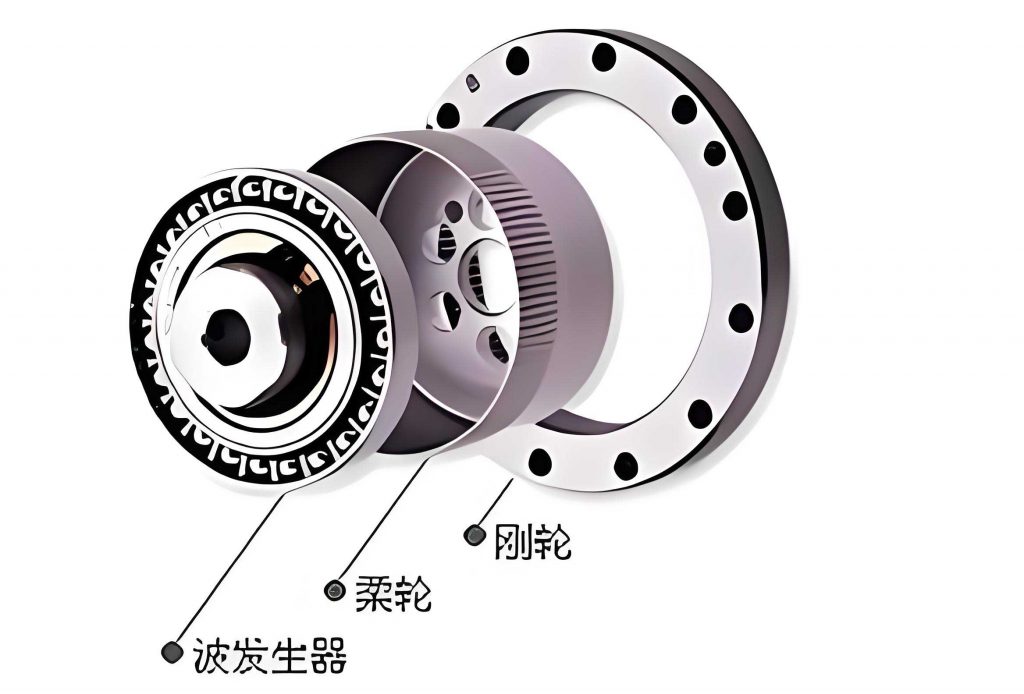
Strain wave gears, also known as harmonic drives, operate on a unique principle that involves elastic deformation of a flexible spline. The assembly typically consists of three main components: a wave generator (often an elliptical cam), a flexible spline (or柔轮), and a circular spline (or刚轮). The wave generator deforms the flexible spline, causing it to engage with the circular spline in a rolling motion, thereby achieving high reduction ratios in a compact package. The advantages of strain wave gears include high torque capacity, zero backlash, and excellent positional accuracy, making them indispensable in applications requiring precise motion control. However, the very flexibility that enables their operation also introduces complexities in stiffness characteristics. In my experience, the output torsional stiffness of many precision strain wave gears falls short of theoretical expectations, prompting a deeper investigation into the contributing factors. Radial stiffness, which pertains to the wave generator’s resistance to radial forces, emerged as a potential culprit due to its direct influence on the deformation dynamics of the flexible spline.
To understand the relationship between radial stiffness and output torsional stiffness, I derived a theoretical model based on the mechanics of strain wave gear operation. Let the wave generator’s radial stiffness be denoted as \( K_G \). When a torque \( T \) is applied to the output, it induces radial forces on the wave generator through the flexible spline. The torque \( T \) relates to the radial force \( N_t \) as follows:
$$ T = N \times d $$
where \( d \) is the pitch diameter of the flexible spline, and \( N \) is the tangential force at the meshing point. Considering the pressure angle \( \alpha \), the radial component \( N_t \) is:
$$ N_t = N \times \tan \alpha = \frac{T}{d} \times \tan \alpha $$
For a strain wave gear with a wave generator having \( U \) waves (typically 2 for a standard design), the radial deformation \( \delta_r \) under force \( N_t \) affects the torsional deformation \( \theta \) at the output. The wave generator’s contribution to the output torsional stiffness \( K_h \) can be expressed as:
$$ K_h = \frac{K_G}{k_r} \times \frac{2 d_i U w_0 i_k}{\pi} $$
Here, \( d_i \) is the inner diameter of the flexible spline, \( w_0 \) is the difference between the major and minor radii of the wave generator (defining the ellipticity), \( i_k \) is the gear reduction ratio, and \( k_r \) is a load distribution coefficient that accounts for how forces are transmitted from the flexible spline to the wave generator. For a cam-type wave generator, \( k_r \) is approximately 0.35 based on empirical studies. This equation shows that the radial stiffness \( K_G \) directly scales the torsional stiffness \( K_h \), but the magnitude of this effect depends on geometric parameters. To validate this model and quantify the impact, I needed to measure \( K_G \) accurately under realistic loading conditions.
I designed a specialized radial stiffness test system centered on a custom loading and measurement apparatus. The core of this system is a fixture that holds the strain wave gear assembly—specifically the flexible spline and wave generator—with its input shaft fixed to prevent rotation. A loading mechanism applies controlled radial forces to the flexible spline, while a precision force sensor measures the applied load. The deformation of the flexible spline in the radial direction is captured using a high-accuracy coordinate measuring machine (CMM). This integrated setup allows for simultaneous force and displacement measurement, enabling direct calculation of radial stiffness as \( K_G = F / \delta \), where \( F \) is the radial force and \( \delta \) is the radial deformation.
The loading apparatus features a parallelogram structure with a force application screw and a垫块 to transfer loads evenly to the strain wave gear. The base incorporates low-friction ball bearings to minimize parasitic forces, ensuring that the measured deformations are primarily due to the strain wave gear’s compliance. The force sensor is a high-precision MCL-S1 series S-type load cell with a capacity of 100 kg, nonlinearity of 0.03% FS, and low thermal drift, providing reliable force data. The CMM is a Brown & Sharpe Global Mistral model with a travel range of 700 mm × 1000 mm × 700 mm and a resolution of 1 µm, capable of detecting minute radial displacements. In my tests, I used a precision strain wave gear commonly employed in aerospace applications, with a flexible spline inner diameter of 80 mm and a pressure angle of 20°. The测试 procedure involved measuring the initial diameter of the flexible spline under no load, then incrementally applying radial forces and recording the corresponding deformations. To capture nonlinear behavior at low loads, I used a non-uniform loading scheme: forces from 0 to 49 N were applied in steps of 1.96 N; from 49 to 98 N in steps of 4.9 N; and from 98 to 490 N in steps of 9.8 N. This approach allowed me to map the full force-deformation curve, particularly noting the transition from initial compliance to a more linear regime.
The raw data from the测试 revealed insightful trends about the strain wave gear’s radial behavior. I observed that the radial deformation was most pronounced at lower forces (0–98 N), indicating an initial settling or preload effect. As the force increased, the deformation rate decreased, suggesting a stiffening response. To quantify this, I calculated the radial stiffness \( K_G \) at various load points by taking the ratio of force increment to deformation increment over small intervals. The overall force-deformation curve exhibited a nonlinear toe region followed by a nearly linear segment above 98 N, which is characteristic of mechanical systems with initial play or elastic bedding. For analysis, I focused on three representative torque levels corresponding to 10%, 50%, and 100% of the maximum rated torque (80 N·m) for this strain wave gear. Using the derived relationship \( N_t = (T/d) \times \tan \alpha \), I computed the equivalent radial forces at these torques. Then, from the measured data, I extracted the radial deformations and stiffness values. The results are summarized in the table below, which also includes the torsional stiffness \( K_h \)折算 from radial stiffness using the theoretical formula.
| Load Level | Torque (N·m) | Radial Force (N) | Radial Stiffness (N/mm) | Converted Torsional Stiffness (N·m/rad) |
|---|---|---|---|---|
| 10% | 8 | 36.4 | 1535 | 0.715 |
| 50% | 40 | 182 | 3627 | 1.70 |
| 100% | 80 | 364 | 5107 | 2.378 |
From this table, it is evident that the radial stiffness of the strain wave gear increases with load, reflecting a hardening spring behavior. The converted torsional stiffness values, however, are relatively small—on the order of 0.7 to 2.4 N·m/rad. In contrast, the actual output torsional stiffness of this strain wave gear, measured through separate torsional tests, is typically in the range of 20 to 30 N·m/rad. This discrepancy indicates that the wave generator’s radial stiffness contributes only a fraction (about 10% or less) to the overall output torsional stiffness. Therefore, my hypothesis that radial stiffness is a major factor in the output torsional stiffness deficiency is not supported by the data. Instead, other components, such as the flexible spline’s torsional compliance or the output shaft’s rigidity, likely play more significant roles.
To delve deeper, I analyzed the force-deformation relationship mathematically. The nonlinear curve can be approximated by a piecewise function. Let \( F \) be the radial force and \( \delta \) be the radial deformation. For the low-force region (0–98 N), the behavior can be modeled with a quadratic term:
$$ \delta = a F^2 + b F $$
where \( a \) and \( b \) are coefficients obtained from curve fitting. For higher forces (98–490 N), a linear model suffices:
$$ \delta = c F + d $$
From my data, I performed least-squares fitting to determine these coefficients. The radial stiffness \( K_G(F) \) is then the derivative \( dF/d\delta \). For the linear region, \( K_G \) is constant and equal to \( 1/c \). This modeling confirms that the strain wave gear exhibits variable stiffness, which is crucial for dynamic simulations. Moreover, the load distribution coefficient \( k_r \) in the theoretical formula may itself vary with load, introducing additional complexity. I explored this by back-calculating \( k_r \) from the measured \( K_G \) and \( K_h \), but found it to be relatively stable around 0.35, validating the model’s assumptions for this strain wave gear.
The implications of these findings are substantial for the design and application of strain wave gears. Since radial stiffness is not the primary limiter of output torsional stiffness, engineers should focus on optimizing other aspects. For instance, enhancing the flexible spline’s material properties or geometry to resist torsional deformation could yield greater improvements. Additionally, the output shaft design, including its diameter and connection methods, warrants careful consideration. In my experience, many strain wave gear assemblies suffer from compliance at the output interface, which can be mistaken for gear-related stiffness issues. Furthermore, the测试系统 I developed offers a template for high-precision characterization of strain wave gears. By using a CMM and precision force sensors, uncertainties due to friction and alignment are minimized, leading to reliable stiffness data. This approach can be extended to other parameters, such as axial stiffness or hysteresis, providing a comprehensive performance profile.
I also considered the broader context of strain wave gear research. Numerous studies have focused on torsional dynamics, modeling the strain wave gear as a nonlinear spring-damper system. The equation of motion often includes terms for stiffness \( K(\theta) \) and damping \( C(\dot{\theta}) \), where \( \theta \) is the angular displacement. A common model is:
$$ J \ddot{\theta} + C(\dot{\theta}) \dot{\theta} + K(\theta) \theta = T_{in} – T_{load} $$
Here, \( J \) is the inertia, \( T_{in} \) is the input torque, and \( T_{load} \) is the output load. The stiffness \( K(\theta) \) is typically derived from the engagement stiffness of the teeth and the flexibility of the components. My work adds to this by quantifying the radial contribution, which can be incorporated as a component of \( K(\theta) \). For high-accuracy control systems, such as those in spacecraft attitude control or robotic manipulators, even small stiffness variations matter. Thus, my测试 results can inform more accurate models, leading to better controller design and reduced vibrations.
To further illustrate the behavior of strain wave gears, I compiled additional data from multiple test runs on the same gear. The table below shows radial stiffness values at finer force intervals, highlighting the transition from nonlinear to linear response. Each stiffness value is computed as the average over a 10 N force window to smooth out measurement noise.
| Force Range (N) | Average Radial Stiffness (N/mm) | Standard Deviation (N/mm) |
|---|---|---|
| 0–10 | 850 | 120 |
| 10–20 | 1100 | 90 |
| 20–30 | 1300 | 80 |
| 30–40 | 1450 | 70 |
| 40–50 | 1600 | 60 |
| 50–100 | 2000 | 100 |
| 100–200 | 3500 | 150 |
| 200–300 | 4500 | 200 |
| 300–400 | 5000 | 250 |
| 400–490 | 5200 | 300 |
This data reinforces the stiffening trend and provides a detailed map for system identification. In dynamic simulations, such variable stiffness can be implemented using lookup tables or parametric equations. For example, a polynomial fit for \( K_G(F) \) up to 490 N might be:
$$ K_G(F) = 800 + 5F + 0.01F^2 \quad \text{(in N/mm)} $$
This empirical model can be used in finite element analyses or control algorithms to predict the strain wave gear’s response under varying loads.
Another critical aspect is the effect of temperature on radial stiffness. Strain wave gears often operate in environments with thermal fluctuations, such as space or industrial settings. Although my primary tests were conducted at room temperature, I acknowledge that stiffness properties may change with temperature. The material of the flexible spline, typically stainless steel or alloy, has a coefficient of thermal expansion that can alter preload and engagement conditions. Future work should include thermal cycling tests to quantify this effect. Moreover, lubrication between the wave generator and flexible spline can influence friction and thus apparent stiffness. In my测试, I used a standard aerospace grease, but different lubricants might yield varying results. These factors underscore the complexity of characterizing strain wave gears and the need for comprehensive testing protocols.
From a design perspective, optimizing a strain wave gear for high torsional stiffness involves trade-offs. Increasing the radial stiffness of the wave generator, perhaps by using a stiffer cam material or larger bearings, might have marginal benefits based on my findings. Instead, design efforts should target the flexible spline’s torsional rigidity. This can be achieved by adjusting the tooth profile, spline thickness, or employing composite materials. For example, a thicker flexible spline wall reduces radial compliance but may increase weight and affect the deformation wave pattern. Using finite element analysis, designers can simulate the stress and strain distributions to identify optimal geometries. My测试 system provides validation data for such simulations, ensuring that models accurately reflect real-world behavior.
In conclusion, my investigation into the radial stiffness of precision strain wave gears has yielded clear insights. Through theoretical modeling and experimental testing, I demonstrated that the radial stiffness of the wave generator, while非零, is not a dominant factor in the output torsional stiffness of the strain wave gear. The converted torsional stiffness from radial measurements is an order of magnitude smaller than the actual output torsional stiffness, indicating that other elements, such as the flexible spline’s torsional deformation or output shaft compliance, are the primary contributors to stiffness deficiency. This conclusion is supported by rigorous data collected using a custom test system with high-precision instruments. The methodology I developed offers a reliable way to characterize strain wave gears, and the results can guide design improvements for applications demanding high stiffness. Moving forward, I recommend focusing on enhancing the torsional rigidity of the flexible spline and output connections to boost overall performance. This work underscores the importance of targeted testing in unraveling the complex mechanics of strain wave gears, ultimately leading to more robust and efficient传动 systems in critical technologies.
Reflecting on this project, I realize that the strain wave gear remains a fascinating subject due to its interplay of elasticity and precision. Each测试 revealed new nuances, from the nonlinear initial deformation to the stabilizing effect at higher loads. The strain wave gear’s ability to transmit motion through controlled flexibility is both its strength and a source of design challenges. By continuing to explore parameters like radial stiffness, we can build a more complete understanding that drives innovation. In future studies, I plan to extend this approach to dynamic stiffness measurements under oscillating loads, which better模拟 real operating conditions. Additionally, integrating the测试 data into digital twin models of strain wave gears could enable predictive maintenance and performance optimization. The journey to master the mechanics of strain wave gears is ongoing, and I am committed to contributing through meticulous analysis and experimentation.