
As a researcher deeply immersed in the field of mechanical transmission systems, I find strain wave gear technology to be a fascinating and pivotal innovation. Originating in the mid-1950s to meet the demands of aerospace advancements, strain wave gear drives, also known as harmonic drives, have rapidly evolved into a superior alternative to conventional gear systems. Their unique operating principle, which involves the controlled elastic deformation of a flexible component called the flexspline, enables exceptional performance characteristics. Compared to traditional gear trains, strain wave gear systems offer significant advantages, including large and wide-ranging transmission ratios, smooth operation, high load-carrying capacity, compact size and light weight per unit torque transmitted, uniform and minimal tooth wear, high transmission efficiency, remarkable precision with minimal backlash, and the ability to transmit motion into sealed spaces. These attributes have propelled strain wave gear drives into diverse applications, from robotics and aerospace to precision instrumentation and industrial automation.
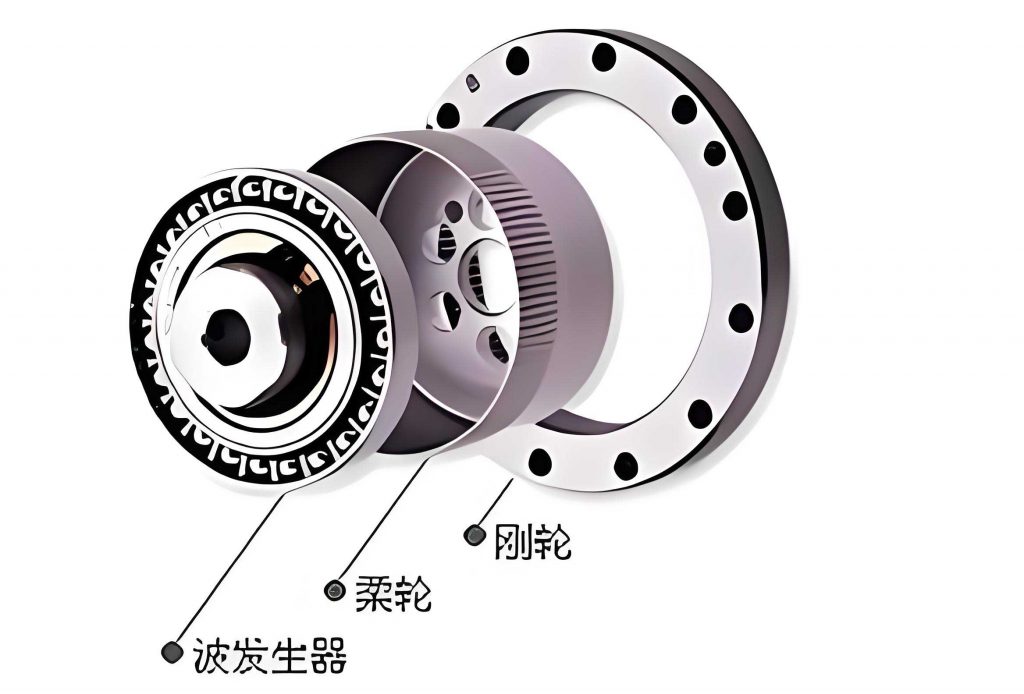
The global recognition of strain wave gear potential in the 1960s spurred intensive research into its principles, design, and manufacturing. Countries like the United States, Japan, and the former Soviet Union established standardized series and dedicated production facilities. While foundational work has yielded mature products and design methodologies, the inherent complexity introduced by the flexible flexspline means that certain aspects of strain wave gear technology remain ripe for deeper investigation. This article, from my perspective, delves into the core research foci and evolving dynamics surrounding strain wave gear drives, highlighting critical areas where further exploration is essential to unlock their full potential.
Research Foci and Developmental Trends in Strain Wave Gear Technology
The investigation into strain wave gear systems spans multiple interconnected disciplines. A comprehensive understanding requires examining the meshing theory, kinematics, tooth profile design, stress analysis of the flexspline, structural parameter optimization, manufacturing processes, and transmission accuracy.
Meshing Principle Investigations
The study of meshing theory is fundamental to enhancing the performance of strain wave gear assemblies and developing new processing techniques. The significant influence of the flexspline’s elastic deformation on the conjugate motion of the tooth pairs complicates this theory, attracting continuous scholarly attention. Several methodologies have been employed to analyze the meshing principles of strain wave gear drives.
Graphical Analysis Method: This approach involves determining one tooth profile of a meshing pair and then using the deformation relationship of the neutral curve or the geometrical relationship of the meshing motion in a polar coordinate system to graphically derive the other profile. While intuitive, its conclusions are often approximate, and the diagrams become exceedingly complex when load conditions are considered.
Analytical Method Using Envelope Theory: This method essentially incorporates the elastic deformation of the flexspline as an integral part of the conjugate motion. The conjugate tooth profile for a strain wave gear is then solved using envelope theory. The fundamental condition for conjugation can be expressed as the requirement that the common normal at the contact point passes through the instantaneous center of relative motion. For a strain wave gear, this is often analyzed by considering the wave generator’s motion and the flexspline’s deflection.
Iso-velocity Curve Method: Here, the meshing process of a single tooth pair in a strain wave gear is viewed as the flexspline tooth and the circular spline tooth moving along their respective iso-velocity curves with equal speed. The transmission ratio is given by the ratio of the lengths of these curves. If $v_f$ is the velocity along the flexspline curve and $v_c$ along the circular spline curve, and they are equal ($v_f = v_c$), then the ratio $i$ relates to the path lengths $s_f$ and $s_c$: $i = \frac{s_c}{s_f}$.
Power Series Method: Borrowing from approximations used in bevel gear research, this rigorous method employs power series expansions to represent the tooth profile curve equations, conjugate conditions, and transmission ratios. It transforms spatial problems into planar ones, offering high precision albeit with complex mathematical handling. The tooth profile might be expressed as a series: $y(x) = a_0 + a_1 x + a_2 x^2 + a_3 x^3 + …$, with coefficients determined by boundary conditions from the deformation.
The following table summarizes these key methodologies for studying strain wave gear meshing principles:
| Method | Core Principle | Advantages | Limitations |
|---|---|---|---|
| Graphical Analysis | Geometric construction based on neutral layer deformation. | Intuitive, visual representation. | Low accuracy, complex under load. |
| Envelope Theory | Treats deformation as part of conjugate motion; solves for envelope of family of curves. | Analytically rigorous, based on solid theory. | Requires precise mathematical modeling of deformation. |
| Iso-velocity Curve | Models teeth moving on curves of equal speed. | Provides a kinematic perspective on ratio. | May oversimplify actual contact mechanics. |
| Power Series | Uses series expansions for profiles and conditions. | High precision, suitable for detailed analysis. | Mathematically intensive, complex derivation. |
Kinematics Analysis
Kinematic models for strain wave gear drives generally fall into two categories, each offering a different lens through which to understand motion transmission.
Friction Model: This model analyzes and defines the transmission ratio based on the principle of pure rolling without sliding. The average angular velocity integration principle is often introduced. For a simple model, if the wave generator causes the flexspline to deform into an ellipse with semi-major axis $a$ and semi-minor axis $b$, and the circular spline has $N_c$ teeth while the flexspline has $N_f$ teeth (with $N_c – N_f$ typically being 2 or a multiple thereof), the basic reduction ratio $i$ is given by: $$i = -\frac{N_f}{N_c – N_f}$$ The negative sign indicates direction reversal. This formula is derived from the no-slip condition at the meshing interface.
Planetary Transmission Model: This approach abstracts the strain wave gear mechanism as a variant of a planetary gear system, applying planetary kinematics to study its motion. However, fundamental differences between the two transmission types mean planetary gear theories are not fully applicable. The wave generator is likened to the planet carrier, the flexspline to the sun gear, and the circular spline to the ring gear, but the elastic deformation element is unique to strain wave gear.
A more recent geometric-kinematic model based on motion transfer offers a clearer view. It ignores the cup-body deformation of the flexspline during assembly, focusing solely on the motion transfer principle. It establishes a correspondence between points on the output shaft circle and points on the elliptical neutral layer of the engaging end, clarifying the influence of the output shaft’s rotation on a specific particle on the flexspline. This model facilitates a more detailed discussion of single-tooth meshing between the flexspline and circular spline in a strain wave gear system.
Tooth Profile Research
The evolution of tooth profiles for strain wave gear drives reflects the ongoing quest for optimal performance, manufacturability, and load distribution. The choice of profile significantly impacts stress concentration, wear, and meshing continuity.
Straight-Sided Triangular Profile (α=28.6°): Proposed by early researchers, this profile is not the theoretical conjugate shape for a strain wave gear as it neglects the tilting of the flexspline tooth profile due to changing curvature during deformation. It also poses manufacturing challenges.
Involute Profile: Due to ease of machining with standard tools, involute profiles, including modified versions, are the most widely used in strain wave gear applications. Pressure angles of 20°, 28.6°, and 30° have been explored. A 20° pressure angle, while allowing standard tooling, risks tooth overlap interference and often requires short teeth and positive correction. A 30° pressure angle, adopted in Japan, avoids interference but increases radial load on the wave generator. The basic involute equation is: $$x = r_b (\cos \theta + \theta \sin \theta)$$ $$y = r_b (\sin \theta – \theta \cos \theta)$$ where $r_b$ is the base circle radius.
Circular-Arc and Substitute Profiles: Circular-arc profiles offer wider tooth spaces, reducing stress concentration, and facilitate oil film formation due to a wedge-shaped side clearance. Their main drawback is the need for special cutting tools. A substitute profile, the cycloidal tooth, inherits these advantages but can be machined with a straight-edged shaping cutter, though tooling remains more complex than for involute gears.
“S” Tooth Profile: A more recent innovation, the “S” profile is designed from the perspective of ensuring continuous contact without requiring tooth deformation. It is based on curve mapping, where the mapping reference curve is the trajectory of the flexspline tooth tip relative to the circular spline. An improved version features a working flank composed of two circular arcs with large radii near the tip and root. This profile shows promise for improving meshing performance and load capacity in strain wave gear drives.
The table below compares the predominant tooth profiles used in strain wave gear design:
| Tooth Profile | Key Characteristics | Pressure Angles | Manufacturability | Primary Advantage |
|---|---|---|---|---|
| Straight Triangular | Simple geometry, early design. | 28.6° | Poor, requires special tools. | Historical significance. |
| Involute | Curved flank, conjugate action. | 20°, 28.6°, 30° | Excellent, uses standard gear tools. | Wide adoption, easy production. |
| Circular-Arc | Wide tooth space, wedge clearance. | Varies | Poor, needs special刀具. | Reduced stress, better lubrication. |
| Cycloidal (Substitute) | Similar to circular-arc, can be shaped. | Varies | Moderate, complex tooling. | Good load distribution. |
| “S” Profile | Dual-arc flank, based on mapping. | Designed specific | Emerging, requires development. | Potential for superior contact and life. |
Flexspline Deformation and Stress State Analysis
The flexspline is the heart of a strain wave gear drive, and its stress-strain state under load is critical for reliability and life prediction. Research methods have evolved from theoretical formulas to advanced computational techniques.
Theoretical Formula Method: This approach typically relies on the geometrically nonlinear theory of elastic thin shells, using a simplified model of a smooth cylindrical shell to derive analytical stress formulas. For a thin-walled cylindrical flexspline, membrane theory can provide initial stress estimates. The circumferential stress $\sigma_\theta$ due to bending from elliptical deformation can be approximated by: $$\sigma_\theta \approx \frac{E \cdot t \cdot \delta}{R^2}$$ where $E$ is Young’s modulus, $t$ is wall thickness, $\delta$ is the radial deformation amplitude, and $R$ is the nominal radius. However, this is highly simplified and neglects many factors.
Experimental Methods: Techniques like photoelasticity and electrical resistance strain gauges offer direct, practical insights. They are invaluable for validation but can be costly, time-consuming, and limited to surface measurements, unable to reveal internal stress states in the strain wave gear component.
Computational Numerical Simulation: The Finite Element Method (FEM) has become a cornerstone for analyzing flexspline stress and strain. It allows for the modeling of complex geometries, material nonlinearities, and contact conditions, providing detailed distribution maps of stress and deformation. A typical FEM analysis of a strain wave gear involves modeling the flexspline, circular spline, and wave generator, applying contact algorithms, and solving under load. This method dramatically shortens development cycles and reduces costs associated with physical prototyping.
A novel experimental-analytical hybrid approach has been proposed to study load distribution within the meshing zone. It uses removable “live teeth” installed radially in the circular spline to measure tangential and radial force data under load. Statistical analysis yields experimental curves, and function approximation derives load distribution equations. This method offers a more accurate reflection of the actual stress state in an operating strain wave gear.
The following formula represents a generalized approach for maximum stress estimation in a cup-type flexspline, considering bending and membrane effects: $$\sigma_{max} = C_m \cdot \frac{E \cdot t \cdot (a-b)}{b^2} + C_b \cdot \frac{6 \cdot M}{\pi \cdot R_m^2 \cdot t}$$ where $a$ and $b$ are ellipse semi-axes, $M$ is transmitted torque, $R_m$ is mean radius, and $C_m$, $C_b$ are coefficients dependent on geometry and load application.
Structural Parameters and Optimization Design
Designing strain wave gear drives with optimal structural parameters to meet specific performance requirements while minimizing size and weight is a key research area. This is especially crucial for applications like robotics and servo systems with stringent space constraints.
One major trend is the reduction of axial dimensions. The length-to-diameter ratio of the cup-type flexspline is a critical parameter. While common ratios range from 0.7 to 1.0, advanced series from the US and research in Russia have achieved ratios as low as 0.2 to 0.5, creating “ultra-short” flexsplines for extremely compact strain wave gear reducers. These designs must carefully balance deformation, stress, and fatigue life.
Recent optimization studies propose a holistic approach that simultaneously considers meshing parameters (like module, pressure angle) and structural parameters (wall thickness, cup length, gear width). This integrated optimization, often using algorithms like Genetic Algorithms (GA) or Particle Swarm Optimization (PSO), aims to maximize efficiency and load capacity while minimizing volume or weight. An objective function $F_{obj}$ for a strain wave gear might be: $$F_{obj} = w_1 \cdot \frac{1}{\eta} + w_2 \cdot V + w_3 \cdot \sigma_{max}$$ subject to constraints on tooth strength, interference, radial clearance, etc., where $\eta$ is efficiency, $V$ is volume, $\sigma_{max}$ is maximum stress, and $w_i$ are weighting factors.
An innovative concept called the “live-tooth end face strain wave gear” has been introduced. This design merges principles from strain wave gear and live-tooth (oscillating tooth) transmissions. It aims to decouple the flexspline’s deformation from its load-carrying capacity, potentially allowing for larger module gears and more simultaneously engaged teeth. This could dramatically increase the power transmission capability of strain wave gear systems while retaining their precision and compactness.
Manufacturing Process Research
The complexity of manufacturing key components, particularly the wave generator and the flexspline, significantly impacts the cost and quality of strain wave gear drives. Advanced processes are continually being developed.
Wave generators, especially cam-based or planetary roller types, often require CNC machining for high precision. For the flexspline and circular spline, which constitute 70-80% of the total manufacturing effort, processes like gear hobbing, shaping, and grinding are standard. However, innovative methods are emerging:
- Flexspline Rolling: A cold-forming process that can enhance surface finish and grain structure, improving fatigue life.
- Circular Spline Internal Gear Rolling/Pressing: Net-shape or near-net-shape forming techniques that reduce material waste and machining time.
- “Converted Meshing Reproduction Method”: This method involves machining the flexspline teeth while the flexspline is subjected to the same deformation state as during no-load meshing with the circular spline. This proactive compensation minimizes initial meshing interference and reduces run-in time for the strain wave gear assembly.
Material innovation is another promising avenue. Replacing traditional alloy steels with advanced composites, such as carbon fiber-reinforced epoxy, for the flexspline is under investigation. These composites offer high specific stiffness and strength, along with excellent damping properties. Research indicates that composite flexsplines can increase torsional stiffness by 50% and improve vibration attenuation by 100% at fundamental frequencies, presenting a significant opportunity for high-performance strain wave gear applications.
Transmission Accuracy Studies
The high transmission accuracy of strain wave gear drives, superior to many conventional gear systems due to multi-tooth simultaneous engagement, is a key merit. However, understanding and minimizing transmission error is vital for precision applications.
Classical formulas for estimating transmission error in strain wave gear drives have been established, often relating error to manufacturing tolerances of components. Contemporary research focuses on dissecting the mechanisms of error generation. According to the principle of independent error action, the total transmission error $\Delta \phi_{total}$ can be considered a superposition of various error components: $$\Delta \phi_{total} = \Delta \phi_{mesh} + \Delta \phi_{ecc\_fs} + \Delta \phi_{ecc\_cs} + \Delta \phi_{bearings} + \Delta \phi_{wavegen} + …$$ where:
- $\Delta \phi_{mesh}$ is error from tooth profile and pitch inaccuracies of the flexspline and circular spline.
- $\Delta \phi_{ecc\_fs}$ and $\Delta \phi_{ecc\_cs}$ are errors due to eccentricity and assembly clearance of the flexspline and circular spline mounts.
- $\Delta \phi_{bearings}$ stems from radial play and runout in supporting bearings.
- $\Delta \phi_{wavegen}$ arises from imperfections in the wave generator assembly.
Each component has a characteristic frequency (e.g., related to tooth mesh frequency, rotational frequency of parts). Studies confirm that manufacturing and assembly errors of the flexspline, circular spline, and wave generator are the primary sources of transmission error, constituting a major nonlinear factor in the dynamics of a strain wave gear system.
Future Research Directions for Strain Wave Gear Drives
Despite the remarkable progress, several frontiers beckon further exploration to advance strain wave gear technology. From my viewpoint, the following areas are particularly promising and necessary for the next generation of strain wave gear systems.
Advanced Dynamics Modeling: Developing comprehensive nonlinear dynamic models that fully account for factors like time-varying mesh stiffness, damping in the flexspline, backlash nonlinearity, and the interaction of multiple error sources. Such models are essential for predicting vibration, noise, and dynamic transmission error, especially in high-speed or high-precision strain wave gear applications. A generalized equation of motion for a strain wave gear system might take the form: $$I\ddot{\theta} + C(\dot{\theta}, t) + K(\theta, t)\theta = T_{in} – T_{load}(\theta)$$ where $I$ is inertia, $C$ is nonlinear damping, $K$ is time-varying mesh stiffness, and $T$ are torques.
Tooth Profile Innovation and Standardization: Continued research into novel tooth profiles like the “S” shape, along with rigorous comparative analysis of their load distribution, stress, efficiency, and manufacturability. Establishing international standards for high-performance profiles could benefit the entire strain wave gear industry.
Integrated Design and Simulation Platforms: Fostering the development of sophisticated Computer-Aided Design (CAD) and analysis systems dedicated to strain wave gear drives. These platforms would integrate parametric modeling, finite element analysis (FEA) for stress and deformation, kinematic simulation, and optimization routines into a seamless workflow, accelerating design cycles and improving reliability.
Material and Process Synergy: Deepening the investigation of novel materials like metal matrix composites or high-performance polymers for flexsplines, and developing tailored manufacturing processes such as additive manufacturing (3D printing) for complex wave generator shapes or prototype gears. The synergy between material properties and fabrication method is key to unlocking new performance envelopes for strain wave gear reducers.
Systematic Performance Characterization: Conducting extensive theoretical and experimental studies on system-level performance metrics under diverse operating conditions—thermal effects, lubrication regimes, long-term wear, and fatigue life. This data is crucial for building accurate predictive maintenance models and expanding the application range of strain wave gear technology.
Miniaturization and New Product Development: Pushing the boundaries of miniaturization for micro-robotics and medical devices, while also developing robust, high-torque series for heavy-duty industrial applications. The standardization and series development of these new strain wave gear product families will be vital for market adoption.
In conclusion, the journey of strain wave gear technology from a specialized aerospace innovation to a cornerstone of precision motion control is a testament to its inherent advantages. The ongoing research dynamics—spanning advanced modeling, innovative design, smart manufacturing, and material science—promise to further elevate the capabilities of strain wave gear drives. As we address the existing challenges and explore these future directions, strain wave gear systems will undoubtedly continue to revolutionize applications demanding compact, precise, and reliable power transmission. The potential for strain wave gear technology remains vast, and its continued evolution will be a fascinating area of mechanical engineering research and development for years to come.