
As a researcher in the field of precision gear transmission, I have long been fascinated by the unique capabilities of strain wave gears. These mechanisms, also known as harmonic drives, offer exceptional advantages in applications requiring compact design, high torque density, and precise motion control. The core principle involves the elastic deformation of a flexible spline, which engages with a rigid circular spline via a wave generator. This interaction creates a multi-tooth engagement zone, distributing load across numerous teeth and enabling high reduction ratios in a single stage. The performance of a strain wave gear is intrinsically linked to the geometry of its tooth profiles and the deformation characteristics of the flexible spline during assembly and operation. In this extensive study, I delve into the intricacies of designing and simulating strain wave gears utilizing circular-arc tooth profiles, with a particular focus on predicting gear backlash and performing interference checks under various assembly conditions.
The widespread adoption of strain wave gears in robotics, aerospace, and medical devices is a testament to their superior performance. However, the traditional involute tooth profile, while manufacturable, is not optimal for this application. It often results in a narrow conjugate zone concentrated near the major axis of the wave generator, leading to high stress concentrations and potential edge contact under load. To overcome these limitations, circular-arc tooth profiles have been proposed. These profiles, comprising connected arcs and straight segments, can provide a more uniform stress distribution and a larger area of simultaneous tooth engagement. This significantly enhances the load capacity, torsional stiffness, and longevity of the strain wave gear. Nevertheless, the design of such profiles is complex. The multi-segment nature demands a precise mathematical description, and the gear backlash—the tiny clearance between mating teeth—becomes critically sensitive to the exact deformed shape of the flexible spline. Improper design can easily lead to tooth profile interference, where material from one tooth encroaches upon the space of another, causing binding, wear, or failure. Therefore, developing a robust simulation methodology to visualize the assembled state and quantify the micron-level gear backlash distribution is paramount for the successful implementation of circular-arc profiles in strain wave gears.
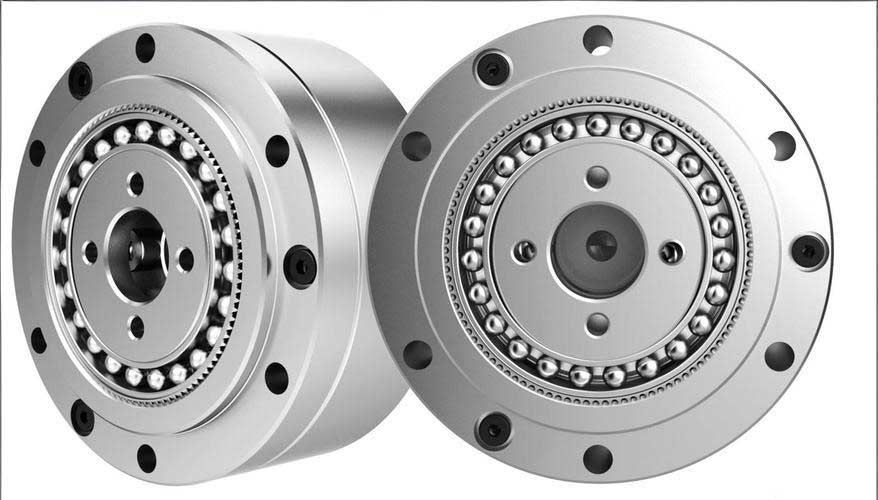
The primary challenge in modeling strain wave gears lies in accurately representing the deformed state of the flexible spline. Unlike conventional gears, the teeth on the flexible spline are not fixed in a perfect circle; they follow the contour imposed by the wave generator. To address this, my approach begins with establishing a unique and continuous mathematical representation for the circular-arc tooth profile. Rather than using standard parametric equations based on an angle, I employ an arc-length coordinate system. This method ensures geometric invariance and continuity, which are essential for precise numerical analysis and simulation. For a common-tangent double circular-arc profile, the contour is defined piecewise. Each segment—whether an arc or a straight line—is expressed as a function of the arc length parameter \( u \). The complete profile is then constructed using Heaviside functions to seamlessly join these segments. This formulation is applied independently to both the rigid spline (circular spline) and the flexible spline.
For the rigid spline, the tooth profile typically consists of a single circular arc and a straight-line segment meeting at a tangent point. The local coordinate system \((x_2, y_2)\) is defined with the \(y_2\)-axis as the tooth’s line of symmetry. The position vector \(\mathbf{X}_2(u)\) for a point on the profile is given by:
For the circular arc segment (\(u \in [0, l_1]\)):
$$\mathbf{X}_2(u) = \mathbf{R} \cdot \boldsymbol{\chi}_u + \mathbf{T}, \quad \text{where} \quad \boldsymbol{\chi}_u = \rho_a \mathbf{R}_u.$$
Here, \(\rho_a\) is the radius of the arc, \(\mathbf{R}_u = \left[ \sin(u/\rho_a), \cos(u/\rho_a), 1/\rho_a \right]^T\), \(\mathbf{R}\) is a rotation matrix aligning the arc’s local frame, and \(\mathbf{T}\) is a translation vector to the arc’s center. The transition length \(l_1\) is calculated based on the arc’s angular span.
For the straight-line segment (\(u \in [l_1, l_2]\)):
$$\mathbf{X}_2(u) = (u – l_1) \mathbf{R}_u + \mathbf{T}.$$
Here, \(\mathbf{R}_u\) is a unit direction vector for the line, and \(\mathbf{T}\) is now the position vector of the tangent point.
The profile for the flexible spline in a strain wave gear is more complex, often featuring three circular arcs and one straight segment. In its local coordinate system \((x_1, y_1)\), the profile is symmetric about the \(y_1\)-axis. The representation follows the same arc-length principle but with more segments. For instance, the lower arc (near the tooth root), the middle arc, the straight flank, and the tip arc are each defined over specific intervals \([l_{i-1}, l_i]\). The general form for an arc segment is:
$$\mathbf{X}_1(u) = \mathbf{R} \cdot \boldsymbol{\chi}_u + \mathbf{T}, \quad \boldsymbol{\chi}_u = \rho \mathbf{R}_u,$$
and for a straight segment:
$$\mathbf{X}_1(u) = (u – l_k) \mathbf{R}_u + \mathbf{T}.$$
The parameters \(\rho\), rotation matrices \(\mathbf{R}\), and translation vectors \(\mathbf{T}\) are uniquely determined for each segment from the design geometry. The key design parameters for these profiles are typically expressed as dimensionless coefficients relative to the module \(m\). A comprehensive set of these parameters for both splines is summarized in the table below.
| Symbol | Description (Flexible Spline) | Typical Value (Flex.) | Description (Rigid Spline) | Typical Value (Rigid) |
|---|---|---|---|---|
| \(h_a^*\) | Addendum coefficient | 0.9 | Addendum coefficient | 0.9 |
| \(h_f^*\) | Dedendum coefficient | 1.212 | Dedendum coefficient | 1.15 |
| \(S_l^*\) | Tooth thickness coeff. at blend point | 1.3565 | Tooth thickness coeff. at blend point | 1.7504 |
| \(\rho_a^*\) | Tip arc radius coefficient | 1.0802 | Arc radius coefficient | 2.0528 |
| \(\rho_f^*\) | Flank arc radius coefficient | 2.0528 | – | – |
| \(\rho_{cf}^*\) | Root fillet radius coefficient | 0.55 | – | – |
| \(\lambda_a^*\) | Tip arc center x-coordinate coeff. | 0.3927 | 1.1560 | – |
| \(\beta_a^*\) | Tip arc center y-coordinate coeff. | -0.366 | – | – |
| \(C\) | Flank line angle (from y-axis) | 7° 30′ 30” | Flank line angle | 8° 24′ |
With the tooth profiles mathematically defined, the next crucial step is to build the assembly model of the strain wave gear. This model must reflect the true working condition where the flexible spline is deformed by the wave generator. The wave generator, which can be of various types like elliptical cam, dual-roller, or quad-roller, imposes a radial displacement \(w(\phi)\) on the neutral curve of the flexible spline. This curve, initially a circle of radius \(r_m\), becomes a non-circular shape described in polar coordinates as \(r(\phi) = r_m + w(\phi)\). The function \(w(\phi)\) depends on the wave generator type; for a classic elliptical cam, \(w(\phi) = w_0 \cos(2\phi)\), where \(w_0\) is the maximum radial displacement. For multi-roller generators, the function is piecewise and derived from the envelope of the rollers.
The position and orientation of each tooth on the deformed flexible spline are not uniformly spaced in angle. They are determined using an equal-arc-length distribution algorithm along the deformed neutral curve. For a tooth initially at angular position \(\phi_0\) on the undeformed circle, its new position \(\mathbf{o}_1\) on the deformed curve is found. Furthermore, the tooth’s line of symmetry rotates relative to the local radial vector by an angle \(\psi\) due to the strain. This rotation is given by:
$$\psi = -\arctan\left( \frac{w'(\phi)}{r_m + w(\phi)} \right),$$
where \(w'(\phi)\) is the derivative of the radial displacement. Therefore, the global coordinates \(\mathbf{X}\) of a point on the flexible spline’s tooth profile (originally at \(\mathbf{X}_1\) in its local frame) after deformation are:
$$\mathbf{X} = \mathbf{R}(\phi + \psi) \cdot \mathbf{X}_1 + \mathbf{T}(\phi).$$
Here, \(\mathbf{R}(\phi + \psi)\) is a rotation matrix accounting for both the circumferential position and the local twist \(\psi\), and \(\mathbf{T}(\phi) = [ (r_m+w)\sin\phi, (r_m+w)\cos\phi, 1 ]^T\) is the translation to the tooth’s root on the deformed curve.
The rigid spline’s teeth remain in their fixed, circular arrangement. By generating all teeth for both splines based on these transformations, a complete three-dimensional assembly model of the strain wave gear is constructed. This model visually reveals the engagement state, showing regions where teeth are in close proximity or potentially overlapping. However, to quantitatively analyze the gear backlash, a more focused approach is needed. Gear backlash is defined as the shortest distance between non-mating tooth surfaces of the rigid spline and the flexible spline within a tooth space. To calculate this efficiently, I perform a coordinate transformation that aligns the rigid spline’s tooth space symmetric axis with the global Y-axis. Then, the profile of the mating flexible spline tooth is positioned relative to this space. By sampling points along both profiles and calculating the minimum Euclidean distance between them, the gear backlash for that specific tooth pair is obtained. Repeating this process for all tooth pairs around the circumference yields the global gear backlash distribution. A negative distance indicates interference, meaning the profiles penetrate each other.
The mathematical core of the engagement check involves solving for the relative position. Let \(\mathbf{X}_r(v)\) be a point on the rigid spline tooth surface (parameter \(v\)) and \(\mathbf{X}_f(u, \phi)\) be a point on the flexible spline tooth (parameter \(u\) at position \(\phi\)). The problem is to find the minimum of \(||\mathbf{X}_r(v) – \mathbf{X}_f(u, \phi)||\) for given \(\phi\). In practice, this is done numerically. The simulation sweeps through all teeth indices (or angles \(\phi\)) and for each, computes the minimal clearance. The entire process can be summarized by the following functional relationship that the simulation evaluates:
$$\text{Backlash}(\phi) = \min_{u, v} \, \left\| \, \mathbf{T}_{r2g}^{-1} \cdot \mathbf{X}_r(v) – \mathbf{T}_{f2g}(\phi) \cdot \mathbf{X}_f(u) \, \right\|,$$
where \(\mathbf{T}_{f2g}(\phi)\) is the transformation matrix placing the flexible spline tooth into the global assembly frame (incorporating deformation), and \(\mathbf{T}_{r2g}^{-1}\) is the inverse transformation that maps the global frame to the local frame of the rigid spline’s tooth space for analysis. This formulation directly provides the gear backlash as a function of the tooth index or angular position.
To demonstrate the power of this simulation methodology, I present results from a detailed case study. The primary design parameters for the strain wave gear are: module \(m = 0.8 \text{ mm}\), flexible spline tooth count \(z_f = 204\), rigid spline tooth count \(z_r = 206\), nominal gear ratio 206:204. The flexible spline has a neutral radius \(r_m = 81.6 \text{ mm}\) and a wall thickness \(\Delta = 1.6 \text{ mm}\). The key variable is the wave generator type and the associated maximum radial displacement \(w_0\). The tooth profile parameters are those listed in the previous table, defining a common-tangent double circular-arc profile.
First, consider a quad-roller wave generator with \(w_0 = 0.848 \text{ mm}\). The assembly model generated by the simulation clearly shows the multi-tooth engagement characteristic of strain wave gears. A large number of teeth are in close contact near the major axis regions of the generator, while teeth near the minor axis are fully disengaged. The gear backlash distribution plot reveals critical insights. The horizontal axis represents the tooth index (with 0 at the major axis), and the vertical axis shows the gear backlash in micrometers (µm). For the quad-roller case, the gear backlash is very small across a wide zone. Approximately 30 teeth on each side of the major axis exhibit gear backlash less than 10 µm. The minimum gear backlash of about 1.91 µm occurs at a specific tooth offset from the major axis. There is no negative gear backlash (interference) across the entire circumference, indicating a viable design.
Next, the same strain wave gear is simulated with an elliptical (two-lobe) cam wave generator, maintaining the same \(w_0\). The gear backlash distribution changes significantly. The engagement zone widens further, with about 41 teeth on each side having gear backlash under 10 µm. The minimum gear backlash increases slightly to around 1.97 µm, and the distribution is remarkably uniform over the central region. This uniformity is highly desirable for load sharing among teeth in power transmission applications. In total, roughly 40.2% of all teeth participate in this low-backlash zone. This result underscores how the wave generator profile profoundly influences the kinematic and load distribution properties of the strain wave gear.
The sensitivity of the circular-arc design is starkly revealed when using a dual-disk (or two-roller) wave generator. With the same \(w_0 = 0.848 \text{ mm}\), the simulation predicts severe interference. The gear backlash curve plunges into negative values for teeth beyond approximately ±31 indices from the major axis. The maximum interference reaches about -14.8 µm, meaning the tooth tips of the flexible spline would collide with the roots or flanks of the rigid spline teeth. This would render the assembly non-functional. However, by adjusting the design parameter \(w_0\)—the maximum radial displacement—the interference can be eliminated. For instance, reducing \(w_0\) to 0.9 mm for the dual-disk generator results in a new gear backlash distribution. The interference vanishes, and a small positive gear backlash is restored across all teeth. The minimum gear backlash becomes extremely small, around 0.096 µm, located very close to the major axis. The ultra-low gear backlash zone, however, becomes narrower, spanning only about 12 teeth symmetrically. This characteristic is actually beneficial for applications requiring extremely high positional accuracy and minimal lost motion, as the effective engagement is highly concentrated.
The mathematical relationship between gear backlash \(B\), tooth profile parameters \(\mathbf{P}\), wave generator type \(G\), and maximum displacement \(w_0\) can be conceptually expressed as:
$$B(\phi; \mathbf{P}, G, w_0) = \mathcal{F}\left(\mathbf{X}_1(u; \mathbf{P}_f), \mathbf{X}_2(v; \mathbf{P}_r), w(\phi; G, w_0), r_m, \phi \right),$$
where \(\mathcal{F}\) represents the entire simulation and minimization process described earlier. The results clearly show that for a fixed tooth profile \(\mathbf{P}\), the function \(B\) is highly sensitive to \(G\) and \(w_0\). This sensitivity is more pronounced for circular-arc profiles in strain wave gears compared to involute profiles, primarily because the circular-arc design aims for a much broader simultaneous contact region.
The implications for designing strain wave gears are substantial. The simulation provides a virtual prototyping tool that allows designers to:
- Visually verify the assembled state and tooth engagement.
- Quantitatively map the micron-level gear backlash distribution.
- Automatically detect and measure tooth profile interference.
- Evaluate the impact of different wave generator types (elliptical, quad-roller, dual-disk) on performance.
- Optimize the critical parameter \(w_0\) to achieve desired gear backlash characteristics—whether for uniform load sharing (power transmission) or minimal lost motion (precision positioning).
A significant finding is that for a given circular-arc tooth geometry, interference caused by one type of wave generator can often be remedied by adjusting \(w_0\) without changing the cutting tool geometry. This offers valuable flexibility in adapting a standard gear set to different actuator configurations. The table below summarizes the performance characteristics observed for the different wave generator types in the simulation study.
| Wave Generator Type | Max Radial Disp. \(w_0\) (mm) | Teeth with Backlash < 10 µm | Min. Backlash (µm) / Location | Interference? | Suggested Application |
|---|---|---|---|---|---|
| Quad-Roller | 0.848 | ~60 (≈30/side) | 1.91 / At offset | No | General purpose |
| Elliptical Cam | 0.848 | ~82 (≈41/side) | 1.97 / At offset | No | Power Transmission |
| Dual-Disk | 0.848 | – | -14.8 (Interference) | Yes | Not viable |
| Dual-Disk | 0.900 | ~12 (≈6/side) | 0.096 / Near major axis | No | Precision Positioning |
In conclusion, the simulation framework developed here provides a comprehensive and accurate method for analyzing strain wave gears with advanced circular-arc tooth profiles. By employing an arc-length coordinate representation for the profiles and rigorously modeling the assembly deformation, the method captures the true working geometry of the strain wave gear. The subsequent gear backlash calculation and interference check offer deep insights that are nearly impossible to obtain through physical experimentation at these micron scales. The results confirm that circular-arc profiles can significantly enlarge the multi-tooth engagement zone in a strain wave gear compared to traditional involute profiles, leading to better load distribution and higher torque capacity. However, this advantage comes with a heightened sensitivity to the wave generator’s kinematics and the magnitude of flexible spline deformation. Even small changes in the maximum radial displacement \(w_0\) can dramatically alter the gear backlash distribution and trigger interference. Therefore, such simulation is not merely beneficial but essential for the reliable design of high-performance strain wave gears. Future work will involve integrating this geometric simulation with elastohydrodynamic lubrication (EHL) models and finite element analysis (FEA) to predict not just kinematic clearance but also contact stresses, lubrication regimes, and transmission error under dynamic loads. The ultimate goal is to establish a fully virtual design and optimization platform for next-generation strain wave gears that push the boundaries of miniaturization, efficiency, and precision in motion control systems.