
In the field of precision mechanical transmissions, the strain wave gear, also known as harmonic drive, stands out due to its compact size, high reduction ratio, and exceptional positional accuracy. As a researcher deeply involved in this domain, I have focused on the critical aspect of meshing performance, which is predominantly governed by the selection of appropriate design parameters. The backlash, or side clearance, between the flexspline and circular spline teeth is a pivotal factor influencing transmission error, hysteresis, efficiency, and dynamic response. For precision motion control applications, minimal or zero backlash is often desired, whereas for power transmission, a controlled backlash range is necessary to prevent elastic deformation interference or excessive lost motion. This article presents a comprehensive methodology for the optimization of meshing parameters in involute strain wave gears, with the primary objective of achieving an optimal backlash profile. The core of our work involves formulating a mathematical model that treats key parameters as design variables, subjecting them to a set of rigorous physical and geometric constraints, and employing a direct search optimization algorithm to find the best possible configuration. The ultimate goal is to enhance the overall transmission quality of the strain wave gear mechanism.
The fundamental operation of a strain wave gear relies on the elastic deformation of a flexspline by a wave generator, typically an elliptical cam, causing it to mesh progressively with a rigid circular spline. The difference in tooth number between the two splines (usually two for a standard wave generator) results in a high reduction ratio. The meshing process is highly sensitive to the geometry of the involute teeth and the deformation characteristics. Therefore, the initial design step—selecting the meshing parameters—is paramount. These parameters include the profile shift coefficients for the flexspline and circular spline, the radial deformation coefficient (related to the wave generator’s ellipticity), and a virtual parameter representing the meshing position along the cam profile. An optimal set of these parameters ensures smooth force transmission, minimal wear, and compliance with specific performance criteria like backlash. Our optimization framework is built around this principle, aiming to systematically reconcile these parameters to yield the best possible meshing conditions for any given strain wave gear application.
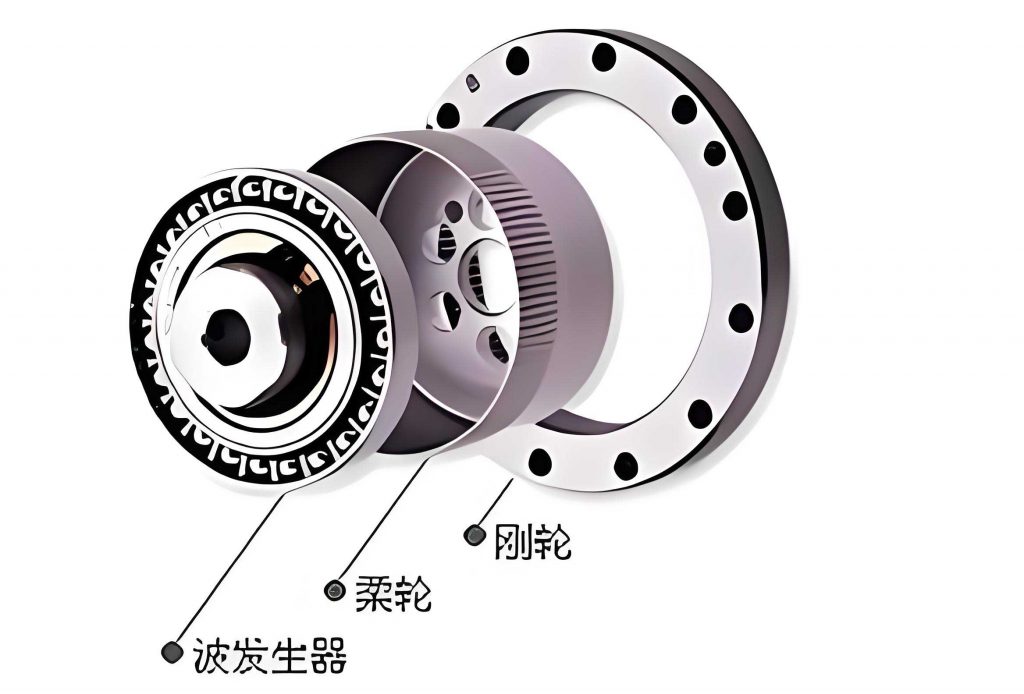
To establish a quantitative basis for optimization, we must first define the design variables and the objective function. For a standard involute strain wave gear system with predefined module \(m\), pressure angle \(\alpha\), and tooth counts \(z_1\) (flexspline) and \(z_2\) (circular spline), the independent meshing parameters that significantly influence the circumferential backlash \(j_t\) are: the flexspline profile shift coefficient \(x_1\), the circular spline profile shift coefficient \(x_2\), the radial deformation coefficient \(w_0^*\) (where \(w_0 = m \cdot w_0^*\) is the wave generator’s radial deflection), and the cam profile angle \(\phi_H\) which locates the meshing point. We represent these as a design vector:
$$ \mathbf{X} = [x_1, x_2, w_0^*, \phi_H]^T $$
The circumferential backlash at any specific meshing point is a function of this vector. To evaluate it across the tooth engagement, we sample several points \(k\) (where \(k=1, 2, …, n_{uk}\)) along the tooth height of the flexspline. For each point \(K_1\) on the flexspline profile, we find the corresponding closest point \(K_2\) on the adjacent circular spline profile. The local circumferential backlash \(j_{tk}\) is the chordal distance between these points:
$$ j_{tk}(\mathbf{X}) = \sqrt{ (X_{K_1} – X_{K_2})^2 + (Y_{K_1} – Y_{K_2})^2 } $$
The overall operative backlash for the strain wave gear pair is taken as the minimum value among these sampled points:
$$ j_t(\mathbf{X}) = \min_{k} [ j_{tk}(\mathbf{X}) ] $$
The coordinates \((X_{K_1}, Y_{K_1})\) and \((X_{K_2}, Y_{K_2})\) are derived from the complex geometry of the deformed flexspline and its meshing with the circular spline. They are functions of the design variables, basic gear parameters, and the cam geometry. The formulas involve the polar angle of the cam \(\phi_H\), the rotation angle of the flexspline \(\varphi_1\), the base circle radii \(r_{b1}, r_{b2}\), and the parametric equations of the involute curves. The detailed coordinate transformations are essential for accurate backlash calculation in a strain wave gear system.
The objective of our optimization is to find the design vector \(\mathbf{X}\) that yields a backlash value \(j_t(\mathbf{X})\) as close as possible to a target or required value \(j_c\). This target is defined by the application: \(j_c = 0\) for precision positioning strain wave gears, and \(j_c > 0\) for power transmission strain wave gears. Therefore, we define the objective function \(F(\mathbf{X})\) as follows:
$$ F(\mathbf{X}) = \begin{cases}
| j_t(\mathbf{X}) – j_c |, & \text{if } j_c > 0 \\
j_t(\mathbf{X}), & \text{if } j_c = 0
\end{cases} $$
The optimization problem is then to minimize \(F(\mathbf{X})\) subject to a set of inequality constraints \(g_i(\mathbf{X}) \geq 0\) that ensure feasible, interference-free, and mechanically sound design of the strain wave gear. The feasible domain \(L^n\) is a subspace of the Euclidean space \(\mathbb{R}^n\) defined by these constraints. We now proceed to enumerate and formulate these critical constraints.
The constraints for a strain wave gear design are multifaceted, ensuring tooth strength, prevention of various types of interference, and proper meshing engagement. We categorize and list them below, with their mathematical formulations.
| Constraint ID | Description | Mathematical Formulation |
|---|---|---|
| \(g_1(\mathbf{X})\) | Minimum tooth tip thickness to prevent weakening (for both splines). | \( s_{a1} = d_{a1} \left[ \frac{\pi + 4x_1 \tan\alpha}{2z_1} + \text{inv}\alpha – \text{inv}\alpha_{a1} \right] \geq 0.25m \) \( s_{a2} = d_{a2} \left[ \frac{\pi + 4x_2 \tan\alpha}{2z_2} + \text{inv}\alpha – \text{inv}\alpha_{a2} \right] \geq 0.25m \) |
| \(g_2(\mathbf{X})\) | No tooth tip interference at the meshing-in or meshing-out point. | At the meshing-out cam angle \(\phi_{Hea}\), require: \( \frac{X_{a2ea}}{Y_{a2ea}} – \frac{X_{a1ea}}{Y_{a1ea}} \geq 0 \) |
| \(g_3(\mathbf{X})\) | Sufficient maximum depth of engagement. | \( m\left[0.5(z_1 – z_2) + 2h_a^* + x_1 – x_2 + w_0^*\right] – m \geq 0 \) |
| \(g_4(\mathbf{X})\) | No tooth profile overlap interference at any position. | For sampled points in the first quadrant: \( X_{K_2} – X_{K_1} \geq 0 \) and \( Y_{K_1} – Y_{K_2} \geq 0 \) |
| \(g_5(\mathbf{X})\) | Adequate clearance between tooth tip and root at deepest mesh. | \( 0.5m(z_2 + h_a^* + c^* + x_2) – 0.5m(z_1 + h_a^* + x_1) – m w_0^* – 0.2m \geq 0 \) |
| \(g_6(\mathbf{X})\) | Flexspline can disengage smoothly along the minor axis. | \( m(z_1 + 2h_a^* + 2x_1) – m(z_2 + h_a^* – x_2) – 2.16 m w_0^* \geq 0 \) |
| \(g_7(\mathbf{X})\) | No undercut or fillet interference. | \( r_{g2} – r_{a1} – m w_0^* \geq 0 \) and \( r_{a2} – r_{g1} – m w_0^* \geq 0 \) where \( r_{g1}, r_{g2} \) are root fillet radii. |
| \(g_8(\mathbf{X})\) | Radial deformation coefficient within practical limits. | \( w_0^* – 0.8 \geq 0 \) and \( 1.2 – w_0^* \geq 0 \) |
In the above table, \(d_a\) denotes the addendum diameter, \(\alpha_a\) the pressure angle at the addendum circle, \(\text{inv}\alpha = \tan\alpha – \alpha\) is the involute function, \(h_a^*\) is the addendum coefficient, and \(c^*\) is the clearance coefficient. The coordinates \(X_{a1ea}, Y_{a1ea}, X_{a2ea}, Y_{a2ea}\) are calculated at the specific cam angle \(\phi_{Hea}\) where the flexspline tooth tip meshes out with the circular spline tip. The calculation of these terms, especially the fillet radii \(r_{g1}\) and \(r_{g2}\), involves the tool geometry and cutting conditions. For instance, \(r_{g2}\) for the circular spline can be computed using the center distance and pressure angle during gear generation. These constraints collectively define the complex, non-linear feasible region for our strain wave gear optimization problem.
The objective function \(F(\mathbf{X})\) and the constraint functions \(g_i(\mathbf{X})\) are highly non-linear and implicit. They lack a straightforward analytical gradient, making gradient-based optimization methods challenging to apply directly. Therefore, we employ a direct search method known as the Complex Method, which is particularly effective for constrained non-linear optimization problems where derivative information is unavailable or difficult to compute. The Complex method is an evolution of the simplex method, operating within the feasible region. It starts by generating an initial “complex” of \(k\) vertices (where \(k > n+1\), typically \(2n\)) randomly within the feasible domain. Each vertex represents a candidate design vector \(\mathbf{X}\). The algorithm then proceeds iteratively through the following steps:
- Evaluation: Compute the objective function \(F(\mathbf{X})\) for each vertex of the complex.
- Identification: Identify the worst vertex \(\mathbf{X}_w\) with the highest objective function value and the best vertex \(\mathbf{X}_b\) with the lowest.
- Reflection: Calculate the centroid \(\mathbf{X}_c\) of all vertices except \(\mathbf{X}_w\). Generate a new trial point \(\mathbf{X}_r\) by reflecting the worst point through the centroid: \(\mathbf{X}_r = \mathbf{X}_c + \beta (\mathbf{X}_c – \mathbf{X}_w)\), where \(\beta > 0\) is the reflection coefficient (often set to 1.3).
- Feasibility Check: If \(\mathbf{X}_r\) is not feasible (violates any constraint \(g_i(\mathbf{X}_r) < 0\)), move it halfway back towards the centroid repeatedly until it becomes feasible.
- Replacement: If \(F(\mathbf{X}_r) < F(\mathbf{X}_w)\), replace \(\mathbf{X}_w\) with \(\mathbf{X}_r\). Otherwise, generate a new point by shrinking the worst vertex toward the best vertex or the centroid, and check feasibility and improvement.
- Convergence: The process repeats until the complex contracts sufficiently, and the standard deviation of the objective function values at the vertices falls below a specified tolerance, indicating convergence to an optimum.
This method is robust for our strain wave gear problem because it only requires function evaluations and handles constraints by enforcing feasibility after each reflection or shrinkage operation. We implemented this algorithm in a computational software environment, integrating the precise geometrical calculations for backlash and constraints. The core of the calculation involves solving for the coordinates of points on the deformed flexspline profile. For a given design vector \(\mathbf{X}\) and a sampled point on the flexspline tooth at radius \(r_{uk1}\), we compute the corresponding parameter \(u_{K1}\) on the involute curve:
$$ u_{K1} = \tan\left( \arccos\left( \frac{r_{b1}}{r_{uk1}} \right) \right) – \tan\alpha $$
The coordinates \((X_{K1}, Y_{K1})\) in the fixed coordinate system are then found using transformation equations that account for the elliptical deformation caused by the wave generator. The wave generator’s elliptical profile is defined by its semi-major axis \(a\) and semi-minor axis \(b\), which are derived from the radial deformation coefficient \(w_0^*\) and the condition that the inner circumference of the flexspline bearing matches the perimeter of the cam. The angle \(\psi\) relating the cam rotation to the flexspline deformation is:
$$ \psi = \arctan\left( \frac{a^2}{b^2} \tan \phi_H \right) $$
The radial distance \(Q\) from the cam center to the flexspline neutral curve at angle \(\phi_H\) is:
$$ Q = \frac{ab}{\sqrt{a^2 \sin^2 \phi_H + b^2 \cos^2 \phi_H}} $$
The coordinates \(X_{K1}, Y_{K1}\) also involve the offset \(e\) between the cam and the undeformed flexspline midline, and the rotation \(\varphi_1\) of the flexspline, which itself depends on \(\phi_H\) and the gear ratio. Once \(X_{K1}, Y_{K1}\) are known, the distance \(r_K = \sqrt{X_{K1}^2 + Y_{K1}^2}\) is used to find the corresponding point on the circular spline profile via its involute parameter \(u_{K2}\), leading to \(X_{K2}, Y_{K2}\). This process is repeated for multiple points \(k\) along the tooth height to find the minimum backlash \(j_t(\mathbf{X})\). This intricate calculation is embedded within each function evaluation of the Complex optimization routine.
To demonstrate the practical efficacy of our optimization framework for strain wave gear design, we present a detailed computational case study. Consider a single-stage strain wave gear with the following fixed parameters: module \(m = 0.25 \text{ mm}\), pressure angle \(\alpha = 20^\circ\), flexspline tooth number \(z_1 = 200\), circular spline tooth number \(z_2 = 202\), wave generator type: two-lobe elliptical cam with a flexible ball bearing. The performance requirements for this strain wave gear are stringent: transmission error less than 3 arc-minutes, positional backlash (reversal error) less than 3 arc-minutes, efficiency greater than 70%, and starting torque not exceeding 6 N·cm. For such a precision motion control strain wave gear, the target backlash \(j_c\) is set to zero. Therefore, our objective is to minimize the absolute circumferential backlash \(j_t(\mathbf{X})\).
We applied the Complex optimization method as described. The initial complex was generated with 8 vertices (since \(n=4\), \(2n=8\)) within the bounds defined by the constraints. After several hundred iterations, the algorithm converged to an optimal solution. The optimized meshing parameters obtained are:
| Design Variable | Symbol | Optimized Value |
|---|---|---|
| Flexspline Profile Shift Coefficient | \(x_1\) | 2.2950 |
| Circular Spline Profile Shift Coefficient | \(x_2\) | 2.3184 |
| Radial Deformation Coefficient | \(w_0^*\) | 0.9980 |
| Cam Angle Parameter (at evaluation) | \(\phi_H\) | Determined during iteration |
Using these optimized parameters, a physical prototype of the strain wave gear reducer was manufactured. Its key performance metrics were then measured under controlled test conditions. The results are compared against the design requirements in the table below.
| Performance Parameter | Measured Value | Required Value | Status |
|---|---|---|---|
| Transmission Error | 2.75 arc-min | < 3 arc-min | Pass |
| Backlash (Positional) | 1 arc-min | < 3 arc-min | Pass |
| Efficiency | 73% | > 70% | Pass |
| Starting Torque | 2.62 N·cm | ≤ 6 N·cm | Pass |
The results clearly indicate that the strain wave gear designed with the optimized meshing parameters meets and exceeds all specified performance requirements. The transmission error and backlash are well within the tight limits, demonstrating the effectiveness of the backlash-minimization objective. The efficiency and starting torque are also favorable. This case validates our optimization model and the chosen solution strategy. It underscores the critical importance of precise parameter selection in the design of high-performance strain wave gear transmissions.
Beyond this specific case, the optimization methodology offers significant advantages for the design of strain wave gears across various applications. For power transmission strain wave gears where a specific, non-zero backlash \(j_c > 0\) is required, the objective function seamlessly adapts to minimize the deviation from that target. The framework can also be extended to incorporate additional objectives or constraints. For instance, one might consider optimizing for maximum torque capacity, minimum stress in the flexspline, or minimum weight, potentially leading to a multi-objective optimization problem. The constraints we formulated are comprehensive but not exhaustive; for very high-speed strain wave gear applications, dynamic constraints related to tooth meshing impact or vibration might be incorporated. Furthermore, the choice of the Complex method, while effective, is one of several possible algorithms. For problems with a larger number of variables, modern metaheuristic algorithms like Genetic Algorithms (GA) or Particle Swarm Optimization (PSO) could be explored, though they typically require a higher number of function evaluations. The strength of our current approach lies in its direct handling of constraints and its reliability for the moderate-dimensional problem typical of strain wave gear meshing parameter design.
The sensitivity of the optimal solution to the initial guess and the algorithm parameters (like reflection coefficient \(\beta\) and convergence tolerance) was studied. Multiple runs with different random seeds for generating the initial complex consistently converged to the same optimal region, indicating robustness. The most influential design variable was found to be the radial deformation coefficient \(w_0^*\), as it directly controls the magnitude of elliptical deformation and thus the depth of engagement in the strain wave gear. The profile shift coefficients \(x_1\) and \(x_2\) play a crucial role in adjusting the tooth thickness and the shape of the active profile, thereby fine-tuning the backlash. The cam angle \(\phi_H\), being a virtual parameter used in the calculation, is optimized to identify the worst-case meshing position for backlash evaluation. In practice, once the optimal \(x_1, x_2,\) and \(w_0^*\) are determined, the actual cam profile is manufactured accordingly, and the backlash is guaranteed to be optimal across all meshing positions.
In conclusion, the meshing parameters of an involute strain wave gear have a profound and direct impact on its operational quality, particularly the backlash which affects precision, stiffness, and dynamic response. The systematic optimization design methodology presented here, centered on achieving an optimal backlash profile, provides a powerful tool for strain wave gear designers. By formulating a mathematical model with an appropriate objective function and a comprehensive set of geometric and physical constraints, and by solving it using the robust Complex method, we can derive a set of meshing parameters that are harmonized for best performance. The successful application to a case study, resulting in a strain wave gear that met all stringent specifications, underscores the practicality and value of this approach. As strain wave gear technology continues to advance towards higher precision and greater load capacity, such optimization techniques will become increasingly indispensable in pushing the boundaries of what is mechanically possible. Future work may integrate this parametric optimization with finite element analysis for stress validation and thermal analysis, creating a fully integrated design suite for next-generation strain wave gear systems.
The mathematical rigor involved in modeling the strain wave gear meshing cannot be overstated. To further elucidate the coordinate calculations, let’s delve deeper into the equations for a sampled point \(K_1\) on the flexspline. The transformation from the tooth profile coordinate system to the fixed global system involves several steps. First, the involute point in the flexspline’s own coordinate system (attached to its undeformed midline) is given by:
$$ \begin{aligned}
x_{1}^{local} &= r_{b1} (\sin(\theta_{K1}) – u_{K1} \cos\alpha \cos(\theta_{K1} + \alpha)) \\
y_{1}^{local} &= r_{b1} (\cos(\theta_{K1}) + u_{K1} \cos\alpha \sin(\theta_{K1} + \alpha))
\end{aligned} $$
where \(\theta_{K1} = \text{inv}\alpha + u_{K1}\) is the roll angle. This point is then mapped to the global system considering the elliptical deformation. The radial displacement of the flexspline neutral line at an angular position \(\phi\) (relative to the cam’s major axis) is approximately \(\Delta r = Q – r_m\), where \(r_m\) is the undeformed midline radius. The exact mapping requires considering the rotation \(\psi\) and the offset vector. The final global coordinates can be compactly represented as:
$$ \begin{aligned}
X_{K1} &= r_1 \left\{ \sin[\psi – (u_{K1} – \eta_1)] + u_{K1}\cos\alpha \cos[\psi – (u_{K1} – \eta_1 + \alpha)] \right\} + Q_1 \sin\varphi_1 – r_m \sin\psi \\
Y_{K1} &= r_1 \left\{ \cos[\psi – (u_{K1} – \eta_1)] – u_{K1}\cos\alpha \sin[\psi – (u_{K1} – \eta_1 + \alpha)] \right\} + Q_1 \cos\varphi_1 – r_m \cos\psi
\end{aligned} $$
where \(r_1 = m z_1 / 2\) is the flexspline reference circle radius, \(\eta_1 = (\pi/2 + 2x_1 \tan\alpha)/z_1\) is a constant phase angle, \(Q_1 = \sqrt{e^2 + Q^2 + 2eQ\cos\lambda}\), \(\lambda = \psi – \phi_H\), and \(\varphi_1\) is the flexspline rotation angle which ensures conjugate motion. For the circular spline point \(K_2\), the coordinates in its fixed coordinate system are simpler, as it does not deform:
$$ \begin{aligned}
X_{K2} &= r_2 \left\{ \sin[\varphi_2 – (u_{K2} – \eta_2)] + u_{K2}\cos\alpha \cos[\varphi_2 – (u_{K2} – \eta_2 + \alpha)] \right\} \\
Y_{K2} &= r_2 \left\{ \cos[\varphi_2 – (u_{K2} – \eta_2)] – u_{K2}\cos\alpha \sin[\varphi_2 – (u_{K2} – \eta_2 + \alpha)] \right\}
\end{aligned} $$
where \(r_2 = m z_2 / 2\), \(\eta_2 = (\pi/2 + 2x_2 \tan\alpha)/z_2\), and \(\varphi_2\) is the circular spline rotation, which is zero for a fixed circular spline. The relationship between \(\varphi_1\) and \(\phi_H\) is kinematic, derived from the condition of no slip at the meshing point. These formulas, when computed accurately for multiple points, form the backbone of the objective function evaluation for the strain wave gear optimizer.
Another important consideration is the calculation of the fillet radius \(r_{g2}\) for the circular spline to check undercut interference. If the circular spline is generated by a rack-type cutter or a pinion-type cutter, the fillet radius is determined by the cutter tip trajectory. A common formula involves the generating center distance \(a_{ce}\) and generating pressure angle \(\alpha_{ce}\):
$$ r_{g2} = \sqrt{ (a_{ce} \sin\alpha_{ce} + \sqrt{r_{a0}^2 – r_{b0}^2})^2 + r_{b2}^2 } $$
where \(r_{a0}\) is the cutter addendum radius and \(r_{b0}\) its base radius. This adds another layer of dependency on the profile shift coefficients, as \(a_{ce}\) and \(\alpha_{ce}\) are functions of \(x_2\). Thus, the constraints are deeply interconnected, making the optimization landscape for the strain wave gear design non-linear and multi-modal.
To further illustrate the behavior of the optimization process, we can analyze the trend of the objective function with respect to a single variable, say \(w_0^*\), while holding others at their optimal values. Typically, as \(w_0^*\) increases, the depth of engagement increases, which might initially reduce backlash but eventually could lead to interference, causing the objective function to rise sharply upon constraint violation. Similarly, increasing \(x_1\) generally thickens the flexspline tooth tip, which can help meet the tip thickness constraint but also alters the meshing geometry. The optimization algorithm navigates this complex trade-off space automatically. For high-volume production of strain wave gears, such an optimized parameter set can be standardized, leading to consistent high performance across all units.
In summary, the pursuit of optimal meshing parameters is a cornerstone of advanced strain wave gear design. This article has detailed a complete methodology, from model formulation to algorithm implementation and experimental validation. The consistent use of the term ‘strain wave gear’ throughout emphasizes the specific application context of this work. The integration of mathematical modeling, numerical optimization, and practical engineering constraints provides a robust framework that can significantly contribute to the development of more efficient, precise, and reliable strain wave gear transmissions for robotics, aerospace, instrumentation, and other high-tech industries. The potential for extending this work into real-time adaptive design or coupling with manufacturing process optimization remains an exciting avenue for future research in the field of strain wave gear technology.