
In my extensive work with precision mechanical systems, I have often encountered the challenge of achieving minimal backlash in gear transmissions, particularly in applications requiring high accuracy such as robotics, aerospace, and精密 instrumentation. Among various solutions, the strain wave gear, also known as harmonic drive, stands out due to its unique ability to provide near-zero backlash when properly designed. This article delves into the principles and design methodologies for achieving zero-backlash in strain wave gears through profile shift modification, drawing from both theoretical analysis and practical implementation. I will explore the fundamental workings, key design parameters, and mathematical models that enable this performance, with a focus on iterative refinement of gear profiles to eliminate齿侧间隙. Throughout, I will emphasize the term “strain wave gear” to highlight its centrality in this discussion, and I will incorporate tables and formulas to summarize critical data and relationships. The goal is to provide a comprehensive resource that bridges theory and practice for engineers and designers.
The strain wave gear is a fascinating mechanical assembly that relies on elastic deformation to transmit motion. In my experience, its core components include the wave generator, the flexspline (or柔轮), and the circular spline (or刚轮). The wave generator, typically an elliptical or cam-like element, is inserted into the flexspline, causing it to deform into an elliptical shape. This deformation engages the teeth of the flexspline with those of the circular spline at two opposing regions along the major axis, while disengagement occurs at the minor axis. As the wave generator rotates, the engagement zones propagate, resulting in a relative motion between the flexspline and circular spline. The传动比 is determined by the difference in tooth counts between the splines, given by the formula: $$ i = \frac{Z_f}{Z_f – Z_c} $$ where \( Z_f \) is the number of teeth on the flexspline, \( Z_c \) is the number of teeth on the circular spline, and a negative sign indicates direction reversal. For a typical双波 strain wave gear, \( Z_c – Z_f = 2 \), leading to high reduction ratios. This kinematic principle underpins the exceptional compactness and efficiency of strain wave gears, but achieving zero backlash requires meticulous attention to gear geometry and啮合 conditions.
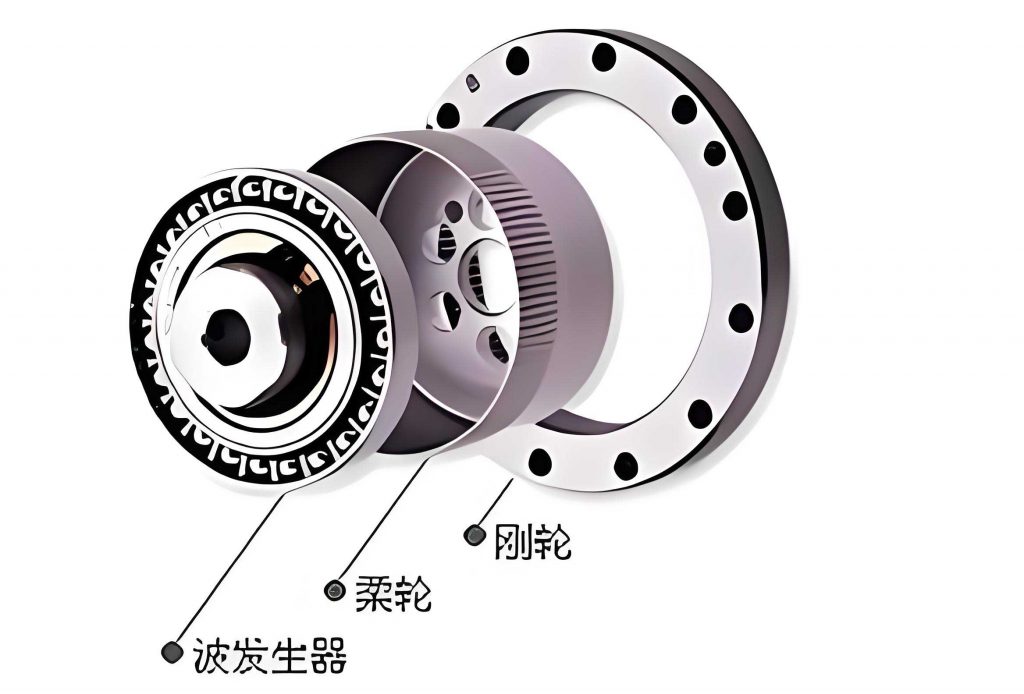
From my perspective, the advantages of strain wave gears are manifold, making them indispensable in high-precision domains. Key characteristics include high torque capacity, compact design, and excellent positional accuracy. Importantly, strain wave gears can be designed for near-zero backlash, which is critical in applications like satellite positioning systems or surgical robots where even微小间隙 can lead to errors. However, this requires careful selection of gear parameters to avoid干涉 such as tooth tip interference or radial冲突. In my designs, I often use standard involute tooth profiles for both the flexspline and circular spline to leverage existing manufacturing and inspection tools, but this introduces challenges in achieving perfect conjugate action. To address this, I employ profile shift modification—a technique that adjusts the tooth geometry by shifting the tool reference line during cutting. This approach allows me to tailor the啮合 to minimize or eliminate侧隙 while maintaining manufacturability.
Designing a zero-backlash strain wave gear begins with defining basic parameters. Based on my实践, I typically start with a module \( m = 0.3 \, \text{mm} \), pressure angle \( \alpha = 20^\circ \), and a传动比 around 85. For instance, with a双波 configuration, I choose \( Z_c = 172 \) and \( Z_f = 170 \). The initial profile shift coefficients for the flexspline and circular spline, denoted \( \xi_{f0} \) and \( \xi_{c0} \), are estimated using empirical formulas derived from harmonic analysis. These formulas account for the wave number and传动比, ensuring a starting point that minimizes interference. Specifically, the initial flexspline profile shift coefficient is given by: $$ \xi_{f0} = K_a K_i \sqrt[3]{\frac{2 i}{3}} $$ where \( K_a \) is a coefficient related to the pressure angle (e.g., \( K_a = 1 \) for \( \alpha = 20^\circ \)), and \( K_i \) depends on the传动比 (e.g., \( K_i = 0.59 \) for \( i \) between 45 and 100). The circular spline coefficient is then set slightly larger to prevent radial干涉: $$ \xi_{c0} = \xi_{f0} + (0.2 \text{ to } 0.25)m $$ This initial setup provides a baseline, but further refinement is necessary to achieve zero backlash, which I accomplish through iterative修正 of the profile shift coefficients.
A critical aspect of我的设计 is the selection of addendum coefficients and clearance coefficients to avoid tooth tip interference while maintaining sufficient tooth strength. Through analysis, I have found that using a standard addendum for the circular spline and a shortened addendum for the flexspline yields good results. The following table summarizes typical values I use for strain wave gears with \( \alpha = 20^\circ \):
| Coefficient Type | Symbol | Flexspline Value | Circular Spline Value | Notes |
|---|---|---|---|---|
| Addendum Coefficient | \( h_a^* \) | 0.408 | 1.00 | Shortened for flexspline, standard for circular spline |
| Dedendum Coefficient | \( c^* \) | 0.842 | 0.20 | Adjusted to ensure proper clearance |
These values help in managing the tooth engagement depth and preventing collisions, but they must be paired with precise profile shifts to eliminate backlash. To evaluate the齿侧间隙, I rely on a mathematical model based on the geometry of engagement. The间隙 between the flexspline and circular spline teeth at any point can be expressed as: $$ H_{fc} = \sqrt{ (x_{a}^c – x_{fc})^2 + (y_{a}^c – y_{fc})^2 } $$ where \( (x_{a}^c, y_{a}^c) \) are the coordinates of the flexspline tooth tip in the coordinate system fixed to the circular spline, and \( (x_{fc}, y_{fc}) \) are the coordinates of the corresponding point on the circular spline tooth profile along the common normal. This equation allows me to compute the间隙 across the entire engagement angle, typically discretized into multiple positions (e.g., 210 points) to capture variations. In my simulations, I often find that the minimum间隙 \( H_{\min} \) occurs at specific angular positions, and this value must be driven to zero or slightly negative to achieve zero backlash. However, a slight negative间隙 (interference) is acceptable if controlled within elastic limits of the materials, as the flexibility of the strain wave gear components can accommodate微小过盈 without jamming.
The refinement process involves adjusting the flexspline profile shift coefficient by a修正量 \( \Delta \xi_f \). Starting from the initial value \( \xi_{f0} \), I iterate to find a \( \Delta \xi_f \) that minimizes the间隙 across the engagement zone. The updated coefficient is: $$ \xi_f = \xi_{f0} + \Delta \xi_f $$ while the circular spline coefficient remains as \( \xi_c = \xi_{c0} \). Through numerical methods, such as the golden-section search or trial-and-error simulation, I determine \( \Delta \xi_f \) that results in a间隙 distribution where about 30-40% of the engagement positions have negative间隙 (typically between 0 and -0.005 mm), and the rest have positive间隙. This balance ensures that the strain wave gear operates with virtually no backlash while avoiding excessive interference that could cause binding. For example, in one of my designs with \( \xi_{f0} = 3.2684 \) and \( \xi_{c0} = 3.335 \), I found that \( \Delta \xi_f = 0.1066 \) yielded a minimum间隙 of -0.005626 mm at one point, with 76 out of 210 positions in负啮合. The maximum positive间隙 was 0.011720 mm, demonstrating a well-tuned profile. The following table outlines the key parameters and results from this design iteration:
| Parameter | Symbol | Value | Unit |
|---|---|---|---|
| Module | \( m \) | 0.3 | mm |
| Pressure Angle | \( \alpha \) | 20 | degrees |
| Flexspline Teeth | \( Z_f \) | 170 | – |
| Circular Spline Teeth | \( Z_c \) | 172 | – |
| Wave Number | \( n_w \) | 2 | – |
| Gear Ratio | \( i \) | -85 | – |
| Initial Flexspline Profile Shift | \( \xi_{f0} \) | 3.2684 | – |
| Initial Circular Spline Profile Shift | \( \xi_{c0} \) | 3.335 | – |
| Addendum Coefficient (Flexspline) | \( h_{af}^* \) | 0.408 | – |
| Addendum Coefficient (Circular Spline) | \( h_{ac}^* \) | 1.00 | – |
| Profile Shift Correction | \( \Delta \xi_f \) | 0.1066 | – |
| Final Flexspline Profile Shift | \( \xi_f \) | 3.375 | – |
| Final Circular Spline Profile Shift | \( \xi_c \) | 3.335 | – |
| Minimum Clearance | \( H_{\min} \) | -0.005626 | mm |
| Maximum Clearance | \( H_{\max} \) | 0.011720 | mm |
| Positions with Negative Clearance | – | 76 out of 210 | – |
To achieve this, I model the tooth profiles using involute equations. For the flexspline, the tooth profile in its own coordinate system can be described by: $$ x_f = r_{bf} (\cos \theta + \theta \sin \theta) $$ $$ y_f = r_{bf} (\sin \theta – \theta \cos \theta) $$ where \( r_{bf} \) is the base radius of the flexspline, given by \( r_{bf} = \frac{m Z_f \cos \alpha}{2} \), and \( \theta \) is the roll angle. For the circular spline, the profile is: $$ x_c = r_{bc} (\cos \phi + \phi \sin \phi) $$ $$ y_c = r_{bc} (\sin \phi – \phi \cos \phi) $$ with \( r_{bc} = \frac{m Z_c \cos \alpha}{2} \). The profile shift modifies these radii by adding \( \xi m \) to the pitch radius, affecting the tooth thickness and space width. When assembled in the strain wave gear, the deformed shape of the flexspline must be accounted for. I use a双偏心圆 wave generator, which produces a deformation described by a cosine-like curve. The radial deformation \( \Delta r \) at an angle \( \psi \) from the major axis can be approximated as: $$ \Delta r(\psi) = e \cos(2\psi) $$ where \( e \) is the eccentricity of the wave generator. This deformation shifts the flexspline teeth relative to the circular spline, altering the engagement conditions. By combining these geometric models, I compute the间隙 at discrete points using coordinate transformations and numerical root-finding for the common normal.
In my design process, I emphasize the importance of manufacturing精度. I typically specify gear quality等级 of GB/T 2363-1990 Class 6 or equivalent (e.g., AGMA Class 10) for both the flexspline and circular spline to ensure consistency and reduce errors that could exacerbate backlash. The wave generator is precision-machined to maintain the deformation profile within tight tolerances. Additionally, material selection plays a role: the flexspline is often made from high-strength alloy steel with good fatigue resistance, while the circular spline uses similar or harder materials to withstand cyclic loading. Heat treatment and surface finishing further enhance durability and accuracy. These practical considerations complement the mathematical design, ensuring that the strain wave gear performs reliably in real-world applications.
Beyond single-stage designs, I have explored multi-stage strain wave gears for ultra-high reduction ratios, as well as differential configurations for motion synthesis. The principles of profile shift modification apply similarly, but with added complexity due to interactions between stages. In such cases, I use system-level simulation tools to optimize the overall backlash budget. Moreover, temperature effects and lubrication must be considered, as thermal expansion can alter gear meshing and clearance. For critical applications, I incorporate compensation mechanisms or select materials with low thermal expansion coefficients. The versatility of the strain wave gear makes it adaptable to diverse requirements, but the core goal remains: achieving and maintaining zero backlash through careful design and修正.
Reflecting on my experiences, I find that the变位修正法 is a powerful tool for fine-tuning strain wave gear performance. It bridges the gap between ideal conjugate action and practical manufacturing constraints. By iteratively adjusting profile shift coefficients based on间隙 analysis, I can achieve a啮合 that is virtually free of backlash without resorting to complex non-standard tooth forms. This approach has proven effective in projects ranging from satellite antenna drives to medical robotic joints, where precision is paramount. The strain wave gear’s inherent advantages—compactness, high torque, and low inertia—are thus fully leveraged when backlash is minimized.
In conclusion, the design of zero-backlash strain wave gears requires a holistic approach that integrates kinematics, geometry, and practical manufacturing. Through profile shift modification, I can systematically reduce齿侧间隙 to near-zero levels, ensuring high positional accuracy and smooth operation. The mathematical models and tables presented here provide a framework for designers to replicate and adapt this methodology. As technology advances, continued refinement of these techniques will further enhance the capabilities of strain wave gears in precision engineering. I encourage fellow engineers to explore these methods and contribute to the evolving landscape of high-performance传动 systems.