
In the field of precision mechanical transmission, strain wave gear systems, also known as harmonic gear drives, have garnered significant attention due to their compact design, high torque capacity, and exceptional positional accuracy. As a researcher deeply involved in advanced gear mechanics, I find the analysis of meshing characteristics crucial for optimizing performance and reliability. This paper focuses on the meshing area of the working meshing pairs in a strain wave gear system, particularly examining an oscillating-teeth end face variant that integrates advantages from both radial harmonic drives and oscillating-teeth mechanisms. Understanding the meshing area is fundamental for assessing load distribution, contact stress, and overall durability in high-ratio, high-power reducers. The strain wave gear principle relies on elastic deformation to achieve motion transmission, and its meshing behavior is inherently dynamic and periodic. Here, I delve into the patterns and influencing factors of the meshing area, deriving mathematical formulations that serve as a foundation for further strength and capacity studies. Throughout this analysis, the term ‘strain wave gear’ will be emphasized to underscore its relevance in modern engineering applications.
The core components of a strain wave gear system typically include a wave generator, a flexible spline, and a circular spline. In the oscillating-teeth end face configuration, the system comprises an end face gear, a slotted wheel, oscillating teeth, and the wave generator. These elements interact to form meshing pairs between the oscillating teeth and the end face gear, each pair exhibiting distinct engagement states during operation. The strain wave gear mechanism transforms input rotation into output motion through controlled elastic deflection, enabling high reduction ratios with minimal backlash. To visualize the structure, consider the following illustration of a strain wave gear assembly, which highlights the interaction between components.
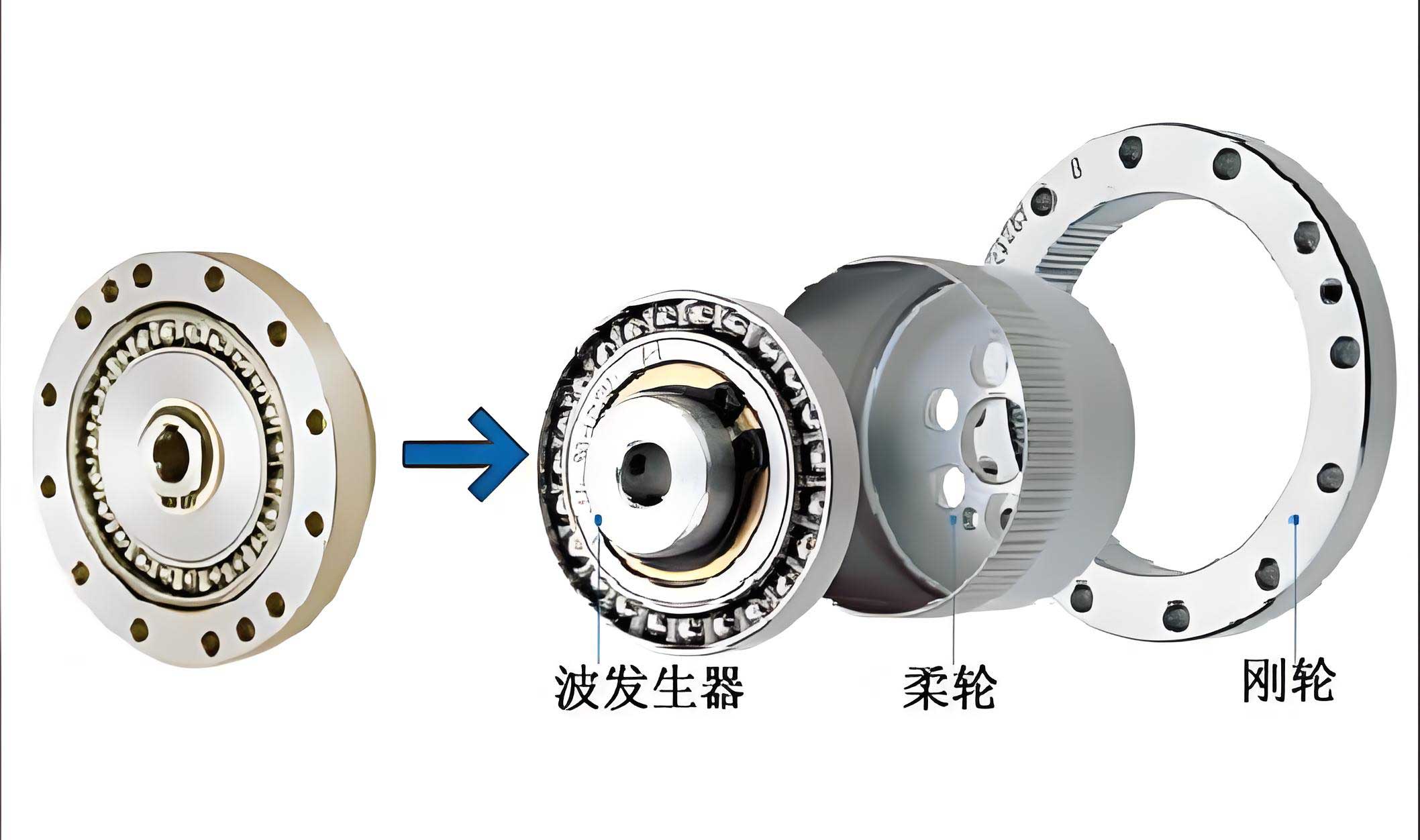
The meshing process in a strain wave gear is not continuous across all teeth simultaneously; instead, it follows a sequential pattern where pairs engage and disengage periodically. At any given instant, some oscillating teeth are in working meshing (i.e., transmitting torque), others are in non-working meshing (disengaging), and some may be fully disengaged. This cyclic behavior leads to variations in the total meshing area of all active pairs, which directly impacts the system’s load-bearing capacity. In this analysis, I define the meshing area as the contact region between an oscillating tooth and the end face gear tooth flank, assumed proportional to the engagement depth for simplicity. Let $$S_e$$ represent the meshing area when a single oscillating tooth is fully engaged with the end face gear. The total meshing area, denoted $$\sum S$$, fluctuates between a maximum and minimum value over one cycle, influenced by geometric and kinematic parameters. The primary goal is to quantify these extremes and understand their dependencies.
The variation in total meshing area is inherently periodic, tied to the wave generator’s rotation. For instance, when the wave generator completes one full cycle, the meshing states of all oscillating teeth repeat. At a specific phase, the total meshing area reaches its peak, corresponding to the moment when the maximum number of teeth are engaged in working meshing with optimal overlap. Conversely, at another phase, the area drops to its minimum, typically when one tooth transitions from working to non-working meshing. This periodicity can be modeled using a geometric representation of meshing states, where all oscillating teeth are virtually superimposed onto a conceptualized tooth profile of the end face gear. This “meshing state geometric model” simplifies visualization and calculation, allowing us to track engagement levels across all pairs. In a strain wave gear system, the wave generator’s profile (often elliptical) induces a traveling wave in the flexible component, dictating the engagement sequence. The number of waves, denoted $$U$$, and the count of oscillating teeth, $$Z_O$$, are critical parameters. Additionally, the number of teeth on the end face gear, $$Z_E$$, plays a role, though its influence on meshing area may be indirect under certain conditions.
To systematically analyze the meshing area, I first examine the factors affecting its variation. One key factor is the transmission type: in a strain wave gear reducer, the wave generator is typically the input, while either the end face gear or the slotted wheel can be fixed. However, both configurations yield identical meshing state geometric models at the instants of maximum and minimum meshing area. This invariance simplifies the analysis, as we can focus on a generalized model without loss of generality. Another factor is the relationship between the number of oscillating teeth $$Z_O$$ and the wave number $$U$$. Specifically, whether $$Z_O/U$$ is an integer or not leads to distinct meshing patterns. When $$Z_O/U$$ is an integer, each wave on the generator hosts an equal number of oscillating teeth, and their meshing states are synchronized per wave. When $$Z_O/U$$ is not an integer, the distribution is uneven, requiring a global model encompassing all teeth. A third factor is the relationship between $$Z_O$$ and $$Z_E$$. In strain wave gear design, $$Z_E$$ can be greater than, less than, or equal to $$Z_O$$, but interestingly, for meshing area calculations, only $$Z_O$$ and $$U$$ matter if the teeth are arranged on the same cylindrical radius. This is because the relative positioning of engaged teeth remains consistent regardless of the $$Z_E$$ and $$Z_O$$ comparison, provided interference is mitigated (e.g., by trimming non-working edges). Thus, the meshing area analysis primarily hinges on $$Z_O$$ and $$U$$.
I now derive formulas for the total meshing area at its maximum and minimum, categorized by the $$Z_O/U$$ condition. The derivations rely on the geometric model, where the working side of the virtual tooth profile is divided into segments proportional to the engagement depth of each oscillating tooth. Let $$Z_N$$ denote the number of oscillating teeth engaged in working meshing at the peak instant. The meshing area for each working pair varies linearly from a fraction to the full $$S_e$$, depending on its position in the engagement sequence. By summing these areas, we obtain the total.
Case 1: $$Z_O/U$$ is an integer. This implies that $$Z_O$$ is a multiple of $$U$$, so each wave has $$Z_O/U$$ teeth. We further distinguish between even and odd $$Z_O/U$$ values.
- Subcase 1.1: $$Z_O/U$$ is even. Here, when one tooth is fully engaged, another is completely disengaged. The number of working teeth per wave is $$Z_N = Z_O/(2U)$$, and across all $$U$$ waves, the total working teeth is $$U \cdot Z_N = Z_O/2$$. In the geometric model, the working side is divided into $$Z_N$$ equal segments per wave. The meshing areas for working teeth in one wave are $$S_e/Z_N, 2S_e/Z_N, \dots, (Z_N-1)S_e/Z_N, Z_N S_e/Z_N$$. Summing over all waves, the maximum total meshing area is:
$$\sum S_{\text{max}} = \frac{Z_O + 2U}{4} S_e$$
The minimum occurs when one tooth exits working meshing, reducing the area by $$S_e$$ per wave? Actually, careful consideration shows that the minimum total meshing area is:
$$\sum S_{\text{min}} = \frac{Z_O – 2U}{4} S_e$$
Thus, the range is:
$$\sum S_{\text{max}} – \sum S_{\text{min}} = U S_e$$
This indicates that in a strain wave gear with even $$Z_O/U$$, the fluctuation amplitude scales linearly with the wave number. - Subcase 1.2: $$Z_O/U$$ is odd. In this scenario, full engagement of one tooth does not coincide with full disengagement of another. The working teeth per wave is $$Z_N = (Z_O + U)/(2U)$$. The geometric model segments the working side into $$Z_N$$ parts, but the engagement sequence differs. The maximum total meshing area computes to:
$$\sum S_{\text{max}} = \frac{(Z_O + U)^2}{4Z_O} S_e$$
The minimum is:
$$\sum S_{\text{min}} = \frac{(Z_O – U)^2}{4Z_O} S_e$$
The difference is:
$$\sum S_{\text{max}} – \sum S_{\text{min}} = U S_e$$
Remarkably, the fluctuation amplitude remains $$U S_e$$, consistent with the even subcase. This uniformity highlights a key property of strain wave gear systems when $$Z_O/U$$ is integer: the wave number directly dictates the meshing area variation.
To summarize Case 1, I present the formulas in a table:
| Condition | Maximum Total Meshing Area | Minimum Total Meshing Area | Fluctuation Amplitude |
|---|---|---|---|
| $$Z_O/U$$ even | $$\sum S_{\text{max}} = \frac{Z_O + 2U}{4} S_e$$ | $$\sum S_{\text{min}} = \frac{Z_O – 2U}{4} S_e$$ | $$U S_e$$ |
| $$Z_O/U$$ odd | $$\sum S_{\text{max}} = \frac{(Z_O + U)^2}{4Z_O} S_e$$ | $$\sum S_{\text{min}} = \frac{(Z_O – U)^2}{4Z_O} S_e$$ | $$U S_e$$ |
Case 2: $$Z_O/U$$ is not an integer. This means $$Z_O$$ is not divisible by $$U$$, leading to an asymmetric distribution of teeth across waves. The analysis requires a global geometric model with all $$Z_O$$ teeth superimposed. Here, the parity of $$Z_O$$ itself becomes important.
- Subcase 2.1: $$Z_O$$ is even. When $$Z_O$$ is even, full engagement of one tooth ensures another is fully disengaged. The number of working teeth is $$Z_N = Z_O/2$$. The geometric model divides the working side into $$Z_N$$ equal segments. The meshing areas for working teeth are $$S_e/Z_N, 2S_e/Z_N, \dots, Z_N S_e/Z_N$$. Summing gives:
$$\sum S_{\text{max}} = \frac{Z_O + 2}{4} S_e$$
The minimum total meshing area is:
$$\sum S_{\text{min}} = \frac{Z_O – 2}{4} S_e$$
Thus, the fluctuation is:
$$\sum S_{\text{max}} – \sum S_{\text{min}} = S_e$$
Notice that the wave number $$U$$ does not appear; the variation depends solely on the tooth count. - Subcase 2.2: $$Z_O$$ is odd. For odd $$Z_O$$, no tooth is fully disengaged when another is fully engaged. The working teeth count is $$Z_N = (Z_O + 1)/2$$. The geometric model segments the working side into $$2Z_N – 1$$ equal parts. The meshing areas follow a sequence: $$S_e/(2Z_N-1), 3S_e/(2Z_N-1), \dots, (2Z_N-1)S_e/(2Z_N-1)$$. After summation and simplification:
$$\sum S_{\text{max}} = \frac{(Z_O + 1)^2}{4Z_O} S_e$$
$$\sum S_{\text{min}} = \frac{(Z_O – 1)^2}{4Z_O} S_e$$
The difference is:
$$\sum S_{\text{max}} – \sum S_{\text{min}} = S_e$$
Again, the fluctuation is $$S_e$$, independent of $$U$$. This contrasts with Case 1, where $$U$$ played a role.
Table for Case 2:
| Condition | Maximum Total Meshing Area | Minimum Total Meshing Area | Fluctuation Amplitude |
|---|---|---|---|
| $$Z_O$$ even | $$\sum S_{\text{max}} = \frac{Z_O + 2}{4} S_e$$ | $$\sum S_{\text{min}} = \frac{Z_O – 2}{4} S_e$$ | $$S_e$$ |
| $$Z_O$$ odd | $$\sum S_{\text{max}} = \frac{(Z_O + 1)^2}{4Z_O} S_e$$ | $$\sum S_{\text{min}} = \frac{(Z_O – 1)^2}{4Z_O} S_e$$ | $$S_e$$ |
The derivations above underscore the intricate behavior of meshing area in strain wave gear systems. To further elucidate, consider the physical interpretation: when $$Z_O/U$$ is integer, the wave generator’s symmetry ensures that meshing area fluctuations are coordinated across waves, leading to a cumulative effect proportional to $$U$$. In contrast, non-integer ratios break this symmetry, causing fluctuations to depend only on the total tooth count, as the system behaves more like a single-wave entity globally. This insight is vital for designers seeking to minimize torque ripple or optimize contact stress in strain wave gear applications.
Expanding on the implications, the meshing area directly influences the contact pressure and wear characteristics. In a strain wave gear, the cyclic loading can lead to fatigue if not properly managed. By knowing the maximum meshing area, engineers can estimate the average contact stress as $$\sigma_c = F / \sum S_{\text{max}}$$, where $$F$$ is the transmitted force. Similarly, the minimum area might correlate with peak stress instances, affecting lubrication and thermal management. Moreover, the formulas enable parametric studies. For example, increasing $$Z_O$$ generally raises the meshing area, enhancing load capacity, but also affects the gear’s size and complexity. The wave number $$U$$, often 2 in common strain wave gears, can be adjusted for specific harmonics; here, we see it directly modulates area variation when teeth are evenly distributed.
To illustrate with numerical examples, assume $$S_e = 1 \, \text{mm}^2$$ for simplicity. For a strain wave gear with $$U=2$$, $$Z_O=20$$ (so $$Z_O/U=10$$, even), we get $$\sum S_{\text{max}} = (20+4)/4 = 6 \, \text{mm}^2$$ and $$\sum S_{\text{min}} = (20-4)/4 = 4 \, \text{mm}^2$$, fluctuating by $$2 \, \text{mm}^2$$. If $$Z_O=21$$ and $$U=2$$ ($$Z_O/U=10.5$$, non-integer, odd), then $$\sum S_{\text{max}} = (21+1)^2/(4*21) \approx 5.76 \, \text{mm}^2$$, $$\sum S_{\text{min}} \approx 4.76 \, \text{mm}^2$$, fluctuation $$1 \, \text{mm}^2$$. Such calculations aid in comparing designs.
Beyond the basics, the strain wave gear’s meshing area also relates to kinematic error and backlash. Since engagement depth varies, tooth deflection and manufacturing tolerances can cause deviations from ideal motion transmission. By modeling the area as a function of wave generator angle $$\theta$$, one could derive dynamic expressions: $$\sum S(\theta) = \sum S_{\text{min}} + \frac{\sum S_{\text{max}} – \sum S_{\text{min}}}{2} \left(1 – \cos(2\pi \theta / \Theta)\right)$$, where $$\Theta$$ is the period. This sinusoidal approximation aligns with the harmonic nature of strain wave gear operation. Furthermore, in high-precision applications like robotics or aerospace, minimizing area fluctuation might be desirable to ensure smooth torque output. This could involve selecting $$Z_O$$ and $$U$$ such that $$Z_O/U$$ is non-integer, as the fluctuation is smaller ($$S_e$$ vs. $$U S_e$$). However, trade-offs exist, such as increased complexity in tooth profiling.
The role of material properties cannot be overlooked. In strain wave gear systems, the flexible component undergoes repeated elastic deformation, which affects the actual contact area due to Hertzian effects. The formulas derived here assume rigid body contact; for refined analysis, compliance could be incorporated by adjusting $$S_e$$ based on load. Research shows that in strain wave gears, the contact ellipse area under load might differ from the geometric overlap, but the periodic trends remain similar. Thus, the presented framework serves as a first-order model.
Another aspect is thermal expansion. In high-power strain wave gear reducers, heat generation from friction can alter clearances and engagement depths, thereby modifying the meshing area. Designers might use the area formulas to estimate heat dissipation requirements or to set tolerance limits. For instance, a larger average meshing area reduces power density, potentially lowering temperatures. This interplay underscores the multidisciplinary nature of strain wave gear engineering.
From a manufacturing perspective, achieving the precise tooth profiles necessary for consistent meshing area is challenging. Advanced methods like grinding or honing are often employed. The formulas can guide tolerance allocation; for example, if the allowable stress dictates a minimum area of $$5 \, \text{mm}^2$$, then $$\sum S_{\text{min}}$$ must exceed this, constraining $$Z_O$$ and $$U$$ choices. Additionally, lubrication regimes (elastohydrodynamic or boundary) depend on contact area and sliding velocity, which vary cyclically in a strain wave gear. Analysis of area variations helps in selecting lubricants and designing cooling systems.
To deepen the theoretical foundation, I explore the derivation steps in more detail. The geometric model essentially maps each oscillating tooth’s engagement to a position on a normalized engagement line from 0 to 1, where 0 represents initial contact and 1 full engagement. For $$Z_N$$ working teeth, their positions are equally spaced at $$i/Z_N$$ for $$i=1,2,\dots,Z_N$$ in the integer-ratio case. The meshing area for the $$i$$-th tooth is $$i S_e / Z_N$$, assuming linear proportionality. Summation yields arithmetic series: $$\sum_{i=1}^{Z_N} i S_e / Z_N = S_e (Z_N+1)/2$$. However, this is for a static snapshot; the maximum occurs when the series includes all terms, while the minimum omits the first term or similar. Correctly, for Case 1 even, the maximum sum per wave is $$S_e (Z_N+1)/2$$, and with $$U$$ waves, $$\sum S_{\text{max}} = U S_e (Z_N+1)/2 = U S_e \left( \frac{Z_O}{2U} + 1 \right)/2 = \frac{Z_O + 2U}{4} S_e$$. For minimum, one tooth per wave drops out, so sum per wave becomes $$S_e (Z_N-1)/2$$, giving $$\sum S_{\text{min}} = U S_e (Z_N-1)/2 = \frac{Z_O – 2U}{4} S_e$$. Similar arithmetic applies to other cases. This mathematical rigor reinforces the reliability of the formulas for strain wave gear analysis.
In practical strain wave gear systems, the wave generator often uses a cam or bearing assembly to create deformation. The number of waves $$U$$ is typically 2, but designs with $$U=3$$ or more exist for specialized applications. The oscillating teeth might be rollers or pads, and their count $$Z_O$$ can range from tens to hundreds. The end face gear teeth $$Z_E$$ usually differ from $$Z_O$$ by the wave number or a multiple to ensure proper phasing. For example, a common strain wave gear has $$Z_E = Z_O + 2$$ for $$U=2$$. However, as shown, the meshing area calculation often ignores $$Z_E$$, focusing on $$Z_O$$ and $$U$$. This simplifies design calculations significantly.
To further expand the discussion, consider the impact of misalignment. In real-world strain wave gear installations, axial or radial offsets can alter the meshing area distribution. The geometric model could be extended to include offset parameters, leading to modified formulas. For instance, if the wave generator is misaligned by $$\delta$$, the engagement depth might vary asymmetrically, affecting the maximum and minimum areas. Such studies are crucial for robust design. Additionally, dynamic effects like vibration might cause transient changes in meshing area. Advanced modeling using finite element analysis (FEA) could validate the derived formulas and reveal nonlinearities.
The historical context of strain wave gear development is worth noting. Invented in the mid-20th century, strain wave gears have evolved from niche components to mainstream solutions in robotics and precision machinery. Their ability to provide high reduction ratios in a compact package stems from the elastic mechanics principles. The analysis of meshing area contributes to this evolution by enabling higher load ratings and longer lifetimes. As industries demand more from strain wave gears, understanding these fundamental aspects becomes increasingly important.
In conclusion, the meshing area in strain wave gear systems exhibits periodic variation with distinct maximum and minimum values. The key factors are the ratio of oscillating teeth count to wave number and the parity of teeth count. When $$Z_O/U$$ is an integer, the fluctuation amplitude is $$U S_e$$, proportional to wave number; when non-integer, the amplitude is $$S_e$$, independent of wave number. These findings, encapsulated in derived formulas, provide a basis for evaluating load capacity and contact stress in strain wave gear design. Future work could integrate these results with elasticity theory and experimental validation to further advance strain wave gear technology for high-performance applications. The enduring relevance of strain wave gears in modern engineering underscores the value of such detailed mechanical analysis.