
In mechanical engineering, the design and analysis of strain wave gear systems, also known as harmonic drives, present unique challenges due to the involvement of flexible components. Unlike traditional rigid-body assemblies, strain wave gear relies on the elastic deformation of a flexspline to transmit motion and torque. This deformation is induced by a wave generator, which forces the flexspline from a circular shape into a non-circular form, enabling meshing with a rigid circular spline. The accurate modeling of this deformed state is crucial for performance evaluation, including mesh analysis, backlash distribution, and interference checking. However, conventional computer-aided design (CAD) systems, which typically handle rigid parts through assembly constraints, cannot directly represent such deformations. Therefore, developing an assembly model that incorporates the deformation of flexible components is essential for visualizing the operational state of strain wave gear and ensuring design reliability.
The core issue lies in precisely determining the position and orientation of the flexspline teeth after deformation. Before assembly, the flexspline’s neutral layer is circular, with teeth uniformly distributed along its circumference. After assembly, under the influence of the wave generator, the neutral layer deforms into a non-circular curve, and the teeth no longer maintain equal angular spacing. According to the assumption that the neutral curve remains unstretched during deformation, the arc length between adjacent teeth on the deformed curve should equal that on the original circle. This principle forms the basis for calculating the post-deformation tooth positions. Various wave generator types, such as dual-disk, four-roller, dual-roller, cosine cam, and standard elliptical, induce different deformation profiles, each described by specific radial displacement functions. Accurate modeling requires solving for tooth root locations and the rotation of tooth symmetry lines on the deformed curve.
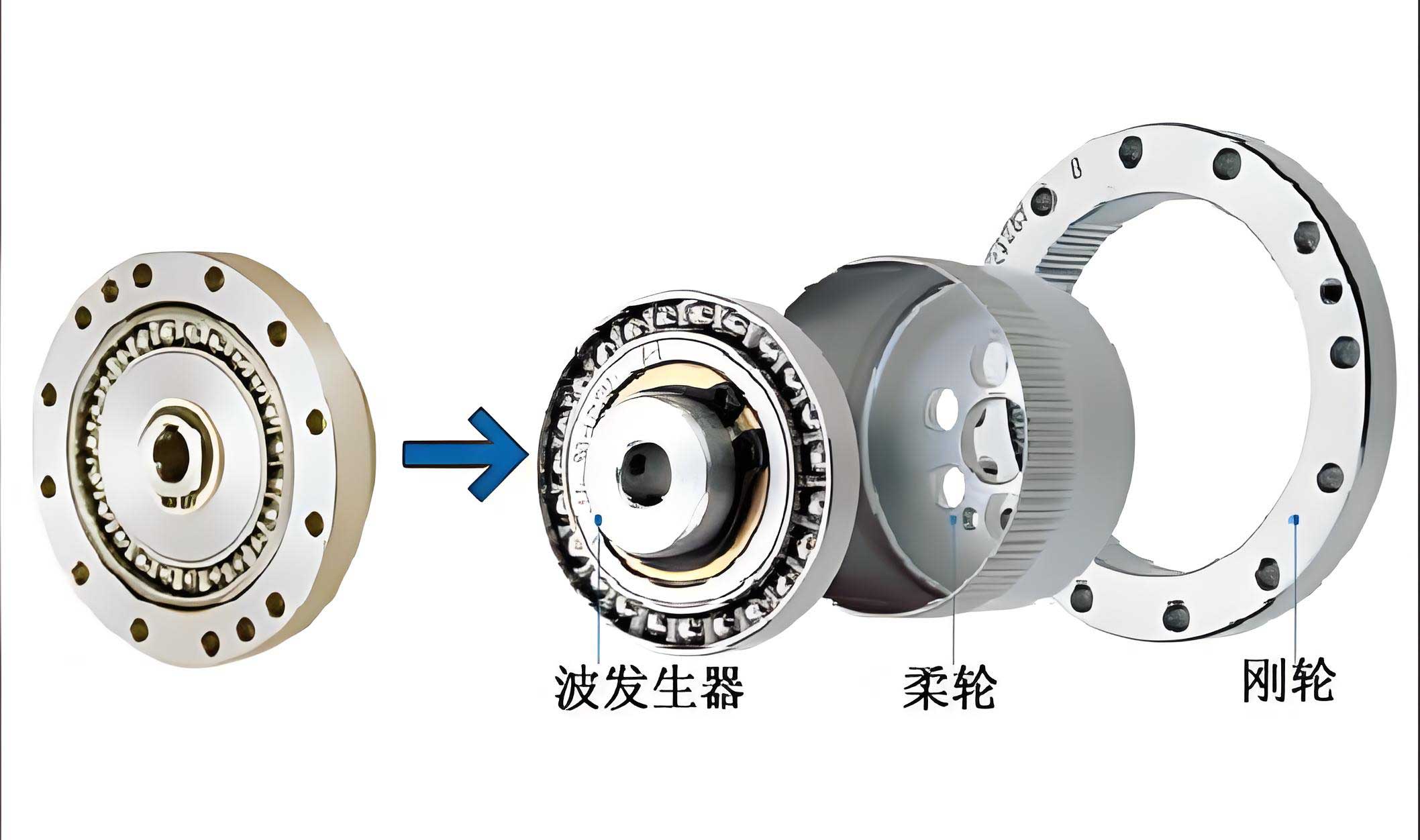
To address this, I propose an equal-arc-length distribution algorithm that directly computes tooth positions on the deformed neutral curve. This algorithm ensures that the arc length between consecutive teeth is constant, adhering to the non-elongation condition. The steps involve calculating the total arc length of the deformed curve, dividing it equally based on the number of teeth, and iteratively determining the angular parameters for each tooth position. For the flexspline tooth profile, typically an involute shape, the coordinates in the deformed state are obtained through coordinate transformations that account for both positional shifts and rotational adjustments of the tooth symmetry line. The rotation angle \( \lambda \) is derived from the geometry of the deformed curve, given by \( \lambda = -\arctan\left(\frac{\dot{w}(\theta)}{r_m + w(\theta)}\right) \), where \( r_m \) is the initial radius, \( w(\theta) \) is the radial displacement, and \( \dot{w}(\theta) \) is its derivative with respect to the angle \( \theta \). This approach enables the parametric generation of the flexspline’s three-dimensional model in the assembled state, facilitating the creation of a comprehensive strain wave gear assembly model.
Common wave generators used in strain wave gear systems induce distinct deformation patterns. The radial displacement \( w(\theta) \) of the flexspline’s neutral curve varies with the wave generator type, affecting the tooth positioning and overall gear performance. Below is a summary of key wave generator types and their corresponding radial displacement functions, where \( \theta \) is the angular coordinate, \( w_0 \) is the maximum deformation, and other parameters are specific to each design.
| Wave Generator Type | Radial Displacement Function \( w(\theta) \) | Parameters |
|---|---|---|
| Dual-Disk | $$ w(\theta) = \begin{cases} \frac{w_0 (A_1 \cos \theta – B_1)}{A_1 – B_1}, & 0 \leq \theta \leq \gamma \\ \frac{w_0 \left[ (1 + \sin^2 \gamma) \sin \theta + \left(\frac{\pi}{2} – \theta\right) \cos \theta – 2\sin \gamma – B_1 \right]}{A_1 – B_1}, & \gamma < \theta \leq \pi \end{cases} $$ |
\( A_1 = \frac{\pi}{2} – \gamma – \sin \gamma \cos \gamma \), \( B_1 = \frac{4}{\pi} \cos \gamma – \left(\frac{\pi}{2} – \gamma\right) \sin \gamma \), \( \gamma \) is wrap angle |
| Four-Roller | $$ w(\theta) = \begin{cases} \frac{w_0}{A – 4/\pi} \left( A \cos \theta + \theta \sin \beta \sin \theta – \frac{4}{\pi} \right), & 0 \leq \theta \leq \beta \\ \frac{w_0}{A – 4/\pi} \left[ B \sin \theta + \left(\frac{\pi}{2} – \theta\right) \cos \beta \cos \theta – \frac{4}{\pi} \right], & \beta < \theta \leq \pi/2 \end{cases} $$ |
\( A = \sin \beta + \left(\frac{\pi}{2} – \beta\right) \cos \beta \), \( B = \cos \beta + \beta \sin \beta \), \( \beta \) is roller angle |
| Dual-Roller | $$ w(\theta) = \frac{w_0}{\pi/2 – 4/\pi} \left( \sin \theta + \left(\frac{\pi}{2} – \theta\right) \cos \theta – \frac{4}{\pi} \right) $$ |
Special case of four-roller with \( \beta = 0 \) |
| Cosine Cam | $$ w(\theta) = w_0 \cos 2\theta $$ |
Simple harmonic profile |
| Standard Elliptical | $$ w(\theta) = \frac{(r_m + w_0)(r_m – w_0)}{\sqrt{(r_m + w_0)^2 \sin^2 \theta + (r_m – w_0)^2 \cos^2 \theta}} – r_m $$ |
Derived from ellipse geometry |
The equal-arc-length distribution algorithm for tooth positioning involves several computational steps. First, the arc length of the deformed neutral curve is calculated using the integral formula for a curve in polar coordinates. For a wave generator-induced deformation, the curve is symmetric, so the total arc length \( L \) is four times the arc length in the first quadrant:
$$
L = 4 \int_{0}^{\pi/2} \sqrt{ \rho(\theta)^2 + \left( \frac{d\rho}{d\theta} \right)^2 } \, d\theta, \quad \text{where } \rho(\theta) = r_m + w(\theta).
$$
Given the number of teeth \( z_1 \) on the flexspline, the arc length per tooth segment \( s \) is \( s = L / z_1 \). The algorithm then iteratively solves for the angular positions \( \theta_i \) on the deformed curve such that the arc length from \( \theta = 0 \) to \( \theta = \theta_i \) equals \( i \cdot s \) for the \( i \)-th tooth in the first quadrant. This is achieved through numerical integration and root-finding methods, ensuring precision by checking cumulative deviations. Once the first quadrant positions are determined, teeth in other quadrants are obtained via symmetry mapping. For tooth profile generation, consider a local coordinate system attached to each tooth, with the origin at the tooth root on the neutral curve. The tooth profile coordinates \( (x_1, y_1) \) in the local system are transformed to the global assembly coordinates \( (X, Y) \) using:
$$
\begin{bmatrix} X \\ Y \\ 1 \end{bmatrix} = \mathbf{R} \cdot \begin{bmatrix} \delta \cos \eta \\ \delta \sin \eta \\ 1 \end{bmatrix} + \mathbf{T},
$$
where \( \delta = \sqrt{(x_1 – x_{o1})^2 + (y_1 – y_{o1})^2} \), \( \eta = \arctan(y_1 / x_1) \), \( \mathbf{R} \) is a rotation matrix accounting for the tooth symmetry line rotation \( \lambda \), and \( \mathbf{T} \) is a translation vector to the tooth root position \( (x_{o1}, y_{o1}) = (\rho \sin \theta, \rho \cos \theta) \). The rotation angle \( \lambda \) is computed as \( \lambda = -\arctan\left( \frac{\dot{w}(\theta)}{r_m + w(\theta)} \right) \), reflecting the tangential slope change due to deformation. This parametric approach allows efficient generation of the deformed flexspline model for any wave generator type, enabling accurate strain wave gear assembly modeling.
To validate the equal-arc-length algorithm, it is essential to compare it with traditional methods based on elastic ring deformation theory. This theory describes the deformation of the flexspline’s neutral layer through radial displacement \( w(\theta) \), tangential displacement \( v(\theta) \), and angular displacement of the tooth symmetry line. Under the non-elongation assumption, the relationship between the initial angle \( \phi \) and the deformed angle \( \theta \) is given by:
$$
\phi = \int_{0}^{\theta_1} \sqrt{ \left(1 + \frac{w(\theta)}{r_m}\right)^2 + \left( \frac{\dot{w}(\theta)}{r_m} \right)^2 } \, d\theta = F(\theta_1),
$$
which is the exact formulation. An approximate method simplifies this by assuming small displacements and neglecting higher-order terms, leading to \( \phi \approx \theta_1 + \frac{v(\theta)}{r_m} \) and \( \lambda \approx \frac{1}{r_m} \frac{dw}{d\theta} \). However, these approximations can introduce errors, especially at intermediate angles. In contrast, the equal-arc-length algorithm directly enforces arc length consistency without such simplifications. A comparative analysis was conducted for a strain wave gear with \( z_1 = 204 \) teeth, \( r_m = 81 \) mm, and \( w_0 = 0.955 \) mm under a four-roller wave generator. The angular deviation \( \Delta \theta = \theta_{\text{deformed}} – \theta_{\text{initial}} \) for teeth in the first quadrant was computed using three methods: the approximate ring theory, exact ring theory, and equal-arc-length algorithm. Results show that the equal-arc-length algorithm closely aligns with the exact theory, while the approximate method exhibits significant deviations near \( 45^\circ \), with a maximum error of \( 0.022^\circ \), corresponding to a circumferential position error of approximately 1.782 mm. This error can impact mesh performance in strain wave gear systems, underscoring the importance of precise computation.
| Method | Maximum Angular Deviation \( \Delta \theta_{\text{max}} \) | Computational Complexity | Accuracy |
|---|---|---|---|
| Approximate Ring Theory | \( 0.022^\circ \) at \( 46.95^\circ \) | Low (analytical expressions) | Moderate, with errors in mid-angles |
| Exact Ring Theory | \( 0.001^\circ \) (near exact) | High (requires numerical integration) | High, but computationally intensive |
| Equal-Arc-Length Algorithm | \( 0.002^\circ \) (close to exact) | Medium (iterative numerical solution) | High, balances accuracy and efficiency |
The slight discrepancy between the equal-arc-length algorithm and the exact theory arises because the algorithm uses the actual integrated arc length of the deformed curve, which may slightly exceed the initial circumference due to deformation. For instance, with \( r_m = 81 \) mm and \( w_0 = 0.955 \) mm, the relative elongation of the neutral curve for different wave generators is computed as follows:
| Wave Generator Type | Initial Circumference (mm) | Deformed Circumference (mm) | Relative Elongation (%) |
|---|---|---|---|
| Four-Roller | 508.938 | 509.012 | 0.0146 |
| Dual-Roller | 508.938 | 509.002 | 0.0126 |
| Dual-Disk | 508.938 | 509.006 | 0.0133 |
| Cosine Cam | 508.938 | 509.009 | 0.0139 |
| Standard Elliptical | 508.938 | 508.956 | 0.0035 |
The standard elliptical wave generator induces the smallest elongation, making it suitable for high-precision strain wave gear applications. However, all elongations are minimal (below 0.015%), validating the non-elongation assumption for practical purposes. The equal-arc-length algorithm effectively captures this behavior, ensuring accurate tooth positioning for assembly modeling.
Application examples demonstrate the effectiveness of the proposed assembly model for strain wave gear systems. Consider a strain wave gear with involute teeth, parameters: \( z_1 = 204 \), \( z_2 = 206 \), module \( m = 0.8 \) mm, pressure angle \( \alpha_0 = 20^\circ \), profile shift coefficient \( x_1 = 1.01288 \), roller angle \( \beta = 30^\circ \), and maximum deformation \( w_0 = 0.955 \) mm. Using a four-roller wave generator, the flexspline and circular spline models are generated parametrically. The assembly model visually displays the deformation of the flexspline, complete meshing at the long axis, and disengagement at the short axis. To analyze backlash distribution, the tooth profile coordinates are projected onto a plane perpendicular to the gear axis, revealing the clearance between meshing teeth. The minimum backlash, critical for load capacity, occurs at the tooth tip of the flexspline. For different wave generators, the backlash variation along the gear circumference is plotted, showing that four-roller generators provide the most uniform distribution, while dual-roller generators exhibit larger fluctuations but may be suitable for light-load applications due to uniform backlash in the long-axis region (0° to 7°).
The backlash \( b(\theta) \) at the flexspline tooth tip can be approximated based on the relative positions of the flexspline and circular spline teeth. For involute profiles, the backlash is influenced by the center distance variation caused by deformation. The effective center distance \( C(\theta) \) between the flexspline and circular spline is \( C(\theta) = r_m + w(\theta) + r_{c} \), where \( r_{c} \) is the circular spline radius. The backlash is then derived from gear mesh geometry, often calculated as \( b(\theta) = 2 C(\theta) \sin(\Delta \phi/2) \), where \( \Delta \phi \) is the angular pitch difference. However, precise computation requires detailed tooth profile analysis. Using the assembly model, backlash values are extracted at multiple points, summarized below for different wave generator types at key angles:
| Wave Generator Type | Backlash at \( \theta = 0^\circ \) (mm) | Backlash at \( \theta = 45^\circ \) (mm) | Backlash at \( \theta = 90^\circ \) (mm) | Uniformity |
|---|---|---|---|---|
| Four-Roller | 0.05 | 0.08 | 0.12 | High (small variation) |
| Dual-Roller | 0.04 | 0.15 | 0.20 | Low (large variation) |
| Dual-Disk | 0.06 | 0.10 | 0.14 | Moderate |
| Cosine Cam | 0.07 | 0.09 | 0.13 | Moderate |
| Standard Elliptical | 0.05 | 0.07 | 0.10 | High |
This backlash analysis aids in selecting appropriate wave generators for specific strain wave gear applications, balancing load distribution and precision requirements. Moreover, the assembly model allows for interference detection by checking geometric overlaps between teeth in the deformed state. For the given example, no interference is observed, confirming design validity. The model can be extended to dynamic simulations by incorporating wave generator rotation, visualizing the progressive meshing process where teeth engage, disengage, and re-engage cyclically. This capability is invaluable for educational and design validation purposes in strain wave gear development.
In conclusion, the assembly model based on elastic component deformation provides a robust framework for accurately representing strain wave gear systems in their operational state. The equal-arc-length distribution algorithm offers a precise and efficient method for determining tooth positions on the deformed flexspline, outperforming approximate ring theory methods and aligning closely with exact theoretical solutions. By parameterizing the deformation induced by various wave generators, the model facilitates the generation of three-dimensional assembly views that vividly illustrate mesh conditions, backlash distribution, and potential interferences. This approach enhances the design and analysis of strain wave gear, enabling engineers to optimize performance parameters such as load capacity and transmission accuracy. Future work could explore alternative tooth profiles beyond involute, such as circular-arc or modified geometries, to further improve mesh performance and minimize backlash variations. Additionally, integrating finite element analysis could refine deformation predictions under load, advancing the fidelity of strain wave gear assembly models for high-precision applications.