
In modern mechanical engineering, strain wave gears, also known as harmonic drives, have become indispensable components in various industries, including robotics, aerospace, and petrochemical machinery. Their unique design offers high reduction ratios, compact size, and precision motion control. However, the reliability of strain wave gears is critical, as failures can lead to significant downtime and safety risks. Traditional design approaches often treat parameters as deterministic or purely random, neglecting the inherent fuzziness in real-world conditions. In this article, I explore the application of fuzzy reliability design to strain wave gears, integrating both randomness and fuzziness to enhance safety and performance. I will derive key formulas, present computational methods using tables and equations, and provide a detailed example to illustrate the process. By incorporating fuzzy sets and membership functions, this approach offers a more realistic assessment of reliability, ensuring that strain wave gears operate robustly under uncertain conditions.
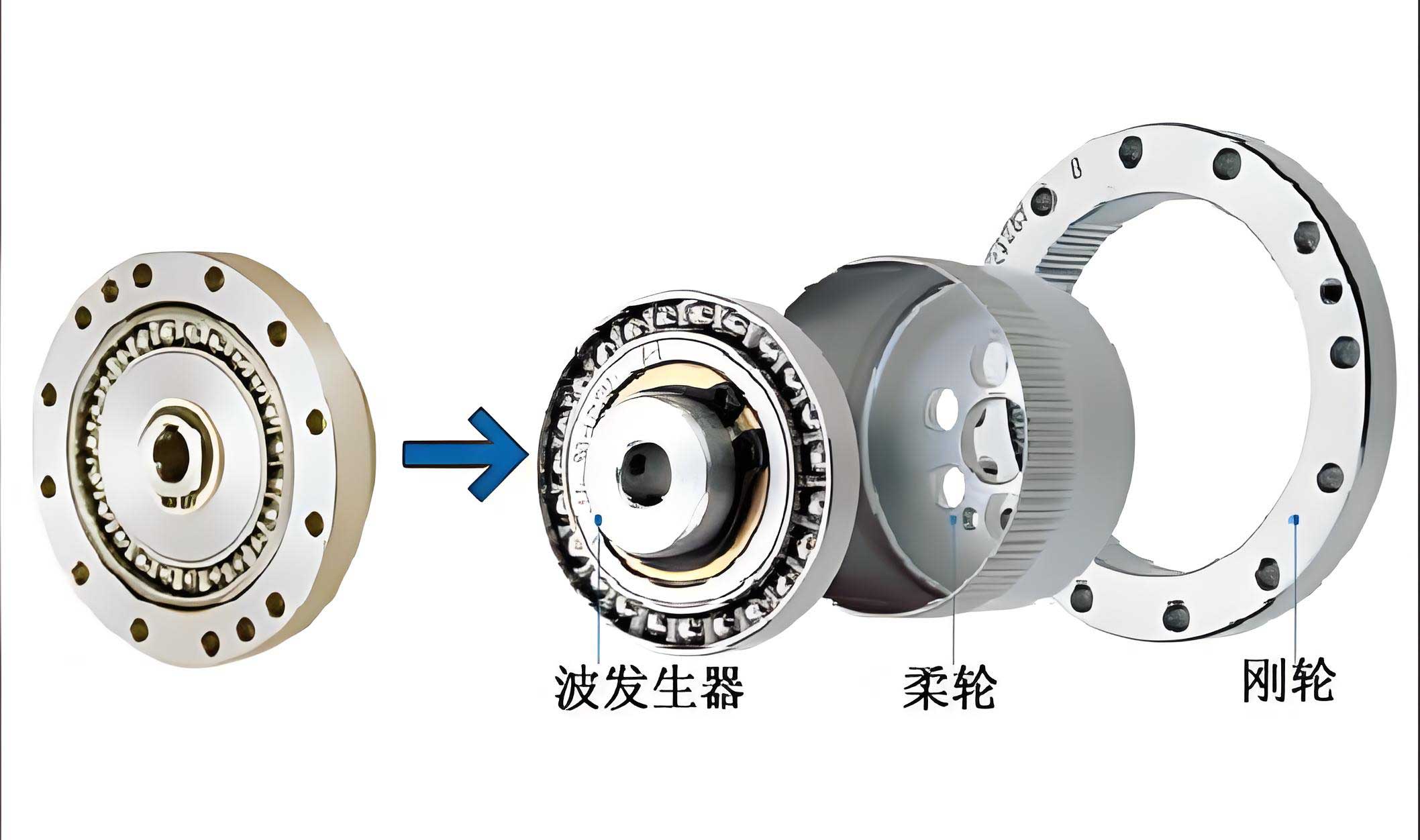
Strain wave gears operate on the principle of elastic deformation, where a flexible spline (or柔轮) interacts with a rigid spline (or刚轮) via a wave generator. This mechanism allows for high torque transmission with minimal backlash. The design of strain wave gears involves multiple strength criteria, including tooth surface wear resistance, flexspline fatigue strength, and wave generator bearing life. Conventional reliability design models these criteria using probabilistic methods, but they often overlook the模糊性 in parameters such as material properties, load variations, and operational boundaries. Fuzzy reliability design addresses this by treating safety states as模糊 events, described by membership functions. This paradigm shift allows for a smoother transition from safe to failed states, capturing the gradual nature of real-world failures. Throughout this discussion, I will emphasize the importance of strain wave gears in industrial applications, highlighting how fuzzy reliability design can optimize their performance and longevity.
The core of fuzzy reliability design lies in defining a membership function that quantifies the degree to which a component belongs to the safe state. For strain wave gears, I adopt a linear membership function, which is simple yet effective for engineering applications. Let the performance function be denoted as $Z = r – s$, where $r$ is the strength and $s$ is the stress, both considered as random variables following normal distributions. The membership function $\mu(Z)$ is given by:
$$
\mu(Z) =
\begin{cases}
1 & \text{if } Z \geq 0 \\
\frac{Z + a}{a} & \text{if } -a < Z < 0 \\
0 & \text{if } Z \leq -a
\end{cases}
$$
Here, $a > 0$ is a parameter that刻画 the fuzziness, chosen based on empirical data. The模糊可靠度 $R$ is then computed as the probability that $Z$ is in the safe fuzzy set. Given that $Z$ follows a normal distribution with mean $\mu_Z = \mu_r – \mu_s$ and standard deviation $\sigma_Z = \sqrt{\sigma_r^2 + \sigma_s^2}$, the probability density function is:
$$
f(Z) = \frac{1}{\sqrt{2\pi}\sigma_Z} \exp\left[ -\frac{(Z – \mu_Z)^2}{2\sigma_Z^2} \right]
$$
The模糊可靠度 is derived as:
$$
R = P(Z \geq \sim 0) = \int_0^\infty f(Z) \, dZ + \int_{-a}^0 \mu(Z) f(Z) \, dZ
$$
Evaluating this integral yields:
$$
R = \frac{1}{a} \left\{ \left[ (a + \mu_Z) \Phi\left( \frac{a + \mu_Z}{\sigma_Z} \right) – \mu_Z \Phi\left( \frac{\mu_Z}{\sigma_Z} \right) \right] + \frac{\sigma_Z}{\sqrt{2\pi}} \left[ \exp\left( -\frac{(a + \mu_Z)^2}{2\sigma_Z^2} \right) – \exp\left( -\frac{\mu_Z^2}{2\sigma_Z^2} \right) \right] \right\}
$$
where $\Phi(\cdot)$ is the standard normal cumulative distribution function. This formula combines conventional reliability (the first term) with an additional term accounting for fuzziness. For strain wave gears, I will apply this to three key strength calculations: tooth surface wear, flexspline fatigue, and wave generator bearing life. Each calculation requires determining the mean and standard deviation of strength and stress, which I will summarize in tables for clarity.
First, consider the tooth surface wear calculation for strain wave gears. Due to the near-surface contact between the flexspline and circular spline, wear is controlled by the contact pressure. The mean pressure $\mu_p$ is given by:
$$
\mu_p = \frac{8000 \mu_K \mu_T}{\mu_\varepsilon \mu_{\chi_d} \mu_{C_h} m d^2 z}
$$
where $\mu_T$ is the torque (in N·m), $\mu_K$ is the load factor, $\mu_\varepsilon$ is the percentage of engaging teeth, $\mu_{\chi_d}$ is the tooth width factor, $\mu_{C_h}$ is the maximum engagement depth factor, $m$ is the module, $d$ is the pitch diameter, and $z$ is the number of teeth. The parameters are treated as random variables with known means and standard deviations. For instance, if a parameter ranges from $x_{\text{min}}$ to $x_{\text{max}}$, the mean and standard deviation can be estimated using the “3-sigma” rule: $\mu_x = (x_{\text{min}} + x_{\text{max}})/2$ and $\sigma_x = (x_{\text{max}} – x_{\text{min}})/6$. The coefficient of variation is $C_x = \sigma_x / \mu_x$. Below is a table summarizing typical parameters for strain wave gear tooth surface wear calculations.
| Parameter | Symbol | Mean ($\mu$) | Standard Deviation ($\sigma$) | Coefficient of Variation ($C$) |
|---|---|---|---|---|
| Allowable Pressure | $[p]$ | 30 MPa | 3.33 MPa | 0.11 |
| Load Factor | $K$ | 1.525 | 0.075 | 0.049 |
| Engagement Percentage | $\varepsilon$ | 0.43 | 0.033 | 0.077 |
| Tooth Width Factor | $\chi_d$ | 0.15 | 0.0167 | 0.111 |
| Engagement Depth Factor | $C_h$ | 1.5 | 0.033 | 0.022 |
Using these values, the mean pressure $\mu_p$ can be computed. The standard deviation $\sigma_p$ is derived from the coefficients of variation: $\sigma_p = \mu_p \sqrt{C_K^2 + C_\varepsilon^2 + C_{\chi_d}^2 + C_{C_h}^2}$. For example, if $\mu_p = 28.47$ MPa, then $\sigma_p = 28.47 \times 0.1454 = 4.14$ MPa. The performance function for wear is $Z = [p] – p$, with mean $\mu_Z = \mu_{[p]} – \mu_p$ and standard deviation $\sigma_Z = \sqrt{\sigma_{[p]}^2 + \sigma_p^2}$. Substituting into the fuzzy可靠度 formula yields the reliability for tooth surface wear in strain wave gears.
Next, I address the flexspline fatigue strength calculation. The flexspline in strain wave gears undergoes cyclic stresses due to deformation, making fatigue a critical failure mode. The safety factor under combined stress is calculated as:
$$
\mu_s = \frac{\mu_{s_\sigma} \mu_{s_\tau}}{\sqrt{\mu_{s_\sigma}^2 + 0.7 \mu_{s_\tau}^2}}
$$
where $\mu_{s_\sigma}$ and $\mu_{s_\tau}$ are the safety factors for normal and shear stresses, respectively. These are derived from material properties and stress analyses. The allowable safety factor $[s]$ is a random variable with mean $\mu_{[s]}$ and standard deviation $\sigma_{[s]}$. The performance function is $Z = [s] – s$, with $\mu_Z = \mu_{[s]} – \mu_s$ and $\sigma_Z = \sqrt{\sigma_{[s]}^2 + \sigma_s^2}$. The fuzzy可靠度 can then be computed similarly. To illustrate, here is a table of typical parameters for flexspline fatigue in strain wave gears.
| Parameter | Symbol | Mean ($\mu$) | Standard Deviation ($\sigma$) |
|---|---|---|---|
| Allowable Safety Factor | $[s]$ | 2.0 | 0.2 |
| Normal Stress Safety Factor | $s_\sigma$ | 3.5 | 0.35 |
| Shear Stress Safety Factor | $s_\tau$ | 4.0 | 0.4 |
Using these values, $\mu_s$ can be calculated, and the fuzzy可靠度 for fatigue strength is obtained. This approach ensures that the inherent uncertainties in material fatigue limits and operational loads are accounted for, enhancing the design of strain wave gears.
Finally, the wave generator bearing life calculation is essential for strain wave gears, as the bearing supports the wave generator and experiences dynamic loads. The bearing life in hours is given by the standard rolling bearing formula:
$$
\mu_{L_h} = \frac{10^6}{60 n} \left( \frac{\mu_C}{\mu_p} \right)^\varepsilon
$$
where $n$ is the rotational speed (in rpm), $\mu_C$ is the dynamic load rating (in N), $\mu_p$ is the equivalent load (in N), and $\varepsilon$ is an exponent (typically 3 for ball bearings). The parameters are random variables, and their variability affects the life prediction. The allowable life $[L]$ has mean $\mu_{[L]}$ and standard deviation $\sigma_{[L]}$. The performance function is $Z = [L] – L_h$, with $\mu_Z = \mu_{[L]} – \mu_{L_h}$ and $\sigma_Z = \sqrt{\sigma_{[L]}^2 + \sigma_{L_h}^2}$. Below is a table summarizing parameters for wave generator bearing life in strain wave gears.
| Parameter | Symbol | Mean ($\mu$) | Standard Deviation ($\sigma$) |
|---|---|---|---|
| Allowable Life | $[L]$ | 20,000 hours | 2,000 hours |
| Dynamic Load Rating | $C$ | 10,000 N | 1,000 N |
| Equivalent Load | $p$ | 2,000 N | 200 N |
| Rotational Speed | $n$ | 1,000 rpm | 50 rpm |
With these inputs, $\mu_{L_h}$ is computed, and the fuzzy可靠度 for bearing life can be determined. This calculation is crucial for ensuring the longevity of strain wave gears in high-duty cycles.
To demonstrate the practical application of fuzzy reliability design for strain wave gears, I provide a detailed example. Consider a strain wave gear reducer used in a petrochemical machine, with an output torque of $T = 400$ N·m. The flexspline is steel with module $m = 0.5$ mm, number of teeth $z = 242$, and pitch diameter $d = 121$ mm. The wave generator is a cam-type with a flexible rolling bearing. The goal is to compute the fuzzy可靠度 for tooth surface wear. I assume the parameters from the earlier table: $\mu_{[p]} = 30$ MPa, $\sigma_{[p]} = 3.33$ MPa, $\mu_K = 1.525$, $\sigma_K = 0.075$, $\mu_\varepsilon = 0.43$, $\sigma_\varepsilon = 0.033$, $\mu_{\chi_d} = 0.15$, $\sigma_{\chi_d} = 0.0167$, $\mu_{C_h} = 1.5$, $\sigma_{C_h} = 0.033$. Torque and geometric dimensions are considered deterministic for simplicity. First, compute the mean pressure:
$$
\mu_p = \frac{8000 \times 1.525 \times 400}{0.43 \times 0.15 \times 1.5 \times 0.5 \times 121^2 \times 242} \approx 28.47 \text{ MPa}
$$
The coefficient of variation for pressure is:
$$
C_p = \sqrt{C_K^2 + C_\varepsilon^2 + C_{\chi_d}^2 + C_{C_h}^2} = \sqrt{0.049^2 + 0.077^2 + 0.111^2 + 0.022^2} \approx 0.1454
$$
Thus, $\sigma_p = \mu_p \times C_p = 28.47 \times 0.1454 \approx 4.14$ MPa. Now, the performance function mean and standard deviation are:
$$
\mu_Z = \mu_{[p]} – \mu_p = 30 – 28.47 = 1.73 \text{ MPa}, \quad \sigma_Z = \sqrt{\sigma_{[p]}^2 + \sigma_p^2} = \sqrt{3.33^2 + 4.14^2} \approx 5.313 \text{ MPa}
$$
For the fuzzy parameter, choose $a = 1$. Substituting into the fuzzy可靠度 formula:
$$
R = \frac{1}{1} \left\{ \left[ (1 + 1.73) \Phi\left( \frac{1 + 1.73}{5.313} \right) – 1.73 \Phi\left( \frac{1.73}{5.313} \right) \right] + \frac{5.313}{\sqrt{2\pi}} \left[ \exp\left( -\frac{(1 + 1.73)^2}{2 \times 5.313^2} \right) – \exp\left( -\frac{1.73^2}{2 \times 5.313^2} \right) \right] \right\}
$$
Evaluating numerically: $\Phi(0.514) \approx 0.696$, $\Phi(0.326) \approx 0.628$, and the exponential terms are small. Simplifying:
$$
R \approx \left[ 2.73 \times 0.696 – 1.73 \times 0.628 \right] + 2.123 \times \left[ e^{-0.088} – e^{-0.053} \right] \approx (1.900 – 1.086) + 2.123 \times (0.916 – 0.948) \approx 0.814 – 0.068 \approx 0.746
$$
Thus, the fuzzy可靠度 for tooth surface wear is approximately 0.746. For comparison, the conventional可靠度 (without fuzziness) is $R_{\text{conv}} = \Phi(\mu_Z / \sigma_Z) = \Phi(1.73 / 5.313) \approx \Phi(0.326) \approx 0.628$. This shows that fuzzy reliability design yields a higher可靠度 by accounting for模糊性, providing a more conservative and realistic assessment for strain wave gears. Similar calculations can be performed for flexspline fatigue and bearing life, but I omit them here for brevity.
The advantage of fuzzy reliability design for strain wave gears is evident in its ability to handle both随机性 and模糊性. In real-world applications, parameters like load, material strength, and operational conditions are not only random but also vaguely defined due to measurement errors, environmental factors, and design tolerances. By incorporating membership functions, this method captures the gradual transition from safe to failed states, which is more aligned with actual failure mechanisms in strain wave gears. For instance, wear in strain wave gear teeth does not occur abruptly; it progresses over time, and the fuzzy model reflects this through the parameter $a$. Moreover, the use of tables and formulas, as demonstrated, facilitates practical implementation in engineering design software. Engineers can input parameter ranges, compute means and standard deviations, and obtain fuzzy可靠度 values to guide decisions on material selection, dimensions, and safety factors.
In conclusion, fuzzy reliability design offers a robust framework for enhancing the performance and safety of strain wave gears. By integrating模糊 sets with probabilistic methods, it addresses limitations in conventional reliability approaches, providing a more comprehensive assessment of failure risks. The derived formulas for tooth surface wear, flexspline fatigue, and wave generator bearing life enable systematic calculations, supported by tables for parameter estimation. The example illustrates that fuzzy可靠度 can be higher than conventional可靠度 under the same conditions, emphasizing the importance of considering模糊性 in design. As strain wave gears continue to be vital in precision machinery, adopting fuzzy reliability design can lead to more reliable and durable systems. Future work could explore nonlinear membership functions or applications to other gear types, but for now, this method stands as a valuable tool for engineers working with strain wave gears.
To further elaborate, I will discuss some mathematical nuances. The choice of the membership function parameter $a$ is critical in fuzzy reliability design for strain wave gears. If $a$ is too small, the model approaches conventional reliability; if too large, it may overestimate safety. Empirical studies suggest that $a$ can be set based on historical failure data or expert judgment. For strain wave gears, a value between 0.5 and 2 is often reasonable, as shown in the example. Additionally, the assumption of normal distributions for strength and stress is common but not always accurate. In practice, log-normal or Weibull distributions might be more appropriate for certain parameters in strain wave gears, such as material fatigue limits. The fuzzy可靠度 formula can be adapted to other distributions, though the integrals may require numerical methods. For simplicity, I stick to normal distributions in this article.
Another aspect is the correlation between parameters. In strain wave gears, factors like load and engagement percentage may be correlated, affecting the overall reliability. The fuzzy reliability model can incorporate correlations by using joint probability distributions or covariance matrices in the performance function. For example, if $K$ and $\varepsilon$ are correlated, the standard deviation $\sigma_p$ would include covariance terms. However, for introductory purposes, I assume independence, as done in the example. Engineers should consider correlations when detailed data is available.
Lastly, the application of fuzzy reliability design extends beyond strength calculations to other aspects of strain wave gears, such as thermal performance or vibration analysis. The core idea remains: define a performance function, establish membership functions, and compute fuzzy probabilities. This holistic approach ensures that strain wave gears are designed for robustness under diverse operating conditions. I hope this article provides a clear guide for implementing fuzzy reliability design in the context of strain wave gears, leveraging tables and formulas to streamline the process.