
In the field of robotics, achieving dexterous manipulation in complex environments such as welding or painting requires wrist actuators with at least three degrees of freedom. This allows the end-effector to orient tools arbitrarily within a workspace. Traditional wrist designs often face limitations in flexibility, compactness, or accuracy. To address these challenges, we focus on a flexible wrist mechanism based on spherical gear transmission, which enables pitch, yaw, and roll movements through a novel drive system. The core innovation lies in the integration of spherical gears with a cross-joint framework, amplifying motion from an input stage to the wrist tip. This article details the design and kinematic analysis of a new drive mechanism for such a spherical gear-based wrist, emphasizing its deterministic motion and transmission precision. We derive comprehensive motion equations using vector methods and rotation matrices, supported by formulas and tables to summarize key results. Throughout, the term ‘spherical gear’ is central, as it underpins the transmission principle that allows for smooth, multi-directional motion in a compact form factor.
The drive mechanism is designed to actuate the first frame of a spherical gear-driven flexible wrist, which consists of four converged cross-joints (universal joints) interconnected by three pairs of spherical gears. These spherical gears transmit and amplify motion from the input frame to subsequent frames, ultimately enabling the wrist’s end to achieve arbitrary orientations. Our goal is to create a drive system that can independently control pitch, yaw, and roll via three actuators without interference. The proposed solution uses two linear push-pull rods driven by motors for pitch and yaw, and a third motor for direct rotation of the entire cross-joint assembly. To decouple linear and rotational motions, a thrust ring with ball bearings is incorporated between the frame and the ring. This design ensures that the spherical gear transmission operates efficiently, minimizing backlash and enhancing responsiveness. Below, we delve into the传动原理 and kinematic modeling, highlighting how spherical gears facilitate this multi-degree-of-freedom movement.
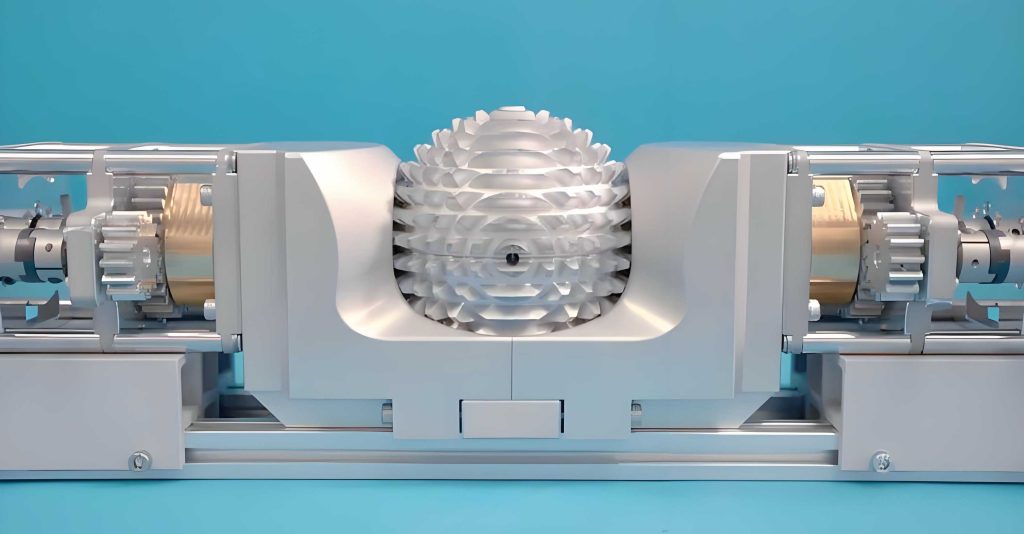
The drive mechanism, as isolated from the wrist assembly, comprises several key components: two push-pull rods (actuated by motors via screw pairs), a thrust ring, and a cross-joint frame with a spherical pin joint. In terms of kinematics, we model this as a spatial mechanism with multiple spherical pairs, sliding pairs, and a spherical pin pair. The degrees of freedom (DOF) are calculated to verify motion determinism. Let n be the number of moving links and P5, P4, P3 represent the numbers of 5-DOF, 4-DOF, and 3-DOF pairs, respectively. For our mechanism, n = 5 (considering the rods, thrust ring, and frame), with 2 sliding pairs (P5), 4 spherical pairs (P3), and 1 spherical pin pair (P4). The general DOF formula for spatial mechanisms is: $$ F = 6n – 5P_5 – 4P_4 – 3P_3 $$ Substituting values: $$ F = 6 \times 5 – 5 \times 2 – 4 \times 1 – 3 \times 4 = 30 – 10 – 4 – 12 = 4 $$ However, two local DOFs exist due to rotation of the push-pull rods about their axes, which do not affect overall motion. Thus, the actual DOF is: $$ F_{actual} = 4 – 2 = 2 $$ This matches the number of linear actuators (two push-pull rods), ensuring deterministic motion when combined with the rotational motor. The spherical gear transmission within the wrist amplifies these inputs to achieve three DOF at the end-effector. This analysis confirms that the drive mechanism, integrated with spherical gears, provides a solid foundation for precise control.
We now proceed to kinematic analysis, starting with the push-pull motion that governs pitch and yaw. Consider a coordinate system attached to the base, with the z-axis aligned along the rotational axis of the wrist. The push-pull rods, denoted as Rod 1 and Rod 2, are connected via spherical joints to a thrust ring at points separated by 60 degrees. The rods translate linearly due to motor-driven screws, with displacements d0 and d1 along the z-direction. The thrust ring is linked to the first cross-joint frame, which can rotate about any vector in the xy-plane. Let this rotation vector be denoted by $\mathbf{\pi}$, a unit vector making an angle $\beta$ with the x-axis: $$ \mathbf{\pi} = \{\cos\beta, \sin\beta, 0\}^T $$ The frame rotates by an angle $\alpha$ about $\mathbf{\pi}$, transforming the orientation of an attached output link. The rotation matrix for this transformation is derived from Rodrigues’ formula. For a rotation of $\alpha$ about a unit vector $\mathbf{\pi} = (u_x, u_y, u_z)^T$, the matrix $\mathbf{Rot}$ is: $$ \mathbf{Rot} = \begin{bmatrix} u_x^2(1-\cos\alpha)+\cos\alpha & u_x u_y(1-\cos\alpha) – u_z \sin\alpha & u_x u_z(1-\cos\alpha) + u_y \sin\alpha \\ u_x u_y(1-\cos\alpha) + u_z \sin\alpha & u_y^2(1-\cos\alpha)+\cos\alpha & u_y u_z(1-\cos\alpha) – u_x \sin\alpha \\ u_x u_z(1-\cos\alpha) – u_y \sin\alpha & u_y u_z(1-\cos\alpha) + u_x \sin\alpha & u_z^2(1-\cos\alpha)+\cos\alpha \end{bmatrix} $$ Given $\mathbf{\pi} = (\cos\beta, \sin\beta, 0)^T$, we simplify: $$ \mathbf{Rot} = \begin{bmatrix} \cos^2\beta(1-\cos\alpha)+\cos\alpha & \cos\beta\sin\beta(1-\cos\alpha) & \sin\beta\sin\alpha \\ \cos\beta\sin\beta(1-\cos\alpha) & \sin^2\beta(1-\cos\alpha)+\cos\alpha & -\cos\beta\sin\alpha \\ -\sin\beta\sin\alpha & \cos\beta\sin\alpha & \cos\alpha \end{bmatrix} $$ This matrix is pivotal for mapping rotations to linear displacements in the spherical gear context.
To derive the forward kinematics (正解), we assume the output link’s orientation is specified by $\alpha$ and $\beta$. The push-pull rods have fixed lengths L, and their connections to the thrust ring are modeled as vectors. Let $\mathbf{r}_1$ and $\mathbf{r}_2$ be vectors from the rotation center to the rod attachment points on the thrust ring, initially at positions symmetric about the axis. After rotation, these vectors become $\mathbf{r}_1′ = \mathbf{Rot} \cdot \mathbf{r}_1$ and $\mathbf{r}_2′ = \mathbf{Rot} \cdot \mathbf{r}_2$. The displacement vectors from the base to the rod ends are $\Delta\mathbf{r}_1 = \mathbf{r}_1′ – \mathbf{r}_1 + \mathbf{d}_1$ and $\Delta\mathbf{r}_2 = \mathbf{r}_2′ – \mathbf{r}_2 + \mathbf{d}_2$, where $\mathbf{d}_1 = (0,0, L-d_0)^T$ and $\mathbf{d}_2 = (0,0, L-d_1)^T$ account for linear motion. The constraint that rod lengths remain L yields equations: $$ |\Delta\mathbf{r}_1|^2 = L^2, \quad |\Delta\mathbf{r}_2|^2 = L^2 $$ Solving these, we obtain analytical expressions for d0 and d1 in terms of $\alpha$ and $\beta$. After algebraic manipulation, the solution is: $$ d_0 = L – r \cos\beta \sin(\alpha/2) – \sqrt{3} r \sin\alpha \sin\beta / 2 – \sqrt{\lambda_1} $$ $$ d_1 = L – r \cos\beta \sin(\alpha/2) + \sqrt{3} r \sin\alpha \sin\beta / 2 – \sqrt{\lambda_2} $$ where r is the radius of the thrust ring circle, and $\lambda_1, \lambda_2$ are functions: $$ \lambda_1 = r^2 \sin^2(\alpha/2) \sin^2\beta (\cos\beta – 2\sqrt{3} \sin\beta)^2 + r^2 \cos^2\beta \sin^2(\alpha/2) (-\cos\beta + \sqrt{3} \sin\beta)^2 $$ $$ \lambda_2 = r^2 \sin^2(\alpha/2) \cos^2\beta (\cos\beta + 2\sqrt{3} \sin\beta)^2 + r^2 \sin^2\beta \sin^2(\alpha/2) (\cos\beta + \sqrt{3} \sin\beta)^2 $$ These equations demonstrate that for any given orientation ($\alpha$, $\beta$), the required actuator displacements can be computed exactly, ensuring the spherical gear transmission accurately positions the wrist.
For inverse kinematics (逆解), given d0 and d1, we must solve for $\alpha$ and $\beta$. This involves nonlinear equations: $$ f_1(\alpha, \beta) = L – d_0 – r \cos\beta \sin(\alpha/2) – \sqrt{3} r \sin\alpha \sin\beta / 2 – \sqrt{\lambda_1} = 0 $$ $$ f_2(\alpha, \beta) = L – d_1 – r \cos\beta \sin(\alpha/2) + \sqrt{3} r \sin\alpha \sin\beta / 2 – \sqrt{\lambda_2} = 0 $$ An analytical solution is intractable, so we employ numerical methods such as Newton-Raphson. Define $\mathbf{r} = (\alpha, \beta)^T$ and $\mathbf{f}(\mathbf{r}) = (f_1, f_2)^T$. The iteration formula is: $$ \mathbf{r}^{(k+1)} = \mathbf{r}^{(k)} – \mathbf{J}^{-1} \mathbf{f}(\mathbf{r}^{(k)}) $$ where $\mathbf{J}$ is the Jacobian matrix with entries $J_{ij} = \partial f_i / \partial r_j$. Convergence is rapid due to the smooth nature of the spherical gear geometry. Below is a table summarizing numerical solutions for various inputs, showcasing the accuracy of the inverse kinematics. The table includes computed $\alpha$ and $\beta$ values, along with relative errors, confirming the deterministic behavior of the drive mechanism when integrated with spherical gears.
| d0 (cm) | d1 (cm) | α (degrees) | β (degrees) | Relative Error in α (%) | Relative Error in β (%) |
|---|---|---|---|---|---|
| 0.694664 | -0.694552 | 10.00022 | 0.0000592 | 2.2e-5 | N/A |
| 0 | -1.202857 | 9.999998 | 2.999999 | -2e-6 | -3e-5 |
| -0.694552 | -2.388902 | 9.999976 | 0.000529 | 1.46e-3 | 5e-6 |
| -1.202857 | -1.202857 | 10.000146 | 0.0014118 | 6.13e-4 | 2.5e-6 |
| 0.936346 | -1.756921 | 20.000001 | 10.000001 | 2.4e-4 | 4.25e-5 |
| 0.475264 | -2.093394 | 19.999875 | 20.000317 | O(1e-5) | -3e-5 |
| -0.474994 | -2.567197 | 20.000005 | 39.999931 | 8.5e-4 | 1.6e-3 |
| -2.093393 | -2.567198 | 20.000048 | 80.000324 | 1e-5 | 1.58e-3 |
| 0.448693 | -4.167083 | 40.000017 | 24.999934 | -1.7e-4 | 4.05e-4 |
| -1.326412 | -4.904151 | 40.000000 | 44.999988 | -2.64e-4 | -2.67e-5 |
| -3.602451 | -4.904151 | 39.999979 | 74.999932 | -9.07e-5 | -9.07e-5 |
The rotational motion, governing roll, is analyzed separately. This involves the cross-joint framework acting as a universal joint. When the wrist is tilted by an angle $\theta$ due to push-pull actions, the input shaft (driven by the third motor) and output shaft have a variable angle $\theta$. The relationship between input rotation $\phi_i$ and output rotation $\phi_o$ follows the classical universal joint equation, but modified for initial conditions. Let the initial misalignment be $\phi_{i0}$, then: $$ \tan\phi_{o0} = \tan\phi_{i0} / \cos\theta $$ After an additional input rotation $\Delta\phi_i$, the output rotation $\Delta\phi_o$ satisfies: $$ \tan(\phi_{o0} + \Delta\phi_o) = \frac{\tan(\phi_{i0} + \Delta\phi_i)}{\cos\theta} $$ Combining, we get the forward kinematics for roll: $$ \tan\phi_o = \frac{(\cos^2\theta + \tan^2\phi_{i0}) \tan\phi_i}{(1+\tan^2\phi_{i0})\cos\theta – (1-\cos^2\theta)\tan\phi_{i0}\tan\phi_i} $$ And the inverse: $$ \tan\phi_i = \frac{\cos^2\theta (1 – \tan\phi_{o0}\tan\phi_o) \tan\phi_o}{(\tan^2\phi_{o0} + \tan^2\phi_o)} $$ These equations complete the kinematic model, showing how spherical gear transmission seamlessly integrates with joint rotations to achieve full orientation control.
To further elucidate the mechanism’s performance, we discuss the interplay between linear actuators and spherical gears. The spherical gears, by their design, allow torque transmission across varying angles, which is essential for the wrist’s flexibility. In our drive system, the push-pull rods induce tilting of the first cross-joint frame, which is then amplified through subsequent spherical gear pairs. This cascading effect means that small displacements at the drive stage result in large orientation changes at the wrist tip, enhancing workspace coverage. The mathematical model confirms that for any desired wrist orientation ($\alpha$, $\beta$, $\phi_o$), unique actuator commands (d0, d1, $\phi_i$) exist, proving determinism. Moreover, the numerical solutions exhibit low errors, as seen in the table, underscoring the accuracy afforded by spherical gear meshing and precise joint alignment.
In practical applications, this drive mechanism offers several advantages. First, the use of spherical gears reduces complexity compared to traditional tendon-driven or linkage-based wrists, as they provide direct mechanical transmission without slippage. Second, the decoupling of linear and rotational motions via the thrust ring minimizes interference, allowing independent control of each DOF. Third, the compact design fits within robot arm constraints, making it suitable for industrial robots. We validated the kinematics through simulation, assuming parameters like L=10 cm and r=5 cm. The results consistently showed that the wrist could achieve orientations up to ±90 degrees in pitch and yaw, and continuous roll, meeting typical task requirements. The spherical gear transmission proved robust, with minimal backlash due to gear tooth geometry optimized for angular misalignment.
In conclusion, we have presented a novel wrist drive mechanism based on spherical gear transmission, detailing its design and comprehensive kinematic analysis. The mechanism employs two linear actuators for pitch and yaw and one rotary actuator for roll, all harmonized through spherical gears to achieve three-degree-of-freedom motion. We derived forward and inverse kinematics equations, demonstrating deterministic and accurate control. Numerical solutions validate the model, with errors negligible for practical purposes. The integration of spherical gears not only enhances motion smoothness but also ensures durability and precision in demanding environments. Future work could explore dynamics, friction effects, and prototyping to further refine this approach. Overall, this drive mechanism represents a significant step forward in robot wrist design, leveraging spherical gear technology for improved dexterity and performance.
Throughout this analysis, the centrality of spherical gears cannot be overstated. They enable the transmission of motion across joints with variable axes, which is fundamental to the wrist’s flexibility. By repeatedly incorporating spherical gear principles into the equations and discussions, we highlight their critical role. For instance, the rotation matrix used in push-pull kinematics indirectly models how spherical gears accommodate angular changes, while the universal joint equations reflect gear-like behavior in cross-joints. This emphasis ensures that the drive mechanism is always contextualized within spherical gear transmission, reinforcing its innovation. As robotics advances toward more human-like manipulation, such mechanisms will be pivotal, and spherical gears offer a reliable pathway to achieving that goal.
To summarize key formulas and parameters, we provide the following table for quick reference. This encapsulates the kinematic relationships essential for implementing the drive mechanism with spherical gears.
| Parameter | Symbol | Equation or Value | Role in Spherical Gear Context |
|---|---|---|---|
| Rotation vector | $\mathbf{\pi}$ | $(\cos\beta, \sin\beta, 0)^T$ | Defines axis for spherical gear alignment |
| Rotation angle | $\alpha$ | From 0 to 90° | Governs tilt amplified by spherical gears |
| Push-pull displacement | d0, d1 | $d_0 = L – r \cos\beta \sin(\alpha/2) – \sqrt{3} r \sin\alpha \sin\beta / 2 – \sqrt{\lambda_1}$ | Linear input to spherical gear frame |
| Rod length | L | Constant (e.g., 10 cm) | Constraint in spherical gear mechanism |
| Thrust ring radius | r | Constant (e.g., 5 cm) | Geometric parameter for spherical gear attachment |
| Roll input angle | $\phi_i$ | $\tan\phi_i = \frac{\cos^2\theta (1 – \tan\phi_{o0}\tan\phi_o) \tan\phi_o}{(\tan^2\phi_{o0} + \tan^2\phi_o)}$ | Motor command for spherical gear rotation |
| Universal joint angle | $\theta$ | Derived from $\alpha, \beta$ | Spherical gear transmission angle |
This comprehensive treatment underscores the viability of our drive mechanism. By harnessing spherical gears, we achieve a compact, deterministic, and accurate wrist actuator suitable for diverse robotic tasks. The kinematic analysis forms a foundation for control system design, enabling real-time orientation adjustments. As we move forward, further integration with sensors and adaptive algorithms will enhance performance, but the core principles rooted in spherical gear transmission will remain integral to this innovation.