
In contemporary society, where competitive pressures are intensifying, parents often find themselves unable to dedicate sufficient time to accompany their children. This lack of companionship can lead to issues such as emotional detachment and poor self-regulation in children. As scientific and manufacturing technologies advance, there is a pressing need to design a comprehensive companion robot that addresses this gap. This companion robot aims to mitigate the problems arising from parental busyness by providing holistic陪伴. With the rapid iteration of technology, the design requirements for companion robots are becoming increasingly comprehensive, stimulating market demand for such products. However, existing companion robots on the market often have singular functions and lack research into surprise-oriented innovations. Therefore, it is crucial to focus on children’s needs for robot improvement design. In this study, we employ an integrated approach combining the Analytic Hierarchy Process (AHP) and Fuzzy Comprehensive Evaluation (FCE) to quantitatively analyze qualitative design elements, thereby reducing the error margin associated with mere expert scoring. Through computational summarization, we holistically analyze the participatory child companion robot, enhancing the feasibility and usability probability of its design. This participatory child companion robot starts from the perspective of user participation and needs, utilizing the Fuzzy Analytic Hierarchy Process (FAHP) to establish improved design element data and apply it to the design practice of the participatory child companion robot.
The core of this research is to develop a companion robot that genuinely engages children and fulfills their multifaceted needs. We target children aged 5 to 10, designing a full-time companion robot for home use that integrates learning, daily life, and entertainment陪伴 functions. The childhood stage is critical for learning, establishing life routines, and character development. This companion robot is intended to oversee various aspects of a child’s life, even assuming parental roles in functions like game陪伴. Through preliminary investigation, we identified that users most need a comprehensive companion robot possessing multiple functions and offering an excellent user experience. To achieve this, we adhere to participatory design principles, ensuring the companion robot embodies realism, interactivity, and emotionality. Realism involves creating an authentic, highly integrated use environment to stimulate interest in participation. Interactivity prioritizes interaction and communication with users during the design process. Emotionality is reflected in the robot’s造型, shape, and color, fostering a warm user experience. These principles are indispensable components of the participatory concept.
To systematically break down the design requirements for this participatory companion robot, we organize the main design elements based on the participatory principles. The realism principle is articulated through functional factors. The interactivity principle indirectly outputs experience factors, while the emotionality principle is demonstrated through appearance factors such as the robot’s screen. User needs, gathered from research, concentrate on three directions: functional, appearance, and experience factors. For functional factors, the improved companion robot should genuinely embody the realism of participatory design. This includes a multi-language translation function to cater to children of different nationalities. The companion robot can be set with virtual protagonists, such as parents, who automatically accompany the child in their language habits. In terms of appearance factors, we focus on using wear-resistant and shock-resistant materials to minimize damage from playful children, emphasizing safety and environmental friendliness. The design incorporates cute shapes and vibrant colors to enhance the趣味 of the companion robot’s appearance. For experience factors, the primary consideration is user experience. We aim to diversify and enliven the operation interface of the companion robot. The screen should feature有趣 and rich cartoon interfaces, using images and shapes instead of繁琐 and枯燥 text. Given children’s lack of safety awareness, a remote monitoring system is essential to allow parents to track their child’s situation随时, ensuring safety. To avoid繁琐 operating systems for children, we design fewer but multifunctional buttons. Additionally, the companion robot’s control system can be automatically updated with design iterations, allowing users to enjoy the latest version and customize content according to their needs.
We construct a judgment model for the participatory child companion robot using the Analytic Hierarchy Process (AHP), a widely used statistical analysis method in recent years. AHP can organize multi-level, multi-indicator, and multi-design elements into an intuitive model system, quantitatively calculating the weights of qualitative design elements through data analysis, thereby providing a reasonable and scientific reference for scheme improvement design. By inviting users, designers, and other stakeholders to analyze the使用感受 of the companion robot, consulting literature, and请教专业 production parties, we反复琢磨 the robot’s improvement points and finalize the整改 design方位. The hierarchical model is established as shown in Table 1.
| Target Layer | Criteria Layer | Sub-criteria Layer | Measures Layer |
|---|---|---|---|
| A: Participatory Child Companion Robot Design Scheme Optimization | B1: Functional Factors | C1: Multi-language Translation | D1: Design emphasizing functional participatory child companion robot D2: Design emphasizing appearance participatory child companion robot D3: Design emphasizing experience participatory child companion robot |
| B2: Appearance Factors | C2: Parent-Child Intercom C3: Virtual Protagonist |
||
| B3: Experience Factors | C4: Body Contour C5: Head Shape C6: Screen Shape C7: Appearance Color C8: Operation Ease of Use C9: Personalized Customization C10: APP Remote Control C11: Interface Richness |
To calculate the weights of design elements at each layer using AHP, we construct pairwise comparison matrices. Assume there are n elements \( f_1, f_2, …, f_n \). The important matrix is defined as \( E = \{a_{ij}, i=1,2,…,m; j=1,2,…,n\} \), where \( a_{ij} \) represents the contribution度 comparison of element \( a_i \) and element \( a_j \) relative to the上级 indicator. We compare factors in the criteria layer of the hierarchical model. For each factor affecting the上一阶梯, all factors in the criteria layer are compared pairwise by 25 experts, scholars, and users in the child companion robot field using the 1~9 comparison scale, as shown in Table 2.
| Scale | Meaning |
|---|---|
| 1 | Equal importance |
| 3 | Moderate importance of one over another |
| 5 | Strong importance |
| 7 | Very strong importance |
| 9 | Extreme importance |
| 2,4,6,8 | Intermediate values |
| Reciprocals | If activity i has one of the above numbers assigned to it when compared with activity j, then j has the reciprocal value when compared with i |
We construct the judgment matrices based on the evaluations from 25 personnel, including 10 robot research experts, 5 parents, 5 children, and 5 robot design teachers. Using the Delphi method for multiple rounds, the judgment matrices are formed as shown in Tables 3 to 6.
| A | B1 | B2 | B3 |
|---|---|---|---|
| B1 | 1 | 1/2 | 1/2 |
| B2 | 2 | 1 | 1 |
| B3 | 2 | 1 | 1 |
| B1 | C1 | C2 | C3 |
|---|---|---|---|
| C1 | 1 | 1/3 | 1/3 |
| C2 | 3 | 1 | 1 |
| C3 | 3 | 1 | 1 |
| B2 | C4 | C5 | C6 | C7 |
|---|---|---|---|---|
| C4 | 1 | 1/5 | 2 | 1/3 |
| C5 | 5 | 1 | 3 | 3 |
| C6 | 1/2 | 1/3 | 1 | 1/3 |
| C7 | 3 | 1/3 | 3 | 1 |
| B3 | C8 | C9 | C10 | C11 |
|---|---|---|---|---|
| C8 | 1 | 1/5 | 3 | 1/7 |
| C9 | 5 | 1 | 7 | 3 |
| C10 | 1/3 | 1/7 | 1 | 1/7 |
| C11 | 7 | 1/7 | 7 | 1 |
Next, we conduct consistency检验 for the constructed judgment matrices. First, normalize the design indicators of the matrix. Let CI be the consistency index; CI=0 indicates complete consistency, and larger CI values indicate greater inconsistency. The normalization formulas and consistency formulas are as follows:
(1) Normalize the judgment matrix:
$$ \bar{a}_{ij} = \frac{a_{ij}}{\sum_{k=1}^{n} a_{kj}}, \quad i,j=1,2,…,n $$
(2) Sum the normalized data by row:
$$ w_i = \sum_{j=1}^{n} \bar{a}_{ij}, \quad i=1,2,…,n $$
(3) Normalize the summed data to obtain the weight vector:
$$ W_i = \frac{w_i}{\sum_{i=1}^{n} w_i}, \quad i=1,2,…,n $$
(4) Calculate the consistency index CI:
$$ CI = \frac{\lambda_{max} – n}{n – 1} $$
Here, \( \lambda_{max} \) is the largest eigenvalue, and n is the number of factors. The consistency ratio CR is defined as:
$$ CR = \frac{CI}{RI} $$
where RI is the random consistency index, as shown in Table 7.
| n | 1 | 2 | 3 | 4 | 5 | 6 | 7 | 8 | 9 | 10 |
|---|---|---|---|---|---|---|---|---|---|---|
| RI | 0 | 0 | 0.57 | 0.92 | 1.13 | 1.25 | 1.33 | 1.40 | 1.42 | 1.47 |
(5) Calculate the largest eigenvalue \( \lambda_{max} \):
$$ \lambda_{max} = \frac{1}{n} \sum_{i=1}^{n} \frac{(AW)_i}{W_i} $$
where A is the judgment matrix, and W is the weight vector.
After calculation, the consistency检验 results are summarized in Table 8. All CR values are less than 0.1, indicating that the constructed matrices are acceptable.
| Matrix | \( \lambda_{max} \) | CI | RI | CR |
|---|---|---|---|---|
| A (Target Layer) | 3 | 0 | 0.57 | 0 |
| B1 (Functional) | 3 | 0 | 0.57 | 0 |
| B2 (Appearance) | 4.0104 | 0.00347 | 0.92 | 0.00377 |
| B3 (Experience) | 4.0212 | 0.00707 | 0.92 | 0.00768 |
We determine the weights of each indicator using the geometric mean method. The process is as follows:
1. Calculate the product of each row’s elements:
$$ M_i = \prod_{j=1}^{n} a_{ij}, \quad i=1,2,…,n $$
2. Compute the geometric mean of each product:
$$ \bar{w}_i = \sqrt[n]{M_i}, \quad i=1,2,…,n $$
3. Normalize to obtain the weight vector:
$$ W_i = \frac{\bar{w}_i}{\sum_{i=1}^{n} \bar{w}_i}, \quad i=1,2,…,n $$
The calculated weights for the evaluation elements are shown in Table 9.
| Evaluation Element | Weight | Evaluation Element | Weight |
|---|---|---|---|
| B1 | 0.2 | C1 | 0.14 |
| B2 | 0.5 | C2 | 0.14 |
| B3 | 0.5 | C3 | 0.14 |
| C4 | 0.1 | ||
| C5 | 0.1 | ||
| C6 | 0.22 | ||
| C7 | 0.071 | ||
| C8 | 0.075 | ||
| C9 | 0.134 | ||
| C10 | 0.167 | ||
| C11 | 0.017 |
We then compute the final weights for all hierarchical indicators, with results shown in Table 10.
| Evaluation Element | Final Weight | Evaluation Element | Final Weight |
|---|---|---|---|
| B1 | 0.22 | C5 | 0.051 |
| B2 | 0.55 | C6 | 0.0222 |
| B3 | 0.55 | C7 | 0.00711 |
| C1 | 0.028 | C8 | 0.03755 |
| C2 | 0.028 | C9 | 0.0674 |
| C3 | 0.028 | C10 | 0.08357 |
| C4 | 0.05 | C11 | 0.00857 |
The results for the measures layer are calculated and shown in Table 11.
| Measures Layer | Result |
|---|---|
| D1: Design emphasizing functional companion robot | 0.211 |
| D2: Design emphasizing appearance companion robot | 0.5199 |
| D3: Design emphasizing experience companion robot | 0.5259 |
We perform hierarchical total排序一致性检验 using the formula:
$$ CR_{total} = \frac{\sum_{j=1}^{m} CI_j W_j}{\sum_{j=1}^{m} RI_j W_j} $$
After calculation, \( CI_1 = 0 \), \( CI_2 = 0 \), \( CI_3 = 0.00087 \), all less than 0.1, so the overall verification is合格.
The normalized hierarchical total排序 results are shown in Table 12.
| Criteria Layer | Sub-criteria Layer | Comprehensive Weight |
|---|---|---|
| B1: Functional Factors (0.16) | C1: Multi-language Translation (0.333) | 0.493 |
| C2: Parent-Child Intercom (0.333) | 0.493 | |
| C3: Virtual Protagonist (0.333) | 0.493 | |
| B2: Appearance Factors (0.42) | C4: Body Contour (0.387) | 0.807 |
| C5: Head Shape (0.387) | 0.807 | |
| C6: Screen Shape (0.17) | 0.59 | |
| C7: Appearance Color (0.056) | 0.476 | |
| B3: Experience Factors (0.42) | C8: Operation Ease of Use (0.702) | 1.122 |
| C9: Personalized Customization (0.1254) | 0.5454 | |
| C10: APP Remote Control (0.1563) | 0.5763 | |
| C11: Interface Richness (0.01592) | 0.43592 |
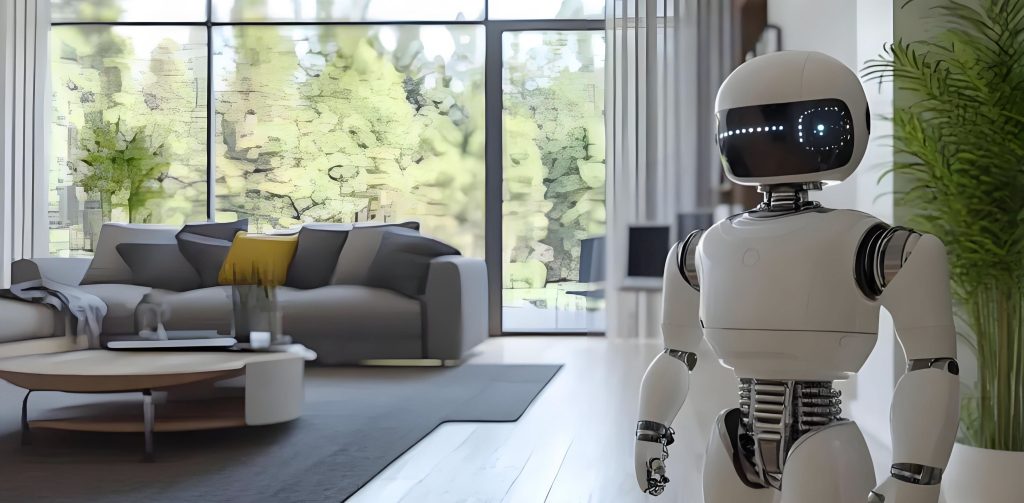
Moving to the design analysis of the participatory child companion robot, we establish clear design objectives. This companion robot is designed for children aged 5-10, offering full-time陪伴 functions. It facilitates parent-child communication, acts as a virtual protagonist for conversations, and embodies participatory design principles integrated with data calculations to enhance user experience. Based on market research of existing child companion robots, we focus on functional, appearance, and experience factors. For functional factors, an innovation is the addition of virtual protagonist角色设置, such as teachers or parents. The companion robot automatically switches systems to serve the child based on the input角色, assuming the role of parents or teachers. The parent-child intercom function allows parents to monitor their child when absent; the child can use voice commands to request a video call, and the companion robot automatically switches to dial the对方 phone, enabling camera转换 and scene switching for environmental awareness. For children of different nationalities, a multi-language translation function is included. For appearance factors, we use a color scheme combining white, gray, blue, and black. The body features an inverted triangular机身 and a cylindrical robot底盘, connected via electromagnetic浮吸力 to maintain an upright posture. The design is both angular and playful, with a机身尺寸 of 70 cm. The body material is ABS+PC plastic, which is impact-resistant, lightweight, and durable. The screen is椭圆形 with a yellow color scheme. For experience factors, the interface uses cartoon-style graphics, predominantly replacing text with images. Control buttons are简洁, and remote control via smartphone is possible. The system updates automatically, and during updates, users can个性化定制 desired functions or buttons, akin to a blind box concept, adding an element of surprise.
We establish an evaluation index system for the participatory child companion robot based on participatory design理念 and user needs. The first-level criteria layer B1-B3 and second-level sub-criteria layer evaluation indicators C1-C11 are established as previously described.
To accurately determine design points, we use a Likert scale to define five evaluation levels \( U = (n_1, n_2, …, n_m) = \{\text{Very Satisfied}, \text{Satisfied}, \text{Moderately Satisfied}, \text{Generally Satisfied}, \text{Dissatisfied}\} \), where Very Satisfied corresponds to scores ≥90, Satisfied 81-90, Moderately Satisfied 70-80, Generally Satisfied 60-70, and Dissatisfied <60. We then invite 25 personnel, including 5 robot researchers, 10 industrial designers, 5 child companion robot manufacturers, and 5 users, to evaluate the participatory child companion robot design scheme and provide scores. The fuzzy evaluation matrix F for each design element under the target layer is established. \( F_1, F_2, F_3 \) represent the fuzzy evaluation matrices for functional, appearance, and experience factors, respectively.
The normalized weight vector for each indicator in the fuzzy comprehensive evaluation is obtained from the AHP results as \( W = \{W_a, W_b, …, W_n\} \). The normalized data is arranged in a matrix, and the evaluation set is defined as \( F = \{f_1, f_2, …, f_n\} \). The fuzzy evaluation matrix F is composed of all design element values calculated using the formula:
$$ F = \begin{bmatrix} f_{11} & f_{12} & \cdots & f_{1m} \\ f_{21} & f_{22} & \cdots & f_{2m} \\ \vdots & \vdots & \ddots & \vdots \\ f_{n1} & f_{n2} & \cdots & f_{nm} \end{bmatrix} $$
Based on the collected evaluations, the fuzzy evaluation matrix for functional factors is:
$$ F_1 = \begin{bmatrix} 0.333 & 0.3996 & 0.1665 & 0.0666 & 0.0333 \\ 0.333 & 0.3996 & 0.1665 & 0.0666 & 0.0333 \\ 0.333 & 0.3996 & 0.1665 & 0.0666 & 0.0333 \end{bmatrix} $$
The fuzzy evaluation matrix for appearance factors is:
$$ F_2 = \begin{bmatrix} 0.1200 & 0.3755 & 0.4351 & 0.0887 & 0.01935 \\ 0.1200 & 0.3755 & 0.4351 & 0.0887 & 0.01935 \\ 0.1200 & 0.3755 & 0.4351 & 0.0887 & 0.01935 \\ 0.1200 & 0.3755 & 0.4351 & 0.0887 & 0.01935 \end{bmatrix} $$
The fuzzy evaluation matrix for experience factors is:
$$ F_3 = \begin{bmatrix} 0.3275 & 0.50377 & 0.17607 & 0.1397 & 0.15645 \\ 0.3275 & 0.50377 & 0.17607 & 0.1397 & 0.15645 \\ 0.3275 & 0.50377 & 0.17607 & 0.1397 & 0.15645 \\ 0.3275 & 0.50377 & 0.17607 & 0.1397 & 0.15645 \end{bmatrix} $$
The integrated weight vector is \( L = \{L_1, L_2, …, L_n\} \), forming the comprehensive fuzzy judgment matrix H. Through calculation, the weights are \( L = (0.16, 0.42, 0.42) \), \( L_1 = (0.333, 0.333, 0.333) \), \( L_2 = (0.387, 0.387, 0.17, 0.056) \), \( L_3 = (0.702, 0.1254, 0.1563, 0.01592) \).
The comprehensive fuzzy judgment matrix is constructed using the formula:
$$ H = L \circ F = \begin{bmatrix} L_1 \circ F_1 \\ L_2 \circ F_2 \\ L_3 \circ F_3 \end{bmatrix} $$
Using the multiplication-bounded operator in fuzzy comprehensive evaluation, we calculate the comprehensive fuzzy evaluation matrix for each indicator element of the scheme. The calculation process for the functional factors \( H_1 \) is exemplified as follows:
$$ H_1 = L_1 \circ F_1 = (0.333, 0.333, 0.333) \circ \begin{bmatrix} 0.333 & 0.3996 & 0.1665 & 0.0666 & 0.0333 \\ 0.333 & 0.3996 & 0.1665 & 0.0666 & 0.0333 \\ 0.333 & 0.3996 & 0.1665 & 0.0666 & 0.0333 \end{bmatrix} = (0.333, 0.3996, 0.1665, 0.0666, 0.0333) $$
Similarly, the comprehensive fuzzy evaluation matrices for appearance and experience factors are:
$$ H_2 = (0.1200, 0.3755, 0.4351, 0.0887, 0.01935) $$
$$ H_3 = (0.3275, 0.50377, 0.17607, 0.1397, 0.15645) $$
The overall comprehensive fuzzy evaluation model is obtained by integrating these matrices. After calculation and normalization, we get \( H = (0.24, 0.29, 0.28, 0.1, 0.09) \). The evaluation conclusion is as follows: for this participatory child companion robot, the proportions for Very Satisfied, Satisfied, Moderately Satisfied, Generally Satisfied, and Dissatisfied are 0.24, 0.29, 0.28, 0.1, and 0.09, respectively. According to the maximum principle, the comprehensive fuzzy evaluation result is 29% for Satisfied, corresponding to scores between 81 and 90. This indicates that the design scheme reflects user needs and addresses the亟待解决 companion robot problem. However, it is not yet at the Very Satisfied level, and the proportions for Dissatisfied and Generally Satisfied are not negligible, suggesting room for improvement.
To make the data more intuitive, we calculate the evaluation value for each factor. The evaluation value for functional factors is:
$$ O_1 = 5 \times 0.333 + 4 \times 0.3996 + 3 \times 0.1665 + 2 \times 0.0666 + 1 \times 0.0333 = 3.9309 $$
The evaluation value for appearance factors is:
$$ O_2 = 5 \times 0.1200 + 4 \times 0.3755 + 3 \times 0.4351 + 2 \times 0.0887 + 1 \times 0.01935 = 3.6041 $$
The evaluation value for experience factors is:
$$ O_3 = 5 \times 0.3275 + 4 \times 0.50377 + 3 \times 0.17607 + 2 \times 0.1397 + 1 \times 0.15645 = 4.6166 $$
The overall评分值 is:
$$ O = 5 \times 0.24 + 4 \times 0.29 + 3 \times 0.28 + 2 \times 0.1 + 1 \times 0.09 = 3.49 $$
Similarly, the sub-criteria layer评分值 are calculated and shown in Table 13.
| Criteria Layer Indicator | Score Value | Sub-criteria Layer Indicator | Score Value |
|---|---|---|---|
| Functional Factors | 3.9309 | Multi-language Translation | 3.52 |
| Appearance Factors | 3.6041 | Parent-Child Intercom | 3.49 |
| Experience Factors | 4.6166 | Virtual Protagonist | 3.38 |
| Body Contour | 3.65 | ||
| Head Shape | 3.98 | ||
| Screen Shape | 3.20 | ||
| Appearance Color | 4.03 | ||
| Operation Ease of Use | 4.23 | ||
| Personalized Customization | 4.66 | ||
| APP Remote Control | 3.18 | ||
| Interface Richness | 3.04 |
From Table 12, we observe that the criteria layer weights for appearance and experience factors are both highest at 0.42. Among the sub-criteria, operation ease of use under experience factors ranks first at 1.122, APP remote control ranks fourth at 0.5763, and personalized customization ranks fifth at 0.5454. For appearance factors, body contour, head shape, and screen shape share the second rank at 0.807, 0.807, and third at 0.59, respectively. Thus, the initial expert scoring highlights experience factors and operation ease of use as top priorities, followed by the companion robot’s appearance, particularly head design and screen novelty. Personalized customization is also important. The fuzzy AHP results from user调研 and expert scoring data show that functional, appearance, and experience factors score 3.9309, 3.6041, and 4.6166, respectively, indicating that experience factors are most crucial. Therefore, the final conclusion is to design with emphasis on user experience factors. For this scheme, experience and functional factors rank top two, with operation ease of use, personalized customization, and appearance color meeting user needs. However, APP remote control and interface richness under experience factors score远低于 user satisfaction, necessitating improvements from perspectives like随时随地的监控, multi-format screen function buttons, and enriched applications. Improvement schemes include installing monitoring chips in every part of the companion robot for 24-hour surveillance to ensure child safety. For multi-format screen function buttons, the operation screen can be designed into different sectors covering all functions, such as dividing the首页 into six sectors for six functions, making operations more intuitive and suitable for children. Enriching applications involves automatic updates of more functional services as the companion robot evolves. Among the subordinate indicators, the results are relatively average, with multi-language translation under functional factors having slightly higher demand, and head shape and appearance color better meeting user aesthetic needs. However, areas like parent-child intercom, virtual protagonist, screen shape, and body contour do not fully meet user needs, leaving room for improvement.
In conclusion, the design of a participatory child companion robot is complex and multi-layered, targeting specific age groups to enhance usability and rationality. The principles of realism, interactivity, and emotionality in participatory design assist researchers in verifying the feasibility of design schemes. We first integrate the Analytic Hierarchy Process with participatory design理念, starting from functional, appearance, and experience factors to establish the criteria layer. Based on this, we细分 specific design elements, refine design steps and main design points, calculate weights for each design element, and form the improved design scheme for the companion robot, ensuring连贯性 and谨慎性. Then, using the Fuzzy Comprehensive Evaluation method with the multiplication-bounded operator, we quantitatively analyze multi-level,模糊 design issues. The integrated use of AHP and FCE allows systematic analysis of users’ direct needs for the companion robot, qualifying design elements and quantifying them through calculation. Through the construction of the comprehensive fuzzy matrix, we直观分析 relatively important design elements and those needing improvement, expressing them systematically and scientifically via quantitative data. This enables the design of a more reasonable participatory child companion robot. Although the qualitative design elements in this study using AHP have some subjectivity, through extensive research, in-depth analysis, and systematic fuzzy operation extraction, we inspire design perspectives for the participatory child companion robot. The companion robot serves as a vital tool in addressing modern parenting challenges, and continued refinement based on user feedback and technological advancements will ensure its effectiveness as a comprehensive companion for children.