
In today’s rapidly aging society, the issue of elderly care, particularly for those living alone, has become increasingly pressing. As urban life accelerates, younger generations often find themselves overwhelmed by work, leaving little time to accompany their aging parents. This has spurred a growing demand for emotional and practical support solutions, with intelligent companion products emerging as a key focus. Among these, companion robots stand out due to their potential for ease of operation, learning, and interaction. In this article, I delve into the design of a companion robot for the elderly, grounded in a deep analysis of user experience. By identifying existing challenges and optimizing design pathways, this work aims to provide a reference for creating more effective and empathetic robotic companions.
User experience (UX) refers to the psychological and emotional feelings users undergo while interacting with a product, whether physical or digital. It encompasses perceptions of the product itself, its services, and its interactive elements. UX is inherently subjective and感性, varying across individuals and contexts. The ultimate goal in UX-driven design is to elicit愉悦感 and satisfaction for each target user, necessitating designs that balance共性 from large-sample studies with个性化 adaptations. Drawing from Donald Norman’s framework, UX can be stratified into three levels: visceral (instinctive reactions), behavioral (usability and performance), and reflective (meaning and personal significance). This hierarchy emphasizes a human-centered approach, where design must prioritize user needs and psychology, ensuring functionality, safety, ease of use, originality, artistry, and趣味性. Applying UX principles to the design of a companion robot for the elderly requires meticulous attention to their physiological and psychological states, aiming to enhance daily life through companionship and support.
To ground our design, we focused on target users aged 55 and above, primarily those living alone due to their children’s work commitments. We conducted extensive research through surveys (separately for elderly individuals and their children) and field interviews. The findings are synthesized below.
| Stakeholder | Key Needs | Percentage/Notes |
|---|---|---|
| Children of Elderly | Health monitoring, real-time alerts, conversational companionship | 73% worried about physical health; 65% noted elderly desire to chat and reminisce |
| Elderly (Physiological) | Easy operation, health tracking, reminder functions | 77% experience presbyopia around age 50; declining memory and learning ability |
| Elderly (Psychological) | Emotional companionship, entertainment, interest cultivation, broadening horizons | 85% of children describe elders as stubborn, often linked to自卑感 and loneliness |
Based on this, we constructed a hierarchical model of user needs. The top level represents the overall need for an elderly companion robot. The second level branches into children’s needs, elderly physiological needs, and elderly psychological needs. Each branch further decomposes into specific sub-needs, such as real-time monitoring,操作方便, and陪伴关怀.
To prioritize these needs, we performed a权重分析 using fuzzy analytic hierarchy process (FAHP). We first built fuzzy complementary judgment matrices for the elements under each parent node. Let the elements be denoted as $a_1, a_2, …, a_n$. The importance relation matrix $E$ is defined as:
$$ E = (e_{ij})_{n \times n} $$
where $e_{ij}$ indicates the relative importance of element $a_i$ over $a_j$. We employed Saaty’s scale for赋值, as shown in the table below.
| Relative Importance | Assigned Value |
|---|---|
| Equally important | 1 |
| Slightly more important | 3 |
| Essentially more important | 5 |
| Strongly more important | 7 |
| Absolutely more important | 9 |
| Intermediate values | 2, 4, 6, 8 |
The matrix satisfies $e_{ij} = 1 / e_{ji}$. For our model, we constructed four such matrices corresponding to different need clusters. To compute fuzzy weights, we first sum each row:
$$ r_i = \sum_{k=1}^{n} e_{ik} \quad \text{for } i = 1, 2, …, n $$
Then, we transform the matrix to achieve consistency via:
$$ e’_{ij} = \frac{r_i – r_j}{2(n-1)} + 0.5 $$
This yields a fuzzy consistent matrix $E’$. Normalizing the rows of $E’$ gives the weight vector $W = [w_1, w_2, …, w_n]^T$, where:
$$ w_i = \frac{\sum_{j=1}^{n} e’_{ij}}{\sum_{i=1}^{n} \sum_{j=1}^{n} e’_{ij}} \quad \text{and} \quad \sum_{i=1}^{n} w_i = 1 $$
After calculations, we obtained local权重 for each need category. The global权重 are computed by multiplying the weight of each element by the weight of its parent node. The排序 results are summarized below, highlighting the most critical needs for the companion robot design.
| Need Category | Global Weight | Priority Rank |
|---|---|---|
| Easy operation | 0.28 | 1 |
| Health monitoring | 0.22 | 2 |
| Emotional companionship | 0.19 | 3 |
| Real-time monitoring | 0.15 | 4 |
| Reminder functions | 0.08 | 5 |
| Information播报 | 0.05 | 6 |
| Interest cultivation | 0.03 | 7 |
Based on this权重排序, we defined the product design concept: to create a companion robot for solitary elders over 55 that is操作简易, provides emotional陪伴关怀, and monitors health. The design specifications are elaborated as follows.
First, intelligent control is paramount. Since many elders struggle with new technology, the companion robot must offer multiple intuitive control methods: voice commands via integrated speech recognition, facial recognition for personalized interaction, and traditional physical buttons as a fallback. This multi-modal approach ensures易用性 even for those with limited tech familiarity.
Second, health monitoring交互设计 is integrated. The companion robot can sync with wearable devices to track vital signs like heart rate and步数, analyze habits, and offer health suggestions. It also maintains a digital medical record for chronic conditions, providing timely reminders for medication or appointments.
Third, emotional陪伴关怀 is woven into the core. The robot’s外观造型 draws from婴儿形象, evoking nurturing instincts and enhancing the elder’s sense of self-worth. It features voice交互 for conversational陪伴 and ambient light feedback that adjusts colors based on the user’s mood, fostering a soothing atmosphere.
Fourth,播报 of news and weather is included. During events like the COVID-19 pandemic, many elders missed critical updates due to limited media access. The companion robot can deliver concise, timely announcements, helping users take preventive measures.
Fifth, reminder functions and danger alerts address健忘. The companion robot can vocalize reminders for tasks like taking medicine or turning off appliances, reducing risks of accidents. It also has built-in fall detection and emergency报警, automatically contacting family or emergency services if needed.
Sixth, real-time interaction with children bridges the distance gap. Through a dedicated app, children can share their schedules, interesting news, or messages via the companion robot. Conversely, elders can dictate notes or requests for the robot to forward, facilitating seamless communication.
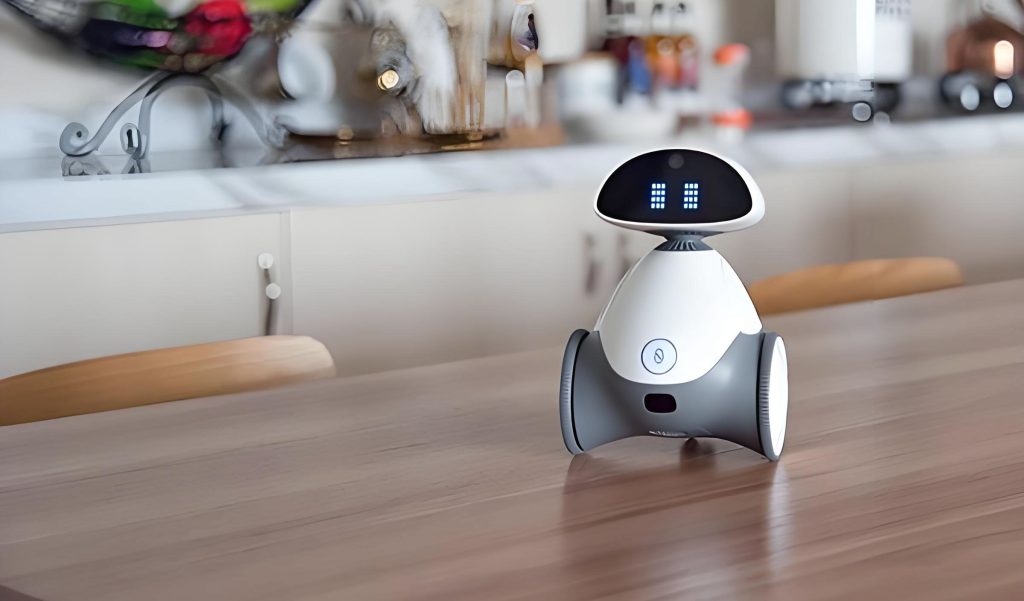
Guided by these concepts, we proceeded to the design实践. The companion robot is intended for日常桌面 use, balancing functionality with aesthetics.
Functionally, we implemented智能语音控制 using existing ASR systems and Bluetooth/IR for device integration. To control costs, we omitted a built-in screen but enabled pairing with smartphones or tablets for visual output. Health monitoring is modular, allowing attachment of第三方 wearables. Reminder and news播报 functions are activated via one-touch buttons, ensuring simplicity.
In造型设计, we avoided humanoid forms that can evoke uncanny valley effects. Instead, we opted for a儿童可爱圆润 silhouette with柔和曲线, making the companion robot approachable. The尺寸 is compact to suit limited living spaces and enhance affordability.
色彩设计 moves beyond stereotypical沉稳 tones. While base colors like灰白色 or米白 provide安全感, we accented with small areas of暖色调 like蓝绿 or orange, adding vibrancy without overwhelming. This palette aims to make the companion robot feel both familiar and engaging.
材料选择 prioritizes warmth and trust. The头部 combines磨砂质感 polyethylene (PE) with金属细节 for a tactile, premium feel. The外壳 uses硅胶 or编织材质 to convey柔和温暖, while minimal metal accents highlight科技感 without sacrificing comfort.
人机交互设计 treats the companion robot as a “大型智能玩具” rather than a human replacement. We tailored interactions to common age-related changes: louder audio for hearing loss, larger fonts for presbyopia, and按键设计 inspired by 1990s electronics to evoke熟悉感. The interface avoids excessive minimalism that could cause误操作, striking a balance between simplicity and clarity. Additionally, we designed a子女端交互界面 for seamless remote engagement.
情感化设计 is infused in two ways. Externally, the可爱娃娃-like appearance triggers nurturing instincts. Operationally, the熟悉原则 incorporates design cues from elders’ youth, such as retro按钮 layouts, fostering emotional connection and easing adoption of this companion robot.
In conclusion, designing an elderly companion robot requires dual consideration of both users (elders) and consumers (their children). Through UX analysis, we identified key needs and weighted them scientifically, leading to a design that emphasizes操作方便, health monitoring, and emotional support. This companion robot not only alleviates loneliness but also promotes mental well-being, potentially aiding in prevention of conditions like Alzheimer’s through cognitive engagement. The integration of familiar交互元素 and empathetic aesthetics helps overcome technological barriers. Ultimately, this UX-centered approach offers a viable pathway for developing companion robots that are both functional and heartfelt, contributing to safer, more fulfilling lives for the elderly. The companion robot thus stands as a testament to how thoughtful design can bridge emotional and practical gaps in elderly care.