
The aging global population presents a profound societal challenge, with an increasing number of older adults experiencing loneliness and social isolation. In this context, the concept of intelligent eldercare has emerged, leveraging information platforms and the Internet of Things to deliver efficient and convenient services. Within this ecosystem, the companion robot has evolved from a speculative concept into a tangible product aimed at enhancing the quality of life for seniors, particularly those living alone or without children. My research focuses on the critical role of emotional design in making these robotic companions not just functional tools, but trusted and empathetic partners. A companion robot that fails to connect on an emotional level risks being perceived as a cold, intimidating machine, ultimately left unused. Therefore, this article synthesizes design theory, technological capabilities, and a deep understanding of elderly users’ needs to explore a framework for emotionally resonant companion robot design.
Foundational Concepts and a Three-Layer Framework
Intelligent eldercare represents a paradigm shift from traditional models, utilizing modern technology to offer diversified solutions that cater to both the physical and, crucially, the psychological well-being of older adults. Service robots within this domain can be broadly categorized. The table below summarizes a functional classification relevant to eldercare:
| Robot Category | Primary Function | Target User Need |
|---|---|---|
| Companion Robot | Provide social interaction, emotional support, and cognitive engagement. | Psychological well-being, alleviating loneliness. |
| Caregiving Robot | Assist with physical tasks (lifting, feeding, mobility). | Physical assistance and safety. |
| Rehabilitation Robot | Guide and monitor physical or cognitive therapy exercises. | Recovery and maintenance of physical/cognitive function. |
My focus is squarely on the first category: the companion robot. Its core mission is to offer emotional and social sustenance to users who may be physically independent but are vulnerable to mental distress due to lack of companionship.
The theoretical bedrock for my analysis is Donald Norman’s three-level model of emotional design. This model provides an excellent scaffold for deconstructing how a companion robot can engage a user.
- Visceral (Instinctive) Level: This concerns the immediate perceptual impact—the look, sound, and feel of the robot. It generates the first, automatic emotional response.
- Behavioral Level: This relates to the experience of use. It encompasses the robot’s functionality, usability, and the fluidity of interaction. Good behavioral design creates a sense of efficacy and pleasure.
- Reflective Level: This is the highest level, involving conscious consideration, intellectualization, and the formation of long-term meaning. It’s where a user builds a relationship with the product, associating it with their self-image and personal values.
The ultimate goal for an elderly companion robot is to successfully engage all three levels, creating a product that is instinctively appealing, effortlessly usable, and reflectively meaningful.
Analyzing Design Excellence Through Norman’s Lens
Examining existing robots through this three-layer filter reveals successful strategies and illuminates the path forward for emotional design.
Visceral-Level Designs: The Power of First Impressions
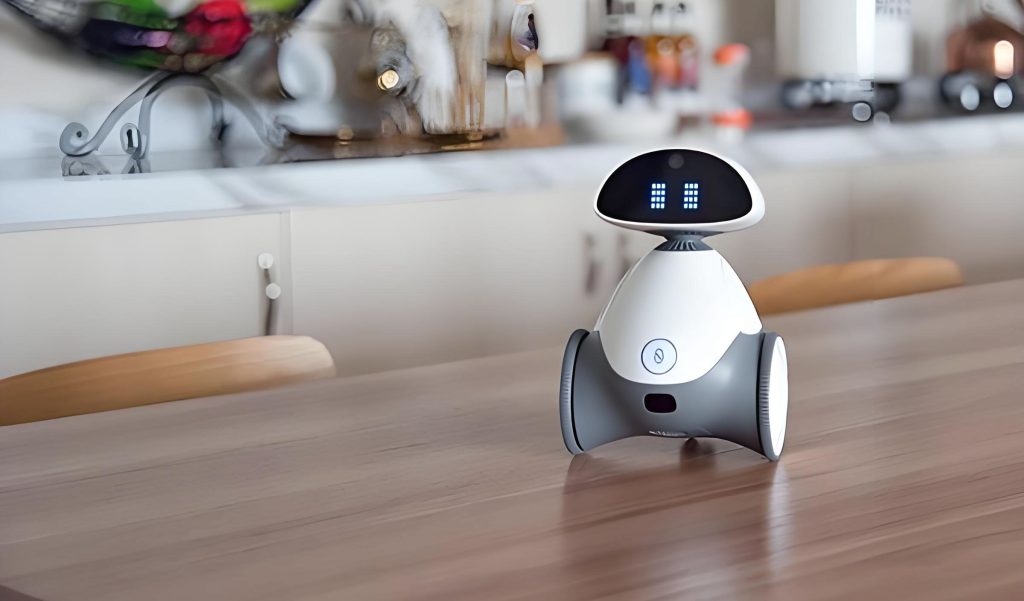
The initial encounter is paramount. Robots like Pepper utilize a humanoid form with gentle, flowing curves, standing at a non-threatening height. This form subconsciously sets expectations for social interaction. Conversely, Paro adopts a biomimetic, non-humanoid approach, embodying a baby seal with soft fur and large, blinking eyes. Its design taps directly into nurturing instincts and perceptions of innocence and warmth. Research supports that a robot’s morphology significantly influences initial perceptions of its trustworthiness and warmth. A well-executed visceral design for a companion robot should signal “friend,” not “appliance.”
Behavioral-Level Designs: Competence and Ease
Once attention is captured, the robot must prove its worth through seamless action. ELLiQ demonstrates this by proactively managing daily routines, offering gentle reminders for medication, and suggesting connections with family. It even provides patient tutorials for new functions. PARLO, deployed in care settings, engages seniors in physical exercises and celebrates birthdays. Crucially, these robots employ multi-modal interactions—voice, touch, and even simple gesture recognition—allowing users to choose the most natural and comfortable communication channel. This flexibility reduces cognitive load and prevents frustration, making the interaction feel like a natural dialogue rather than a technical operation.
Reflective-Level Designs: Building Relationship and Trust
The most profound connection occurs at the reflective level. This is where personality and cultural resonance are key. Some smart assistants are designed with distinct personalities (e.g., based on MBTI frameworks), using vocal tones and response styles that convey life and character. ROLA addressed the reflective level by incorporating regional dialects and accents, making the companion robot feel more familiar and less like a standardized, impersonal technology to users who may not speak perfect standard language. Reflective design requires a deep, empathetic understanding of the user’s life context, values, and latent needs, moving beyond generic functionality to personalized relevance.
Technological Pillars for Emotional Interaction
Emotional design is not merely an artistic endeavor; it is enabled and constrained by technology. For a companion robot to be truly empathetic, it must perceive, interpret, and respond to the user’s state. Several key technologies form the backbone of this capability.
| Technology | Function | Key Design Considerations for the Elderly |
|---|---|---|
| Voice Interaction (ASR, NLP, TTS) |
Enables natural, hands-free communication through speech recognition and synthesis. | Use clear, warm vocal tones (often a trusted female voice). Keep dialogue turns minimal. Employ natural wake words (e.g., “Hello, [Name]”). |
| Emotion Recognition (Facial Expression Recognition – FER) |
Analyzes visual data (static images/video) to infer the user’s emotional state. | System must be robust to varied lighting and postures. Focus on core emotions (joy, sadness, surprise, neutral). Feedback must be appropriate and timely. |
| Multi-Modal Interaction | Integrates inputs from multiple channels (voice, touch, vision, gesture) to create a cohesive and context-aware interaction model. | Provides redundant interaction paths to accommodate different abilities and preferences. Synchronizes modalities to avoid confusion (e.g., voice confirmation of a touch command). |
The integration of these technologies can be conceptualized as a pipeline for emotional responsiveness. A simplified model of this process can be represented as follows:
Let $ U_i $ represent a user input modality (e.g., speech signal, image frame, touch event). Let $ E $ represent the estimated emotional state, and $ R $ represent the robot’s generated response across modalities. The system’s goal is to find the optimal response function $ f $.
$$ E = g(U_1, U_2, …, U_n) $$
$$ R = f(E, C, H) $$
Here, $ g() $ is the multi-modal emotion recognition function that fuses inputs $ U_i $. $ f() $ is the response generation function that considers not only the emotion $ E $ but also the context $ C $ (time of day, location, recent activity) and the interaction history $ H $ to produce a coherent and empathetic response $ R $. This underscores that a true companion robot must move from simple stimulus-response to contextually aware interaction.
A Methodological Framework for Three-Layer Emotional Design
Building on the theoretical framework, case studies, and technological foundations, I propose a structured methodological approach to designing elderly companion robots.
Visceral Layer: Triggering Multidimensional Senses with Kansel Engineering
The goal here is to create an immediately positive sensory impression. Since elderly users may have declining sensory acuity and more ambiguous emotional expressions, a structured approach like Kansel Engineering is invaluable. This method translates subjective user feelings (“Kansel”) into concrete design parameters. The process can be modeled as a mapping from the perceptual space to the design element space.
1. Identify Target Kansel Words: Through interviews and surveys, gather descriptors from elderly users (e.g., “warm,” “friendly,” “safe,” “simple”).
2. Deconstruct Design Elements: Break down the robot’s visceral attributes into variables:
$$ D = \{d_1, d_2, …, d_m\} $$
where $ d_i $ could be curvature radius, color hue (e.g., measured in HSV), material texture coefficient, or interface icon size.
3. Establish Correlation: Using statistical methods (e.g., Semantic Differential, Factor Analysis, Quantification Theory Type I), derive the mathematical relationship between design elements and Kansel impressions.
$$ K_j = \sum_{i=1}^{m} w_{ij} \cdot d_i + \epsilon $$
Here, $ K_j $ is the quantified score for Kansel word $ j $, $ w_{ij} $ is the weight of design element $ i $ on Kansel $ j $, and $ \epsilon $ is an error term.
4. Optimize Design: Use the derived model to configure the set of design elements $ D $ that maximizes positive Kansel scores (e.g., “friendly”) and minimizes negative ones (e.g., “complicated”).
Behavioral Layer: Facilitating Effective Interaction through Empathic Design
The focus shifts to performance and usability. Designers, who are typically not elderly themselves, must overcome a profound empathy gap. The Empathic Design process provides a structured way to “step into the user’s life.” It is a cycle of immersion, connection, detachment, and analysis.
Immersion: Deeply observe and document the daily routines, challenges, and social interactions of elderly users in their own environments.
Connection (Role-Playing): The designer physically simulates the user’s tasks under similar constraints (e.g., wearing glasses that simulate cataracts, gloves that reduce tactile sensitivity) while attempting to use a prototype companion robot. This firsthand experience reveals unarticulated frustrations.
Detachment & Analysis: Step back from the immersive experience to objectively analyze the collected data and role-play insights. Cluster pain points and map them to specific functionalities and interaction flows of the robot. For example, difficulty remembering multi-step voice commands points to a need for simplified dialogue management and clear, progressive feedback. This method ensures the robot’s functions are not just a checklist of features but are deeply aligned with real behavioral patterns and obstacles.
Reflective Layer: Establishing Emotional Bonds with Familiarity Theory
This layer aims to build long-term trust and personal significance. A major barrier for older adults is technophobia—the fear and distrust of complex, unfamiliar systems. Familiarity Theory from cognitive psychology posits that increased familiarity lowers cognitive load and increases positive affect and trust. A companion robot should strategically incorporate familiar elements to feel like a natural part of the user’s world, not an alien intrusion.
| Design Dimension | Familiarity Strategy | Rationale & Example |
|---|---|---|
| Form & Aesthetics | Incorporate traditional, non-threatening forms and organic shapes. | Using rounded corners, warm wood accents, or a form factor reminiscent of a familiar pet or radio reduces perceived technological threat. |
| Interface & Interaction | Mimic well-known interaction paradigms from the physical world. | A “dial” for volume control (tactile or on-screen) is more familiar than a slider. Pressing a large, physical “call” button is more intuitive than navigating a voice menu. |
| Function & Feedback | Anchor new functions in familiar rituals and provide feedback in expected ways. | Instead of “initiating communication protocol,” the robot says, “Shall we call your daughter?” A successful task concludes with a chime similar to a microwave’s, signaling completion. |
| Personality & Content | Align the robot’s communication style and offered content with the user’s cultural and generational context. | Playing music from the user’s youth, using local idioms or humor, and respecting traditional forms of address (Mr., Mrs.) build cultural familiarity and respect. |
The reflective impact of a companion robot designed with such familiarity is profound. It transitions from being a “robot I use” to “my companion,” fostering a sense of security and emotional attachment.
Synthesis and Concluding Perspective
The journey of designing an effective elderly companion robot is a multifaceted challenge that sits at the intersection of gerontology, robotics, interaction design, and cognitive psychology. My analysis, structured through Norman’s three-level model, demonstrates that success cannot be achieved by focusing on technology or aesthetics alone. It requires a holistic, user-centered synthesis.
The visceral layer, powered by methodologies like Kansel Engineering, ensures the robot is instinctively welcoming. The behavioral layer, informed by deep empathic research, guarantees it is useful, usable, and responsive. The reflective layer, strategically employing Familiarity Theory, enables the robot to build lasting trust and integrate meaningfully into the user’s life narrative. Underpinning all of this are enabling technologies—voice interaction, emotion recognition, and multi-modal systems—that must be applied not with technical炫耀, but with thoughtful consideration for the elderly user’s capabilities and preferences.
As intelligent eldercare evolves and the demand for psychological support grows, the companion robot will inevitably become more commonplace. The difference between a device that sits in a corner and a true companion lies in the depth of its emotional design. By rigorously applying the layered framework and methodologies explored here, designers and engineers can create companion robots that do more than perform tasks—they can provide genuine companionship, enrich daily life, and contribute significantly to the mental well-being and happiness of our aging population. The future of eldercare is not just smart; it must be emotionally intelligent.