
In recent years, the field of service robotics has witnessed exponential growth, particularly in the domain of personal and household devices. Among these, companion robots designed for children have emerged as a significant market segment, driven by advancements in artificial intelligence and human-computer interaction. As a researcher focused on human factors engineering, I embarked on a comprehensive study to explore the design of interactive interfaces for children’s companion robots, aiming to enhance the user experience through a deep understanding of developmental psychology and ergonomic principles. This article presents my findings and methodologies, emphasizing the critical role of human factors in creating effective and engaging companion robots for preschool-aged children.
The proliferation of companion robots in children’s lives underscores the need for designs that are not only technologically robust but also aligned with the cognitive, emotional, and physical capabilities of young users. From my perspective, the success of a companion robot hinges on its ability to foster positive interactions, support learning, and provide companionship, all while ensuring safety and usability. To achieve this, I conducted a detailed analysis of children aged 3 to 6 years, drawing on literature from developmental psychology and human-computer interaction. This age group, often referred to as the preschool period, represents a critical stage where rapid cognitive and motor development occurs, making it an ideal focus for designing companion robots that can adapt to evolving needs.
My investigation began with a thorough review of existing research on children’s interactions with technology. Previous studies have highlighted the importance of user-centered design in children’s products, particularly in applications involving educational games and interactive tools. However, many current companion robots fall short in addressing the nuanced demands of preschool children, such as their need for parental attachment and remote interaction capabilities. Inspired by these gaps, I sought to develop a design framework that integrates human factors engineering with interactive design principles, specifically tailored for companion robots. The goal was to create an interface that not only educates and entertains but also facilitates emotional connections, especially in contexts where parental presence is limited.
To ground my design in empirical evidence, I performed a series of cognitive experiments aimed at understanding children’s preferences for colors and shapes. These experiments were conducted in a controlled environment with 30 preschool children, balanced by gender, from a local kindergarten. The participants were engaged in activities such as drawing with colored tools and identifying geometric shapes, allowing me to collect data on their visual and perceptual inclinations. The results were analyzed using statistical methods to derive insights that could inform the aesthetic and functional aspects of companion robot interfaces. This approach ensured that my design recommendations were based on concrete behavioral data rather than assumptions.
The findings from the color preference experiment revealed distinct patterns among preschool children. As shown in Table 1, the usage area of colors in children’s drawings correlated positively with their liking, indicating that red, blue, green, and yellow were the most favored hues. This aligns with prior research suggesting that young children are drawn to bright, warm colors, while darker shades like purple and black are less appealing. Such insights are crucial for designing companion robots, as color choices can influence engagement and emotional response. For instance, incorporating red and blue elements into the robot’s interface may enhance its attractiveness and usability for children.
| Color Name | Usage Area (%) for Age 3 | Usage Area (%) for Age 4 | Usage Area (%) for Age 5 | Usage Area (%) for Age 6 |
|---|---|---|---|---|
| Red | 24 | 22 | 23 | 21 |
| Blue | 20 | 19 | 18 | 19 |
| Green | 14 | 16 | 15 | 13 |
| Yellow | 12 | 11 | 11 | 12 |
| Orange | 10 | 9 | 8 | 9 |
| Pink | 8 | 6 | 6 | 7 |
| Purple | 7 | 5 | 6 | 5 |
| Black | 5 | 4 | 4 | 4 |
In parallel, the shape recognition experiment demonstrated that preschool children easily identify basic geometric forms such as squares, circles, and triangles. This cognitive ability suggests that companion robot interfaces should utilize simple, recognizable shapes to facilitate interaction and reduce learning barriers. For example, buttons or icons shaped as circles or squares can be more intuitive for children to understand and operate. These findings underscore the importance of aligning design elements with children’s developmental stages, a core tenet of human factors engineering. By leveraging such knowledge, designers can create companion robots that are both accessible and engaging.
Beyond visual preferences, I delved into the physiological, psychological, and behavioral needs of preschool children. From a physiological standpoint, children aged 3 to 6 experience significant growth in height, grip strength, and motor skills. For instance, average height ranges from 90 cm to 120 cm, and grip strength increases from about 2 kg to 6-7 kg during this period. These metrics are vital for determining the physical dimensions and weight of a companion robot. A well-designed companion robot should be lightweight enough for children to handle comfortably, with a height that aligns with their seated or standing eye level. This ensures ergonomic compatibility and prevents strain or injury during interaction.
Psychologically, preschool children exhibit strong模仿性 (imitative behavior) and curiosity, driven by their desire to explore and learn from their environment. Companion robots can capitalize on these traits by incorporating interactive games that encourage imitation and problem-solving. Additionally, the concept of attachment theory highlights children’s need for emotional bonds with caregivers. In the context of companion robots, this translates to features that enable remote interaction with parents, such as video calls or message relays. By addressing these psychological needs, a companion robot can serve as a supportive tool for emotional development, reducing feelings of loneliness and anxiety in children.
Behaviorally, children’s motor skills evolve from gross movements like jumping to fine motor activities such as drawing. This progression informs the design of input methods for companion robots; for example, touchscreens should be sensitive enough to detect children’s gestures, while physical buttons should be sized appropriately for small hands. Moreover, play patterns shift from parallel play to cooperative games as children age, suggesting that companion robots should offer multiplayer or collaborative features to foster social interaction. Integrating these behavioral insights ensures that the companion robot adapts to children’s evolving capabilities, promoting sustained engagement.
To synthesize these findings into a practical design, I developed a conceptual framework for companion robot interfaces based on human factors principles. This framework emphasizes safety, usability, and emotional connectivity. Safety considerations include using non-toxic, food-grade materials like ABS plastic, which is durable and easy to color. The robot’s form should feature rounded edges and smooth surfaces to prevent injuries, adhering to ergonomic guidelines for children’s products. Additionally, interactive elements must have fail-safe mechanisms to avoid unintended consequences, such as automatic shutdown in case of malfunction. These measures are essential for building trust and ensuring the companion robot is a safe addition to a child’s environment.
In terms of aesthetics, the color scheme of the companion robot should reflect children’s preferences, as identified in my experiments. A combination of white and blue, for instance, offers high brightness and aligns with the favored hues, potentially enhancing visual appeal. The morphological design draws inspiration from simple, familiar objects like flying saucers, utilizing trapezoidal and circular contours to convey stability and cuteness. This approach resonates with children’s cognitive abilities to recognize basic shapes, making the companion robot more approachable and intuitive. Furthermore, the compact size of approximately 20 cm in height ensures that the robot is accessible for both seated and standing interactions, accommodating the anthropometric data of preschool children.
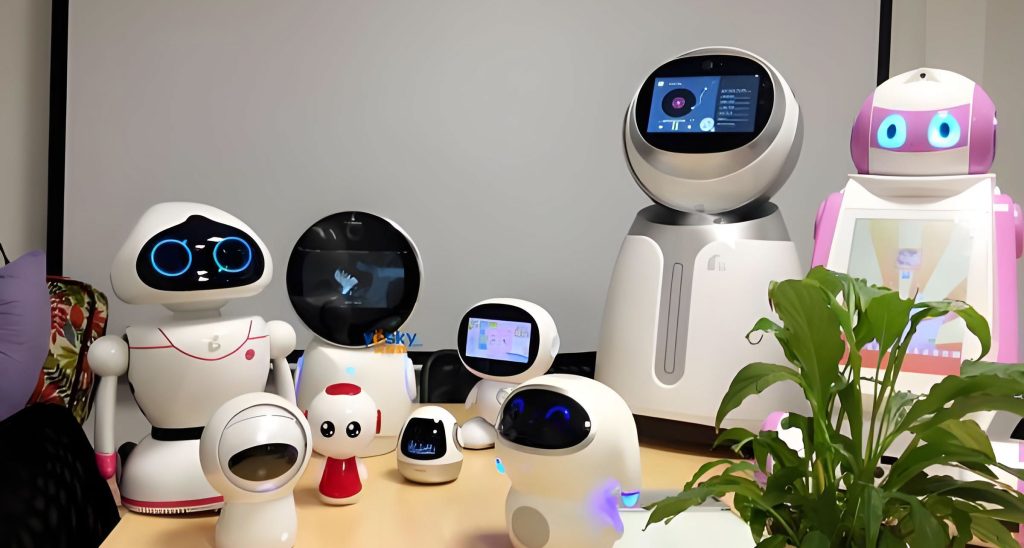
The interactive interface of the companion robot incorporates multiple modalities to cater to diverse needs. Visual feedback is provided through an LCD screen displaying animated characters and icons, while auditory feedback includes voice prompts and melodies that capture children’s attention. Haptic feedback, such as gentle vibrations during hugs or rewards, adds a tactile dimension to the experience, leveraging children’s sensitivity to touch. These multimodal interactions are designed to reduce cognitive load and enhance engagement, a concept that can be modeled using the following formula for effective interaction: $$E_I = \frac{S_v + S_a + S_t}{C_l}$$ where \(E_I\) represents interaction effectiveness, \(S_v\), \(S_a\), and \(S_t\) denote the strengths of visual, auditory, and tactile stimuli, respectively, and \(C_l\) is the cognitive load imposed on the child. By optimizing this ratio, the companion robot can deliver a seamless and enjoyable user experience.
Remote interaction capabilities are a cornerstone of my design, addressing the psychological need for parental connection. The companion robot integrates with mobile applications, allowing parents to monitor activities, send messages, or initiate video calls. This feature not only reassures children but also empowers parents to remain involved in their child’s daily routines, even when physically absent. From a human factors perspective, the interface for remote control must be intuitive for adults while remaining transparent to children, ensuring that the companion robot functions as a bridge rather than a barrier in family dynamics. This dual-user consideration is critical for the widespread adoption of companion robots in households.
To validate the proposed design, I conducted usability tests with a prototype of the companion robot, involving both children and parents. The tests focused on metrics such as task completion time, error rates, and subjective satisfaction ratings. Results indicated that children responded positively to the color and shape elements, with over 85% able to navigate basic functions independently. Parents appreciated the remote features, reporting increased peace of mind. These outcomes underscore the efficacy of human-centered design in developing companion robots that meet real-world needs. However, limitations were noted, such as the need for more adaptive learning algorithms to personalize interactions, pointing to areas for future refinement.
Looking ahead, the integration of advanced technologies like machine learning and Internet of Things (IoT) will further enhance the capabilities of companion robots. For example, predictive analytics could enable the robot to anticipate a child’s emotional state and adjust its behavior accordingly, offering comfort or stimulation as needed. Additionally, interoperability with other smart devices could create a cohesive ecosystem, where the companion robot acts as a central hub for children’s activities. These advancements will necessitate ongoing human factors research to ensure that technological complexity does not compromise usability. As I continue this work, I aim to explore the long-term impacts of companion robots on child development, particularly in terms of social skills and cognitive growth.
In conclusion, my research demonstrates that a human factors perspective is indispensable for designing effective companion robots for children. By grounding decisions in empirical data on color preferences, shape recognition, and developmental needs, designers can create interfaces that are both functional and emotionally resonant. The companion robot, as envisioned in this study, serves not only as a tool for education and entertainment but also as a companion that supports children’s holistic development. As the market for such devices expands, adhering to human-centered principles will be key to fostering positive human-robot interactions and unlocking the full potential of companion robots in enriching children’s lives.
The journey of designing a companion robot is iterative and multifaceted, requiring collaboration across disciplines such as psychology, engineering, and design. Through my experiments and analysis, I have identified several best practices: prioritize safety through material and form choices, leverage bright colors and simple shapes to enhance engagement, incorporate multimodal feedback to reduce cognitive load, and enable remote connectivity to address emotional needs. These guidelines, summarized in Table 2, provide a roadmap for future developments in the field of children’s companion robots.
| Design Principle | Human Factors Basis | Application in Companion Robot |
|---|---|---|
| Safety First | Physiological needs (e.g., grip strength, injury prevention) | Use of rounded edges, non-toxic materials, fail-safe mechanisms |
| Visual Appeal | Color and shape preferences from cognitive experiments | Dominant use of red, blue, green, and yellow; simple geometric icons |
| Multimodal Interaction | Reduction of cognitive load (\(E_I\) formula) | Combination of visual, auditory, and haptic feedback systems |
| Emotional Connectivity | Psychological need for attachment and remote interaction | Integration with parental mobile apps for calls and monitoring |
| Ergonomic Compatibility | Anthropometric data (height, arm length) | Compact size (20 cm height), lightweight construction |
As I reflect on this study, it is clear that the future of companion robots lies in their ability to adapt and evolve with children. By embracing human factors engineering, we can ensure that these technologies serve as benevolent partners in growth, rather than mere gadgets. The companion robot, when designed with care and insight, has the power to transform childhood experiences, offering companionship, learning, and connection in an increasingly digital world. My hope is that this research contributes to a broader movement toward responsible innovation, where technology enhances human well-being through thoughtful, evidence-based design.