
The Planetary Roller Screw Mechanism (PRSM) represents a critical advancement in power transmission systems, renowned for its exceptional load-bearing capacity, high precision, and superior resistance to shock and vibration. Its unique architecture, which involves the synchronous meshing of thread pairs and gear pairs, has cemented its role as a premier actuator in electromechanical servo systems across demanding military and civilian applications. However, this very complexity—the coupled interaction between the threaded engagements and the gear engagement—gives rise to intricate dynamic sliding behaviors that directly impact efficiency, wear, and overall performance. A profound understanding of these sliding characteristics is therefore paramount for the optimal design and reliable operation of the planetary roller screw.
My investigation into the planetary roller screw begins with its fundamental operating principle. The mechanism typically comprises a central screw, a translating nut, multiple planetary rollers, an internal gear ring, and a retainer or carrier.
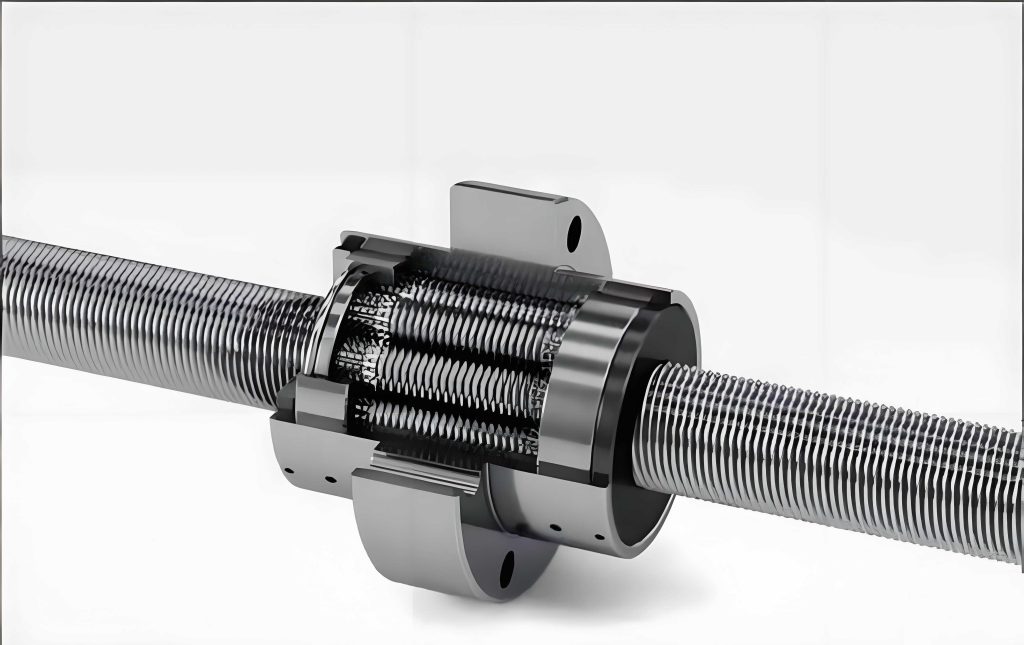
The screw, when rotated, drives the planetary rollers via threaded contact. These rollers, in turn, mesh with the internal threads of the nut, causing its linear translation. Crucially, the rollers also engage with a stationary internal gear ring via spur or helical teeth at their ends. This gear meshing constrains the rollers’ orbit, ensuring proper phasing and preventing relative rotation around the screw axis. The retainer maintains the angular spacing between the rollers. The core kinematic challenge, and the source of sliding, stems from the fact that the roller must satisfy two simultaneous kinematic conditions: one dictated by the thread meshing with the screw and nut, and the other dictated by the gear meshing with the internal ring.
The heart of the sliding phenomenon in a standard planetary roller screw lies in what is known as pitch circle offset. In an ideal, rigid-body scenario, the pitch circle radius of the roller thread ($r_R$) would be identical to the pitch circle radius of the roller gear ($G_R$). However, under operational load, the roller thread is subjected to substantial radial compressive forces from both the screw and the nut. This load-induced elastic deformation causes a radial contraction of the roller thread, effectively making its operational pitch circle smaller than its nominal value. Consequently, a mismatch arises: $r_R < G_R$. This geometric offset is the fundamental driver of relative sliding, particularly in the roller-nut thread interface.
To quantify this sliding, I establish a kinematic model focusing on the “slip angle” ($\theta_{slip}$). Consider the planetary roller screw in operation. When the screw rotates by an angle $\theta_S$, the roller axis undergoes a planetary motion, revolving around the screw axis by an angle $\theta_R$ (revolution) and rotating about its own axis by an angle $\theta_r$ (rotation). The relationship between the roller’s rotation and revolution, governed by the gear mesh, is:
$$\theta_r = \frac{G_N – G_R}{G_R} \theta_R$$
where $G_N$ is the pitch radius of the internal gear ring. Assuming pure rolling at the roller-screw thread interface (a dominant condition), the revolution angle is linked to the screw rotation by:
$$\theta_R = \frac{r_S}{2(r_S + r_R)} \theta_S$$
where $r_S$ is the nominal pitch radius of the screw.
Now, due to the pitch circle offset, the actual rotation of the roller body, as dictated by the gear mesh ($\theta_{GR}$), differs from the rotation it would have if its threads rolled purely on the nut threads ($\theta_{HR}$). The gear-mandated rotation is:
$$\theta_{GR} = \frac{G_R}{G_N – G_R} \theta_r$$
The hypothetical pure-rolling rotation on the nut is:
$$\theta_{HR} = \frac{r_R}{r_N – r_R} \theta_r$$
where $r_N$ is the nominal pitch radius of the nut. The slip angle, representing the relative angular displacement between the roller gear and the roller thread at the nut interface, is the difference:
$$\theta_{slip} = \theta_{GR} – \theta_{HR}$$
Substituting the previous relations, I derive the comprehensive expression for the slip angle in a planetary roller screw:
$$\theta_{slip} = \left(1 – \frac{r_R}{G_R}\right) \frac{r_S G_R}{r_S G_R + r_R G_N} \theta_S$$
This formula elegantly captures how the geometric mismatch ($1 – r_R/G_R$), the screw rotation ($\theta_S$), and the fundamental radii of the planetary roller screw components collectively determine the magnitude of sliding.
To analyze these dynamic effects with greater fidelity, I developed a detailed numerical model. Given the cyclic symmetry of the planetary roller screw, the model was rationally simplified to include one screw, one nut, three equally-spaced planetary rollers (each with five complete threads), an internal ring, and a retainer. This approach captures the essential multi-contact dynamics while ensuring computational efficiency. The material properties and geometric parameters for the thread pairs and gear pairs are summarized below.
| Parameter | Value |
|---|---|
| Screw Pitch Diameter, $d_S$ | 44 mm |
| Number of Screw Thread Starts, $n$ | 6 |
| Thread Pitch, $p$ | 2 mm |
| Lead Angle, $\lambda$ | 4.962° |
| Thread Profile Angle, $\beta$ | 45° |
| Roller Thread Pitch Diameter, $d_R$ | 11 mm |
| Number of Roller Threads | 5 |
| Nut Pitch Diameter, $d_N$ | 66 mm |
| Arc Profile Radius, $\rho_a$ | 7.778 mm |
| Parameter | Roller Gear | Internal Ring Gear |
|---|---|---|
| Module | 0.55 mm | 0.55 mm |
| Number of Teeth | 20 | 120 |
| Pressure Angle | 37.5° | 37.5° |
| Addendum Circle Diameter | 10 mm | 64 mm |
| Dedendum Circle Diameter | 8.73 mm | 65.27 mm |
| Fillet Radius | 0.1 mm | 0.1 mm |
The model’s boundary conditions replicate real operation: a rotary joint on the screw, a translational joint on the nut, fixed connection between the nut and internal ring, revolute joints between rollers and retainer, and a cylindrical joint on the retainer. Axial load is applied to the nut opposing its direction of motion, and rotational speed is applied to the screw.
I first validated the slip angle model. With a constant nut load of 5 kN, simulations were run for screw angular velocities ($\omega_S$) of 10, 20, and 30 rad/s over 0.02 seconds. The pure-roll angle of the roller thread was extracted from the model. Concurrently, the theoretical slip angle was calculated using the derived formula, with $r_R$ and $G_R$ determined from a separate static force analysis accounting for contact deformation. The results show excellent agreement, confirming the accuracy of both the kinematic model and the numerical simulation for the planetary roller screw.
| Screw Speed $\omega_S$ (rad/s) | Numerical Slip Angle $\theta_{slip}$ (°) | Analytical Slip Angle $\theta_{slip}$ (°) | Relative Error |
|---|---|---|---|
| 10 | 0.017 | 0.018 | 5.56% |
| 20 | 0.035 | 0.037 | 5.41% |
| 30 | 0.054 | 0.056 | 3.57% |
With the validated model, I proceeded to analyze the influence of operational parameters on the sliding characteristics of the planetary roller screw. The slip angle’s absolute value increases with screw speed, but a more revealing metric is its proportion to the total gear rotation angle. My analysis shows that as the screw speed increases from 10 to 30 rad/s, the slip angle grows from 0.37% to 0.39% of the roller gear’s rotation. This indicates that higher operational speeds, while increasing throughput, also slightly elevate the relative sliding at the roller-nut interface, which has implications for wear and efficiency.
The effect of load on the planetary roller screw is more pronounced. Under a constant screw speed of 30 rad/s, increasing the nut load from 5 kN to 7 kN causes the slip angle to rise from 0.054° to 0.071°. This is a direct consequence of intensified contact deformation at the thread interfaces. Higher load increases the radial compression on the roller threads, enlarging the pitch circle offset ($r_R$ becomes smaller relative to $G_R$). According to the slip angle formula $\theta_{slip} \propto (1 – r_R/G_R)$, this directly increases sliding. This trend highlights a critical design trade-off: while the planetary roller screw is valued for high load capacity, operating at these extremes exacerbates sliding losses.
To gain a spatially resolved understanding, I examined the sliding distance distribution. Under a load of 5 kN and screw speed of 30 rad/s, the sliding distance on the contact surfaces was extracted. The results are starkly different for the two thread pairs. On the roller-screw side, sliding distance is significant, distributed along the thread helix, with a maximum value near 0.167 mm. The distribution pattern mirrors the load distribution, being highest on the first loaded thread and decreasing for subsequent threads. In contrast, the roller-nut side exhibits much smaller and more uniform sliding, with a maximum around 0.018 mm. This confirms the established understanding that the roller-screw interface is predominantly a sliding contact, while the roller-nut interface is primarily a rolling contact, albeit with a small but non-negligible slip component induced by the gear constraint in the planetary roller screw.
The gear pair in the planetary roller screw also exhibits measurable sliding, which is not purely rolling. The sliding distance is concentrated near the root of the roller gear tooth, particularly on the side closest to the threaded section of the roller, reaching a maximum of about 0.117 mm. This pattern suggests that the mechanical state of the threaded region influences the gear mesh dynamics, likely through load-induced deflections of the roller shaft.
Analyzing the temporal evolution of sliding distance provides further dynamic insight. The curves for both thread pairs and the gear pair show an initial transient with high fluctuation before stabilizing. This transient corresponds to the take-up of initial assembly clearances and the gradual establishment of full contact across multiple teeth and threads. The steady-state mean sliding distance for the roller-screw side (≈0.1698 mm) is an order of magnitude larger than that for the roller-nut side (≈0.0176 mm), while the gear pair sits in between (≈0.117 mm), confirming its mixed rolling-sliding state.
The influence of screw speed on sliding distance is multifaceted. As speed increases from 10 to 30 rad/s (under 5 kN load), the steady-state sliding distance on both the roller-screw and roller-nut sides increases proportionally, reaching 0.1698 mm and 0.0177 mm, respectively. This is expected as a higher input speed translates to a greater cumulative relative displacement over time. Interestingly, for the gear pair, the steady-state sliding distance decreases from 0.149 mm to 0.117 mm with increasing speed. I attribute this to a change in dynamic engagement conditions. Higher rotational frequencies may alter the phasing of contact entry and exit, or modify the effective load distribution due to inertial effects, leading to a reduction in the average sliding distance per cycle in the gear mesh of the planetary roller screw. The higher speed also causes the system to dampen initial clearance oscillations more rapidly, leading to a quicker stabilization of the sliding distance curves.
The effect of increasing nut load (at 30 rad/s) is more uniform across all interfaces in the planetary roller screw. A higher load of 7 kN increases the steady-state sliding distance on the roller-screw side to 0.2043 mm, on the roller-nut side to 0.0193 mm, and on the gear pair to 0.139 mm, compared to the 5 kN case. The larger contact deformation under load not only increases the kinematic slip angle but also amplifies the sliding displacement at every contact point. Furthermore, the initial transient oscillation becomes more severe with higher load due to the greater force impact when taking up clearances, though the system still settles to a steady state faster than under lower load conditions.
In conclusion, my comprehensive analysis of the planetary roller screw mechanism reveals the intricate and coupled nature of its dynamic sliding characteristics. The kinematic model successfully quantifies the slip angle arising from the inevitable pitch circle offset, a fundamental trait of the loaded planetary roller screw. The numerical simulations validate this model and provide a detailed spatial and temporal map of sliding distances. The key findings are that sliding is most severe at the roller-screw thread interface, is non-negligible and load-sensitive at the roller-nut interface, and is present in the gear mesh, linking the dynamics of both systems. Both increased operational speed and load generally exacerbate sliding, though their effects on the gear pair can differ. This work underscores that the design and performance prediction of a high-performance planetary roller screw must explicitly account for the synchronous, interacting sliding behaviors in its thread pairs and gear pairs to optimize efficiency, durability, and precision.