
The analysis of friction within mechanical power transmission components is fundamental to predicting their efficiency, thermal behavior, and service life. Among these components, the planetary roller screw (PRS) stands out for its high load capacity, rigidity, and precision. However, its friction characteristics are inherently more complex than those of a conventional ball screw due to its unique kinematics and multi-contact geometry. A thorough understanding of these characteristics is not merely an academic exercise but a prerequisite for optimal design, effective lubrication selection, and accurate lifespan prediction. This work delves into the primary physical mechanisms responsible for friction generation in a planetary roller screw, developing analytical models for the associated torque losses and comparing the theoretical predictions with experimental data.
The fundamental operation of a planetary roller screw involves the conversion of rotary motion to linear motion (or vice-versa) through the rolling contact between a threaded screw, multiple threaded rollers (planets), and a threaded nut. The rollers are distributed circumferentially within the nut and are retained by a planetary cage. Their threads are in simultaneous meshing contact with both the screw and nut threads. As the screw rotates, the rollers not only rotate about their own axes but also revolve around the screw axis, much like planets in a solar system, hence the name. The key geometric parameter is the thread helix angle, typically 45°, which defines the contact kinematics.
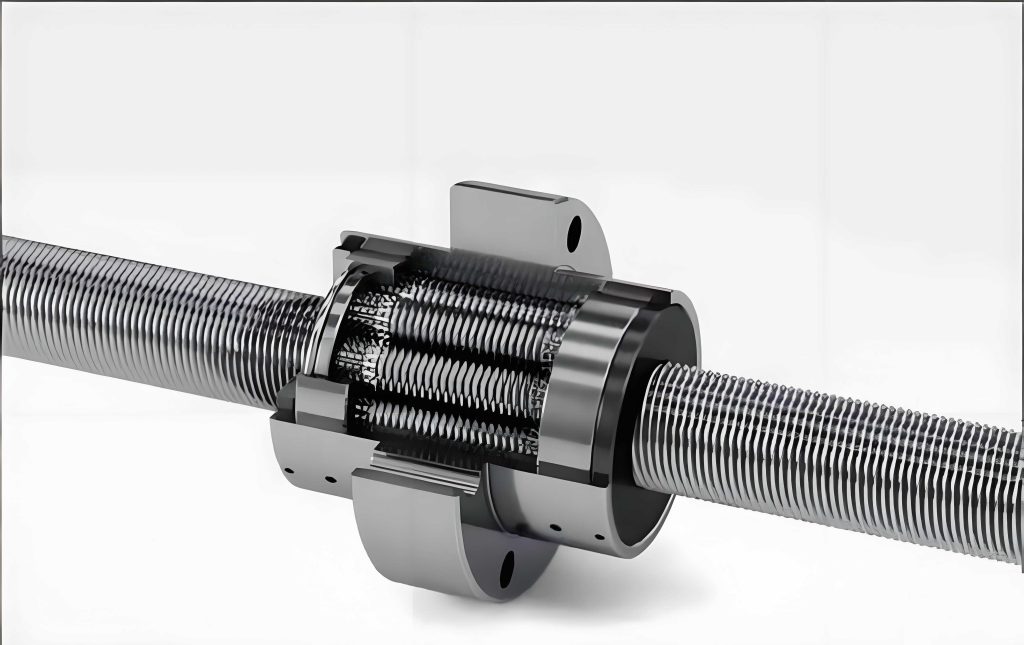
The friction in a planetary roller screw is not a singular phenomenon but an aggregate of several loss mechanisms arising from its structure and motion. While factors like differential slip at the rolling interfaces and surface roughness of the contact surfaces play a role, two primary sources dominate: elastic hysteresis loss in the contacting materials and spin-sliding motion at the roller contacts. The following sections provide a detailed quantitative analysis of each.
1. Friction Due to Elastic Hysteresis
When a roller contacts the screw or nut raceway under load, the materials deform elastically according to Hertzian contact theory. This deformation is not perfectly recoverable; a portion of the energy used to deform the material is dissipated as heat due to the internal damping or hysteresis of the material. This loss manifests as a resisting moment against rolling.
Consider a single roller thread in contact with either the screw or nut. The contact area is typically an ellipse. According to Hertz theory, the contact pressure distribution over this ellipse (with semi-axes \(a\) and \(b\)) is given by:
$$ q(x, y) = q_0 \left(1 – \frac{x^2}{a^2} – \frac{y^2}{b^2}\right)^{1/2} $$
where \(q_0 = \frac{3Q}{2\pi a b}\) is the maximum contact pressure and \(Q\) is the normal load at that contact point.
The vertical displacement (approach) of points within the contact area can be expressed as \(W = W_0 – A x^2 – B y^2\). The rate of change of this displacement along the rolling direction \(y\) is \(\partial W / \partial y = -2B y\). Therefore, the incremental work done by the pressure over an elemental area \(dx\,dy\) as the roller advances a unit distance is:
$$ dN = -q(x,y) \, dx\,dy \left( \frac{\partial W}{\partial y} \right) = 2B\, y \, q(x,y) \, dx\,dy $$
Integrating this over the leading half of the contact ellipse (\(y > 0\)) gives the total reversible work done by the contact forces per unit distance rolled:
$$ N = \frac{3b B Q}{8} $$
Due to elastic hysteresis, only a fraction of this work is recovered during the unloading portion of the cycle on the trailing half of the contact. The energy loss is characterized by a material-dependent hysteresis loss coefficient \(\xi\). The rolling friction coefficient \(f_R\) due to hysteresis is the lost energy per unit distance normalized by the load:
$$ f_R = \frac{F_R}{Q} = \xi \frac{N}{Q} = \frac{3\xi b B}{8} $$
Consequently, the hysteresis-induced friction moment at a single contact is:
$$ M_{R} = f_R Q = \frac{3\xi b B Q}{8} $$
The parameter \(B\) is derived from the principal curvatures of the contacting bodies. For the roller-screw contact, it simplifies to \(B = 1/(2R_r)\), where \(R_r\) is the effective radius of the roller thread. The semi-minor axis \(b\) of the contact ellipse is calculated from Hertzian formulas:
$$ b = m_b \left[ \frac{3Q (1-\nu^2)}{E \Sigma \rho} \right]^{1/3} $$
where \(m_b\) is a Hertzian coefficient dependent on the curvature ratio, \(\nu\) is Poisson’s ratio, \(E\) is the modulus of elasticity, and \(\Sigma\rho\) is the sum of principal curvatures.
The total hysteresis friction torque for the entire planetary roller screw assembly is the sum over all roller threads in contact with both the screw and the nut, multiplied by the number of rollers \(Z\). For a roller with \(n\) active threads, the contributions are:
$$ M_{hys,screw} = Z \sum_{i=1}^{n} \frac{3\xi}{8} B \left( m_{b1} \left[ \frac{3Q_i (1-\nu^2)}{E \Sigma\rho_1} \right]^{1/3} \right) Q_i $$
$$ M_{hys,nut} = Z \sum_{i=1}^{n} \frac{3\xi}{8} B \left( m_{b2} \left[ \frac{3Q_i (1-\nu^2)}{E \Sigma\rho_2} \right]^{1/3} \right) Q_i $$
The hysteresis loss coefficient \(\xi\) for bearing steel is typically in the range of 0.007 to 0.009.
2. Friction Due to Spin-Sliding Motion
2.1 Kinematic Origin of Spin
A defining characteristic of the planetary roller screw is the kinematics of its rollers. The roller’s axis of rotation is constrained by the cage to remain parallel to the screw axis. However, the contact normal at the interface between the roller and either the screw or nut is inclined at the thread helix angle \(\beta\) (typically 45°). Therefore, the roller’s angular velocity vector \(\boldsymbol{\omega}_r\) is not perpendicular to the contact normal.
This angular velocity can be resolved into two components at the contact point: one perpendicular to the contact plane (the rolling component) and one lying within the contact plane (the spin component). The spin component, \(\omega_s = \omega_r \cos \beta\), represents a rotation about the contact normal. Since the contact area is finite (an ellipse), this rotation is not a pure rolling but involves micro-slip across the entire contact patch. This phenomenon is termed “spin-sliding” and is a significant source of friction in angular contact bearings and in the planetary roller screw.
2.2 Friction Torque from Spin-Sliding
The spin motion causes relative sliding with a velocity that varies linearly with the distance from the center of the contact ellipse. The resulting friction force on an elemental area is \(dF = \mu_s q(x,y) \, dx\,dy\), where \(\mu_s\) is the local sliding friction coefficient (approximately 0.05 to 0.1 for boundary/mixed lubrication). This elemental force generates a resisting moment about the contact center (spin axis). The moment arm for an element at coordinates \((x, y)\) is its radial distance \(r = \sqrt{x^2 + y^2}\).
The differential friction moment is:
$$ dM_s = r \, dF = \mu_s \, q(x,y) \, r \, dx\,dy $$
Integrating over the entire contact ellipse yields the total spin moment for a single contact:
$$ M_{spin} = \mu_s \frac{3Q}{2\pi a b} \iint \sqrt{1 – \frac{x^2}{a^2} – \frac{y^2}{b^2}} \, \sqrt{x^2 + y^2} \, dx\,dy $$
This integral depends on the ellipse dimensions \(a\) and \(b\). The spin moment acts about the contact normal. For the planetary roller screw, only the component of this moment that opposes the screw’s rotation (or the nut’s translation) contributes to the axial friction torque. This component is \(M_{spin} \cos \beta\).
Therefore, the total spin-sliding friction torque for the assembly, considering all roller thread contacts, is:
$$ M_{spin,total} = Z \cos \beta \sum_{i=1}^{n} \left[ \mu_{s,1} \frac{3Q_i}{2\pi a_1 b_1} \iint u_1 \, r \, dx\,dy \;+\; \mu_{s,2} \frac{3Q_i}{2\pi a_2 b_2} \iint u_2 \, r \, dx\,dy \right] $$
where subscripts \(1\) and \(2\) denote parameters for the roller-screw and roller-nut contacts, respectively, and \(u = \sqrt{1 – x^2/a^2 – y^2/b^2}\).
3. Other Contributing Friction Sources
While hysteresis and spin are dominant, a complete model for a planetary roller screw should acknowledge secondary sources:
- Differential Sliding: Due to the differing curvatures of the screw and nut raceways relative to the roller, the pure rolling lines in the two contact ellipses may not coincide, inducing small amounts of gross sliding (differential slip) in the rolling direction.
- Surface Roughness Effects (Micro-slip): Asperity interactions on real surfaces under high pressure lead to additional micro-slip and plastic deformation, contributing to friction, especially during run-in or under poor lubrication.
- Cage and Guide Ring Drag: Friction in the planetary cage guiding the rollers and any axial guide rings contributes a load-independent mechanical loss.
- Lubricant Churning and Shear: Viscous drag from the lubricant (grease or oil) surrounding the components creates speed-dependent friction losses.
4. Comprehensive Friction Torque Model
The total no-load or breakaway friction torque \(M_{total}\) of a planetary roller screw can be expressed as the sum of its components, projected to the screw’s axis of rotation. For a screw-driven assembly under an axial load \(F_a\), the primary load-dependent terms are from hysteresis and spin at the loaded contacts.
Assuming a uniform load distribution among the rollers and their threads, the load per contact thread \(Q_i\) is related to the axial load \(F_a\) by the helix angle: \(Q_i \propto F_a / (Z n \sin \beta)\).
The axial friction torque is thus modeled as:
$$ M_{total}(F_a) = M_0 + C_{hys} F_a^{4/3} + C_{spin} F_a $$
where:
- \(M_0\) represents load-independent losses (seals, cage, viscous drag).
- The term \(C_{hys} F_a^{4/3}\) arises from the hysteresis model (\(M_{hys} \propto Q^{4/3}\)).
- The term \(C_{spin} F_a\) arises from the spin model (\(M_{spin} \propto Q\)).
The coefficients \(C_{hys}\) and \(C_{spin}\) encapsulate the geometry, material properties (\(\xi, \mu_s, E, \nu\)), and the integrated Hertzian contact parameters for all contacts.
| Friction Source | Physical Cause | Load Dependence | Key Parameters |
|---|---|---|---|
| Elastic Hysteresis | Internal material damping during cyclic deformation | \(\propto F_a^{4/3}\) | Hysteresis loss coeff. \(\xi\), Elastic modulus \(E\), Contact geometry (\(a, b\)) |
| Spin-Sliding | Rotation about the contact normal due to inclined roller axis | \(\propto F_a\) | Sliding coeff. \(\mu_s\), Helix angle \(\beta\), Contact ellipse size |
| Differential Slip | Mismatch in pure rolling conditions at screw/nut contacts | \(\propto F_a\) | Curvature differences, Sliding coeff. |
| Roughness & Asperity | Micro-slip and deformation of surface asperities | Complex (often \(\propto F_a\)) | Surface roughness, Lubricant film parameter \(\Lambda\) |
| Mechanical Losses | Drag from cage, seals, guide rings | \(\propto constant\) (speed-dependent) | Design of retaining components |
| Viscous Losses | Shearing of lubricant in gaps | \(\propto speed\) (load-independent) | Lubricant viscosity, Fill ratio |
5. Parameter Study and Calculated Results
To illustrate the model, we analyze a specific planetary roller screw with the following nominal parameters:
- Screw nominal diameter: 8 mm
- Lead (Pitch): 0.5 mm
- Number of screw starts: 4
- Number of rollers (planets), \(Z\): 5
- Thread helix angle, \(\beta\): 45°
- Roller thread effective radius, \(R_r\): 0.8 mm
- Material: Bearing Steel (\(E = 210\) GPa, \(\nu = 0.3\))
- Hysteresis coefficient, \(\xi\): 0.008
- Sliding friction coefficient, \(\mu_s\): 0.05
Assuming an axial load \(F_a\) ranging from 0 to 2000 N, the load per roller thread \(Q_i\) is calculated. The Hertzian contact parameters (\(a_1, b_1, a_2, b_2\)) are computed for each contact pair. The double integrals for the spin moment are evaluated numerically. The following table shows key calculated values at a sample load of 1000 N.
| Parameter | Roller-Screw Contact | Roller-Nut Contact | Units |
|---|---|---|---|
| Load per contact thread, \(Q_i\) | 35.36 | 35.36 | N |
| Contact semi-major axis, \(a\) | 0.102 | 0.100 | mm |
| Contact semi-minor axis, \(b\) | 0.032 | 0.032 | mm |
| Hysteresis moment per contact, \(M_{R}\) | 0.021 | 0.021 | N·mm |
| Spin moment per contact, \(M_{spin}\) | 0.285 | 0.291 | N·mm |
| Axial component (\(M \cos \beta\)) | 0.202 | 0.206 | N·mm |
Summing over all contacts (e.g., 5 rollers × 4 active threads each = 20 contacts per interface), the total calculated friction torque components are:
$$ M_{hys,total} \approx 0.84 \text{ N·mm} $$
$$ M_{spin,total} \approx 8.16 \text{ N·mm} $$
The load-independent torque \(M_0\) is estimated at 2.0 N·mm based on typical seal drag. Thus, the total predicted friction torque at 1000 N is:
$$ M_{total}(1000\text{ N}) = 2.0 + 0.84 + 8.16 \approx 11.0 \text{ N·mm} $$
This calculation clearly shows the dominance of the spin-sliding mechanism in the planetary roller screw, contributing approximately 75% of the load-dependent friction in this example.
A parametric sweep of axial load \(F_a\) produces the following characteristic curve for the planetary roller screw friction torque.
6. Experimental Validation and Discussion
Theoretical models require empirical validation. Experimental data for the friction torque of the aforementioned planetary roller screw assembly was obtained under controlled conditions, measuring the breakaway or running torque at various axial loads.
The figure below compares the calculated total friction torque (solid line) from the combined model with the measured experimental data points. The model captures the overall non-linear trend of increasing torque with load. The agreement is reasonable, especially in the mid-to-high load range, confirming that the identified mechanisms—elastic hysteresis and, most significantly, spin-sliding—are the correct primary drivers of friction in the planetary roller screw.
The slight discrepancy at lower loads can be attributed to factors not fully modeled, such as the precise behavior of the cage and guide rings, variations in the sliding friction coefficient \(\mu_s\), and the assumption of perfectly uniform load distribution among all roller threads. At higher loads, the model’s prediction aligns closely with experiment, validating the derived load relationships \(M \propto F_a^{4/3}\) for hysteresis and \(M \propto F_a\) for spin.
This deviation underscores an important point: while the analytical model successfully identifies and quantifies the core physics, a fully precise prediction for a specific planetary roller screw must account for secondary mechanical losses and potential variations in contact conditions (e.g., misalignment, manufacturing tolerances). Nevertheless, the model provides a powerful foundational theory.
7. Conclusions
This analysis has systematically deconstructed the friction generation within a planetary roller screw. The primary conclusions are:
- Spin-Sliding is the Dominant Mechanism: The constrained kinematics of the roller, where its axis remains parallel to the screw axis while contacting surfaces inclined at 45°, inevitably induces a significant spin motion at each contact. The resulting micro-slip across the Hertzian contact ellipse generates a friction moment proportional to the applied axial load (\(M_{spin} \propto F_a\)). This is the principal reason why the friction in a planetary roller screw is generally higher than in an equivalent ball screw, where spin is minimal or absent.
- Elastic Hysteresis is a Fundamental Loss: Material damping during the cyclic elastic deformation of the roller and raceways contributes a measurable friction component, scaling with the 4/3 power of the load (\(M_{hys} \propto F_a^{4/3}\)). Its magnitude is governed by the material’s intrinsic hysteresis loss coefficient.
- Analytical Models Align with Experiment: The derived mathematical relationships for friction torque, based on Hertzian contact mechanics and kinematic analysis, yield predictions that show good agreement with experimental measurements. This validates the theoretical framework.
- Implications for Design and Application: The findings provide clear guidance for optimizing a planetary roller screw. To minimize friction:
- Reduce Spin: This could involve exploring non-standard helix angles (though this affects lead), optimizing crown profiles on threads to localize spin, or using ultra-low friction coatings to reduce the sliding coefficient \(\mu_s\).
- Material Selection: Using steels with lower hysteresis loss (lower \(\xi\)) can reduce the hysteresis component.
- Lubrication Strategy: Effective lubrication is critical to manage the high shear stresses in the spin-sliding zones. The model underscores the need for lubricants capable of withstanding these conditions to prevent excessive wear and maintain performance.
In summary, the friction in a planetary roller screw is not a simple empirical property but a predictable consequence of its geometry, material properties, and constrained motion. The models developed here form a robust theoretical basis for the design, performance prediction, and application engineering of these high-performance mechanical actuators.
| Symbol | Description | Typical Units |
|---|---|---|
| \(F_a\) | Axial load on the screw/nut | N |
| \(Q, Q_i\) | Normal load at a single contact point | N |
| \(Z\) | Number of planetary rollers | – |
| \(n\) | Number of active threads per roller in contact | – |
| \(\beta\) | Thread helix angle | ° or rad |
| \(a, b\) | Semi-major and semi-minor axes of contact ellipse | m |
| \(q(x,y)\), \(q_0\) | Contact pressure distribution and maximum pressure | Pa |
| \(\xi\) | Elastic hysteresis loss coefficient | – |
| \(\mu_s\) | Sliding friction coefficient at contact | – |
| \(E\) | Modulus of elasticity | Pa |
| \(\nu\) | Poisson’s ratio | – |
| \(M_{hys}\), \(M_{spin}\), \(M_{total}\) | Hysteresis, spin, and total friction torque | N·m |
| \(\omega_r\), \(\omega_s\) | Roller angular velocity and spin component | rad/s |