
The transmission of motion and force in a planetary roller screw mechanism occurs through highly stressed, concentrated contacts between the threaded surfaces of its primary components: the screw, the nut, and the planetary rollers. Under typical operating conditions, these contacts are assumed to be purely elastic, governed by classical Hertzian theory. However, in applications involving shock loads, overload scenarios, or extremely high static loads, the material at these contact points may be stressed beyond its yield point, leading to permanent plastic deformation. Understanding this transition from elastic to elastic-plastic contact is crucial for accurately predicting the mechanism’s static load capacity, deformation behavior, and long-term performance. Therefore, this article focuses on establishing a theoretical and numerical framework for analyzing the elastic-plastic contact state within a planetary roller screw mechanism.
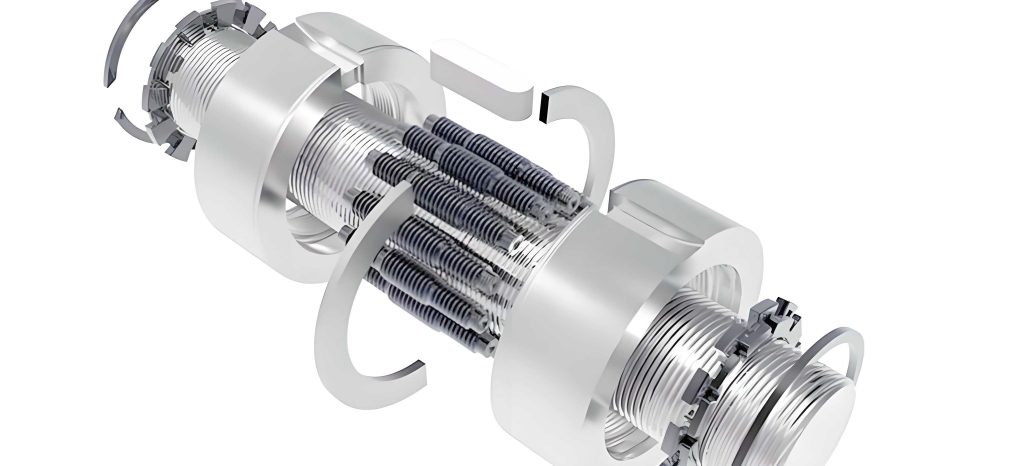
The fundamental operating principle involves the conversion of rotary motion to linear motion, or vice-versa, through the engagement of threads. The rollers, which are the central rolling elements, typically feature a modified thread profile with a spherical contour to promote point contact and improve load distribution. This analysis centers on the most critical contact pair: the interaction between the screw and a single planetary roller. We begin by establishing the theoretical basis for the onset of yielding at this interface.
The analysis of contact stresses in a planetary roller screw mechanism traditionally relies on Hertzian contact theory for elliptical point contacts. For two elastic bodies in point contact, the maximum contact pressure, \(\sigma_{Hmax}\), at the center of the contact ellipse is given by:
$$ \sigma_{Hmax} = \frac{3Q}{2\pi a b} $$
where \(Q\) is the normal contact force, and \(a\) and \(b\) are the semi-major and semi-minor axes of the contact ellipse, respectively. These axes are calculated as:
$$ a = m_a \sqrt[3]{\frac{3Q}{2\Sigma\rho E^*}}, \quad b = m_b \sqrt[3]{\frac{3Q}{2\Sigma\rho E^*}} $$
Here, \(\Sigma\rho\) is the sum of principal curvatures of the contacting bodies, \(E^*\) is the equivalent elastic modulus, and \(m_a\), \(m_b\) are coefficients dependent on the geometry of the contact (related to the curvature difference). The normal approach or elastic deformation, \(\delta_H\), is related to the load by:
$$ \delta_H = K_1 Q^{2/3}, \quad \text{with} \quad K_1 = \frac{2K(e)}{\pi m_a} \sqrt[3]{\frac{9}{32} \frac{1}{(E^*)^2 \Sigma \rho}} $$
where \(K(e)\) is the complete elliptic integral of the first kind.
To determine when the contact in a planetary roller screw transitions from elastic to plastic, a yield criterion must be applied. For ductile materials like the bearing steels commonly used, the Von Mises criterion is appropriate. Yielding initiates beneath the surface at a point where the orthogonal shear stress reaches a critical value. The relationship between the maximum Hertzian contact pressure and the material’s tensile yield strength \(\sigma_s\) is:
$$ \sigma_{Hmax} = \frac{\sigma_s}{\sqrt{3} \cdot k_{st}} $$
where \(k_{st}\) is a coefficient related to the ellipticity ratio \(b/a\) of the contact. For typical contact ellipses in a planetary roller screw, \(k_{st}\) ranges from approximately 0.30 to 0.33. By substituting the expression for \(\sigma_{Hmax}\) from Hertz theory and the expression relating deformation to load, we can solve for the critical normal approach \(\delta’_H\) at which yielding first occurs:
$$ \delta’_H = \frac{K (\pi m_a m_b)^2 \sigma_{max}^2}{2 \Sigma\rho (E^*)^2} $$
where \(\sigma_{max} = \sigma_s / (\sqrt{3} k_{st})\). Consequently, the critical normal load \(Q_s\) on a single thread that causes initial yielding is:
$$ Q_s = \frac{2(\pi m_a m_b)^3}{9\sqrt{3}} \frac{(\Sigma\rho)^2 (E^*)^2}{\left( \frac{\sigma_s}{k_{st}} \right)^3} $$
This load must then be translated into an axial load on the planetary roller screw mechanism. The axial force component from a single engaged thread is \(Q \sin\beta \cos\lambda\), where \(\beta\) is the contact angle and \(\lambda\) is the lead angle. Accounting for the number of engaged threads \(\tau\) on a roller and a load distribution factor \(K_v\) (which accounts for uneven load sharing among threads due to structural deflections), the critical axial load \(F_{asv}\) for a single roller to initiate yield is:
$$ F_{asv} = \frac{\tau \cdot Q_s \sin\beta \cos\lambda}{K_v} $$
For a planetary roller screw with \(z\) rollers, and assuming even load sharing among rollers for this initial estimate, the overall critical axial load would be \(F_{nas} = z \times F_{asv}\). This provides a theoretical basis for judging the onset of plastic deformation in the planetary roller screw assembly.
To proceed with a concrete analysis, we define the parameters for a specific planetary roller screw mechanism model. The geometric parameters are summarized in the table below.
| Component | Major Diameter (mm) | Pitch Diameter (mm) | Minor Diameter (mm) | Pitch (mm) | Number of Starts | Thread Angle |
|---|---|---|---|---|---|---|
| Screw | 49.43 | 48.00 | 45.38 | 5 | 5 | 90° |
| Planetary Roller | 17.60 | 16.00 | 14.00 | 5 | 1 | 90° |
Table 1: Key geometric parameters of the analyzed planetary roller screw mechanism.
The material properties for both the screw and rollers are selected as high-carbon chromium bearing steel (GCr15), common for such high-precision, high-load components.
| Property | Value |
|---|---|
| Elastic Modulus, \(E\) | 2.12 × 10⁵ MPa |
| Poisson’s Ratio, \(\mu\) | 0.29 |
| Tensile Yield Strength, \(\sigma_s\) | 1617 MPa |
Table 2: Material properties for the screw and planetary roller components.
Using these parameters, the principal curvatures at the contact point between the screw and a planetary roller can be calculated. The planetary roller’s spherical thread profile radius \(R\) is derived from its pitch diameter \(d_r\) and contact angle \(\beta\):
$$ R = \frac{d_r}{2\sin\beta} $$
The sum of curvatures \(\Sigma\rho\) and the curvature difference function \(F(\rho)\) are then computed. For the given geometry (\(\beta = 45^\circ\), lead angle \(\lambda \approx 1.9^\circ\)), we find \(\Sigma\rho = 0.2058 \, \text{mm}^{-1}\) and \(F(\rho) = 0.1412\). From standard Hertzian tables, this yields coefficients \(m_a = 1.09886\), \(m_b = 0.09091\), and \(2K(e)/(\pi m_a) = 0.99037\). The ellipticity ratio is \(b/a = m_b/m_a = 0.0827\), leading to a stress coefficient \(k_{st} \approx 0.328\). Assuming a load distribution factor \(K_v = 1.8\) for the first engaging thread on the screw side, the theoretical critical axial load for a single roller is calculated as \(F_{asv} \approx 1498 \, \text{N}\), with a corresponding maximum Hertzian contact stress of approximately 2346 MPa.
While the theoretical analysis provides a closed-form criterion for yield initiation, it cannot capture the progression of plastic deformation, stress redistribution, or the behavior under larger overloads. For this, a Finite Element Analysis (FEA) model is developed. To reduce computational cost while maintaining accuracy, a sector model containing five engaged threads of both the screw and a single planetary roller is constructed. The model is meshed with hexahedral elements (C3D8R in Abaqus), with significant refinement in the contact regions to resolve the high stress gradients.
The material model is crucial for elastic-plastic analysis. The GCr15 steel is modeled as an elastic, linearly plastic material with isotropic hardening. The plastic behavior beyond the yield point is defined by a true stress vs. plastic strain curve. Boundary conditions are applied to simulate a realistic load case: symmetric constraints on the sides of the sector model, a fixed constraint on one end of the screw segment, and an axial force applied to one end of the planetary roller segment. The contact between the roller threads (master surface) and screw threads (slave surface) is defined as frictionless for the initial analysis. The FEA model allows us to investigate the state of stress, strain, and deformation beyond the theoretical yield point.
The finite element model was used to identify the critical load for initial yielding. Through iterative analysis, it was found that the planetary roller exhibits a non-zero equivalent plastic strain (PEEQ) at an axial load of approximately 1475 N, while the screw remains purely elastic until about 1515 N. This confirms that in this configuration, the planetary roller is the weaker component and yields first. The contact stress at this load from FEA is around 2370-2429 MPa for the roller and screw sides, respectively, showing excellent agreement (within ~3.6%) with the theoretical Hertzian prediction of 2346 MPa. This validates the theoretical yield criterion for the planetary roller screw mechanism at the point of yield initiation.
The primary advantage of the FEA model is its ability to simulate behavior well into the plastic regime. A series of analyses were conducted with axial loads ranging from 1000 N to 10,000 N. The results for maximum contact pressure are plotted against the theoretical Hertzian elastic solution.
| Axial Load (N) | FEA Contact Stress (MPa) | Hertz Theory (MPa) | Error |
|---|---|---|---|
| 1500 | ~2400 | 2346 | < 3% |
| 3000 | ~3020 | 2960 | ~2% |
| 4500 | ~3450 | 3390 | ~1.8% |
| 6000 | ~3650 | 3760 | ~ -3% |
| 8000 | ~3850 | 4140 | ~ -7% |
Table 3: Comparison of contact stress from FEA and Hertzian theory at various loads.
The data shows that for loads up to about 4500 N, the Hertzian theory remains remarkably accurate despite the presence of small-scale plasticity. Beyond this point, the FEA-predicted contact stress increases at a slower rate than the elastic theory predicts, as plastic deformation begins to significantly enlarge the contact area, thereby reducing the pressure. This indicates that for moderate overloads where plasticity is contained, simplified elastic analysis can still be useful, but for severe overloads, a full elastic-plastic analysis is necessary.
The evolution of plastic deformation with increasing load reveals important insights into the failure progression of the planetary roller screw mechanism. At lower overloads (e.g., 4500 N), the plastic deformation is confined to the first engaged thread of the planetary roller and is minimal in the screw. As the load increases to around 7000 N, an interesting phenomenon occurs: the maximum plastic strain on the roller shifts from the first thread to the second thread. This suggests that after significant yielding, the first thread may experience some load shedding or geometric compromise, transferring additional load to the subsequent thread. The screw’s maximum plastic strain, however, remains on the first thread. This uneven progression of plasticity can affect the load distribution across threads and ultimately the mechanism’s functional integrity.
A key concept in bearing design is the “static load rating” (\(C_0\)), defined as the load that produces a certain permissible level of permanent deformation. For ball and roller bearings, this is often set at a deformation of 0.0001 times the rolling element diameter. Applying this concept to the planetary roller screw mechanism, we can analyze the load required to cause a specific plastic deformation in the roller. For the studied mechanism with 12 rollers, the catalog static load rating is 224.2 kN, implying a load of approximately 18.68 kN per roller. The FEA model predicts that this load results in a maximum plastic deformation of about 3.15 μm on the roller. Given the roller pitch diameter of 16 mm, this deformation is roughly 0.000197 of the diameter, which is remarkably close to the 0.0001 factor used in standard bearing theory.
This correlation provides a valuable theoretical basis for defining and estimating the static load capacity of a planetary roller screw mechanism. It suggests that a permissible plastic deformation limit on the order of one ten-thousandth of the planetary roller’s diameter can be a rational criterion for establishing the rated static load. When designing a non-standard planetary roller screw mechanism, engineers can use elastic-plastic finite element analysis to determine the axial load that causes this level of deformation, thereby deriving a reliable estimate of its static load-carrying capacity.
In summary, the elastic-plastic contact analysis of planetary roller screw mechanisms demonstrates that the planetary roller typically yields before the screw. The theoretical Hertzian formulas remain reasonably accurate for predicting contact stresses even in the presence of small-scale plasticity, up to a certain load limit. The progression of plastic deformation under increasing load reveals a potential shift in the most critically stressed thread on the roller. Most importantly, linking the analysis to the concept of static load rating provides a practical design guideline: the rated static load for a planetary roller screw mechanism can be associated with an allowable plastic deformation in the roller approximately equal to 0.0001 times its diameter. This integrated theoretical and numerical approach offers a solid foundation for assessing the overload performance and establishing safety factors for these complex and highly loaded mechanical actuators.