
In the field of precision motion conversion, the planetary roller screw mechanism represents a pivotal technology due to its exceptional load capacity, longevity, and accuracy. My investigation focuses on elucidating the fundamental stress cycle behaviors exhibited by the critical components—the screw, nut, and rollers—through a detailed kinematic analysis. The transmission of motion and force within a planetary roller screw is accomplished via the planetary movement of multiple rollers and the meshing of their intricate helical surfaces. Understanding the kinematic relationships is not merely an academic exercise; it is the cornerstone for predicting fatigue life, optimizing design, and ensuring reliability in demanding applications such as aerospace actuators, precision machine tools, and robotic systems. This article presents a comprehensive, first-principles kinematic model derived from the parametric descriptions of the helical surfaces, leading directly to the characterization of contact point trajectories and, ultimately, the cyclic stress patterns governing component durability.
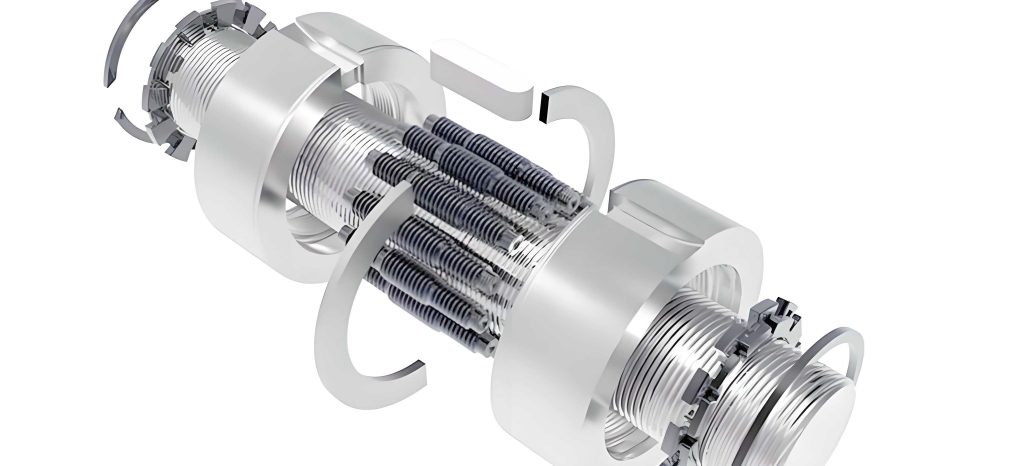
To construct a rigorous kinematic model of the planetary roller screw, one must first establish a mathematical representation of the helical surfaces for all three primary contacting bodies. I define a fixed Cartesian coordinate system O-xyz, where the z-axis aligns with the central axis of the assembly. The helical surface for any component can be generated by sweeping a defined thread profile along a helical path. For a general point Q on such a surface, its position can be parameterized by the radial distance \(r\) and the angular coordinate \(\alpha\). The axial position incorporates the thread profile function \(\phi(r)\) and the lead \(l\). The parametric vector equation for a helical surface is thus:
$$
\boldsymbol{\psi}(r, \alpha) = \left[ r \cos\alpha,\ r \sin\alpha,\ \zeta \phi(r) + \frac{\alpha l}{2\pi} \right]^T
$$
Here, \(\zeta\) is a Boolean variable distinguishing the two flanks of the thread: \(\zeta = +1\) for the lower contact surface and \(\zeta = -1\) for the upper contact surface. The unit normal vector \(\mathbf{n}\) at any point on the surface, crucial for contact analysis, is given by:
$$
\mathbf{n} = \zeta \frac{ \boldsymbol{\psi}_r \times \boldsymbol{\psi}_\alpha }{ \| \boldsymbol{\psi}_r \times \boldsymbol{\psi}_\alpha \| }
$$
with partial derivatives \(\boldsymbol{\psi}_r = \partial \boldsymbol{\psi} / \partial r\) and \(\boldsymbol{\psi}_\alpha = \partial \boldsymbol{\psi} / \partial \alpha\). Applying this framework specifically to the screw, nut, and roller yields their unique surface equations. For the screw, which is a multi-start external thread with a trapezoidal profile, the profile function \(\phi_S(r_S)\) depends on its pitch \(P_S\), half-angle \(\beta_S\), and nominal mid-diameter \(d_{S0}\). The resulting unit normal vector for the screw surface is:
$$
\mathbf{n}_S = \zeta_S \begin{bmatrix}
\displaystyle \frac{l_S \sin\alpha_S}{2\pi r_S} – \zeta_S \cos\alpha_S \tan\beta_S \\[10pt]
\displaystyle -\frac{l_S \cos\alpha_S}{2\pi r_S} – \zeta_S \sin\alpha_S \tan\beta_S \\[10pt]
1
\end{bmatrix} \cdot \left[ 1 + \left( \frac{l_S}{2\pi r_S} \right)^2 + \tan^2 \beta_S \right]^{-1/2}
$$
where \(l_S = n_S P_S\) is the screw lead and \(n_S\) is the number of thread starts. The nut, an internal multi-start thread, has a complementary trapezoidal profile. Its profile function \(\phi_N(r_N)\) and unit normal \(\mathbf{n}_N\) are derived similarly, with its lead being \(l_N = n_N P_N\). The roller, typically a single-start thread with a circular (arc) profile to minimize friction, has a distinct profile function \(\phi_R(r_R)\) involving the arc radius \(R_e = d_{R0}/(2\sin\beta_R)\). Its unit normal vector is:
$$
\mathbf{n}_R = \zeta_R \begin{bmatrix}
\displaystyle \frac{l_R \sin\alpha_R}{2\pi r_R} – \frac{\zeta_R \cos\alpha_R \cdot r_R}{\sqrt{R_e^2 – r_R^2}} \\[10pt]
\displaystyle -\frac{l_R \cos\alpha_R}{2\pi r_R} – \frac{\zeta_R \sin\alpha_R \cdot r_R}{\sqrt{R_e^2 – r_R^2}} \\[10pt]
1
\end{bmatrix} \cdot \left[ 1 + \left( \frac{l_R}{2\pi r_R} \right)^2 + \frac{r_R^2}{R_e^2 – r_R^2} \right]^{-1/2}
$$
With the surfaces defined, I proceed to establish the kinematic model of the entire planetary roller screw assembly. I consider the fixed coordinate system O-xyz to be coincident with the nut’s frame. The screw rotates about its axis with angular velocity \(\omega_S\) without axial translation. The nut translates axially with velocity \(v_{Nz}\) but does not rotate. Each roller undergoes a complex spatial motion: it rotates about its own axis (spin) with angular velocity \(\omega_R\) and simultaneously revolves around the screw axis (orbit) with angular velocity \(\omega_H\), all while translating axially in sync with the nut. The position of any point on a roller is a combination of its relative motion in a frame attached to the roller’s center and the牵连 motion of that center. After time \(t\), with rotation angles \(\theta_S = \omega_S t\), \(\theta_R = \omega_R t\), and \(\theta_H = \omega_H t\), the absolute position \(\mathbf{r}^o_R\) and velocity \(\mathbf{v}^o_R\) of a point on a roller (with coordinates \((r_R, \alpha_R)\) in its local frame) in the fixed system are:
$$
\begin{aligned}
\mathbf{r}^o_R &= \begin{bmatrix}
r_R \cos(\alpha_R – \theta_R) + r_H \cos\theta_H \\
r_R \sin(\alpha_R – \theta_R) + r_H \sin\theta_H \\
\zeta \phi_R(r_R) + \dfrac{\alpha_R l_R}{2\pi} – \dfrac{\theta_S l_S}{2\pi}
\end{bmatrix}, \\[15pt]
\mathbf{v}^o_R &= \begin{bmatrix}
r_R \omega_R \sin(\alpha_R – \theta_R) – r_{RH} \omega_H \sin(\theta_H + \alpha_{RH}) \\
-r_R \omega_R \cos(\alpha_R – \theta_R) + r_{RH} \omega_H \cos(\theta_H + \alpha_{RH}) \\
-\omega_S l_S / (2\pi)
\end{bmatrix}.
\end{aligned}
$$
In these equations, \(r_H = (d_{S0}+d_{R0})/2\) is the orbital radius, and \(r_{RH}\) and \(\alpha_{RH}\) are the polar coordinates of the roller point’s projection relative to the screw axis, derivable from geometric relations. The absolute velocities for points on the screw and nut are simpler: \(\mathbf{v}^o_S = [-r_S \omega_S \sin(\alpha_S+\theta_S),\ r_S \omega_S \cos(\alpha_S+\theta_S),\ 0]^T\) and \(\mathbf{v}^o_N = [0,\ 0,\ -\omega_S l_S/(2\pi)]^T\).
The core of the kinematic analysis for the planetary roller screw lies in determining the precise locations of contact points between the screw-roller and nut-roller interfaces and analyzing their relative motions. Contact occurs where the surfaces touch tangentially. For the screw-roller pair, the condition of continuous tangency requires that at the contact point, the unit normals are collinear but opposite: \(\mathbf{n}_{Sc} = -\mathbf{n}_{RSc}\). This, combined with the geometric constraint that the contact points on the two bodies are coincident in space, yields a system of equations. Let \((r_{Sc}, \alpha_{Sc})\) and \((r_{RSc}, -\alpha_{RSc})\) be the parameters for the contact point on the screw and roller (relative to its own frame), respectively. The geometric constraints are:
$$
\begin{aligned}
r_{Sc} \sin\alpha_{Sc} &= r_{RSc} \sin\alpha_{RSc}, \\
r_{Sc} \cos\alpha_{Sc} + r_{RSc} \cos\alpha_{RSc} &= \frac{d_{S0} + d_{R0}}{2}.
\end{aligned}
$$
The collinearity condition \(\mathbf{n}_{Sc} = -\mathbf{n}_{RSc}\) provides two additional scalar equations derived from the components of the normal vectors. Solving this system numerically for a given planetary roller screw geometry determines the contact radii and angles. A similar set of equations governs the nut-roller contact point \((r_{Nc}, \alpha_{Nc})\) and \((r_{RNc}, \alpha_{RNc})\):
$$
\begin{aligned}
r_{Nc} \sin\alpha_{Nc} &= r_{RNc} \sin\alpha_{RNc}, \\
r_{Nc} \cos\alpha_{Nc} – r_{RNc} \cos\alpha_{RNc} &= \frac{d_{N0} – d_{R0}}{2},
\end{aligned}
$$
along with \(\mathbf{n}_{Nc} = -\mathbf{n}_{RNc}\). The solution reveals a key insight: while the screw-roller contact occurs at a point with a non-zero contact angle \((\alpha_{Sc} \neq 0)\), the nut-roller contact point lies precisely on the line connecting their axes \((\alpha_{Nc} = 0, \alpha_{RNc} = 0)\). This nut-roller contact point is, in fact, the instantaneous center of velocity (instant center) for that pair, meaning the relative velocity at that point is zero.
To derive the fundamental kinematic relations for the planetary roller screw, I analyze the velocity compatibility at the contact points. At the screw-roller contact, the normal components of velocity must be equal to maintain continuous contact. This condition, \(\mathbf{n}_{Sc} \cdot \mathbf{v}_{Sc} + \mathbf{n}_{RSc} \cdot \mathbf{v}_{RSc} = 0\), after considerable algebraic manipulation involving the contact point parameters and velocity expressions, yields:
$$
\frac{\omega_R}{\omega_H} = \frac{l_S}{l_R}.
$$
Applying the same normal velocity compatibility condition at the nut-roller contact point gives:
$$
\frac{\omega_R}{\omega_H} = \frac{l_N}{l_R}.
$$
Furthermore, the instant center condition at the nut-roller interface directly provides another relation from its planar kinematics: \(\omega_R / \omega_H = d_{N0} / d_{R0}\). Combining these with the basic kinematic relation between the screw’s rotational speed and the orbital speed of the rollers, \(\omega_H = \omega_S d_{S0} / [2(d_{S0}+d_{R0})]\), allows us to consolidate all geometric and kinematic parameters. Defining the ratio \(k_\omega = d_{N0} / d_{R0}\), the complete set of design relations for a functional planetary roller screw mechanism is:
| Relation | Equation |
|---|---|
| Orbital to Screw Speed Ratio | $$\omega_H = \dfrac{\omega_S (k_\omega – 2)}{2(k_\omega – 1)}$$ |
| Roller Spin to Screw Speed Ratio | $$\omega_R = \dfrac{\omega_S k_\omega (k_\omega – 2)}{2(k_\omega – 1)}$$ |
| Key Geometric Ratio | $$k_\omega = \dfrac{\omega_R}{\omega_H} = \dfrac{l_S}{l_R} = \dfrac{l_N}{l_R} = \dfrac{d_{N0}}{d_{R0}}$$ |
| Screw Mid-Diameter | $$d_{S0} = (k_\omega – 2) d_{R0}$$ |
These equations are paramount. They dictate that for a meshing planetary roller screw, the leads (or pitches) and diameters cannot be chosen independently; they must satisfy these ratios to ensure proper kinematic function and avoid interference or backlash. To illustrate with concrete numbers, consider a planetary roller screw with the following parameters, which I will use for all subsequent trajectory and stress cycle calculations:
| Component | Parameter | Symbol | Value |
|---|---|---|---|
| Screw | Major Diameter | \(d_{S1}\) | 49.43 mm |
| Mid Diameter | \(d_{S0}\) | 48.00 mm | |
| Minor Diameter | \(d_{S2}\) | 45.38 mm | |
| Pitch | \(P_S\) | 5 mm | |
| Number of Starts | \(n_S\) | 5 | |
| Half Angle | \(\beta_S\) | 45° | |
| Nut | Major Diameter | \(d_{N1}\) | 82.62 mm |
| Mid Diameter | \(d_{N0}\) | 80.00 mm | |
| Minor Diameter | \(d_{N2}\) | 78.57 mm | |
| Pitch | \(P_N\) | 5 mm | |
| Number of Starts | \(n_N\) | 5 | |
| Half Angle | \(\beta_N\) | 45° | |
| Roller | Major Diameter | \(d_{R1}\) | 17.60 mm |
| Mid Diameter | \(d_{R0}\) | 16.00 mm | |
| Minor Diameter | \(d_{R2}\) | 14.00 mm | |
| Pitch | \(P_R\) | 5 mm | |
| Number of Starts | \(n_R\) | 1 | |
| Half Angle | \(\beta_R\) | 45° |
For this design, \(k_\omega = d_{N0}/d_{R0} = 80/16 = 5\). If the screw input speed is set to \(\omega_S = 5\ \text{rad/s}\), the derived speeds are \(\omega_H \approx 1.875\ \text{rad/s}\) and \(\omega_R \approx 9.375\ \text{rad/s}\). Solving the contact point equations for this geometry at time \(t=0\) yields the following specific locations:
| Contact Interface | Component | Contact Radius (mm) | Contact Angle (°) | Relative Velocity at Point (mm/s) |
|---|---|---|---|---|
| Screw-Roller | Screw | \(r_{Sc} = 24.17\) | \(\alpha_{Sc} = -3.67\) | \(\mathbf{v}_{SR} = [-159.94, -698.68, -62.5]^T\) |
| Roller | \(r_{RSc} = 8.03\) | \(\alpha_{RSc} = -11.29\) | ||
| Nut-Roller | Nut | \(r_{Nc} = 40.00\) | \(\alpha_{Nc} = 0\) | \(\mathbf{v}_{NR} = [0, 0, 0]^T\) (Instant Center) |
| Roller | \(r_{RNc} = 8.00\) | \(\alpha_{RNc} = 0\) |
The results confirm the theoretical predictions: the screw-roller contact point has a finite contact angle and a significant relative sliding velocity, while the nut-roller contact point is on the centerline and has zero relative velocity, acting as a pure rolling interface in the plane perpendicular to the axis.
By substituting the contact point parameters into the absolute motion equations, I can simulate the spatial trajectories of these specific points over time. This exercise is crucial for visualizing the motion and, more importantly, for understanding the loading history on the thread flanks. The trajectory of a point on the screw that is in contact is a simple circle in a plane perpendicular to the axis, as the screw only rotates. A point on the nut in contact moves along a straight line parallel to the axis. The trajectory of a specific point on a roller’s thread that contacts the nut, however, is a complex, three-dimensional space curve. This curve is periodic with the roller’s orbital period \(T_H = 2\pi/\omega_H\). Remarkably, within one orbital period \(T_H\), the roller completes exactly \(k_\omega = 5\) full rotations about its own axis (since \(\omega_R/\omega_H = k_\omega\)). Each spin period \(T_R = 2\pi/\omega_R\) has a distinct shape, and the axial advance per spin \(\Delta z_R\) and per orbit \(\Delta z_H\) are constant for a given geometry:
$$
\Delta z_R = \frac{\omega_S l_S}{\omega_R} = \frac{2\pi (k_\omega – 1) l_S}{k_\omega (k_\omega – 2) \omega_S} \cdot \omega_S = \frac{2\pi (k_\omega – 1) l_S}{k_\omega (k_\omega – 2)}, \quad \Delta z_H = k_\omega \cdot \Delta z_R.
$$
For our example with \(l_S = n_S P_S = 25\ \text{mm}\), we get \(\Delta z_R \approx 8.38\ \text{mm}\) and \(\Delta z_H \approx 41.89\ \text{mm}\). The trajectory shows that a specific point on the roller re-establishes contact with the nut not after every full rotation, but after an angular advance of \(\theta_c = 2\pi/(k_\omega + 1)\) in its orbit. This means the loading on a fixed point on the roller is not continuous but intermittent with a regular period.
This kinematic periodicity directly dictates the stress cycle behavior, which is the ultimate focus of my analysis. Assuming the planetary roller screw is under a constant operational load \(F\), the contact stresses at the interfaces (calculated via Hertzian theory, which is beyond the detailed scope here but follows from the contact geometry and load) will exhibit characteristic cyclic patterns based on how often a specific material point on a thread enters the loaded contact zone.
Let us define \(z\) as the number of rollers in the mechanism. For a specific, fixed point on a roller’s thread flank, it comes into contact with either the screw or the nut periodically. The time interval between successive contacts at the same point is \(T_{Rc} = 2\pi / [\omega_H (k_\omega + 1)]\). Therefore, this point experiences a load pulse with a constant period \(T_{Rc}\). The contact stress \(\sigma_R\) at this point thus follows a stable pulsating (or repeated) cycle, rising from zero to a maximum value \(\sigma_{R,max}\) and back to zero each time it passes through the contact zone. The number of such stress cycles this roller point endures per revolution of the screw is:
$$
n_{Rc} = \frac{2\pi}{\omega_S T_{Rc}} = \frac{(k_\omega – 2)(k_\omega + 1)}{2(k_\omega – 1)}.
$$
For \(k_\omega=5\), \(n_{Rc} = (3\times6)/(2\times4) = 18/8 = 2.25\) cycles per screw revolution. Over a long operating time \(L_h\) hours, with screw speed \(\omega_S\) in rad/s, the total stress cycles on that roller point are:
$$
N_{Rc} = \frac{1800 \omega_S n_{Rc} L_h}{\pi}.
$$
The situation for a specific, fixed point on the nut’s internal thread is analogous but driven by the passing of rollers. Since \(z\) rollers are evenly spaced, this nut point is loaded each time a roller’s contact zone sweeps over it. The time between successive contacts is \(T_{Nc} = 2\pi/(z \omega_H)\). Consequently, the contact stress \(\sigma_N\) at this fixed nut point also follows a stable pulsating cycle with period \(T_{Nc}\). The number of loading cycles per screw revolution is:
$$
n_{Nc} = \frac{2\pi}{\omega_S T_{Nc}} = \frac{z (k_\omega – 2)}{2(k_\omega – 1)}.
$$
Assuming \(z=10\) rollers in our example, \(n_{Nc} = (10 \times 3)/(2 \times 4) = 30/8 = 3.75\) cycles per screw revolution. The total cycles over time \(L_h\) are \(N_{Nc} = 1800 \omega_S n_{Nc} L_h / \pi\).
The stress history for a specific, fixed point on the screw’s external thread is fundamentally different and more complex. This point is loaded when it engages with the contact zone of any of the \(z\) rollers. However, due to the screw’s rotation and the axial progression of the rollers, the engagement pattern is not a simple periodic pulse train. The time between engagements with successive rollers is \(T_{Sc} = 2\pi / [z (\omega_S – \omega_H)]\). The duration for which a particular roller’s entire threaded segment interacts with this screw point depends on the axial length of engagement. More critically, in practical applications, the nut and rollers often reciprocate over a finite stroke length \(l_{PRSM}\). Therefore, a given screw point experiences loading only when the nut/roller assembly is in a specific axial position relative to it. This results in a load/stress history that is a periodic, variable-amplitude cycle. The load magnitude may be constant during each contact event, but the pattern of these events over time is modulated by the reciprocating motion. The number of times this screw point is loaded during one complete back-and-forth stroke of duration \(T_{PRSM} = 2 l_{PRSM} / (\omega_S l_S / (2\pi)) = 4\pi l_{PRSM} / (\omega_S l_S)\) can be derived, but the key characteristic is the non-constant spacing between load applications, leading to a complex fatigue spectrum. An approximate count of engagements per stroke can be expressed as:
$$
n_{Sc} \approx \frac{z P_R (\omega_S – \omega_H)}{\omega_H \Delta z_H},
$$
where \(P_R\) is related to the axial length of the roller’s threaded zone. The total stress cycles over life \(L_h\) would then be \(N_{Sc} \approx 3600 n_{Sc} L_h / T_{PRSM}\).
To predict the working life \(L_N\) of the planetary roller screw mechanism, I employ the standard fatigue life model for rolling contact, often expressed as a power-law relation between the maximum contact stress \(\sigma_{max}\) and the number of cycles to failure \(N_H\):
$$
N_H = \frac{\sigma_0^m N_0}{\sigma_{max}^m},
$$
where \(\sigma_0\) is the material’s contact fatigue limit, \(N_0\) is the cycle base (e.g., \(10^7\) cycles), and \(m\) is the bearing life exponent (e.g., \(m \approx 9\) for point contact). Using the total cycle counts \(N_{Rc}\), \(N_{Nc}\), and \(N_{Sc}\) derived from the kinematic analysis for the roller, nut, and screw points respectively, and knowing the maximum Hertzian contact stresses \(\sigma_{R,max}\), \(\sigma_{N,max}\), \(\sigma_{S,max}\) from static load distribution analysis, the fatigue life in hours for each component can be estimated. The system life is limited by the shortest of these:
$$
L_N = \min \left( \frac{N_{Rc, fatigue}}{n_{Rc} \cdot (1800\omega_S/\pi)},\ \frac{N_{Nc, fatigue}}{n_{Nc} \cdot (1800\omega_S/\pi)},\ \frac{N_{Sc, fatigue} \cdot T_{PRSM}}{3600 n_{Sc}} \right).
$$
Here, \(N_{Rc, fatigue} = \sigma_0^m N_0 / \sigma_{R,max}^m\), and similarly for the nut and screw. This formulation directly links the kinematic-derived stress cycle counts to the classical fatigue life equation, providing a powerful tool for life prediction. The distinct cycle types—stable pulsating for the roller and nut versus complex variable-amplitude for the screw—must be accounted for in a detailed fatigue analysis, potentially using cumulative damage rules like Miner’s rule for the screw.
In summary, my kinematic analysis, starting from the fundamental geometry of the helical surfaces, has unraveled the intricate motion relationships within the planetary roller screw mechanism. I derived the essential design constraints linking diameters and pitches, identified the contact point characteristics, and mapped the spatial trajectories of these points. Most significantly, this kinematic foundation allowed me to deduce the fundamental stress cycle behaviors: fixed points on the rollers and nut threads undergo stable, periodic pulsating stress cycles, whereas fixed points on the screw thread experience a more complex, variable-amplitude cyclic stress history due to the reciprocating motion typical in service. This understanding is critical for accurate fatigue life prediction and robust design of planetary roller screw systems. The methodology presented here, combining detailed parametric geometry, rigid-body kinematics, and cycle counting, forms a comprehensive framework for analyzing and improving the durability of these high-performance mechanical actuators. Future work could integrate this kinematic model with elastohydrodynamic lubrication analysis and system-level dynamics to create an even more complete virtual prototype of the planetary roller screw mechanism.