
In the realm of high-precision motion control, such as that required in aerospace actuation, advanced robotics, and precision machine tools, the demand for传动 components that offer high stiffness, load capacity, and dynamic response is paramount. Among these, the planetary roller screw (PRS) stands out as a superior alternative to the more common ball screw. Its design, utilizing threaded rollers as the load-transferring elements instead of balls, provides a greater effective contact curvature and a higher number of concurrent contact points. This fundamental characteristic endows the planetary roller screw with exceptional durability, the ability to withstand significant loads, and the capacity for high-speed and high-acceleration operation. While extensive research has been conducted on the efficiency, kinematics, and load distribution of planetary roller screws under large rotational inputs, their behavior during small angular motions—a critical regime for fine positioning and servo-control applications—remains less explored. This gap is significant because in small-signal operation, effects like elastic deformation at contact interfaces and micro-slip can dominate the output response, potentially impacting system accuracy and stability. This article presents a comprehensive investigation into the dynamic characteristics of a planetary roller screw under small angular displacements, integrating theoretical modeling based on Hertzian contact mechanics with detailed finite element analysis (FEA) to elucidate both its motion transmission fidelity and dynamic response.
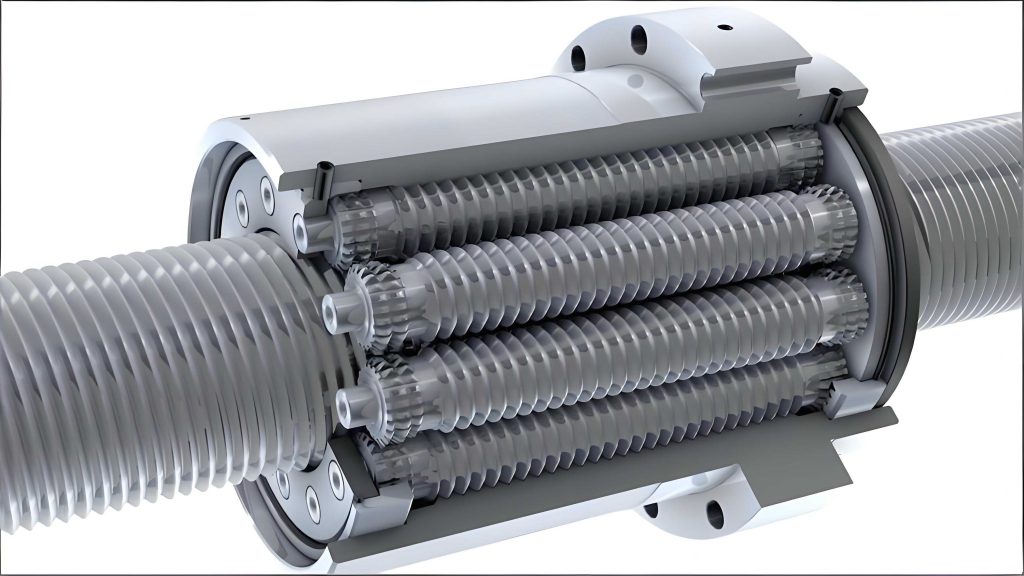
The core function of a planetary roller screw is to convert rotary motion into precise linear translation. The assembly typically consists of five main components: a central threaded screw, multiple planet rollers (also threaded) that mesh with both the screw and a surrounding nut, a carrier or retainer that holds the rollers, and often internal gearing to synchronize the rollers’ orbit. During operation, the rotation of the screw induces a planetary motion in the rollers, which in turn drives the axial movement of the nut (or conversely, prevents its rotation to produce linear output). For the analysis of small angular inputs, the total axial displacement \( l \) of the nut can be conceptually decomposed into two primary components: the quasi-static elastic deformation \( \delta \) arising from the compression at the threaded meshing contacts under load, and the kinematic displacement \( l_k \) resulting from the ideal geometric传动 of the planetary roller screw mechanism. Thus, we express the total displacement as:
$$ l = \delta + l_k $$
Understanding and quantifying both parts is essential for predicting the precise output of a planetary roller screw in high-fidelity control systems.
Mathematical Modeling of Contact Elasticity
The elastic deflection \( \delta \) is a critical factor, especially under preload or external load, as it represents a loss in motion that must be accounted for or compensated. To model this, we turn to Hertzian contact theory, which provides an analytical framework for calculating the deformation between two elastic bodies in point contact. The theory is applicable under the assumptions of smooth surfaces, purely elastic material behavior (Hookean), and that the contact area dimensions are small compared to the radii of curvature of the bodies—conditions generally satisfied by a precision planetary roller screw under rated loads.
For a planetary roller screw, two distinct Hertzian contacts exist: the screw-roller interface and the roller-nut interface. Each can be modeled as the contact between two cylinders with crossed axes, resulting in an elliptical contact patch. The geometry of the planetary roller screw threads defines the principal curvatures at the contact points. For the screw-roller contact, the curvatures are:
$$
\begin{aligned}
\rho_{11}^{(S-R)} &= \frac{1}{R_r}, \quad \rho_{12}^{(S-R)} = \frac{2\cos\lambda_r \cos\alpha}{d_{mr}} \\
\rho_{21}^{(S-R)} &= 0, \quad \rho_{22}^{(S-R)} = \frac{2\cos\lambda_s \cos\alpha}{d_{ms} – d_{mr}\cos\alpha}
\end{aligned}
$$
For the roller-nut contact, the curvatures are:
$$
\begin{aligned}
\rho_{11}^{(R-N)} &= \frac{1}{R_r}, \quad \rho_{12}^{(R-N)} = \frac{2\cos\lambda_r \cos\alpha}{d_{mr}} \\
\rho_{21}^{(R-N)} &= 0, \quad \rho_{22}^{(R-N)} = -\frac{2\cos\lambda_n \cos\alpha}{d_{mn} + d_{mr}\cos\alpha}
\end{aligned}
$$
Here, \( R_r \) is the roller thread radius, \( d_{m} \) denotes the pitch diameter, \( \lambda \) is the thread lead angle, \( \alpha \) is the contact angle, and the subscripts \( s \), \( r \), and \( n \) refer to the screw, roller, and nut respectively. The key structural parameters for the analyzed planetary roller screw are summarized below.
| Component | Lead (mm) | Number of Thread Starts | Pitch Diameter, \(d_m\) (mm) | Lead Angle, \(\lambda\) (deg) |
|---|---|---|---|---|
| Screw | 4.75 | 5 | 18.0 | 4.8 |
| Planetary Roller | 0.95 | 1 | 6.0 | 2.9 |
| Nut | 4.75 | 5 | 30.0 | 4.8 |
Table 1: Basic structural parameters of the analyzed planetary roller screw. The contact angle \(\alpha\) is 42.2°.
The sum of curvatures \( \sum \rho \) and the curvature difference function \( F(\rho) \) are calculated from these values. The material for all components is assumed to be 42CrMo4 steel with an elastic modulus \( E = 210 \) GPa and a Poisson’s ratio \( \nu = 0.29 \). The equivalent modulus \( E’ \) is given by:
$$ E’ = \frac{2}{\frac{1-\nu_1^2}{E_1} + \frac{1-\nu_2^2}{E_2}} $$
For a given normal contact force \( Q \) (derived from the axial preload distributed among the contact points), the semi-major axis \( a \) and semi-minor axis \( b \) of the contact ellipse, as well as the mutual approach \( \delta \), are found using the Hertz solution:
$$ a = m_a \sqrt[3]{\frac{3Q}{E’ \sum \rho}}, \quad b = m_b \sqrt[3]{\frac{3Q}{E’ \sum \rho}}, \quad \delta = \frac{K(e)}{\pi m_a} \sqrt[3]{\frac{3Q^2(\sum \rho)}{(E’)^2}} $$
The coefficients \( m_a \), \( m_b \), and the elliptic integrals \( K(e) \) (first kind) and \( L(e) \) (second kind) depend on the ellipticity parameter \( e \) (or \( k = b/a \)), which is determined by solving the equation \( F(\rho) = \frac{(1+k^2)L(e) – 2k^2K(e)}{(1-k^2)L(e)} \) iteratively. A numerical procedure combining Romberg integration for the elliptic integrals and a root-finding algorithm was implemented. The results for the elastic approach under varying loads are presented below.
| Axial Load per Contact, \(Q\) (N) | Screw-Roller Contact | Roller-Nut Contact | ||
|---|---|---|---|---|
| \(\delta_{S-R}\) (µm) | \(a_{S-R}\) (µm) | \(\delta_{R-N}\) (µm) | \(a_{R-N}\) (µm) | |
| 10 | 0.72 | 42.5 | 0.65 | 50.1 |
| 20 | 1.15 | 53.5 | 1.03 | 63.1 |
| 50 | 1.99 | 73.4 | 1.77 | 86.5 |
| 100 | 3.14 | 92.5 | 2.79 | 109.0 |
| 200 | 4.95 | 116.6 | 4.39 | 137.4 |
Table 2: Hertz contact results showing elastic deformation (δ) and contact ellipse semi-major axis (a) for varying loads.
This analysis confirms that even under moderate preloads typical for eliminating backlash, the planetary roller screw undergoes micron-level elastic deformations at its meshing interfaces. In a small-angle motion regime, this non-kinematic deformation constitutes a significant portion of the initial axial movement and must be considered for precise positioning.
Kinematic Transmission Relationship
The kinematic displacement \( l_k \) is derived from the ideal, no-slip rolling motion between the components. Considering the pitch diameters and the thread leads, the fundamental kinematic equation for a planetary roller screw can be established. In an ideal no-slip condition, the relationship between the screw rotation \( \theta_s \) and the nut axial displacement \( l \) is:
$$ l_{ideal} = \frac{1}{2\pi} \left( p_s \theta_s \pm p_r \frac{\theta_s r_s}{r_r} \right) $$
where \( p \) denotes lead, \( r \) denotes pitch radius, and the sign depends on the hand of the threads (positive for same hand, negative for opposite hand). For the analyzed planetary roller screw with opposite-handed threads on the screw and roller, this simplifies to:
$$ l_{ideal} = 0.302394 \cdot \theta_s $$
where \( \theta_s \) is in radians and \( l_{ideal} \) is in millimeters.
However, in a real planetary roller screw, especially under load, some degree of micro-slip at the contacts is inevitable. This slip \( \theta_{slide} \) reduces the effective screw rotation contributing to kinematic output. If we assume a slip factor such that \( \theta_{slide} = 0.005\theta_s \), then the effective screw rotation is \( \theta’_s = 0.995\theta_s \). Substituting into the kinematic equation yields the more realistic传动 relation for the planetary roller screw under load:
$$ l’_{real} = 0.3008824 \cdot \theta_s $$
The difference between the ideal and real slopes, though small in absolute terms, is systematic and becomes relevant for high-precision modeling of the planetary roller screw behavior.
Finite Element Modeling and Dynamic Simulation
To capture the complex, dynamic interaction of all components under transient loading, a three-dimensional finite element model of the planetary roller screw was developed. Given the computational cost of modeling full threads, a segment containing several engaged threads of the screw, one representative roller, and the corresponding nut segment was constructed. The model was meshed with C3D4 tetrahedral elements, with refined grids at the contact interfaces, resulting in a model with approximately 68,000 elements. The material properties for 42CrMo4 were assigned (density \( \rho = 7.8 \times 10^{-9} \) tonne/mm³, E=210 GPa, ν=0.29).
Contact interactions between the screw-roller and roller-nut threads were defined using a surface-to-surface contact algorithm with a “hard” normal contact and a tangential behavior with a Coulomb friction coefficient of 0.3. The analysis was performed in two explicit dynamic steps:
- Preload Step: An axial preload force was applied to the nut reference point, ramping up to 100 N. All translational and rotational degrees of freedom except the axial translation of the roller and nut were constrained. This step established the initial contact conditions and induced the elastic deformation predicted by Hertz theory.
- Torque Step: With the preload maintained, a rotational boundary condition (torque) was applied to the screw to induce a small rotation. The constraints were adjusted to allow rotation to the screw, roller, and nut, and axial translation to the roller and nut, simulating the operational condition.
The dynamic simulation provided a wealth of data on the stress state and kinematic response of the planetary roller screw assembly. The von Mises stress distribution at two different time instances revealed that the highest stresses occurred at the screw-roller contact interfaces, with localized values exceeding the material’s yield strength, indicating regions of plastic yielding. This is consistent with the high contact pressures predicted by Hertz theory for these点 contacts with smaller relative curvature.
| Time (s) | Component | Max. von Mises Stress (MPa) |
|---|---|---|
| 0.0003136 | Screw | 675.1 |
| Roller (Screw side) | 1247.0 | |
| Nut | 474.4 | |
| 0.000704 | Screw | 984.1 |
| Roller (Both sides) | 1335.0 | |
| Nut | 424.2 |
Table 3: Finite element analysis results for maximum von Mises stress.
The kinematic outputs were of primary interest. The angular displacement curves confirmed the expected motion: the screw rotated in the driven direction, the planetary roller spun in the opposite direction, and the nut (whose rotation was partially restrained by boundary conditions) showed a slight opposite rotation. Most critically, the axial displacement history of the nut was extracted.
At the end of the preload step (0.0002 s, preload=100 N), the axial displacement of the roller was 0.00164042 mm. This value corresponds directly to the elastic deformation \( \delta \) from the Hertz model. Comparing it to the theoretically calculated deformation for a 20 N load per contact (100 N total / 5 rollers ≈ 20 N) of approximately 0.0016 mm shows excellent agreement, with a relative error of only 2.5%. This validates the application of Hertz theory for estimating the static elastic compliance of the planetary roller screw.
Following the application of torque, the nut’s axial displacement increased. Plotting the nut displacement against the screw rotation angle after the preload step yielded the dynamic传动 relationship. The slope of this curve from the FEA simulation was calculated to be 0.300010 mm/rad.
| Model Type | Transmission Slope (mm/rad) | Description |
|---|---|---|
| Theoretical (Ideal, No-slip) | 0.302394 | Pure kinematic relation. |
| Theoretical (With 0.5% slip) | 0.300882 | Kinematic relation adjusted for micro-slip. |
| Finite Element Simulation | 0.300010 | Dynamic result from explicit FEA. |
Table 4: Comparison of planetary roller screw传动 ratios from different models.
The remarkable concordance between the FEA result (0.300010) and the adjusted theoretical model accounting for slip (0.300882) is evident, with an error of merely 0.29%. This strongly supports the notion that micro-slip is an integral part of the real传动 mechanics in a loaded planetary roller screw, even during small-angle motions.
Conclusion
This integrated study, combining analytical Hertz contact mechanics and dynamic finite element analysis, provides significant insights into the behavior of planetary roller screws under small angular motion—a critical operational regime for precision伺服 systems. The key findings are twofold. Firstly, the elastic deformation at the threaded meshing contacts, calculable via Hertz theory, represents a non-negligible, load-dependent component of the initial axial displacement. For accurate positioning, this elastic compliance must be characterized and compensated within the control algorithm of systems employing a planetary roller screw. Secondly, the actual kinematic transmission of a planetary roller screw under load deviates slightly from the ideal geometric ratio due to the presence of micro-slip. The dynamic finite element simulation successfully captured this effect, yielding a传动 relationship that aligns closely with a theoretical model incorporating a small slip factor. The methodology and results presented here offer a refined model for predicting the fine-motion output of a planetary roller screw, thereby contributing to the design and control of high-performance, high-precision linear actuation systems where understanding the nuances of small-angle dynamics is essential.