
The Planetary Roller Screw (PRS) is a critical mechanical component in precision transmission systems, renowned for its superior load-carrying capacity, high rigidity, and long service life compared to its ball screw counterpart. Its operation involves the conversion of rotary motion into linear motion, or vice versa, through the rolling contact between threaded elements. This mechanism finds indispensable applications in demanding fields such as aerospace actuation, robotics, and high-precision machine tools. The core assembly of a planetary roller screw consists of three primary components: a central threaded screw, multiple threaded rollers (planets) distributed around it, and an outer threaded nut. The performance and longevity of this system are intrinsically linked to the uniformity of load distribution across the threads of these rollers.
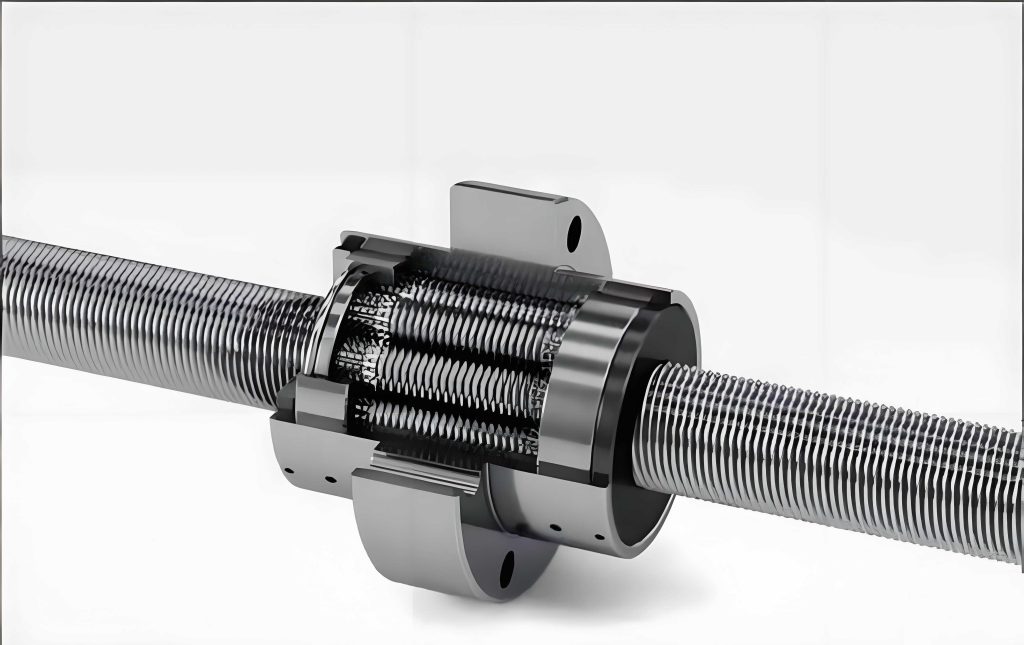
Current research on the planetary roller screw encompasses kinematics, axial stiffness, dynamic characteristics, and transmission efficiency. However, a critical aspect often oversimplified in load distribution models is the assumption of perfect assembly geometry. In practical engineering scenarios, assembly errors are inevitable. These errors arise from dimensional tolerances in support structures like bearing housings and linear guide rails, leading to a misalignment between the central axes of the screw and the nut. This misalignment fundamentally alters the initial contact conditions between the screw and the rollers before any operational load is applied. Some rollers may experience pre-loading (assembly stress), while others may partially lose contact, leading to a highly non-uniform distribution of the operational load. This uneven loading accelerates wear, reduces fatigue life, and can lead to premature failure of the most heavily loaded rollers, undermining the inherent advantages of the planetary roller screw system. Therefore, developing a comprehensive analytical model that accounts for these assembly errors is paramount for accurate life prediction, optimal design, and the formulation of precise assembly guidelines.
Modeling of Assembly-Induced Misalignment
In a typical industrial application, the screw is connected to a drive motor and supported by a bearing housing. The nut, often integrated into a housing with a planetary cage and ring gear, is fixed to a moving slide block that runs on linear rails. The vertical distances from the mounting reference plane to the centerlines of the screw and the nut, denoted as \( h_s \) and \( h_n \) respectively, are subject to manufacturing tolerances. The resultant assembly error is defined as the vertical offset \( t = h_s – h_n \). A positive \( t \) indicates the screw axis is above the nut axis, and a negative \( t \) indicates it is below.
This offset \( t \) disrupts the ideal concentric arrangement. In the nominal, error-free state, all rollers are uniformly spaced around the screw with a constant center distance \( r_{sr} \). With an error \( t \), the center distance for an individual roller becomes a function of its angular position. Consider a coordinate system with the nut center \( O_N \) at the origin. The screw center \( O_S \) is offset to (0, t). Let \( O_{jr} \) be the center of the j-th roller, located at an angle \( \alpha_j \) measured from the positive x-axis. The distance \( r_{sr}^j \) between the screw and this j-th roller is no longer constant and is given by the law of cosines:
$$ r_{sr}^j = \sqrt{ r_{sr}^2 + t^2 – 2 r_{sr} t \cos(\alpha_j) } $$
This variation has two direct consequences:
- Pre-loading: If \( r_{sr}^j < r_{sr} \), the roller is physically closer to the screw than in the nominal state. This causes an initial elastic compression at the screw-roller thread contacts even before the drive motor is engaged, creating what is termed “assembly stress.”
- Loss of Contact: If \( r_{sr}^j > r_{sr} \), the roller is farther away, potentially breaking the initial contact and creating a gap. This roller will remain unloaded until the applied operational force is large enough to close the gap through deformation.
The range of roller positions that maintain contact can be determined geometrically. The locus of roller centers that maintain the nominal center distance \( r_{sr} \) from both \( O_S \) and \( O_N \) are the intersection points of two circles. Rollers positioned on the arc between these intersection points that is closer to the screw center \( O_S \) will be pre-loaded. Rollers on the opposite arc will have a clearance. This fundamentally alters the load-sharing landscape of the planetary roller screw assembly at the very onset of operation.
Load Distribution Model Incorporating Assembly Stress
To analyze the load distribution under operational loads while considering pre-existing assembly stresses, a comprehensive model based on elastic contact mechanics and deformation compatibility is established. The analysis rests on the following key assumptions:
- All materials behave linearly elastically.
- The bending deformation of the screw shaft is negligible compared to the local contact deformations at the threads.
- The contact points on the two sides (screw-side and nut-side) of a single roller are symmetrically positioned relative to the screw axis.
- The system is under static equilibrium.
Step 1: Quantifying Assembly Stress
For a roller experiencing pre-load (\( r_{sr}^j < r_{sr} \)), the initial normal approach (deformation) at the screw-roller contact due to assembly error is:
$$ \delta_{s0}^j = r_{sr} – r_{sr}^j $$
This deformation occurs along the line connecting the screw and roller centers. It can be resolved into two components: one radial to the screw (\( \delta_{s1}^j \)) and one axial (\( \delta_{s2}^j \)), related by the thread lead angle \( \beta \). For small angles, \( \tan(\beta) \approx \beta \), and the relationship is:
$$ \delta_{s2}^j = \delta_{s0}^j \cdot \tan(\beta) $$
According to Hertzian contact theory, the corresponding axial pre-load force \( F_{sa}^j \) on each engaged thread of this roller is related to the axial deformation. A common power-law relationship for the contact between two threaded bodies approximated as cylinders is:
$$ (F_{sa}^j)^{2/3} = \frac{\delta_{s2}^j}{C} $$
where \( C \) is a contact stiffness coefficient dependent on the material properties (Young’s modulus \( E \), Poisson’s ratio \( \nu \)) and the geometry (effective radii of curvature) of the screw and roller threads. The total assembly pre-load contributed by the j-th roller with \( n \) engaged threads is \( n F_{sa}^j \). Due to static equilibrium of the roller, an equal but opposite pre-load force is developed at its nut-side threads.
Step 2: Deformation Compatibility Under Operational Load
The assembly pre-load deforms the threads, axially displacing the contact points. When an external axial force \( F_{ext} \) is applied to the nut (or screw), additional deformations occur. The core of the load distribution model lies in enforcing compatibility of deformations between all elastic elements in the load path.
Consider two consecutive contact points, \( i \) and \( i+1 \), on the screw with a particular roller. In the unloaded state (post-assembly, pre-operation), the axial distance between them is the pitch \( P \). Under the external load, three factors change the relative position of these points:
- Elongation/compression of the screw segment between them.
- Additional contact deformation at point \( i+1 \).
- Additional contact deformation at point \( i \).
The compatibility condition states that the change in distance between the material points on the screw that are in contact at \( i \) and \( i+1 \) must equal the change in distance between the corresponding material points on the roller. This yields the fundamental equation for the screw-roller contact line:
$$ P + \delta_{i+1} + \Delta L_{s,i} = P + \Delta L_{r,i} + \delta_{i} $$
where:
- \( \delta_{i} \) and \( \delta_{i+1} \) are the additional contact deformations at points \( i \) and \( i+1 \) due to \( F_{ext} \).
- \( \Delta L_{s,i} \) is the axial deformation of the screw segment between these contact points.
- \( \Delta L_{r,i} \) is the axial deformation of the roller segment between these contact points.
Simplifying, we get:
$$ \delta_{i+1} – \delta_{i} = \Delta L_{r,i} – \Delta L_{s,i} $$
The axial deformation of a prismatic segment (like a section of screw or roller) under a varying axial force \( F(x) \) is given by:
$$ \Delta L = \int \frac{F(x)}{A E} \, dx $$
For a discrete model with segments of length \( \Delta x_k \) and average force \( F_k \), this becomes \( \Delta L = \sum (F_k \cdot \Delta x_k)/(A E) \).
Step 3: Equilibrium Equations
Two sets of equilibrium equations close the system:
- Roller Equilibrium: For each roller \( j \), the sum of axial forces from all screw-side thread contacts must equal the sum of axial forces from all nut-side thread contacts.
$$ \sum_{i=1}^{n} F_{s,i}^j = \sum_{i=1}^{n} F_{n,i}^j = F_{r}^j $$
where \( F_{r}^j \) is the total axial force carried by that roller.
- Screw (or Nut) Global Equilibrium: The externally applied axial force \( F_{ext} \), plus the sum of all assembly pre-load forces from rollers in contact, must be balanced by the sum of the operational forces from all rollers.
For the screw:
$$ F_{ext} + \sum_{j \in \text{contact}} n F_{sa}^j = \sum_{j=1}^{k} F_{r}^j $$
where \( k \) is the total number of rollers.
Step 4: Physical (Force-Deformation) Relations
The additional contact deformation \( \delta_i \) is related to the additional contact force \( \Delta F_i \) at that point via the contact stiffness. For Hertzian point contact, a general power law applies:
$$ \Delta F_i = K_c \cdot (\delta_i)^{3/2} $$
where \( K_c \) is the combined contact stiffness constant derived from the material and geometry of the contacting threads. The total force at a contact point is the vector sum of the assembly pre-load force and this operational increment, though their directions are aligned.
Simultaneously solving the system of equations from the deformation compatibility conditions, the equilibrium conditions, and the physical force-deformation relations for all contact points across all rollers yields the complete load distribution \( F_{s,i}^j \) and \( F_{n,i}^j \). This typically requires an iterative numerical solution method, such as the Newton-Raphson technique, implemented in computational software like MATLAB.
Numerical Case Study and Results
To demonstrate the application and implications of the model, a detailed case study is performed. The geometric parameters of the planetary roller screw are listed in the table below.
| Component | Screw | Roller | Nut |
|---|---|---|---|
| Pitch Diameter (mm) | 19.5 | 6.5 | 32.5 |
| Pitch, P (mm) | 0.4 | 0.4 | 0.4 |
| Number of Starts | 4 | 1 | 4 |
| Number of Engaged Threads per Roller | – | 20 | – |
| Lead Angle, β (approx.) | ~1.87° | ~1.12° | ~1.12° |
| Material (GCr15) E (GPa), ν | 212, 0.29 | ||
The assembly consists of \( k = 4 \) rollers. An assembly error of \( t = +0.5 \) mm is assumed (screw axis above nut axis). The angular positions \( \alpha_j \) of the rollers are 0°, 90°, 180°, and 270°. An external axial load \( F_{ext} = 20 \text{ kN} \) is applied. The contact stiffness coefficient \( C \) is calculated based on the Hertzian theory for crossed cylinders representing the thread contacts.
First, the initial assembly state is calculated using Equation (1) and (2).
| Roller j | α (deg) | r_{sr}^j (mm) | Status | Assembly Pre-load per Thread, F_{sa}^j (N) |
|---|---|---|---|---|
| 1 | 0 | 19.0 | Pre-loaded | 15.2 |
| 2 | 90 | 20.006 | Clearance | 0 |
| 3 | 180 | 20.5 | Clearance | 0 |
| 4 | 270 | 19.993 | Pre-loaded | 1.1 |
Next, the full system of equations is solved numerically to obtain the load distribution under the combined effect of assembly pre-load and the 20 kN external load. The results for the total axial force carried by each roller are summarized below, and the detailed thread-by-thread load distribution for two representative rollers is shown graphically.
| Roller j | α (deg) | Total Roller Load, F_r^j (kN) | Percentage of Total (%) |
|---|---|---|---|
| 1 | 0 | 11.8 | 59.0 |
| 2 | 90 | ~0 | ~0 |
| 3 | 180 | ~0 | ~0 |
| 4 | 270 | 8.2 | 41.0 |
The results are striking. Due to the assembly error:
- Rollers 2 and 3 (α=90°, 180°): These rollers have a center distance \( r_{sr}^j > r_{sr} \). The initial clearance is not fully closed by the external load under this analysis, rendering them practically unloaded. They carry a negligible portion of the total 20 kN force.
- Roller 1 (α=0°): This roller has the smallest center distance (\( r_{sr}^1 = 19.0 \) mm) and therefore the largest assembly pre-load. Consequently, it carries the lion’s share of the external load, approximately 59%.
- Roller 4 (α=270°): While also pre-loaded, its center distance is very close to nominal, resulting in a smaller pre-load. It carries the remaining 41% of the load.
This demonstrates a severe load concentration, deviating drastically from the ideal uniform distribution of 25% (5 kN) per roller. The load distribution along the threads of the active rollers (1 and 4) also follows a characteristic pattern, typically with the highest loads on the threads nearest to the point of load application on the nut.
Finite Element Validation
To validate the analytical model, a detailed 3D Finite Element Analysis (FEA) was conducted using Abaqus/Standard. The model included:
- Geometry: Parametric CAD models of the screw, four rollers, and nut with exact helical threads.
- Mesh: A high-fidelity mesh using predominantly C3D8R elements for computational efficiency and C3D10M elements in critical contact regions for accuracy. The total model contained approximately 4.1 million elements.
- Contacts: Surface-to-surface contact interactions were defined between all threaded surfaces, with a penalty friction formulation (friction coefficient μ=0.05).
- Boundary Conditions & Load Steps:
- Step 1 (Establish Contact): Light pressure applied to ensure stable initial contact.
- Step 2 (Apply Assembly Error): The screw reference point was displaced vertically by \( t = 0.5 \) mm relative to the nut, simulating the misalignment.
- Step 3 (Apply Operational Load): An axial force of 20 kN was applied to the nut housing reference point, while the screw end was fixed in all degrees of freedom except rotation about its axis.
The FEA results for the total axial force transmitted through each roller were extracted from the contact forces. The comparison with the analytical model predictions is shown below.
| Roller j | Analytical Model F_r^j (kN) | FEA Result F_r^j (kN) | Relative Error (%) |
|---|---|---|---|
| 1 | 11.8 | 12.1 | -2.5 |
| 2 | ~0 | ~0.1 | – |
| 3 | ~0 | ~0.05 | – |
| 4 | 8.2 | 7.75 | +5.8 |
The agreement between the analytical model and the FEA is excellent. The model correctly predicts the drastic non-uniformity, identifying Roller 1 as the most heavily loaded and Rollers 2 & 3 as nearly unloaded. The minor discrepancies (within ~6%) are attributable to the simplifications in the analytical model, such as treating the screw/roller as simple tensile members and using a simplified Hertzian stiffness, whereas the FEA captures full 3D elasticity, thread root bending, and more precise contact geometry. This validation confirms the fidelity and usefulness of the proposed analytical model for understanding the fundamental impact of assembly errors in a planetary roller screw.
Discussion and Implications
The analysis unequivocally demonstrates that even small assembly errors can catastrophically degrade the load-sharing performance of a planetary roller screw. The key insights are:
- Load Concentration: The roller with the smallest screw-roller center distance (closest to the direction of screw offset) becomes the primary load-bearer, potentially carrying more than double its intended share. This dramatically increases its contact stresses and reduces its fatigue life according to the Lundberg-Palmgren theory (\( L_{10} \propto (Load)^{-3} \)).
- Idle Rollers: Rollers on the opposite side of the offset may become completely inactive, failing to contribute to load capacity. This effectively reduces the number of working rollers, increasing the load on the active ones and nullifying a key advantage of the multi-roller planetary design.
- System Stiffness and Backlash: The presence of clearances at some roller contacts introduces non-linear stiffness and potential backlash at low loads, which is detrimental for precision positioning applications.
- Practical Significance: This study underscores that achieving high manufacturing precision for the planetary roller screw components alone is insufficient. Equal importance must be placed on the assembly tolerances of the supporting structure (bearing housings, rail mounts). Designers must specify tight tolerances for \( h_s \) and \( h_n \) or incorporate adjustable alignment features to minimize the offset \( t \).
The model also provides a tool for sensitivity analysis. One can analyze how varying the magnitude of \( t \) influences the worst-case roller load. Furthermore, it suggests that intentional, controlled pre-loading (e.g., via selective fitting or adjustable eccentric sleeves) could be used to optimize load distribution, though this must be balanced against increased friction and torque.
Conclusion
This investigation has developed and validated a comprehensive analytical model for predicting the load distribution in a planetary roller screw mechanism subject to assembly-induced misalignment. The model integrates Hertzian contact theory, deformation compatibility conditions, and static equilibrium to account for the initial pre-load or clearance state of each roller caused by vertical axis offset. The numerical case study reveals a profound consequence: instead of uniform load sharing, a severe concentration occurs where one or two rollers shoulder most of the external load, while others may remain unloaded.
The findings have critical implications for the reliable design and application of planetary roller screw drives. To harness their full potential for high load capacity and longevity, stringent control over assembly alignment is as crucial as the precision of the screw components themselves. The presented model serves as a valuable tool for engineers to assess the sensitivity of their designs to assembly errors, to specify appropriate assembly tolerances, and to develop strategies for mitigating uneven wear and premature failure. Future work could extend this model to include dynamic effects, the influence of manufacturing thread errors, and thermal deformations for an even more holistic life prediction capability for the planetary roller screw.