
As a critical component within the realm of traditional manufacturing, forging equipment is responsible for producing high-performance and precision components. Screw presses, a vital class of such equipment, are widely utilized. However, conventional screw presses, which typically employ a trapezoidal thread sliding screw pair for motion conversion, suffer from significant drawbacks. These include persistent lubrication difficulties, inherently high coefficients of friction, low mechanical efficiency often below 50%, and consequently, high energy consumption. This inefficiency stems from the fundamental reliance on sliding friction within the transmission mechanism.
The pursuit of green manufacturing and energy conservation demands a transformation in such traditional, energy-intensive processes. A promising path forward involves replacing the sliding friction mechanism with a rolling contact solution. For a nominal 16MN gear-type electric screw press, this translates to substituting the traditional sliding screw pair with a planetary roller screw transmission system. This technology fundamentally alters the friction mode from sliding to rolling, offering a path to resolve lubrication challenges, drastically reduce the friction coefficient, and significantly boost transmission efficiency to levels around 90%, thereby achieving substantial energy savings.
The core of a screw press is its ability to convert rotational motion into linear motion for delivering forging force. In a typical gear-driven electric screw press, a large gear acting as a flywheel is driven by multiple motors through pinions. This flywheel is rigidly connected to the screw (or螺杆). A nut (or螺母), fixed to the press slide, forms a screw pair with the screw. The rotation of the screw, driven by the flywheel, forces the nut and the attached slide to move linearly. While effective, this traditional sliding screw pair is the primary source of inefficiency.
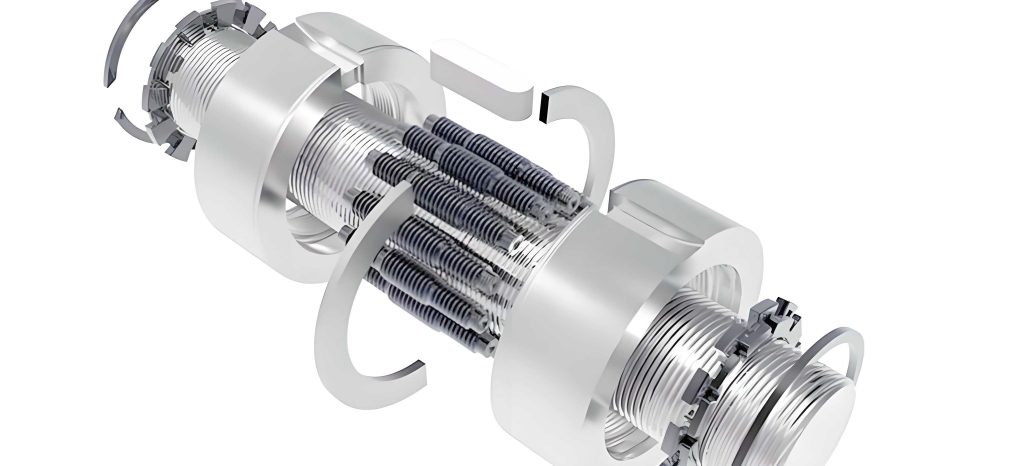
The planetary roller screw presents a superior alternative. A standard planetary roller screw assembly consists of a central threaded screw, a surrounding threaded nut, and multiple threaded rollers arranged planetarily between them. The rollers are held in a circumferential array by retainers (or cages) and mesh with internal ring gears at both ends of the nut to maintain precise phasing and prevent skewing. The primary advantage lies in the contact mechanics: the load is transferred through rolling contact between the screw threads and the roller threads, and between the roller threads and the nut threads. This multi-point, rolling contact distribution leads to exceptionally high load capacity, rigidity, and efficiency compared to both sliding screw pairs and even ball screws, especially in heavy-load, low-speed applications typical of forging presses.
Designing a planetary roller screw for a 16MN press begins with fundamental mechanical principles. The relationship between the input torque required at the screw and the output axial forging force is governed by the following efficiency equation, where the sliding friction of a trapezoidal thread is replaced by the rolling friction of the planetary roller screw:
$$ M = \frac{F \cdot n_s \cdot p}{2\pi \eta} $$
Where:
- \( M \) is the input torque (N·mm)
- \( F \) is the axial force (N)
- \( n_s \) is the number of starts (threads) on the screw
- \( p \) is the pitch of the screw (mm)
- \( \eta \) is the transmission efficiency (significantly higher for a planetary roller screw, e.g., 0.85-0.90).
For the target press with a maximum cold forging force \( F = 32,000 \text{ kN} \), and initial design parameters of \( n_s = 6 \), \( p = 25 \text{ mm} \), and \( \eta = 0.85 \), the required input torque \( M \) is calculated. The screw is subjected to combined compression and torsion. Its minimum root diameter \( d_{s1} \) is determined using the von Mises (4th strength) theory to ensure structural integrity under the most severe loading condition:
$$ \sigma_{r4} = \sqrt{ \left( \frac{4F}{\pi d_{s1}^2} \right)^2 + 3 \left( \frac{16M}{\pi d_{s1}^3} \right)^2 } \leq \frac{\sigma_s}{n} $$
Where \( \sigma_s \) is the yield strength of the material (e.g., GCr15 bearing steel) and \( n \) is the safety factor. Solving this equation establishes a minimum root diameter. Subsequently, other critical geometric parameters of the planetary roller screw are derived based on kinematic relationships. The design ensures a constant transmission ratio by matching the gear geometry at the roller ends with the thread geometry. Key kinematic relations include the ratio of screw-to-roller diameters being inversely proportional to their number of starts, and the requirement that the pitch is identical for screw, nut, and rollers to ensure proper meshing:
$$ \frac{d_s}{d_r} = \frac{n_r}{n_s} = \frac{z_n}{z_r} $$
$$ d_n = d_s + 2d_r $$
$$ d_r = m \cdot z_r $$
Where \( d_s, d_r, d_n \) are the pitch diameters of the screw, roller, and nut, respectively; \( n_r \) is the number of starts on the roller (typically 1); \( z_n, z_r \) are the number of teeth on the internal ring gear and the roller-end gear; and \( m \) is the gear module.
Following these calculations, a complete set of structural parameters for the planetary roller screw is defined, as summarized in the table below.
| Table 1: Key Structural Parameters of the Designed Planetary Roller Screw | ||||||
|---|---|---|---|---|---|---|
| Component | Pitch Diameter (mm) | Major Diameter (mm) | Minor Diameter (mm) | Pitch (mm) | Number of Starts | Thread Profile |
| Screw | 480 | 488 | 470 | 25 | 6 | Triangular (90°) |
| Roller | 120 | 128 | 110 | 25 | 1 | Circular Arc |
| Nut | 720 | 730 | 712 | 25 | 6 | Triangular (90°) |
| Additional Gear Data: Roller gear teeth \( z_r = 30 \), Module \( m = 4 \), Ring gear teeth \( z_n = 180 \). | ||||||
The meshing characteristics of the planetary roller screw are complex due to its multi-body, spatial thread contact. A critical design step is interference checking. Based on mathematical models of the helical surfaces, the initial geometric interference between the screw and roller threads is calculated analytically. The roller thread thickness is then reduced by a specific amount (e.g., 0.66 mm per flank in this case) to eliminate this interference and ensure smooth, backlash-free rolling contact under no load.
Static strength analysis is performed to verify the contact stress and permanent deformation under load are acceptable. A finite element analysis (FEA) model of a single screw-roller thread pair in contact is established. The model applies the portion of the total axial load expected on one contact point. The material (GCr15) is defined with its elastic-plastic properties. The analysis iteratively finds the load at which the permanent deformation on the roller after unloading is less than 1/10,000 of its diameter—a criterion for maintaining precision. This per-tooth load capacity, combined with the number of rollers and engaged threads, determines the required threaded length of the rollers to safely carry the 32 MN load. The results confirm the designed thread profile and material can withstand the press’s operational loads.
| Table 2: Summary of Static Finite Element Analysis for Thread Contact | ||
|---|---|---|
| Objective | Verify contact strength and permissible plastic deformation for a single thread contact pair. | |
| Model | Simplified 3D model of one screw thread segment and one roller thread segment in contact. | |
| Material | GCr15 Bearing Steel (Elastic-Plastic model defined). | |
| Key Result | Allowable load per thread contact point | ~92 kN |
| Criterion Met | Permanent deformation after unloading < 0.017 mm (1/10,000 of roller diameter). | |
Before physical manufacturing, dynamic simulation of the fully virtual planetary roller screw assembly is crucial for validating the kinematic design and overall behavior. A multi-body dynamics model is created, incorporating all components: screw, nut, rollers, retainers, and ring gears. Appropriate joints and contacts are defined. The screw is given a rotational velocity input, and a constant 32 MN axial force is applied to the nut, opposing its motion.
The simulation solves the equations of motion, accounting for contact forces and friction. The output provides the dynamic angular velocities of the rollers and retainers, as well as the linear velocity and displacement of the nut. These simulated values are then compared to their theoretical counterparts derived from the kinematic design equations. The close agreement between simulation and theory, as shown in the table below, validates the correctness of the planetary roller screw parameter design and its ability to perform the required motion transformation under load.
| Table 3: Dynamic Simulation Results vs. Theoretical Kinematic Values | |||
|---|---|---|---|
| Motion Parameter | Theoretical Value | Simulated Average Value | Relative Error |
| Roller Angular Velocity | 1560 deg/s | 1480 deg/s | 5.13% |
| Retainer Angular Velocity | 312 deg/s | 294.5 deg/s | 5.61% |
| Nut Linear Velocity | 325 mm/s | 332.8 mm/s | 2.40% |
| Nut Linear Displacement (over 2s) | 650 mm | 645.75 mm | 0.65% |
In conclusion, the theoretical design, static finite element analysis, and dynamic multi-body simulation collectively demonstrate that a standard-type planetary roller screw is a technically viable and superior replacement for the traditional trapezoidal sliding screw pair in a 16MN electric screw press. The comprehensive design process ensures all components—screw, nut, and rollers—are correctly proportioned to handle the extreme forging loads. The transition from sliding friction to the rolling friction inherent in the planetary roller screw mechanism directly addresses the core limitations of conventional presses. This technological upgrade offers a clear path toward significant improvements in energy efficiency, operational reliability (via reduced lubrication demands), and potentially higher operational speeds due to lower heat generation, aligning perfectly with the goals of modern, sustainable manufacturing.
| Table 4: Comparative Summary: Traditional vs. Planetary Roller Screw Drive | ||
|---|---|---|
| Aspect | Trapezoidal Sliding Screw Pair | Planetary Roller Screw |
| Friction Mechanism | Sliding Friction | Rolling Friction |
| Typical Efficiency (η) | < 50% | 85% – 90% |
| Lubrication Demand | High, Difficult | Lower, More Manageable |
| Heat Generation | High at high speeds | Substantially Lower |
| Load Distribution | Few sliding contact lines | Multiple rolling contact points |
| Key Advantage for Presses | Simple, low-cost | High efficiency, high load capacity, energy-saving |