
As a mechanical engineer specializing in precision drive systems, I have witnessed firsthand the transformative impact of the planetary roller screw in heavy-duty applications. This ingenious device converts rotary motion into linear motion, much like its more common counterpart, the ball screw, but with profound differences that make it superior in demanding environments. The core distinction lies in the load-bearing elements: while ball screws rely on balls rolling in helical grooves, the planetary roller screw utilizes threaded rollers with a large-radius convex tooth profile. Typically, a nut houses 9 to 13 of these rollers, all actively engaged, creating a multitude of contact points. This design grants the planetary roller screw exceptional load capacity and stiffness, far exceeding that of ball screws. In scenarios requiring high load-bearing capability, the planetary roller screw offers unparalleled advantages over hydraulic systems. It operates with a simpler control system, eliminating the need for complex ancillary components like valves, pumps, filters, and sensors. This inherent simplicity avoids issues such as hydraulic fluid leakage and unpredictable failures. Moreover, the planetary roller screw can endure heavy or progressively increasing loads for thousands of hours under extremely harsh conditions. Consequently, the superior characteristics of the planetary roller screw make it the ideal choice for heavy-duty transmission and operation in adverse environments.
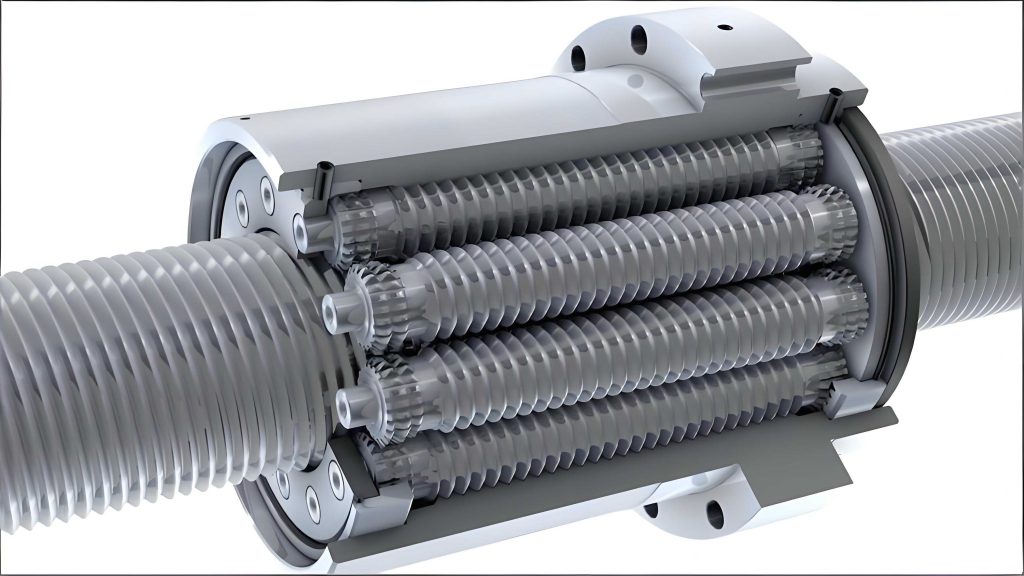
In my analysis of power transmission components, the structure of the planetary roller screw is both elegant and robust. A typical planetary roller screw assembly features a central screw with 5 or 6-start threads, surrounded by 9 to 13 planetary rollers. The screw thread usually has a triangular 90° tooth profile. The nut possesses an internal thread with identical parameters and number of starts as the screw. Each roller is a single-start thread with a large-radius convex tooth profile. At both ends, these rollers are machined with small-module external gears and cylindrical plain shafts. The external gears mesh with an internal ring gear, which is fixed to the nut, ensuring the rollers maintain axial parallelism. The cylindrical shafts are housed in uniformly distributed holes within a cage, guaranteeing equal spacing among all rollers during operation. This precise arrangement is fundamental to the reliable performance of the planetary roller screw.
The working principle of the planetary roller screw is a fascinating study in planetary mechanics. When an electric motor, often via a gearbox, drives the central screw shaft to rotate, the threaded rollers engage with both the screw and the nut. Due to this meshing and the constraint provided by the internal ring gear, the rollers perform a planetary motion—they rotate on their own axes while revolving around the central screw. Because the rollers are also in threaded engagement with the nut, this planetary motion forces the nut to translate axially along the screw. Thus, the rotary motion of the screw is converted into the linear motion of the nut. Throughout this process, the cage maintains the uniform circumferential distribution of the rollers, and the gear meshing prevents any axial tilting, keeping all roller axes perfectly parallel. The contact between the roller’s convex tooth profile and the screw/nut threads is essentially a point contact, analogous to numerous balls in a bearing system. This allows each roller in the planetary roller screw to function like a series of ball bearings, drastically increasing the load-carrying capacity.
When evaluating performance, the planetary roller screw demonstrates clear advantages over the traditional ball screw. I have compiled a comprehensive comparison based on load testing, lifespan analysis, and operational data.
| Performance Metric | Planetary Roller Screw | Ball Screw | Key Advantage for Planetary Roller Screw |
|---|---|---|---|
| Load Capacity (Dynamic) | Extremely High | Moderate to High | Approximately 3 times higher for comparable size, due to more contact points and favorable Hertzian contact stress. |
| Speed & Acceleration | Up to 100 m/s, over 3.5g | Limited by ball recirculation | No recirculation components allow for higher maximum speed and acceleration. |
| Operational Lifetime (L10) | Exceptionally Long | Standard | Can be up to 15 times longer under a 1-ton load for a 20mm diameter, 6mm lead screw. |
| Environmental Tolerance | Excellent (ice, dust, poor lubrication) | Requires clean, lubricated environment | Less sensitive to contaminants; maintains performance in harsh conditions. |
| Noise Level | Lower (e.g., ~68 dB at 2000 rpm for 30x20mm) | Higher (e.g., 72-78 dB at 2000 rpm for 32x20mm) | Absence of ball recirculation noise leads to quieter operation. |
| Reliability & Shock Resistance | Outstanding | Good, but vulnerable to recirculation failure | Robust design with no delicate recirculation elements; high impact resistance. |
The superior load capacity of the planetary roller screw can be fundamentally explained by Hertzian contact theory. The dynamic load rating, a critical parameter, is derived from formulas similar to those for rolling bearings. For a planetary roller screw, the basic dynamic load rating \( C_a \) (in Newtons) is given by:
$$C_a = f_c (\cos \alpha)^{0.86} Z_1^{2/3} D_w^{1.8} \tan \alpha (\cos \phi)^{1/3}$$
Where:
\( f_c \) is a factor dependent on the material and geometry of the planetary roller screw system.
\( \alpha \) is the half-angle of the screw thread tooth profile (typically 45°).
\( Z_1 \) is the number of effective contact points in the loaded zone.
\( D_w \) is the radius of curvature of the roller’s convex tooth profile (in mm).
\( \phi \) is the helix angle of the thread.
The curvature radius \( D_w \) for the roller thread can be estimated if the pitch \( P \) and nominal roller diameter \( d \) are known:
$$D_w \approx \sqrt{ \frac{2.5 P d}{2\sqrt{2}} }$$
The theoretical service life of a planetary roller screw, expressed in revolutions, is calculated using the standard life rating formula:
$$L_{10} = \left( \frac{C_a}{F_m} \right)^3 \times 10^6$$
Here, \( L_{10} \) is the life in revolutions that 90% of a group of identical planetary roller screws are expected to exceed, and \( F_m \) is the equivalent axial load (in N). This cubic relationship highlights how a small increase in load dramatically reduces life, underscoring the importance of the high \( C_a \) value inherent to planetary roller screw design.
Efficiency is another crucial performance indicator for any screw mechanism. The planetary roller screw is non-self-locking, meaning both the screw and the nut can act as the driving element. Therefore, we define two efficiencies:
| Efficiency Type | Formula | Description |
|---|---|---|
| Forward Efficiency (Rotary to Linear) |
$$\eta_f = \frac{1}{1 + \mu \cot \phi}$$ | Governs operation when the screw is driven to move the nut. |
| Reverse Efficiency (Linear to Rotary) |
$$\eta_r = 1 – \mu \cot \phi$$ | Governs operation when the nut is driven to rotate the screw. |
In these formulas, \( \mu \) represents the coefficient of friction. The high lead angles often used in planetary roller screws contribute to their excellent efficiency, frequently exceeding 90%.
For high-speed applications, the critical speed of the screw shaft becomes a limiting factor to avoid resonant vibrations. The critical speed \( n_{cr} \) (in rpm) for a simply supported screw in a planetary roller screw assembly is estimated by:
$$n_{cr} = \frac{4.90 \times 10^5 \cdot f_1 \cdot d_1}{L_0^2}$$
Where:
\( f_1 \) is a support condition factor (typically 1.0 for simple support, 2.0 for fixed-fixed).
\( d_1 \) is the nominal screw diameter (in mm).
\( L_0 \) is the distance between screw supports (in mm).
This formula emphasizes the need for proper mounting and support design in high-speed planetary roller screw applications to prevent catastrophic failure.
The application spectrum for the planetary roller screw is vast, precisely due to its ruggedness and high performance. In my professional experience, I have specified planetary roller screws for numerous demanding fields. In industrial machinery, they are the drive of choice for large injection molding machines, where they provide the immense clamping force with precision and reliability. Metalworking industries employ them in rolling mill equipment and broaching machines, where high thrust forces and stiffness are paramount. The military and aerospace sectors leverage the planetary roller screw for actuation in flight control surfaces, landing gear, and missile guidance systems, where failure is not an option. Robotics, particularly large-scale industrial robots and exoskeletons, benefit from their high force density and dynamic response. Even in the energy sector, from valve actuators in oil and gas to pitch control in wind turbines, the planetary roller screw proves its mettle. The common thread across all these applications is the need for a linear actuator that combines high load, long life, and robustness in potentially unforgiving operational environments—a niche perfectly filled by the planetary roller screw.
To further illustrate the design considerations, let’s delve into the factors influencing the dynamic load rating of a planetary roller screw. The number of effective contact points \( Z_1 \) is not simply the number of rollers. It depends on the load distribution, which is affected by manufacturing precision, alignment, and the elastic deformation of the components. Advanced design of a planetary roller screw involves optimizing the thread profile to maximize \( D_w \) and thus minimize Hertzian stress. The following table summarizes key design parameters and their influence:
| Design Parameter | Symbol | Influence on Performance | Typical Range / Value |
|---|---|---|---|
| Number of Rollers | N | Directly increases \( Z_1 \), enhancing load capacity and stiffness. | 9 to 13 |
| Roller Curvature Radius | \( D_w \) | Larger radius reduces contact stress, dramatically increasing \( C_a \) (to the 1.8 power). | Optimized based on pitch and diameter. |
| Screw Thread Half-Angle | \( \alpha \) | Affects load distribution and \( C_a \). A 90° total angle (45° half-angle) is common. | 45° |
| Helix Angle | \( \phi \) | Higher angle improves efficiency but may reduce maximum load slightly. Critical for speed. | Function of lead and diameter. |
| Number of Screw Thread Starts | S | More starts allow for a larger lead without an excessively steep helix angle, enabling higher linear speed. | 5 or 6 |
The longevity of a planetary roller screw is also a function of lubrication and maintenance. While it is tolerant of harsh conditions, proper lubrication significantly extends life by reducing wear and friction. The recommended lubricant type (grease or oil) and relubrication intervals must be calculated based on the operational parameters of the specific planetary roller screw installation. The basic life calculation \( L_{10} \) can be adjusted for different reliability levels or for the influence of lubrication conditions using modification factors \( a_1 \) and \( a_{23} \):
$$L_{na} = a_1 \cdot a_{23} \cdot L_{10}$$
Where \( L_{na} \) is the adjusted life for a reliability of \( (100-n)\% \), \( a_1 \) is the reliability factor, and \( a_{23} \) is a factor accounting for material, lubrication, and environmental conditions. For a standard 90% reliability, \( a_1 = 1 \).
In conclusion, the planetary roller screw stands as a pinnacle of linear motion technology. Its unique architecture, characterized by multiple engaged threaded rollers performing a planetary dance, bestows upon it an extraordinary combination of high load capacity, exceptional longevity, remarkable speed capability, and rugged environmental resilience. The absence of recirculating components eliminates a common failure mode, leading to smoother operation, lower noise, and superior reliability. From the formulas governing its dynamic load rating \( C_a \) and life \( L_{10} \), to its efficient motion conversion, every aspect of the planetary roller screw is engineered for performance under pressure. As industries continue to push the boundaries of automation, force, and precision in challenging settings, the planetary roller screw will undoubtedly remain an indispensable component, faithfully translating rotation into linear force for countless critical applications worldwide. Its design philosophy—distributing load across many robust contact points—ensures that the planetary roller screw is not just an alternative but often the definitive solution for heavy-duty linear actuation.