
The planetary roller screw mechanism represents a pivotal advancement in power transmission technology, offering a unique combination of high load capacity, compactness, and reliability for converting rotary motion to linear thrust and vice versa. Its superior performance stems directly from its sophisticated load-bearing characteristics, which govern how forces are transmitted, distributed, and absorbed within the assembly. These characteristics—encompassing force analysis, axial deformation, load distribution over threads, load sharing among rollers, and frictional behavior—are not merely academic concerns; they are the fundamental determinants of the mechanism’s precision, efficiency, durability, and ultimately, its suitability for demanding applications in aerospace, heavy machinery, and precision automation. This article synthesizes the current state of knowledge regarding the load-bearing mechanics of the planetary roller screw, employing analytical models, formulas, and comparative tables to elucidate its complex behavior and to chart a course for future research essential for its continued evolution and optimization.
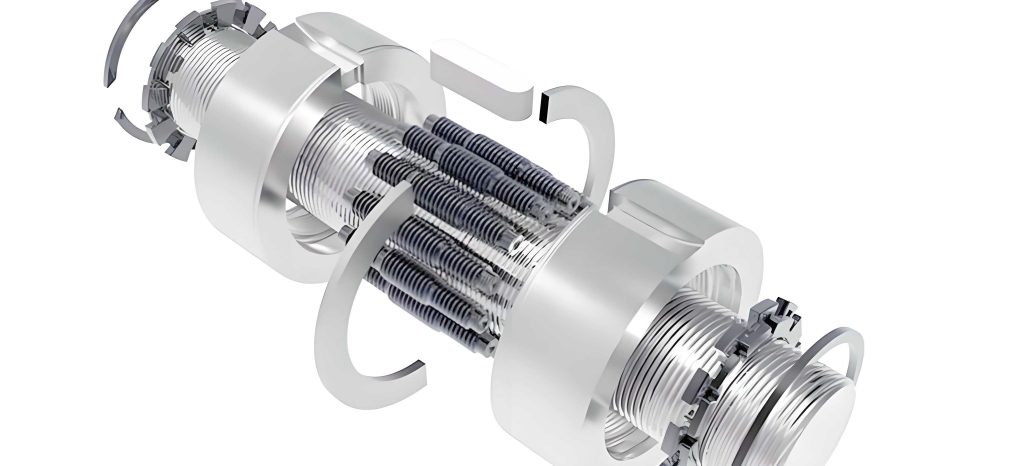
At its core, the planetary roller screw assembly consists of three primary threaded components: a multi-start screw, a matching multi-start nut, and a set of single-start threaded rollers positioned between them. The rollers are arranged planet-like around the screw, meshing simultaneously with both the screw and nut threads. A key feature is the use of a gear ring or synchronizing mechanism at each end of the nut to prevent relative rotation of the rollers, ensuring their axes remain parallel to the screw axis. This configuration creates multiple, parallel load paths. When an axial load is applied, it is transferred from the nut to the screw (or vice-versa) through the network of contacting thread flanks on the rollers. Each contact point is subjected to a complex, three-dimensional force system. The resultant load-bearing capability is exceptionally high because the total load is shared among numerous contact points across several rollers, a stark contrast to ball screw designs. Understanding the detailed mechanics at these contact points is the first step in modeling the overall performance of the planetary roller screw.
1. Force Analysis and Kinematic Relationships
The force transmission in a planetary roller screw begins at the microscopic contact ellipses formed between the screw-roller and roller-nut thread flanks. The force at any contact point acts normal to the complex spatial surface defined by the thread geometry. This normal force can be resolved into three fundamental components relative to the screw/roller axis: an axial component (Fa), a tangential component (Ft), and a radial component (Fr). The relationships are governed by the thread’s helix angle (λ) and the pressure or contact angle (φ) within the thread profile. For a given normal contact force \( F_n \), the components are:
$$ F_a = F_n \cos \phi \cos \lambda $$
$$ F_t = F_n \cos \phi \sin \lambda $$
$$ F_r = F_n \sin \phi $$
The axial component \( F_a \) is responsible for generating the useful thrust. The tangential component \( F_t \) contributes to the driving or resistive torque. The radial component \( F_r \) imposes a separating force on the components, which must be reacted by the structure. Crucially, the presence of friction modifies this idealized picture. For a planetary roller screw to transmit motion efficiently, the rollers must predominantly roll rather than slide. This rolling condition is satisfied when the tangential force due to friction at the contact exceeds the tangential component of the normal force attempting to cause slip. This imposes a constraint on design parameters like the coefficient of friction and the lead. Furthermore, due to the spatial kinematics of the meshing helical surfaces, the points of contact on a single roller with the screw and the nut are not diametrically opposed. This offset creates an overturning moment on the roller, which must be counteracted by the synchronizing gear ring. An imbalance in the forces at the two gear ring meshes can lead to uneven loading among rollers, highlighting the interconnectedness of the threaded and geared subsystems within the planetary roller screw.
2. Axial Deformation and System Stiffness
The axial stiffness of a planetary roller screw is a critical performance metric, directly influencing the positional accuracy and dynamic response of a servo system. The total axial deformation (δtotal) under an applied axial load (Fax) is a superposition of several elastic deformations:
$$ \delta_{total} = \delta_{shaft} + \delta_{nut\_body} + \sum \delta_{thread\_flexure} + \sum \delta_{Hertzian} $$
Where:
δshaft and δnut_body represent the tensile/compressive deformation of the screw and nut bodies treated as axial springs.
∑δthread_flexure is the cumulative bending and shear deflection of the loaded thread teeth on the screw, rollers, and nut.
∑δHertzian is the cumulative local contact deformation at all loaded screw-roller and roller-nut interfaces, governed by Hertzian contact theory.
Finite Element Analysis (FEA) studies have confirmed that the local Hertzian contact deformations and thread tooth bending often constitute the largest portion of the total compliance, especially in compact designs. The axial stiffness (Kax) is then defined as:
$$ K_{ax} = \frac{F_{ax}}{\delta_{total}} $$
Research has shown that stiffness increases with larger thread contact angles (φ) and smaller helix angles (λ), as these geometric changes improve the load-directing efficiency. A common method to dramatically increase the effective stiffness in applications is preloading, typically achieved using a double-nut arrangement. Preloading eliminates axial backlash and places the planetary roller screw assembly in a state of initial elastic compression. Under an external working load, only one “side” of the preloaded pair experiences additional load, while the other side unloads, resulting in a much smaller net displacement for a given load change compared to a single, non-preloaded nut. The stiffness of the preloaded assembly is highly sensitive to the magnitude of the initial preload force.
| Modeling Approach | Key Features & Assumptions | Primary Outputs | Typical Application Stage |
|---|---|---|---|
| Finite Element Analysis (FEA) | High-fidelity 3D model. Considers full geometry, material properties, and complex contact. Computationally intensive. | Detailed stress/strain fields, total deformation, stiffness. Excellent for validation. | Detailed design verification, parametric studies on specific geometry. |
| Direct Stiffness Method (Lumped Parameter) | Represents components as springs (axial, bending, contact) in series/parallel. Based on simplified mechanics (beam theory, Hertz). | System stiffness, load-deformation curve. Enables rapid parametric analysis. | Preliminary design, sensitivity analysis, system modeling. |
| Analytical Compliance Integration | Integrates formulas for shaft stretch, thread segment bending, and Hertzian contact to calculate total deflection. | Closed-form expression for stiffness as function of geometry and material. | Conceptual design, first-order sizing calculations. |
3. Load Distribution over Threads and Among Rollers
Perhaps the most intricate aspect of planetary roller screw mechanics is the distribution of the total axial load. Two levels of distribution exist: 1) Load Distribution over Threads: How the load carried by a single roller is shared among its individual engaged thread teeth. 2) Load Sharing Among Rollers: How the total external load is allocated across the set of planetary rollers. Perfectly uniform distribution is an ideal never achieved in practice due to manufacturing tolerances, assembly misalignments, and elastic deflections.
The load distribution over the threads of a single engaged pair (e.g., screw-roller) is analogous to that in a threaded fastener or a spline connection. It is highly non-uniform, with the first few threads adjacent to the loaded face carrying a disproportionately high share of the load. This is a direct consequence of the cumulative axial compression of the screw and the roller (or nut). The i-th thread pair experiences a load P_i, and the deformation compatibility condition must be satisfied. If δs,i and δr,i represent the axial displacements of the screw and roller at the i-th thread due to shaft deformation and thread bending, and δc,i is the Hertzian contact approach, then for all loaded threads:
$$ \delta_{s,i} + \delta_{c,i} + \delta_{r,i} = \text{constant} $$
Simultaneously, the sum of all thread loads must equal the portion of the total load carried by that roller:
$$ \sum_{i=1}^{N} P_i = F_{roller} $$
Solving this system requires modeling the stiffness of each thread segment (kthread,i) and each contact (kcontact,i). Advanced models discretize the screw, rollers, and nut into a network of springs, as illustrated conceptually below, and solve the resulting matrix equation. Research using such models has revealed that the axial compliance of the screw and nut bodies is the root cause of thread load inequality. Furthermore, the load distribution on the screw-roller side and the roller-nut side are coupled; an uneven distribution on one side influences the other.
| Model Basis | Representation of Components | Strengths | Limitations |
|---|---|---|---|
| Discrete Spring Network | Screw/Roller/Nut segments as beam/axial springs; contacts as nonlinear Hertzian springs. | Physically intuitive. Captures coupling between thread distribution and roller sharing. Can include manufacturing errors. | Model setup complexity. Computational cost for large number of threads/rollers. |
| Equivalent Disk/Beam Method | Rollers represented as continuous beams on elastic foundations; contacts smeared. | Computationally efficient. Good for analyzing effects of pitch errors and nut flexibility. | Less detailed local thread info. May not capture end effects accurately. |
| Finite Element Analysis (Full/Submodel) | Full 3D solid geometry with contact definitions. | Most accurate for a given geometry. No need for simplifying stiffness assumptions. | Extremely high computational cost. Less suitable for rapid design iteration. |
To mitigate the innate uneven thread load distribution, innovative design strategies have been proposed. One promising approach is pitch deviation or lead matching. By intentionally manufacturing the screw, rollers, and nut with slightly different but matched pitches, the cumulative elastic deformation under load can be compensated, encouraging more threads to engage and share the load more uniformly. This is a sophisticated form of “tooth relief” applied to helical threads. The optimal pitch deviation is a function of the nominal load and the elastic properties of the components.
Load sharing among rollers is governed by the concentricity of the assembly, the parallelism of the roller axes, the uniformity of roller diameters, and the precision of the synchronizing gear ring. Even minor discrepancies can cause one or two rollers to carry significantly more load than others, becoming potential points of premature failure. While thread load distribution models often assume equal load per roller for simplification, a complete system model must integrate both levels of distribution. The challenge is that tolerances influencing roller-to-roller sharing are statistical in nature, requiring a probabilistic or six-sigma design approach for high-reliability planetary roller screw applications.
4. Friction, Wear, and Efficiency
The frictional behavior of a planetary roller screw directly impacts its transmission efficiency, heat generation, and smoothness of operation. The total friction torque (Tfric) resisting input rotation has several contributors:
$$ T_{fric} = T_{hysteresis} + T_{spin} + T_{viscous} + T_{sliding} $$
1. Hysteresis Loss (Thysteresis): Arises from the elastic hysteresis of the material during cyclic Hertzian contact loading/unloading. It is proportional to the load and independent of speed.
2. Spin Friction (Tspin): A significant source in planetary roller screw contacts. Due to the opposing helix angles on either side of the roller’s thread, the contact ellipse rotates relative to both the screw and nut surfaces, causing micro-slip within the contact patch. This spin motion consumes energy.
3. Viscous Drag (Tviscous): Generated by the lubricant shearing in the contacts and in the roller end bearings/synchronizing gears.
4. Macro Sliding Friction (Tsliding): Occurs in the synchronizing gear meshes and at any sliding seals.
The mechanical efficiency (η) of the planetary roller screw is the ratio of useful output power (linear thrust × speed) to input mechanical power (torque × angular velocity). For a screw-driven system:
$$ \eta = \frac{F_a \cdot v}{T_{in} \cdot \omega} = \frac{F_a \cdot (l \cdot \omega / 2\pi)}{(F_a \cdot l / 2\pi + T_{fric}) \cdot \omega} = \frac{1}{1 + \frac{2\pi \cdot T_{fric}}{F_a \cdot l}} $$
where \( l \) is the lead of the screw. This shows that efficiency increases with higher axial load (Fa) and lower friction torque. Preload, while boosting stiffness, increases Tfric and thus reduces efficiency, especially at low operating loads, creating a classic design trade-off.
Wear is the ultimate life-limiting factor. The rolling-contact fatigue (pitting) of thread flanks is a primary failure mode. However, the inevitable presence of spin and micro-slip can lead to adhesive wear or abrasive wear if lubrication breaks down. Experimental studies using disk-on-ring setups to simulate the complex rolling/sliding contact have shown that lubrication is absolutely critical. Under dry conditions, severe wear or scuffing occurs rapidly. With effective lubrication, the contact can sustain millions of cycles. The localized heat generation from friction, particularly in high-speed applications, can lead to thermal expansion, altering preload and clearance, and potentially causing thermal runaway. Therefore, thermal management through effective lubrication, cooling, and heat path design is integral to the reliable operation of a high-performance planetary roller screw.
5. Future Research Directions and Concluding Perspectives
Despite significant progress, the modeling and understanding of planetary roller screw load-bearing characteristics are not complete. Future research should focus on closing critical gaps to enable next-generation designs.
Integrated System Stiffness Modeling: Current stiffness models often focus on the nut-screw-roller sub-assembly. A holistic “component-level” stiffness model is needed, incorporating the variable-length loaded screw shaft, support bearings, and mounting interfaces. This system-level stiffness governs the dynamic bandwidth and positioning accuracy in a machine tool or actuator.
Unified Probabilistic Load Share and Distribution Model: A comprehensive model that simultaneously accounts for statistical variations in roller diameter, pitch error, gear ring backlash, and assembly misalignment to predict the probabilistic load share among rollers and the consequent load distribution on their threads is essential for reliability-centered design and life prediction.
Advanced Friction and Thermal Models: Friction models need deeper validation against experimental data across a wide range of speeds, loads, and lubricants. Coupled thermal-mechanical models are required to predict operating temperature, thermal growth, and the resulting shift in preload and performance, especially in closed-loop controlled actuators.
Experimental Validation and Material Science: There is a pressing need for standardized experimental methods to measure internal load distribution, friction torque, and efficiency. Furthermore, research into advanced surface treatments, coatings, and lubricants tailored for the unique rolling/sliding environment of the planetary roller screw could dramatically improve life and performance.
Design for Uniform Load (True “Load-Equalization”): Beyond pitch matching, innovative concepts like compliant nut structures, actively controlled preload, or novel roller profiling should be explored to actively promote uniform load sharing, pushing the performance limits of the mechanism.
In conclusion, the exceptional load-bearing capacity of the planetary roller screw is a result of its multi-path, multi-contact design, but this advantage is fully realized only through a deep understanding of its internal mechanics. The interplay of force, deformation, distribution, and friction is complex and multifaceted. Continued research, blending refined analytical models with rigorous experimentation, will not only demystify these characteristics but also provide the tools to design and manufacture planetary roller screw mechanisms that are stronger, more precise, more efficient, and more durable, thereby unlocking their potential in an ever-wider sphere of advanced mechanical systems.