
As a researcher focused on precision mechanical transmissions, I have dedicated significant effort to understanding the complex dynamics of planetary roller screws. These components are critical in applications demanding high load capacity, accuracy, and reliability, such as aerospace actuators, military systems, and advanced manufacturing equipment. The planetary roller screw operates on a rolling contact principle, which theoretically minimizes friction compared to sliding mechanisms. However, in practice, several sources of friction persist, affecting the overall efficiency and performance. This article presents a comprehensive investigation into the frictional moment and transmission efficiency of planetary roller screws, based on Hertzian contact theory, kinematic analysis, and lubrication dynamics. The goal is to develop accurate models that account for key factors like elastic hysteresis, spinning sliding, and viscous drag, and to explore how design parameters—such as contact angle, helix angle, and roller thread count—influence these properties. Through this work, I aim to provide insights that can guide the optimization of planetary roller screw designs for enhanced efficiency and reduced energy loss.
The planetary roller screw is a sophisticated mechanical device that converts rotational motion into linear motion via rolling elements. Unlike ball screws, which use balls as rolling bodies, the planetary roller screw employs threaded rollers, allowing for higher load distribution and improved stiffness. A typical planetary roller screw assembly consists of a central screw with multiple-start threads, a nut with corresponding internal threads, and several planetary rollers that engage both the screw and nut threads. The rollers are constrained by a ring gear and carrier mechanism to maintain proper alignment and motion. The fundamental operation involves the screw rotating, which drives the rollers to both rotate about their own axes and revolve around the screw axis, thereby translating the nut linearly. This intricate motion introduces unique frictional challenges, primarily due to the constrained rotation of the rollers and the helical contact geometry.
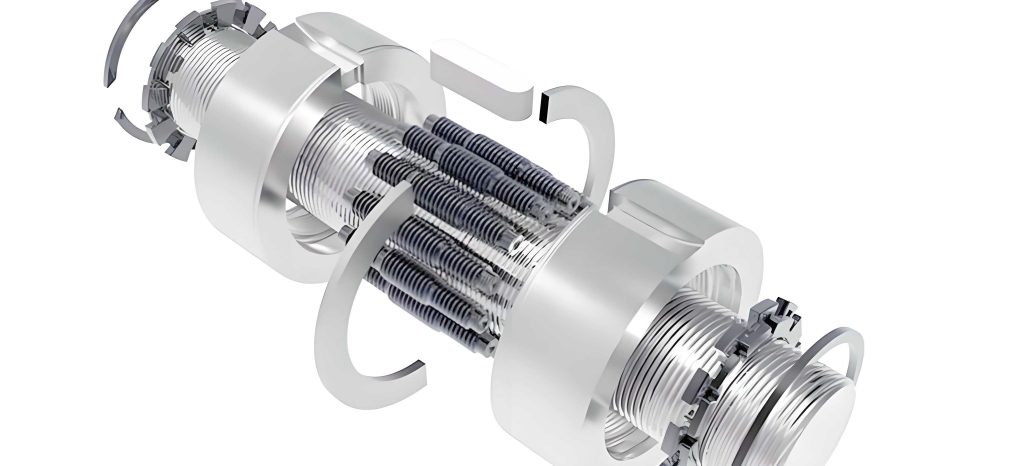
To analyze the frictional behavior, we must first consider the load distribution across the roller threads. Under axial load, each thread tooth of the roller experiences a normal force, leading to Hertzian contact ellipses at the interfaces with the screw and nut. The contact mechanics are complex due to the curved profiles and multi-point contacts. In this study, we model the roller threads as a series of equivalent spheres to simplify calculations while retaining accuracy. The equivalent sphere radius $R$ is derived from the roller pitch diameter $d_r$ and the contact angle $\beta$: $$R = \frac{d_r}{2 \sin \beta}.$$ This approximation allows us to apply Hertz theory to compute contact stresses and deformations. The normal load $N_i$ on each thread tooth varies due to the load distribution along the roller; we sum contributions from all teeth to obtain total forces and moments.
The frictional moment in a planetary roller screw arises from three primary sources: elastic hysteresis of the material, spinning sliding of the rollers, and viscous resistance of the lubricant. Each source contributes differently depending on operating conditions and design parameters. Below, we derive detailed models for each component.
Frictional Moment Due to Elastic Hysteresis: When materials undergo cyclic loading and unloading, such as in rolling contacts, some energy is dissipated due to internal friction, known as elastic hysteresis. For the planetary roller screw, this occurs at the contact ellipses between the roller and both the screw and nut. Based on Hertzian theory, the frictional moment from elastic hysteresis on the screw side $M_{fs}$ and nut side $M_{fn}$ can be expressed as:
$$M_{fs} = N_0 \sum_{i=1}^{\tau} \frac{3}{8} \gamma B_s m_{bs} \sqrt[3]{\frac{3 E’_s}{2 \sum \rho_s}} N_i^{4/3},$$
$$M_{fn} = N_0 \sum_{i=1}^{\tau} \frac{3}{8} \gamma B_n m_{bn} \sqrt[3]{\frac{3 E’_n}{2 \sum \rho_n}} N_i^{4/3}.$$
Here, $N_0$ is the number of rollers, $\tau$ is the number of thread teeth per roller, $\gamma$ is the energy loss coefficient (typically around 0.007), $B = 1/(2R)$ with $R$ as the equivalent sphere radius, $m_b$ is the ellipse parameter derived from Hertzian contact geometry, $E’$ is the equivalent elastic modulus, $\sum \rho$ is the sum of curvatures at the contact, and $N_i$ is the normal load on the $i$-th tooth. The parameters for the screw and nut sides are denoted by subscripts $s$ and $n$, respectively. The elliptic integrals and curvature calculations follow standard Hertz formulations, which depend on the thread profiles and material properties.
Frictional Moment Due to Spinning Sliding: A key characteristic of planetary roller screws is that the roller’s axis of rotation is constrained to be parallel to the screw axis, while the contact normal is inclined at the contact angle $\beta$. This constraint causes a spinning motion of the roller relative to the contact surfaces, leading to sliding friction. The angular velocity of the roller $\omega_r$ has a component $\omega_r \cos \beta$ perpendicular to the contact plane, which acts as a spin velocity. The resulting frictional moment arises from integrating the sliding friction over the contact ellipse area. For the screw side, the moment $M_{ks}$ is:
$$M_{ks} = N_0 \cos \beta \sum_{i=1}^{\tau} \iint_{A_{si}} f_h \cdot \frac{3N_i}{2\pi a_{si} b_{si}} \sqrt{1 – \frac{x^2}{a_{si}^2} – \frac{y^2}{b_{si}^2}} \cdot \sqrt{x^2 + y^2} \, dx \, dy,$$
and for the nut side, $M_{kn}$ is:
$$M_{kn} = N_0 \cos \beta \sum_{i=1}^{\tau} \iint_{A_{ni}} f_h \cdot \frac{3N_i}{2\pi a_{ni} b_{ni}} \sqrt{1 – \frac{x^2}{a_{ni}^2} – \frac{y^2}{b_{ni}^2}} \cdot \sqrt{x^2 + y^2} \, dx \, dy.$$
In these equations, $f_h$ is the sliding friction coefficient (approximately 0.05 for lubricated steel contacts), $a$ and $b$ are the semi-major and semi-minor axes of the contact ellipse, and the integration is performed over the ellipse area $A$. The limits for $x$ and $y$ are defined by the ellipse boundaries: $x$ from $-a\sqrt{1 – y^2/b^2}$ to $a\sqrt{1 – y^2/b^2}$, and $y$ from $-b$ to $b$. The spinning sliding contribution is often the dominant source of friction in planetary roller screws due to the significant spin velocities involved.
Frictional Moment Due to Lubricant Viscous Resistance: In lubricated planetary roller screws, the lubricant film between rolling surfaces generates viscous drag, which opposes motion. This effect is modeled by considering the rolling of equivalent spheres through a lubricated contact. The viscous rolling resistance force $F_v$ for an equivalent sphere is given by:
$$F_v = 2.86 E’ R_x^2 \kappa^{0.348} \bar{U}^{0.66} P^{0.022} \bar{W}^{0.47},$$
where $R_x$ is the equivalent radius in the rolling direction, $\kappa = R_y / R_x$ is the radius ratio, $\bar{U} = \eta_0 U / (2 E’ R_x)$ is the dimensionless speed parameter ($\eta_0$ is the dynamic viscosity, $U$ is the rolling velocity), $P = \alpha E’$ is the material parameter ($\alpha$ is the pressure-viscosity coefficient), and $\bar{W} = N / (E’ R_x^2)$ is the dimensionless load parameter. For the screw side, the rolling direction radius $R_{xs}$ and transverse radius $R_{ys}$ are:
$$R_{xs} = \frac{R (d_m – 2R \cos \beta)}{d_m}, \quad R_{ys} = \frac{2 \kappa_s R}{2 \kappa_s – 1},$$
and for the nut side:
$$R_{xn} = \frac{R (d_m + 2R \cos \beta)}{d_m}, \quad R_{yn} = \frac{2 \kappa_n R}{2 \kappa_n – 1},$$
with $d_m$ as the pitch diameter of the screw, and $\kappa_s$, $\kappa_n$ as curvature parameters (typically between 0.515 and 0.54). The viscous resistance moments for the screw and nut sides are then:
$$M_{ls} = N_0 \sum_{j=1}^{\tau_0} F_{vsj} \cdot R_s, \quad M_{ln} = N_0 \sum_{j=1}^{\tau_0} F_{vnj} \cdot R_n,$$
where $\tau_0$ is the number of equivalent spheres per roller (often equal to $\tau$), $R_s$ and $R_n$ are distances from the contact points to the screw axis, and $F_{vsj}$, $F_{vnj}$ are the viscous forces on each sphere. The total frictional moment $M$ is the sum of all components:
$$M = M_{fs} + M_{ks} + M_{ls} + M_{fn} + M_{kn} + M_{ln}.$$
This comprehensive model allows us to predict frictional losses under various operating conditions. To illustrate the parameters involved, Table 1 summarizes key geometric and material properties used in our calculations, based on typical planetary roller screw designs.
| Parameter | Symbol | Typical Value |
|---|---|---|
| Screw Pitch Diameter | $d_s$ | 30 mm |
| Screw Number of Starts | $n_s$ | 5 |
| Pitch | $L_s$ | 2 mm |
| Helix Angle | $\lambda$ | 6.056° |
| Contact Angle | $\beta$ | 45° |
| Roller Pitch Diameter | $d_r$ | 10 mm |
| Nut Pitch Diameter | $d_n$ | 50 mm |
| Number of Rollers | $N_0$ | 10 |
| Number of Thread Teeth per Roller | $\tau$ | 20 |
| Equivalent Sphere Radius | $R$ | 7.069 mm |
| Rolling Friction Coefficient | $\mu_r$ | 0.005 |
| Sliding Friction Coefficient | $f_h$ | 0.05 |
| Energy Loss Coefficient | $\gamma$ | 0.007 |
| Elastic Modulus | $E$ | 210 GPa |
| Poisson’s Ratio | $\nu$ | 0.3 |
| Lubricant Dynamic Viscosity | $\eta_0$ | 0.1 Pa·s |
| Pressure-Viscosity Coefficient | $\alpha$ | 2.2e-8 Pa⁻¹ |
With the frictional moment model established, we now turn to transmission efficiency. The efficiency $\eta$ of a planetary roller screw is defined as the ratio of output power to input power. Neglecting friction, the ideal torque required to drive the screw under an axial load $F_a$ is:
$$M’_s = F_a \cdot \frac{L_s}{2\pi},$$
where $L_s$ is the lead of the screw (equal to pitch times number of starts). In reality, the input torque must overcome the frictional moment $M$, so the actual input torque is $M’_s + M$. Thus, the transmission efficiency is:
$$\eta = \frac{M’_s}{M’_s + M}.$$
This efficiency model incorporates all frictional losses and allows us to evaluate how design and operational variables affect performance. In the following sections, we analyze the influences of various parameters on both frictional moment and efficiency, using numerical simulations based on the derived equations.
Influence of Axial Load on Frictional Moment: Axial load is a primary operational variable in planetary roller screws. As the load increases, the normal forces at contact points rise, leading to larger contact areas and higher friction. Our calculations show that the frictional moment components behave differently with axial load. The elastic hysteresis moment $M_f$ grows slowly, proportional to $N_i^{4/3}$, while the spinning sliding moment $M_k$ increases more rapidly, approximately linearly at higher loads. The viscous moment $M_l$ remains relatively small and nearly constant because it depends more on speed and lubrication than on load. Overall, the total frictional moment $M$ increases with axial load, and for loads above approximately 4000 N, the relationship becomes nearly linear. This linearity arises because the contact ellipses expand, but the pressure distribution stabilizes, making friction forces proportional to load. Notably, the spinning sliding contribution dominates, accounting for over 80% of the total friction in typical scenarios. This underscores the importance of minimizing spin through design optimizations in planetary roller screws.
Influence of Contact Angle on Frictional Moment: The contact angle $\beta$ is a critical design parameter in planetary roller screws. It affects the normal force components, spin velocities, and contact geometry. Our analysis reveals that a higher contact angle reduces the frictional moment significantly, especially under heavy axial loads. This reduction occurs because a larger $\beta$ decreases the spin velocity component $\omega_r \cos \beta$, thereby lowering the spinning sliding moment. Additionally, the equivalent sphere radius $R$ increases with $\beta$ (since $R = d_r/(2 \sin \beta)$), which slightly alters Hertzian contact pressures. However, beyond $\beta = 45°$, the benefits diminish, and excessively large angles can lead to engagement issues and reduced load capacity. For instance, at an axial load of 10,000 N, increasing $\beta$ from 30° to 50° reduces the total frictional moment by about 40%. Therefore, selecting a contact angle around 45° is often optimal for balancing friction reduction with mechanical integrity in planetary roller screws.
Influence of Helix Angle on Frictional Moment: The helix angle $\lambda$ determines the lead of the planetary roller screw and influences the kinematic relationships. Interestingly, our models indicate that $\lambda$ has minimal direct impact on frictional moment. This is because changes in $\lambda$ slightly affect the normal load distribution but do not alter the fundamental friction mechanisms significantly. The frictional moment remains nearly constant across a range of helix angles from 3° to 15°. However, the helix angle plays a crucial role in transmission efficiency, as discussed later. In practice, $\lambda$ is chosen based on required linear speed and resolution rather than friction considerations for planetary roller screws.
Influence of Roller Thread Tooth Count on Frictional Moment: The number of thread teeth per roller $\tau$ affects load distribution and total contact area. Intuitively, more teeth might increase friction due to additional contact points, but our analysis shows the opposite: increasing $\tau$ reduces the total frictional moment. This counterintuitive result stems from the load distribution effect. With more teeth, each tooth carries a smaller portion of the axial load, leading to lower contact pressures and reduced sliding friction per tooth. Although the total contact area increases, the decrease in pressure outweighs the area increase, resulting in lower overall friction. For example, doubling $\tau$ from 20 to 40 can reduce the frictional moment by up to 20% under high loads. This suggests that designing planetary roller screws with higher thread counts can enhance both load capacity and efficiency, albeit at the cost of increased complexity and size.
Influence of Screw Rotational Speed on Frictional Moment and Efficiency: Screw rotational speed $\omega_s$ influences frictional moment primarily through viscous effects and spin velocities. The viscous resistance moment $M_l$ increases with speed due to higher lubricant shear rates, following the $\bar{U}^{0.66}$ dependency. The spinning sliding moment $M_k$ also rises slightly as speed increases because spin velocities are proportional to $\omega_s$. However, the overall increase in frictional moment with speed is moderate compared to load effects. More significantly, speed impacts transmission efficiency. Our efficiency model demonstrates that $\eta$ decreases as $\omega_s$ increases, because the frictional moment grows while the output torque $M’_s$ remains constant for a given axial load. For instance, at $F_a = 1500$ N, increasing $\omega_s$ from 1000 to 5000 rpm reduces efficiency from about 90% to 70%. Conversely, at higher axial loads, the efficiency drop is less severe because $M’_s$ is larger, making friction a smaller relative loss. This highlights that planetary roller screws operate more efficiently under high loads and low speeds, which is valuable for applications like heavy-duty positioning systems.
Comprehensive Analysis of Transmission Efficiency: Building on the frictional moment model, we can now explore efficiency trends in detail. The transmission efficiency of planetary roller screws depends on both operational conditions and design parameters. Using our derived formula $\eta = M’_s / (M’_s + M)$, we compute efficiency for various scenarios. Table 2 summarizes efficiency values for different combinations of axial load, screw speed, and contact angle, based on simulations with the parameters from Table 1.
| Axial Load $F_a$ (N) | Screw Speed $\omega_s$ (rpm) | Contact Angle $\beta$ (°) | Efficiency $\eta$ (%) |
|---|---|---|---|
| 1500 | 1000 | 45 | 89.5 |
| 1500 | 3000 | 45 | 78.2 |
| 3000 | 1000 | 45 | 92.1 |
| 3000 | 3000 | 45 | 84.3 |
| 5000 | 1000 | 45 | 94.7 |
| 5000 | 3000 | 45 | 88.9 |
| 3000 | 2000 | 30 | 80.5 |
| 3000 | 2000 | 45 | 87.6 |
| 3000 | 2000 | 55 | 89.2 |
The data confirms that higher axial loads improve efficiency, as the output torque increases disproportionately to friction. For example, at 2000 rpm, increasing $F_a$ from 1500 N to 5000 N boosts efficiency from 85% to 91%. Similarly, a higher contact angle enhances efficiency by reducing friction, with gains of up to 8% when $\beta$ increases from 30° to 55°. The helix angle $\lambda$ also affects efficiency indirectly via the lead $L_s$. Since $M’_s = F_a L_s / (2\pi)$, a larger $\lambda$ (and thus larger $L_s$) increases $M’_s$, raising efficiency. For instance, doubling $\lambda$ from 6° to 12° can improve efficiency by about 5% at moderate loads, assuming constant friction. However, as noted, $\lambda$ has little effect on friction itself, so efficiency gains are primarily kinematic. These insights guide the selection of parameters for optimal planetary roller screw performance.
Discussion on Practical Implications: The models and analyses presented here have important implications for the design and application of planetary roller screws. In high-performance systems like aircraft actuators or precision machine tools, minimizing friction and maximizing efficiency are crucial for energy savings, heat management, and longevity. Our findings suggest that designers should prioritize reducing spinning sliding, perhaps through tailored contact profiles or advanced lubrication. Additionally, operating planetary roller screws at high loads and low speeds within their capacity can yield efficiency over 90%, making them competitive with other linear actuators. The trade-offs between parameters—such as contact angle versus engagement stability, or thread count versus size—require careful optimization based on specific use cases. Future work could explore dynamic effects, temperature influences, and wear over time, which were beyond the scope of this study.
In conclusion, this comprehensive investigation into the frictional moment and transmission efficiency of planetary roller screws has provided detailed models and insights. We derived analytical expressions for friction components—elastic hysteresis, spinning sliding, and viscous resistance—and integrated them into a total frictional moment model. The transmission efficiency was then formulated as a function of operational and design variables. Our analysis highlights that spinning sliding is the dominant friction source, and that parameters like contact angle, axial load, and roller thread count significantly influence performance. Specifically, higher contact angles reduce friction and improve efficiency, while increased thread counts lower friction through better load distribution. Screw speed negatively impacts efficiency, especially at light loads. These results empower engineers to tailor planetary roller screw designs for enhanced efficiency and reliability, advancing their use in demanding mechanical systems. The planetary roller screw, with its unique rolling mechanism, continues to offer promising avenues for innovation in precision motion control.
To further illustrate the relationships, we can summarize key equations and parameters in a consolidated form. The total frictional moment $M$ in a planetary roller screw is a sum of six components, each dependent on geometry, load, and speed. The efficiency $\eta$ directly follows from the ratio of ideal to actual torque. For quick reference, the core equations are:
Total frictional moment: $$M = N_0 \sum_{i=1}^{\tau} \left[ \frac{3}{8} \gamma B_s m_{bs} \sqrt[3]{\frac{3 E’_s}{2 \sum \rho_s}} N_i^{4/3} + \frac{3}{8} \gamma B_n m_{bn} \sqrt[3]{\frac{3 E’_n}{2 \sum \rho_n}} N_i^{4/3} \right] + N_0 \cos \beta \sum_{i=1}^{\tau} \left[ \iint_{A_{si}} f_h \cdot \frac{3N_i}{2\pi a_{si} b_{si}} \sqrt{1 – \frac{x^2}{a_{si}^2} – \frac{y^2}{b_{si}^2}} \cdot \sqrt{x^2 + y^2} \, dx \, dy + \iint_{A_{ni}} f_h \cdot \frac{3N_i}{2\pi a_{ni} b_{ni}} \sqrt{1 – \frac{x^2}{a_{ni}^2} – \frac{y^2}{b_{ni}^2}} \cdot \sqrt{x^2 + y^2} \, dx \, dy \right] + N_0 \sum_{j=1}^{\tau_0} \left[ 2.86 E’ R_{xs}^2 \kappa_s^{0.348} \bar{U}_s^{0.66} P^{0.022} \bar{W}_s^{0.47} \cdot R_s + 2.86 E’ R_{xn}^2 \kappa_n^{0.348} \bar{U}_n^{0.66} P^{0.022} \bar{W}_n^{0.47} \cdot R_n \right].$$
Transmission efficiency: $$\eta = \frac{F_a L_s / (2\pi)}{F_a L_s / (2\pi) + M}.$$
These models, while complex, capture the essential physics of planetary roller screws and can be implemented in computational tools for design optimization. Through continued research and development, planetary roller screws will likely see wider adoption in industries where precision, load capacity, and efficiency are paramount.