
As a precision electromechanical actuator, the planetary roller screw mechanism plays a critical role in converting rotary motion into linear thrust. Its superior load capacity, high precision, and excellent dynamic response make it indispensable in aerospace, defense, and high-end industrial applications. While significant research exists on its kinematics and static performance, a comprehensive understanding of its dynamic behavior during operation remains less explored. In this analysis, I employ the explicit dynamic finite element method to investigate the transient characteristics of a planetary roller screw assembly under varying operational speeds. The focus is on the dynamic responses at the thread contact interfaces, including axial vibration and transient stress distribution, which are paramount for predicting performance, wear, and fatigue life.
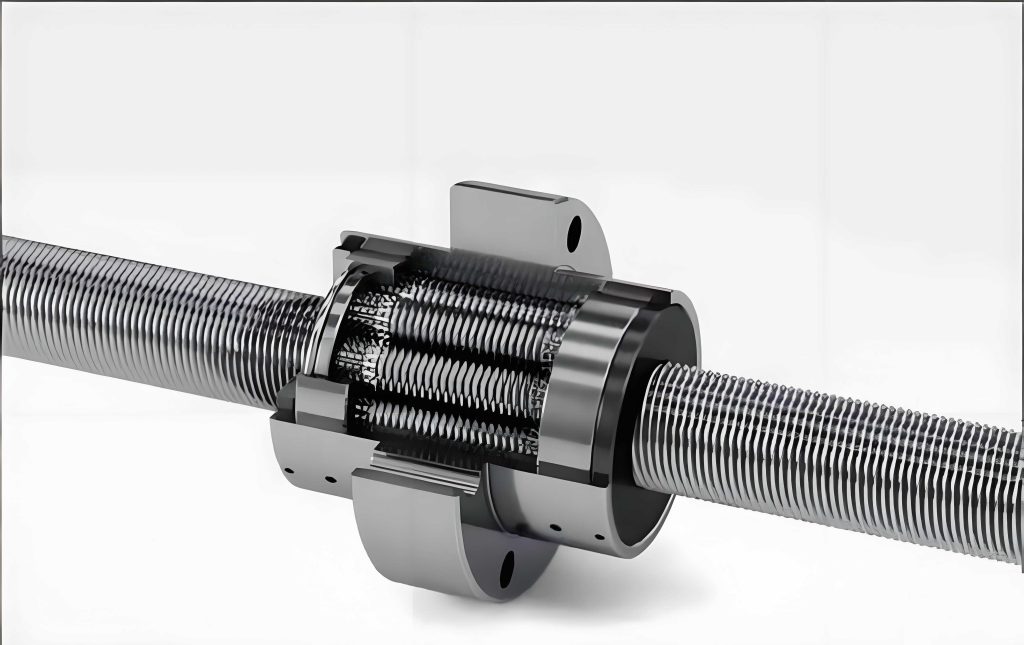
The standard planetary roller screw assembly consists of a multi-start threaded screw, a correspondingly threaded nut, and several threaded rollers arranged planetarily. A critical feature is the straight gear teeth machined at both ends of each roller, which mesh with an internal ring gear. This configuration constrains the roller’s axis to remain parallel to the screw’s axis, preventing tilt and ensuring pure rolling motion is maintained as much as possible. The kinematic relationships governing this system are foundational for setting up a dynamic analysis. For a screw-driven configuration, the relative motions are defined as follows. The relationship between the angular velocity of the screw ($\omega_s$), the nut ($\omega_n$), and the orbital velocity of the rollers ($\omega_{ro}$) is given by:
$$ \omega_s \cdot P_s = (\omega_s – \omega_n) \cdot P_n + \omega_{ro} \cdot D_{ro} $$
where $P_s$ and $P_n$ are the pitches of the screw and nut, respectively, and $D_{ro}$ is the orbital diameter of the rollers. The roller’s spin velocity ($\omega_{rs}$) relative to its carrier is related to the screw and nut velocities:
$$ \omega_{rs} = \frac{(\omega_s – \omega_n) \cdot (d_s – d_r)}{2 d_r} $$
Here, $d_s$ and $d_r$ represent the pitch diameters of the screw and roller, respectively. For the purpose of my dynamic simulation, where the roller is taken as the driving input to simplify boundary condition application, these relationships are inverted. The axial velocity of the screw relative to the roller ($v_{a, s/r}$) becomes a key output metric and can be derived from the kinematic chain:
$$ v_{a, s/r} = \pm \frac{\omega_{rs} \cdot d_r \cdot P_s}{d_s \cdot \tan(\lambda_s)} $$
where $\lambda_s$ is the lead angle of the screw. The sign depends on the handedness of the threads and the direction of rotation.
Finite Element Modeling and Explicit Dynamics Methodology
To analyze the dynamic characteristics efficiently, I developed a focused three-dimensional finite element model of the planetary roller screw assembly. The model prioritizes the threaded engagement regions, which are the primary load paths. I retained only the first five complete threads on the screw, nut, and each roller to capture contact dynamics while managing computational cost. The model is constructed using C3D8R elements (8-node linear brick, reduced integration). To control potential hourglassing modes, which can corrupt results in explicit analyses, I selectively assigned the element property to be fully integrated for critical contact regions. The components are modeled as linear elastic materials with the following properties: density $\rho = 7800\ \text{kg/m}^3$, Young’s modulus $E = 210\ \text{GPa}$, and Poisson’s ratio $\nu = 0.3$.
The geometric parameters defining my planetary roller screw model are summarized in the tables below. These parameters are essential for replicating the kinematic constraints and contact conditions.
| Parameter | Symbol | Value |
|---|---|---|
| Screw Pitch Diameter | $d_s$ | 32.0 mm |
| Screw Thread Starts | $N_s$ | 5 |
| Lead (Pitch) | $P_s, P_n$ | 5.0 mm |
| Screw Lead Angle | $\lambda_s$ | 4.55° |
| Thread Profile Angle | $\alpha$ | 90° |
| Roller Pitch Diameter | $d_r$ | 6.5 mm |
| Nut Pitch Diameter | $d_n$ | 45.0 mm |
| Roller Orbital Diameter | $D_{ro}$ | 38.5 mm |
| Parameter | Symbol | Value |
|---|---|---|
| Gear Module | $m$ | 0.8 mm |
| Roller Gear Teeth | $z_r$ | 12 |
| Ring Gear Teeth | $z_{rg}$ | 36 |
| Pressure Angle | $\phi$ | 20° |
For boundary conditions, the roller is designated as the driving element. Its radial and axial degrees of freedom are constrained, leaving only rotation free. A constant angular velocity is applied to the roller. The screw and nut are constrained radially but are free to rotate and translate axially. This setup induces the relative motion dictated by the planetary roller screw kinematics. Surface-to-surface contact is defined between the screw and roller threads and between the roller and nut threads. A Coulomb friction model is used with a static coefficient of $\mu_s = 0.1$ and a kinetic coefficient of $\mu_k = 0.05$. The simulation solves for a duration of 5 ms to ensure all modeled threads engage in the dynamic event.
The explicit dynamics solution is governed by the weak form of the momentum equation. The principle of virtual work for a deformable body leads to the discrete equation of motion:
$$ \mathbf{M} \ddot{\mathbf{u}}^{(t)} + \mathbf{C} \dot{\mathbf{u}}^{(t)} = \mathbf{F}_{\text{ext}}^{(t)} – \mathbf{F}_{\text{int}}^{(t)} (\mathbf{u}^{(t)}) $$
where $\mathbf{M}$ is the diagonal lumped mass matrix, $\mathbf{C}$ is the damping matrix, $\ddot{\mathbf{u}}$, $\dot{\mathbf{u}}$, and $\mathbf{u}$ are the nodal acceleration, velocity, and displacement vectors, $\mathbf{F}_{\text{ext}}$ is the external force vector, and $\mathbf{F}_{\text{int}}$ is the internal force vector arising from element stresses. In explicit time integration, the state at time $t+\Delta t$ is computed using information from time $t$. The central difference method is employed:
$$ \dot{\mathbf{u}}^{(t+\Delta t/2)} = \dot{\mathbf{u}}^{(t-\Delta t/2)} + \frac{\Delta t^{(t+\Delta t)} + \Delta t^{(t)}}{2} \ddot{\mathbf{u}}^{(t)} $$
$$ \mathbf{u}^{(t+\Delta t)} = \mathbf{u}^{(t)} + \Delta t^{(t+\Delta t)} \dot{\mathbf{u}}^{(t+\Delta t/2)} $$
The critical advantage of the explicit method for problems like the planetary roller screw contact is that it does not require iterative solution of global equilibrium equations, making it highly efficient for highly nonlinear, short-duration transient events involving complex contact and impact. The stable time increment $\Delta t$ is limited by the Courant condition, based on the smallest element size $L_e$ and the material’s wave speed $c_d$:
$$ \Delta t \le \kappa \frac{L_e}{c_d} = \kappa L_e \sqrt{\frac{\rho (1+\nu)(1-2\nu)}{E(1-\nu)}} $$
where $\kappa$ is a reduction factor less than 1.0. My model uses mass scaling and a mixed time integration strategy to increase this critical time step reasonably without sacrificing accuracy, thereby enhancing computational speed for the planetary roller screw simulation.
Analysis of Dynamic Response at Thread Contact Interfaces
Axial Vibration Response of Contact Nodes
I analyzed the dynamic behavior of the planetary roller screw under four different roller spin velocities: $\omega_{rs} = 1000\ \text{rpm}$, $2000\ \text{rpm}$, $3000\ \text{rpm}$, and $4000\ \text{rpm}$. The primary output of interest is the axial motion of the nut (or conversely, the screw). In my model setup, this is observed as the axial displacement and velocity of a specific contact node on the screw thread at the theoretical pitch diameter. The response curves for axial displacement and velocity at this node are extracted from the simulation.
The results indicate a clear trend: as the roller spin speed increases, the magnitude of the axial displacement and velocity of the screw relative to the roller increases proportionally. More significantly, the amplitude of fluctuation or vibration around the mean value also becomes more pronounced at higher speeds. For instance, at $1000\ \text{rpm}$, the velocity profile shows minor oscillations, while at $4000\ \text{rpm}$, the signal exhibits substantial high-frequency noise and larger amplitude deviations. This growing nonlinearity with speed is attributed to the increased prominence of microscopic slip and impact phenomena at the contacting asperities of the planetary roller screw threads. The initial assembly clearance and the inherent sliding tendency (spin sliding) of the rollers become more dynamic drivers of vibration at elevated speeds.
To validate the fidelity of the explicit dynamics model, I compare the time-averaged axial velocity from the simulation against the theoretical kinematic velocity derived from the pure-rolling equation $v_{a, s/r} = \frac{\omega_{rs} \cdot d_r \cdot P_s}{d_s \cdot \tan(\lambda_s)}$. The comparison is summarized below:
| Roller Speed $\omega_{rs}$ (rpm) | Theoretical $v_{a}$ (mm/s) | FEA Mean $v_{a}$ (mm/s) | Relative Error |
|---|---|---|---|
| 1000 | 83.02 | 81.5 | -1.83% |
| 2000 | 166.04 | 162.9 | -1.89% |
| 3000 | 249.06 | 244.5 | -1.83% |
| 4000 | 332.08 | 325.8 | -1.89% |
The close agreement, with errors consistently below 2%, confirms that the explicit dynamics model accurately captures the fundamental kinematics of the planetary roller screw mechanism. The slight discrepancy arises because the theoretical value assumes ideal, no-slip rolling contact, whereas the finite element analysis inherently includes the effects of friction, micro-slip, and dynamic engagement transients, which slightly reduce the effective transmission velocity.
Dynamic Stress on Contacting Thread Elements
Beyond kinematic outputs, the dynamic load distribution across the threads is critical for assessing performance and durability. I examined the time-history of the von Mises stress ($\sigma_{vM}$) at specific integration points on contacting thread elements. For both the screw-roller and roller-nut interfaces, I monitored one element on each of the five engaged threads. The positions of these monitored elements are conceptually located at the pitch line where initial contact is expected.
A prominent finding is the non-uniform distribution of load among the engaged threads of the planetary roller screw, a phenomenon evident in the dynamic stress profiles. The figure below illustrates the $\sigma_{vM}$ stress history for elements on the five screw threads contacting the roller. The stress level and fluctuation pattern are distinct for each thread. Consistently, the first engaged thread (closest to the loaded end in a static analogy) experiences the highest stress magnitude and the most severe fluctuations. For example, under a $3000\ \text{rpm}$ condition, the peak $\sigma_{vM}$ on the first screw thread element reached approximately $580\ \text{MPa}$, while the values on subsequent threads were progressively lower. This pattern aligns with classical load distribution problems in threaded connections and confirms that dynamic effects in a planetary roller screw do not eliminate this inherent unevenness; instead, they subject the first thread to the most aggressive dynamic loading, making it a potential site for fatigue initiation.
The same non-uniform pattern is observed on the roller threads contacting the nut, though the absolute stress levels are different. Comparing the two sides of the roller reveals a significant difference: the contact elements on the roller’s screw-side experience markedly higher von Mises stress than those on its nut-side. This asymmetry can be explained by the geometry of contact. The screw has a smaller pitch diameter than the nut, resulting in a higher contact curvature (smaller relative radius of curvature) at the screw-roller interface compared to the roller-nut interface. According to Hertzian contact theory, for the same normal force, a smaller relative curvature leads to higher contact pressure and subsurface stress, which is reflected in the higher $\sigma_{vM}$ values on the screw side of the planetary roller screw.
The effect of operational speed on the dynamic contact stress was also investigated. The table below lists the maximum $\sigma_{vM}$ stress recorded for selected elements on the first engaged thread of each component across the four simulated speeds.
| Component & Interface | $\omega_{rs}=1000$ rpm | $\omega_{rs}=2000$ rpm | $\omega_{rs}=3000$ rpm | $\omega_{rs}=4000$ rpm |
|---|---|---|---|---|
| Screw (vs. Roller) | 572 MPa | 575 MPa | 580 MPa | 585 MPa |
| Roller (Screw-side) | 550 MPa | 553 MPa | 558 MPa | 562 MPa |
| Roller (Nut-side) | 410 MPa | 412 MPa | 415 MPa | 418 MPa |
| Nut (vs. Roller) | 405 MPa | 408 MPa | 410 MPa | 413 MPa |
The key observation is that while the vibration amplitude of kinematic outputs increases substantially with speed, the peak dynamic contact stress in the planetary roller screw threads shows only a marginal increase. The primary stress state is dominated by the transmitted load (which is constant in this simulation, as only inertial forces from acceleration are present), and the dynamic fluctuations due to speed mainly superimpose oscillatory components rather than drastically elevating the peak stress magnitude. This suggests that for a given load, the fatigue damage due to stress cycling might increase with speed due to more frequent and possibly larger amplitude oscillations, rather than due to a higher peak stress level.
Conclusion
In this detailed dynamic analysis of a planetary roller screw mechanism using explicit nonlinear finite element methods, I have derived several important conclusions regarding its operational characteristics. The explicit dynamics formulation proved to be a robust and accurate tool for simulating the complex, transient contact interactions within the assembly, with kinematic results showing excellent agreement with theoretical predictions.
Firstly, the axial vibration response is significantly influenced by the operating speed. Higher roller spin velocities lead to larger magnitudes of relative axial displacement and velocity, accompanied by increased fluctuation amplitudes. This highlights a growing nonlinear dynamic behavior in the planetary roller screw at high speeds, primarily driven by micro-slip and impact within the thread contacts.
Secondly, a fundamental characteristic observed is the non-uniform dynamic load distribution across the engaged threads. In all simulated cases, the first thread sustained the highest and most fluctuating von Mises stress, identifying it as the most critically loaded element for fatigue considerations. This uneven distribution persists under dynamic conditions.
Thirdly, a clear asymmetry in contact stress exists between the two sides of the roller. The screw-roller interface consistently experiences higher dynamic stresses than the roller-nut interface, a direct consequence of the more conforming (larger relative radius of curvature) contact geometry on the nut side of the planetary roller screw assembly.
Finally, while speed dramatically affects vibration, its direct impact on the peak magnitude of contact stress is relatively modest for a constant load condition. The dominant factor for peak stress remains the transmitted force, with speed mainly governing the frequency and amplitude of stress oscillations around this mean level. This comprehensive dynamic profile provides essential insights for the design, performance prediction, and life estimation of high-performance planetary roller screw actuators.