
As a mechanical engineer deeply involved in the field of precision linear motion, I find the evolution of the planetary roller screw to be a compelling narrative of mechanical innovation overcoming design and manufacturing challenges. This mechanism represents a significant leap over the more ubiquitous ball screw, offering a robust solution for high-load, high-speed, and high-precision applications where performance boundaries are constantly being pushed. My analysis draws from extensive technical literature and industrial trends to provide a detailed examination of the technology’s principles, manufacturing intricacies, global industrial landscape, and future potential.
Fundamentally, the planetary roller screw is a mechanical actuator that converts rotary motion into linear motion, or vice-versa. Its architecture is elegantly complex. A central threaded shaft (the screw) engages with multiple threaded rollers arranged in a planetary configuration around it. These rollers, in turn, mesh with an internally threaded nut. As the screw (or the nut) rotates, the rollers not only rotate about their own axes but also revolve around the screw, driving the nut (or the screw) along the linear axis. This multi-point contact geometry is the source of its superior performance. The kinematic relationship defining the linear travel per revolution (lead, L) is given by the screw’s thread pitch and the gear ratio between the components. A simplified representation of the lead is:
$$ L = P_s \cdot \frac{Z_n}{Z_r} $$
Where \( P_s \) is the pitch of the screw thread, \( Z_n \) is the number of starts on the nut, and \( Z_r \) is the number of starts on the roller. This fundamental equation governs the transmission ratio and is critical for design.
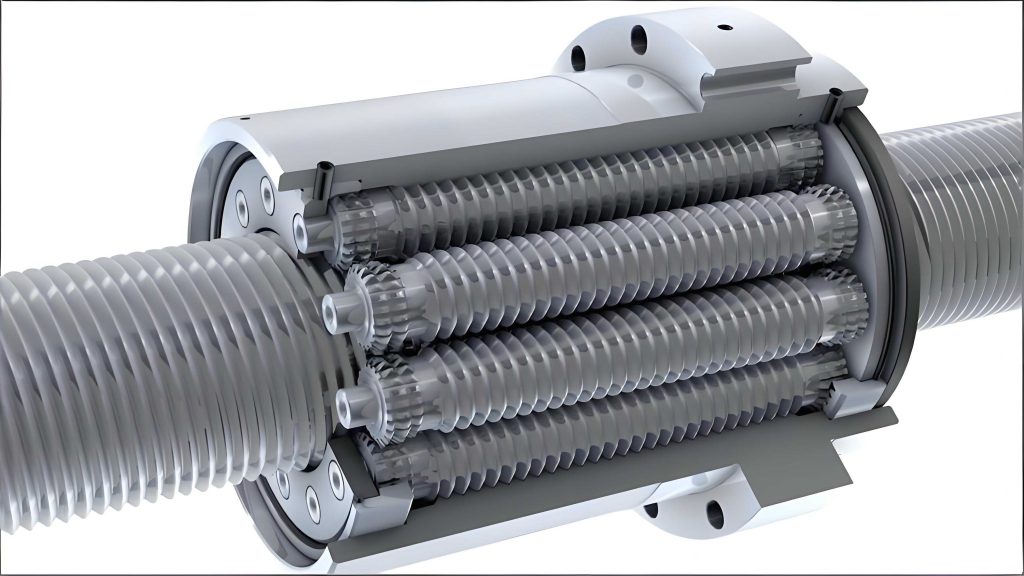
The principal advantage of the planetary roller screw over a ball screw of comparable envelope size lies in its vastly increased load-carrying capacity and stiffness. This stems from the line contact between the screw/roller and roller/nut interfaces, as opposed to the point contact found in ball screws. The contact mechanics, described by Hertzian theory, show a significantly larger contact area, distributing load more effectively and reducing contact stresses. The basic Hertzian contact stress (\(\sigma_H\)) for line contact can be expressed as:
$$ \sigma_H = \sqrt{\frac{F}{l} \cdot \frac{1}{\pi} \cdot \frac{\frac{1}{R_1} + \frac{1}{R_2}}{\frac{1-\nu_1^2}{E_1} + \frac{1-\nu_2^2}{E_2}}} $$
Where \(F\) is the normal load, \(l\) is the contact length, \(R\) are the radii of curvature, \(E\) is the modulus of elasticity, and \(\nu\) is Poisson’s ratio. The larger effective contact length \(l\) in a planetary roller screw directly contributes to lower stress for a given load. This translates to higher static and dynamic load ratings, greater rigidity (reduced axial deflection under load), and improved life expectancy under heavy loads. Furthermore, the design allows for higher rotational speeds due to the controlled kinematics of the rollers, which experience less centrifugal force than free-flowing balls in a recirculating channel.
| Performance Parameter | Planetary Roller Screw | Ball Screw (Equivalent Size) | Advantage Factor |
|---|---|---|---|
| Static Load Capacity | Extremely High | High | 2x – 5x |
| Dynamic Load Capacity | Very High | High | 2x – 4x |
| Axial Stiffness | Very High | Moderate to High | 1.5x – 3x |
| Maximum Rotational Speed | High | Limited by ball recirculation | Up to 2x |
| Durability / Life | Longer under high load | Long under moderate load | Significantly longer in shock/load conditions |
| Efficiency | High (>90%) | High (>90%) | Comparable, but more consistent under load |
| Compactness for given load | Excellent | Good | More compact for ultra-high load applications |
Global Industrial Landscape: Development and Application
The global market for planetary roller screw technology is dominated by established European, American, and Japanese corporations that have invested decades in R&D, precision manufacturing, and application engineering. This long history has resulted in a formidable portfolio of intellectual property and deeply specialized manufacturing know-how. The primary product variants available globally include:
- Standard/Inverted Planetary Roller Screws: The most common design where either the screw or the nut rotates.
- Recirculating Planetary Roller Screws: Utilize a mechanism to recirculate the rollers within the nut, allowing for longer strokes.
- Differential Planetary Roller Screws: Offer extremely fine leads for micro-positioning applications.
- Axial Fixed Roller Screws: A variant where the rollers do not move axially, simplifying the nut design for certain applications.
Applications are demanding. In aerospace, they are integral to flight control actuation systems, landing gear drives (e.g., in advanced fighter aircraft), and thrust vector control. In defense, they power gun turret drives, missile launcher positioning, and submarine steering systems. Industrial applications are equally critical: they drive massive presses in metal forming, provide precise motion in injection molding machines, act as the primary actuator in high-performance electric cylinders, and enable the dynamic motion of flight and driving simulators.
The Manufacturing Crucible: Materials, Processes, and Precision
The superior performance of a planetary roller screw is not only a product of its design but is crucially dependent on materials science, heat treatment, and micron-level manufacturing precision. The choice of material is dictated by the need for high core strength, excellent surface hardness, and resistance to wear and fatigue.
| Component | Common Material | Key Properties & Treatment | Target Hardness |
|---|---|---|---|
| Screw | 42CrMo4 / 50CrMo4 (AISI 4140/4150 equivalent) | Case hardened (carburizing or nitriding) to develop a hard, wear-resistant surface over a tough, ductile core. | 58 – 62 HRC (surface) |
| Rollers | 100Cr6 (AISI 52100 equivalent) | Through-hardened bearing steel. Provides uniform high hardness and excellent contact fatigue life. | 58 – 62 HRC |
| Nut | 100Cr6 or Case-hardened alloy steel | Similar to rollers, requiring high and consistent hardness to match the rollers’ interaction. | 58 – 62 HRC |
Manufacturing a precision planetary roller screw is a symphony of advanced processes. The thread profiles on the screw, nut, and rollers are typically ground on CNC thread grinders capable of achieving accuracies better than G5 grade per DIN 69051-3. The relationship for lead accuracy is often specified as:
$$ \Delta L_{300} = \text{(Grade Constant)} \cdot \sqrt{300} $$
Where \( \Delta L_{300} \) is the travel deviation over 300 mm. For a G5 grade, the constant is 12 μm, resulting in a tight tolerance. Post-grinding, superfinishing processes are often applied to reduce surface roughness (\(R_a\) values below 0.2 μm), which minimizes friction and wear. Assembly is a critical, often manual, process requiring selective fitting of rollers to ensure uniform load distribution and preload adjustment to eliminate backlash and maximize stiffness.
Research, Testing, and the Path Forward
Academic and industrial research continues to refine the planetary roller screw. Focus areas include advanced dynamic modeling to predict behavior under extreme speeds and accelerations, lubrication optimization for extended life in vacuum or high-temperature environments, and the development of more efficient manufacturing techniques to reduce cost. Testing is paramount and involves sophisticated rigs capable of measuring:
- Static & Dynamic Stiffness: Applying axial loads and measuring deflection.
- Efficiency: Measuring input torque vs. output force over the speed range.
- Life Testing: Running the screw under load for millions of cycles to validate life calculations based on modified bearing life formulas like:
$$ L_{10} = \left( \frac{C}{P} \right)^3 \cdot 10^6 \text{ revolutions} $$
Where \(L_{10}\) is the rated life (90% reliability), \(C\) is the dynamic load rating, and \(P\) is the equivalent dynamic load.
For the global industry and particularly for emerging manufacturing regions aiming to build indigenous capability, the path forward involves several strategic pillars:
- Investment in Ultra-Precision Manufacturing Infrastructure: Developing or acquiring next-generation grinding and metrology equipment capable of producing and measuring micron- and submicron-level features consistently.
- Deepening Material and Process Expertise: Mastering case-hardening, nitriding, and specialized coatings to tailor performance for extreme environments (e.g., corrosion-resistant coatings for marine applications).
- Integrated System Design: Moving beyond component supply to developing integrated mechatronic solutions, such as direct-drive planetary roller screw actuators with embedded sensors and controls.
- Building Application-Specific Knowledge: Developing deep partnerships with end-users in aerospace, defense, and heavy industry to co-engineer solutions for their most challenging motion control problems.
In conclusion, the planetary roller screw stands as a pinnacle of mechanical actuation technology. Its dominance in the most demanding applications is a testament to its fundamental design advantages. While the barriers to entry in high-volume, high-precision manufacturing remain significant, the ongoing trends towards electrification, automation, and performance maximization across all industrial sectors ensure that the importance and adoption of planetary roller screw technology will only continue to grow. The future belongs to those who can master not just its manufacture, but its intelligent integration into the next generation of high-performance machinery.