
The transition from rotary to linear motion is a fundamental requirement in countless mechanical systems, from industrial automation to aerospace actuation. Among the various devices developed for this purpose, the planetary roller screw mechanism stands out as a premier solution for applications demanding exceptional load capacity, high precision, and reliable operation in demanding environments. Unlike its more common counterpart, the ball screw, which transmits force through recirculating balls, the planetary roller screw mechanism utilizes threaded rollers in a planetary configuration to achieve force transmission. This fundamental difference in design principle bestows upon the planetary roller screw mechanism its superior characteristics: a significantly larger number of contact points along the threads, leading to higher load ratings and stiffness, and the absence of recirculating elements, which enhances its suitability for high-speed, long-stroke, or harsh-condition applications. The core of its operational excellence, however, lies in the complex spatial interaction between its three primary components: the central screw, the array of planetary rollers, and the encircling nut. Understanding this interaction—the meshing theory of the planetary roller screw—is not merely an academic exercise but a critical foundation for predicting its performance, optimizing its design, and ensuring its reliability.
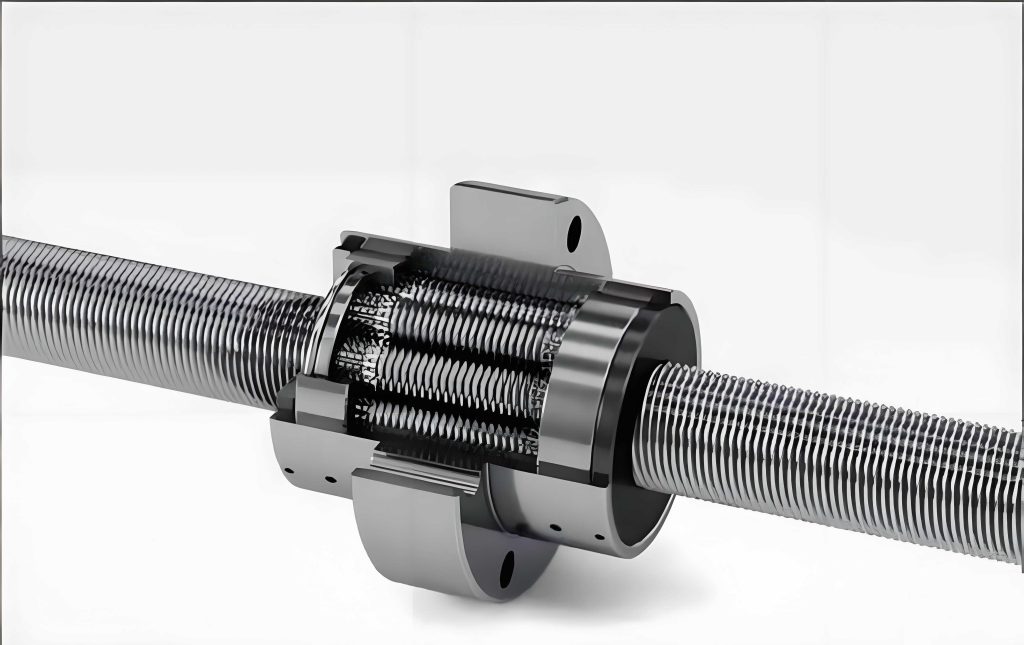
The intricate dance of contact within a planetary roller screw mechanism is governed by the geometry of helical surfaces. Each component—the screw, the rollers, and the nut—features precise thread profiles that must remain in continuous, conjugate contact during operation. The nature of this contact defines the load distribution across the threads, influences the kinematic relationships and potential slippage between components, determines the mechanism’s static and dynamic stiffness, and ultimately dictates its efficiency and service life. Therefore, a rigorous investigation into the meshing principles of the planetary roller screw mechanism is paramount. This involves deriving the mathematical equations describing the contacting surfaces, establishing the conditions necessary for their proper conjugation, solving for the exact location of contact points under load, and analyzing the relative motion at these points. This article delves into these aspects, providing a comprehensive overview of the meshing theory that underpins the functionality of the planetary roller screw mechanism.
The Unique Meshing Geometry of Planetary Roller Screws
The defining feature of a planetary roller screw mechanism is its multi-contact, threaded planetary arrangement. The central screw is typically a multi-start thread, while each planetary roller has a single-start thread. The nut, enclosing the assembly, carries a multi-start internal thread that matches the screw. The rollers are seated in a planetary carrier and their axial movement relative to the nut is prevented either by gear teeth machined on their ends engaging with an internal ring gear on the nut (standard type) or by gear teeth engaging with a central gear on the screw (inverted type). This basic architecture gives rise to a unique meshing geometry distinct from both lead screws and ball screws.
The contact between components occurs along helical surfaces. For a standard planetary roller screw mechanism under an axial load pushing the nut in one direction, two primary contact lines are active: one between the screw’s “upper” flank and the roller’s “lower” flank, and another between the nut’s “lower” flank and the roller’s “upper” flank. The terminology “upper” and “lower” refers to the flanks relative to the direction of axial thrust. Reversing the load direction switches the active flanks. The thread profile on the screw and nut is usually trapezoidal, while the roller thread profile is often circular (gothic arc) to reduce stress concentration and improve load distribution. This mismatch in profiles means the contact between a roller and the screw (or nut) is theoretically a point contact that elastically deforms into an elliptical contact patch under load, a critical aspect analyzed using Hertzian contact theory.
The spatial orientation of these contact points is not arbitrary. Due to the differing lead angles and the fact that the screw-roller pair is an external meshing while the nut-roller pair is an internal meshing, the contact points do not lie in the plane containing the axes of the screw and the roller. They are offset by a specific angle. This “meshing offset angle” is a fundamental parameter derived from the meshing conditions. To visualize this, consider a cross-section taken perpendicular to the screw axis at a specific radial distance. The projection of the contact points onto this plane reveals their location. The following table summarizes key geometric parameters essential for describing the meshing state in a planetary roller screw mechanism.
| Symbol | Description | Typical Notation |
|---|---|---|
| $r_{s0}, r_{r0}, r_{n0}$ | Nominal pitch radii of screw, roller, and nut. | Design parameters |
| $L_s, L_r, L_n$ | Lead of the screw, roller, and nut threads. For multi-start threads, $L = n \cdot P$, where $n$ is number of starts and $P$ is pitch. | $L_s = L_n$, $L_r$ is different |
| $\lambda_{s0}, \lambda_{r0}, \lambda_{n0}$ | Nominal lead angles at the pitch radius: $\tan \lambda = L / (2\pi r)$. | $\lambda_{s0} = \lambda_{n0}$ |
| $\beta_s, \beta_r, \beta_n$ | Thread flank angles (half of the thread profile angle) for screw, roller, and nut. | $\beta_s = \beta_n$, $\beta_r$ often defined by arc radius |
| $r_{sc}, r_{rc}^{(s)}, r_{rc}^{(n)}, r_{nc}$ | Actual contact radii on screw, roller (screw-side), roller (nut-side), and nut. | Solved from meshing equations |
| $\phi_{sc}, \phi_{rc}^{(s)}, \phi_{rc}^{(n)}, \phi_{nc}$ | Meshing offset angles for contact on screw, roller (screw-side), roller (nut-side), and nut. | Solved from meshing equations |
| $\rho_r$ | Radius of the circular arc profile on the roller thread. | Design parameter for optimization |
The primary goal of meshing theory for the planetary roller screw mechanism is to determine the set of contact radii $r_{sc}, r_{rc}^{(s)}, r_{rc}^{(n)}, r_{nc}$ and their corresponding offset angles $\phi_{sc}, \phi_{rc}^{(s)}, \phi_{rc}^{(n)}, \phi_{nc}$ for a given set of design parameters and load direction. These values define the precise kinematic and load transfer paths within the mechanism.
Mathematical Foundation: Surface Equations and Meshing Conditions
The analysis begins with the mathematical representation of the helical surfaces. A point on a right-handed helical surface can be generated by rotating and translating a planar profile curve. For a screw or nut with a straight-sided trapezoidal profile, the surface equations are relatively straightforward. For a roller with a circular arc profile, the equations are more complex but essential for accuracy.
Let’s define a coordinate system $O-xyz$ fixed to the screw, with the $z$-axis along the screw’s axis. A point on the screw’s thread flank surface $\Sigma_s$ can be described by two parameters: a profile parameter $u$ and a helical motion parameter $\theta_s$ (the rotation angle of the screw). For the screw’s upper flank (assuming a symmetric thread), the vector equation is:
$$
\mathbf{r}_s(u, \theta_s) = \begin{bmatrix}
(r_{s0} + u \sin\beta_s) \cos\theta_s – u \cos\beta_s \sin\theta_s \\
(r_{s0} + u \sin\beta_s) \sin\theta_s + u \cos\beta_s \cos\theta_s \\
\frac{L_s}{2\pi}\theta_s – u \cos\beta_s \tan\lambda_{s0}
\end{bmatrix}
$$
Here, $u$ measures the distance along the thread flank from the pitch cylinder. The surface normal vector $\mathbf{n}_s(u, \theta_s)$ is crucial for meshing conditions and can be found by taking the cross product of the partial derivatives: $\mathbf{n}_s = \frac{\partial \mathbf{r}_s}{\partial u} \times \frac{\partial \mathbf{r}_s}{\partial \theta_s}$.
Similarly, for a planetary roller with a circular arc profile of radius $\rho_r$, a coordinate system $O_r-x_ry_rz_r$ is fixed to the roller. A point on its lower flank surface $\Sigma_r$ is given by a central angle parameter $\alpha$ and the roller’s rotation parameter $\theta_r$. The vector from the roller’s center to the center of the arc profile is first defined, and then the point on the arc is located:
$$
\mathbf{r}_r(\alpha, \theta_r) = \begin{bmatrix}
\rho_r \cos\alpha \cos\theta_r + (r_{r0} – \rho_r \sin\beta_r) \sin\theta_r \\
\rho_r \cos\alpha \sin\theta_r – (r_{r0} – \rho_r \sin\beta_r) \cos\theta_r \\
\frac{L_r}{2\pi}\theta_r + \rho_r \sin\alpha
\end{bmatrix}
$$
The fundamental requirement for two surfaces to be in mesh (i.e., to transmit motion smoothly without interference or loss of contact) is the condition of continuous tangency. At any instant, for the contacting surfaces $\Sigma_s$ and $\Sigma_r$, the position vectors and the unit normal vectors at the contact point must satisfy two vector equations in the same fixed coordinate system (e.g., $O-xyz$):
1. Coordinate Identity Condition: The position of the contact point is the same for both surfaces.
$$ \mathbf{r}_s^{(c)} = \mathbf{r}_r^{(c)} $$
2. Normal Collinearity Condition: The surface normals at the contact point are collinear (opposite in direction for external contact).
$$ \mathbf{n}_s^{(c)} = -\mathbf{n}_r^{(c)} $$
These conditions give rise to the meshing equation. For the screw-roller pair in a planetary roller screw mechanism, after substantial algebraic manipulation that accounts for the transformation between coordinate systems and the geometric relationships, the meshing equation can be simplified into a set of scalar equations relating the contact radii and angles. One form of these essential equations is:
$$
\begin{aligned}
r_{sc} \cos\phi_{sc} &= -r_{rc}^{(s)} \cos\phi_{rc}^{(s)} + (r_{s0} + r_{r0}) \\
r_{sc} \sin\phi_{sc} &= r_{rc}^{(s)} \sin\phi_{rc}^{(s)} \\
\cos\phi_{sc} \tan\beta_s + \sin\phi_{sc} \tan\lambda_{sc} &= \cos\phi_{rc}^{(s)} \tan\beta_{rc}^{(s)} + \sin\phi_{rc}^{(s)} \tan\lambda_{rc}^{(s)} \\
\sin\phi_{sc} \tan\beta_s – \cos\phi_{sc} \tan\lambda_{sc} &= -\sin\phi_{rc}^{(s)} \tan\beta_{rc}^{(s)} + \cos\phi_{rc}^{(s)} \tan\lambda_{rc}^{(s)}
\end{aligned}
$$
where $\lambda_{sc} = \arctan(L_s / (2\pi r_{sc}))$ and $\lambda_{rc}^{(s)} = \arctan(L_r / (2\pi r_{rc}^{(s)}))$ are the lead angles at the actual contact radii. The term $\tan\beta_{rc}^{(s)}$ is the effective flank angle of the roller at the contact point on the screw-side, which for a circular arc profile is a function of the contact radius $r_{rc}^{(s)}$, the nominal radius $r_{r0}$, the arc radius $\rho_r$, and the nominal flank angle $\beta_r$:
$$
\tan\beta_{rc}^{(s)} = \frac{r_{rc}^{(s)} – r_{r0} + \rho_r \sin\beta_r}{\sqrt{\rho_r^2 – \left( r_{rc}^{(s)} – r_{r0} + \rho_r \sin\beta_r \right)^2}}
$$
A similar set of four equations governs the meshing between the nut and the roller. Given the design parameters ($r_{s0}, r_{r0}, r_{n0}, L_s, L_r, L_n, \beta_s, \beta_n, \beta_r, \rho_r$), these coupled nonlinear equations can be solved numerically to find the four unknowns: $r_{sc}, r_{rc}^{(s)}, \phi_{sc}, \phi_{rc}^{(s)}$ for the screw-roller pair, and $r_{nc}, r_{rc}^{(n)}, \phi_{nc}, \phi_{rc}^{(n)}$ for the nut-roller pair. This solution defines the fundamental meshing geometry of the loaded planetary roller screw mechanism.
Methods for Solving Meshing Problems and Their Evolution
The pursuit of accurately and efficiently solving for the meshing state in a planetary roller screw mechanism has led to the development of several methodologies, each with its own advantages and levels of sophistication. The evolution reflects a move from simplified approximations towards more comprehensive, three-dimensional contact analyses.
| Methodology | Core Approach | Advantages | Limitations |
|---|---|---|---|
| 2D Sectioning Method | The 3D meshing problem is discretized into multiple 2D cross-sections perpendicular to the screw axis. In each section, the distance between the projected profiles of the screw and roller (or nut and roller) is calculated. The contact point is approximated where this distance is minimized across all sections. | Conceptually simple; can graphically illustrate proximity and axial backlash; easy to implement in basic CAD or computational scripts. | Inherently approximate; does not rigorously satisfy the 3D tangency conditions; accuracy depends on section density; computationally inefficient for high precision. |
| Spiral Curve & Frenet Frame Method | Focuses on the spatial contact curve (a helix) on each component. The Frenet-Serret frame (Tangent, Normal, Binormal vectors) is established along this helix. The contact condition is expressed through the orientation of the thread profile’s normal vector within this moving frame, linked to the concept of pressure/contact angle. | Provides a clear kinematic interpretation of contact angles; useful for deriving relationships between lead angles, contact angles, and offset angles; forms a good basis for efficiency and dynamics analysis. | Derivation can be complex; indirectly addresses the surface geometry; calculating exact axial backlash from this framework is non-trivial. |
| 3D Surface Meshing Theory (Direct Method) | Directly employs the mathematical equations of the helical surfaces (as described in the previous section) and enforces the vector conditions of coordinate identity and normal collinearity to derive the fundamental meshing equations. | Most rigorous and accurate; fully accounts for 3D geometry and true tangency conditions; allows for precise calculation of both contact location and axial backlash; essential for advanced analysis like load distribution. | Results in complex, coupled nonlinear equations requiring numerical solution; derivation is mathematically intensive. |
The trend in research clearly favors the 3D Surface Meshing Theory approach. It provides the necessary foundation for all subsequent performance analyses of the planetary roller screw mechanism. For instance, the knowledge of exact contact radii $r_{sc}$ and $r_{rc}^{(s)}$ is critical for determining the steady-state velocity ratio between the screw and the roller’s orbital motion. The kinematic relationship, ignoring slip, is given by:
$$
\frac{\omega_{s}}{\omega_{c}} = 1 + \frac{L_s}{L_r} \cdot \frac{r_{rc}^{(s)}}{r_{sc}}
$$
where $\omega_s$ is the screw angular velocity and $\omega_c$ is the angular velocity of the roller carrier (orbital speed). Any deviation of the actual contact radii from assumed nominal values will cause a deviation in this ratio, potentially inducing parasitic micro-motions or affecting positioning accuracy.
From Meshing to Performance: Load Distribution and Contact Mechanics
The solved meshing geometry directly feeds into the analysis of the planetary roller screw mechanism’s structural and tribological performance. The most immediate application is in calculating the load distribution among the multiple threads in engagement. Since the screw, nut, and rollers are not perfectly rigid, they undergo elastic deformations under load. The total axial force $F_a$ is shared by all loaded contact lines on all active rollers. The force on an individual contact point depends on the combined axial deformation of the screw and nut threads at that point relative to the roller.
Using the meshing geometry, one can formulate a system of compatibility equations that relate the deformation at each potential contact point to the load it carries. A common approach uses the Hertzian contact theory for point contacts and the axial stiffness of the threaded sections. The deformation $\delta_i$ at the i-th contact point is proportional to the normal load $Q_i$ raised to the 2/3 power (for Hertzian contact):
$$
\delta_i = k_{H,i} \cdot Q_i^{2/3}
$$
where $k_{H,i}$ is the Hertzian contact stiffness coefficient, which itself depends on the material properties (Young’s modulus $E$, Poisson’s ratio $\nu$) and the geometry of the contact (principal curvatures of the two surfaces at the contact point). The principal curvatures are derived from the first and second fundamental forms of the helical surfaces at the solved contact point $(r_c, \phi_c)$, making the meshing solution a prerequisite. The total axial deformation must be compatible across all contact points, leading to a nonlinear system of equations that is solved iteratively to find the set of $Q_i$ values. This analysis reveals whether the load is evenly distributed or concentrated on a few threads, which is vital for predicting the fatigue life and static load capacity of the planetary roller screw mechanism.
Furthermore, the contact stresses at each point are calculated using Hertz’s equations. For the elliptical contact patch expected between a circular roller profile and a flat or trapezoidal screw/nut flank, the maximum contact pressure $p_{max}$ is:
$$
p_{max} = \frac{3Q}{2\pi a b}
$$
where $a$ and $b$ are the semi-major and semi-minor axes of the contact ellipse, calculated from the Hertzian formulae involving the normal load $Q$, material properties, and the relative curvature $\kappa$ at the contact point: $\kappa = \kappa_{1}^{(s)} + \kappa_{2}^{(s)} + \kappa_{1}^{(r)} + \kappa_{2}^{(r)}$, where $\kappa_{1,2}$ are the principal curvatures. Controlling $p_{max}$ is essential to prevent surface pitting (fatigue failure) and is a key objective in optimizing the roller profile (e.g., selecting $\rho_r$) in the design of a planetary roller screw mechanism.
Influence of Meshing State on Kinematics and Efficiency
The meshing theory also elucidates the kinematic imperfections and sources of energy loss within the planetary roller screw mechanism. Even with geometrically perfect components, the relative motion at the contact points is not pure rolling; a sliding component always exists due to the differing lead angles on the screw and roller (or nut and roller) at the actual contact radii.
The relative sliding velocity $\mathbf{v}_{sl}^{(sr)}$ at the screw-roller contact point is the difference between the velocities of the two surface points in contact. This can be expressed in the screw coordinate system as:
$$
\mathbf{v}_{sl}^{(sr)} = \left( \boldsymbol{\omega}_s \times \mathbf{r}_{sc} + \mathbf{v}_s \right) – \left( \boldsymbol{\omega}_r \times \mathbf{r}_{rc}^{(s)} + \mathbf{v}_r \right)
$$
where $\boldsymbol{\omega}$ and $\mathbf{v}$ represent angular and linear velocity vectors of each body. For a standard planetary roller screw mechanism with a fixed nut ($\mathbf{v}_n=0, \omega_n=0$), the relationships between $\omega_s$, $\omega_r$, and the translational speed of the nut $v_n$ are constrained by the gear engagement at the roller ends and the thread meshing. The sliding velocity has components both tangent to the contact ellipse (causing friction) and along the thread helix. The magnitude and direction of this sliding vector, determined by the meshing geometry, directly influence the friction torque and thus the mechanical efficiency.
The mechanical efficiency $\eta$ of a planetary roller screw mechanism is primarily governed by the friction losses at the numerous thread contact points and the gear contacts at the roller ends. An analytical model can express the driving torque $T_{in}$ as the sum of the useful work output torque and the torque required to overcome all friction forces. For a screw-driven mechanism lifting a load:
$$
T_{in} = \frac{F_a \cdot L_s}{2\pi \eta}
$$
where the efficiency $\eta$ can be derived from the geometry (lead angles at contact $\lambda_{sc}, \lambda_{rc}$) and an assumed coefficient of friction $\mu$ at the contacts. A simplified expression for the efficiency of a single contact pair, ignoring spin friction, resembles that of a sliding screw but with the effective lead angle defined by the meshing geometry:
$$
\eta_{pair} \approx \frac{\tan \lambda_{eff}}{\tan(\lambda_{eff} + \varphi’)}, \quad \text{where } \varphi’ = \arctan \mu
$$
Here, $\lambda_{eff}$ is a function of the contact radii and angles. The overall efficiency of the planetary roller screw mechanism is an aggregate of losses from all active contact pairs and gear meshes, highlighting how the detailed meshing solution impacts this critical performance metric. Furthermore, the meshing state affects the reversibility or “back-drivability” of the mechanism. A self-locking condition may occur if the effective lead angle becomes too small relative to the friction angle, a phenomenon that can be predicted through meshing analysis.
Future Directions: Integrated Models and Advanced Analysis
While significant progress has been made, the meshing theory for planetary roller screw mechanisms continues to evolve towards more holistic and realistic models. Future research directions will likely focus on several integrated and advanced fronts:
1. Tolerance, Error, and System-Level Analysis: Current meshing models often assume perfect geometry. The next step involves incorporating manufacturing errors (lead error, profile error, pitch deviation), assembly misalignments (parallelism error, eccentricity), and elastic deflections of the housing and supports into the meshing equations. This will allow for predicting the variation in contact point locations, load distribution asymmetry, and the resultant positioning error or vibration characteristics of a real-world planetary roller screw mechanism.
2. Coupled Kineto-Elasto-Dynamic Modeling: A comprehensive model must integrate the kinematic meshing constraints with the elastic deformation of components and the system’s dynamics. This involves developing a multi-body dynamics model of the planetary roller screw mechanism where the contacts are represented by nonlinear spring-damper elements whose stiffness is derived from the Hertzian-meshing analysis. Such a model can simulate transient responses, such as the impact of reversing direction, the effect of high acceleration/deceleration on load sharing, and the prediction of natural frequencies and dynamic loads.
3. Thermal-Meshing Interaction: Under high-speed or continuous operation, significant frictional heat is generated at the contact points. This heat causes thermal expansion of the screw, rollers, and nut, altering their nominal dimensions ($r_{s0}, r_{r0}, r_{n0}$) and the lead $L$. This thermal deformation, in turn, changes the meshing geometry—contact radii, offset angles, and axial preload/backlash. An advanced model would couple the thermal network model (predicting temperature distribution) with the meshing and load distribution model in a feedback loop, enabling prediction of performance degradation or seizure risk under thermal loads.
4. Lubrication and Wear Modeling: Extending the meshing analysis to the micro-scale involves modeling the elastohydrodynamic lubrication (EHL) film in the contact ellipses. The thickness of this lubricant film affects friction and wear. The initial geometry from meshing theory provides the input for EHL simulations. Furthermore, models can be developed to predict wear progression over time, which slowly modifies the surface profiles (especially the roller’s circular arc), thereby evolving the meshing state throughout the life of the planetary roller screw mechanism.
In conclusion, the meshing theory of the planetary roller screw mechanism forms the indispensable bedrock upon which all understanding of its performance is built. From the fundamental equations dictating the precise points of contact to the sophisticated analyses of load sharing, stress, efficiency, and dynamics, it provides the critical link between the mechanism’s geometric design and its operational behavior. As the demands on these powerful linear actuators grow—for greater precision, higher speed, longer life, and operation in more extreme environments—the depth and breadth of meshing theory research will continue to expand, driving innovation in the design and application of the planetary roller screw mechanism.